文件上传源码分析
先上文件上传的方法调用过程时序图
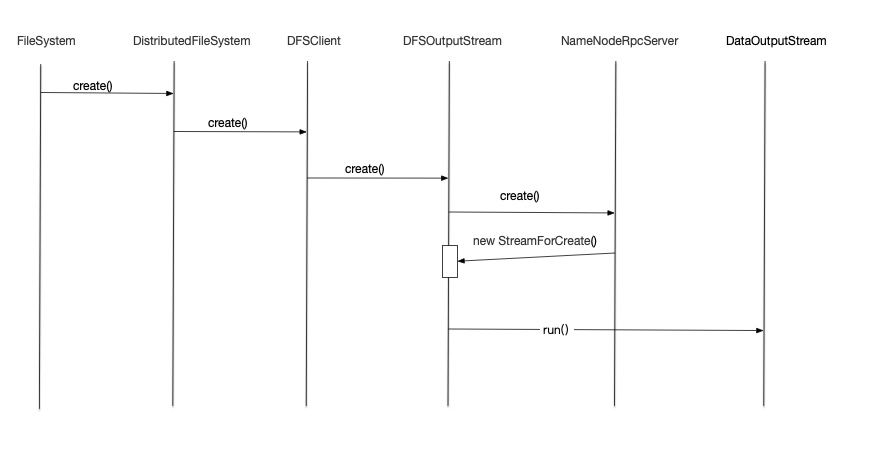
其主要执行过程:
1、FileSystem初始化,Client拿到NameNodeRpcServer代理对象,建立与NameNode的RPC通信
2、调用FileSystem的create()方法,由于实现类为DistributedFileSystem,所以是调用该类中的create()方法
3、DistributedFileSystem持有DFSClient的引用,继续调用DFSClient中的create()方法
4、DFSOutputStream提供的静态newStreamForCreate()方法中调用NameNodeRpcServer服务端的create()方法并创建DFSOutputStream输出流对象返回
5、通过hadoop提供的IOUtil工具类将输出流输出到本地
下面我们来看下源码:
首先初始化文件系统,建立与服务端的RPC通信:
调用FileSystem的create()方法,由于FileSystem是一个抽象类,这里实际上是调用的该类的子类create()方法
public abstract FSDataOutputStream create(Path var1,FsPermission var2,boolean var3,int var4,short var5,long var6,Progressable var8) throws IOException;
前面我们已经说过FileSystem.get()返回的是DistributedFileSystem对象,所以这里我们直接进入DistributedFileSystem:
FileSystem fs=FileSystem.get(new URI("hdfs://hadoop01:9000"), conf, "hadoop");// 获取hdfs的操作对象 获取的是hdfs的操作句柄对象 FileSystem对象FileSystem fileSystem = FileSystem.get(conf);// DFS[DFSClient[clientName=DFSClient_NONMAPREDUCE_-22357267_1, ugi=hadoop (auth:SIMPLE)]]System.out.println(fileSystem);//返回的是DistributedFileSystem对象System.out.println(fs instanceof DistributedFileSystem);
@Overridepublic FSDataOutputStream create(final Path f, final FsPermission permission,final EnumSet<CreateFlag> cflags, final int bufferSize,final short replication, final long blockSize,final Progressable progress, final ChecksumOpt checksumOpt)throws IOException {statistics.incrementWriteOps(1);storageStatistics.incrementOpCounter(OpType.CREATE);Path absF = fixRelativePart(f);return new FileSystemLinkResolver<FSDataOutputStream>() {@Overridepublic FSDataOutputStream doCall(final Path p) throws IOException {final DFSOutputStream dfsos = dfs.create(getPathName(p), permission,cflags, replication, blockSize, progress, bufferSize,checksumOpt);//dfs为DistributedFileSystem所持有的DFSClient对象,调用的是DFSClient.create方法return dfs.createWrappedOutputStream(dfsos, statistics);}@Overridepublic FSDataOutputStream next(final FileSystem fs, final Path p)throws IOException {return fs.create(p, permission, cflags, bufferSize,replication, blockSize, progress, checksumOpt);}}.resolve(this, absF);}
DFSClient的create()返回一个DFSOutputStream对象:
public DFSOutputStream create(String src, FsPermission permission,EnumSet<CreateFlag> flag, boolean createParent, short replication,long blockSize, Progressable progress, int buffersize,ChecksumOpt checksumOpt, InetSocketAddress[] favoredNodes,String ecPolicyName) throws IOException {checkOpen();final FsPermission masked = applyUMask(permission);LOG.debug("{}: masked={}", src, masked);//调用DFSOutputStream的静态方法newStreamForCreate,返回输出流final DFSOutputStream result = DFSOutputStream.newStreamForCreate(this,src, masked, flag, createParent, replication, blockSize, progress,dfsClientConf.createChecksum(checksumOpt),getFavoredNodesStr(favoredNodes), ecPolicyName);beginFileLease(result.getFileId(), result);return result;}
我们继续看下newStreamForCreate()中的业务逻辑:
tatic DFSOutputStream newStreamForCreate(DFSClient dfsClient, String src,FsPermission masked, EnumSet<CreateFlag> flag, boolean createParent,short replication, long blockSize, Progressable progress,DataChecksum checksum, String[] favoredNodes, String ecPolicyName)throws IOException {try (TraceScope ignored =dfsClient.newPathTraceScope("newStreamForCreate", src)) {HdfsFileStatus stat = null;// Retry the create if we get a RetryStartFileException up to a maximum// number of timesboolean shouldRetry = true;int retryCount = CREATE_RETRY_COUNT;while (shouldRetry) {shouldRetry = false;try {//通过dfsClient的 namenode 代理对象调用NamenodeRpcServer实现的create方法stat = dfsClient.namenode.create(src, masked, dfsClient.clientName,new EnumSetWritable<>(flag), createParent, replication,blockSize, SUPPORTED_CRYPTO_VERSIONS, ecPolicyName);break;} catch (RemoteException re) {IOException e = re.unwrapRemoteException(AccessControlException.class,DSQuotaExceededException.class,QuotaByStorageTypeExceededException.class,FileAlreadyExistsException.class,FileNotFoundException.class,ParentNotDirectoryException.class,NSQuotaExceededException.class,RetryStartFileException.class,SafeModeException.class,UnresolvedPathException.class,SnapshotAccessControlException.class,UnknownCryptoProtocolVersionException.class);if (e instanceof RetryStartFileException) {if (retryCount > 0) {shouldRetry = true;retryCount--;} else {throw new IOException("Too many retries because of encryption" +" zone operations", e);}} else {throw e;}}}Preconditions.checkNotNull(stat, "HdfsFileStatus should not be null!");//new 出输出流对象final DFSOutputStream out;if(stat.getErasureCodingPolicy() != null) {out = new DFSStripedOutputStream(dfsClient, src, stat,flag, progress, checksum, favoredNodes);} else {out = new DFSOutputStream(dfsClient, src, stat,flag, progress, checksum, favoredNodes, true);}//调用内部类DataStreamer的start()方法,DataStreamer继承 Thread,所以这是一个线程,从 Namenode 中申请新的 block 信息//同时之前提到的 pipline(流水线)作业也是在这里实现的。out.start();return out;}}
到此,Client拿到了服务端的输出流对象,那么后面就容易了,都是一些简答的文件输出,输入流的操作(hadoop提供的IOUitl)。
文件下载源码分析
文件上传的大致流程与文件下载类似,与上传一样,我们先上程序方法调用时序图:
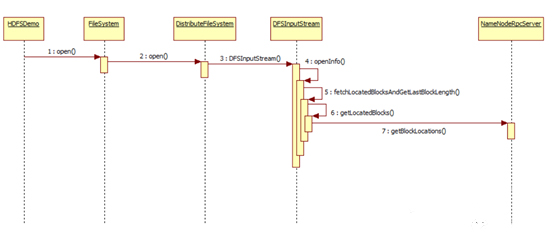
主要执行过程:
FileSystem初始化,Client拿到NameNodeRpcServer代理对象,建立与NameNode的RPC通信(与前面一样)
调用FileSystem的open()方法,由于实现类为DistributedFileSystem,所有是调用该类中的open()方法
DistributedFileSystem持有DFSClient的引用,继续调用DFSClient中的open()方法
实例化DFSInputStream输入流
调用openinfo()方法
调用fetchLocatedBlocksAndGetLastBlockLength()方法,抓取block信息并获取最后block长度
调用DFSClient中的getLocatedBlocks()方法,获取block信息
在callGetBlockLocations()方法中通过NameNode代理对象调用NameNodeRpcServer的getBlockLocations()方法
将block信息写入输出流
交给IOUtil,下载文件到本地
接下来,我们开始看源码:
首先任然是FileSystem的初始化,前面有,这里就不贴出来了,我们直接从DistributedFileSystem的open()开始看。
@Overridepublic FSDataInputStream open(PathHandle fd, int bufferSize)throws IOException {statistics.incrementReadOps(1);storageStatistics.incrementOpCounter(OpType.OPEN);if (!(fd instanceof HdfsPathHandle)) {fd = new HdfsPathHandle(fd.bytes());}HdfsPathHandle id = (HdfsPathHandle) fd;final DFSInputStream dfsis = dfs.open(id, bufferSize, verifyChecksum);//dfs 为 DFSClient对象,调用 open()防护输入流return dfs.createWrappedInputStream(dfsis);}
DFSClient中并没有直接使用NameNode的代理对象,而是传给了DFSInputStream:
public DFSInputStream open(String src, int buffersize, boolean verifyChecksum)throws IOException {checkOpen();// Get block info from namenodetry (TraceScope ignored = newPathTraceScope("newDFSInputStream", src)) {LocatedBlocks locatedBlocks = getLocatedBlocks(src, 0);return openInternal(locatedBlocks, src, verifyChecksum);}}private DFSInputStream openInternal(LocatedBlocks locatedBlocks, String src,boolean verifyChecksum) throws IOException {if (locatedBlocks != null) {ErasureCodingPolicy ecPolicy = locatedBlocks.getErasureCodingPolicy();if (ecPolicy != null) {return new DFSStripedInputStream(this, src, verifyChecksum, ecPolicy,locatedBlocks);}//DFSClient中并没有直接使用NameNode的代理对象调用服务端方法,直接 new 输入流并把当前对象作为参数传入return new DFSInputStream(this, src, verifyChecksum, locatedBlocks);} else {throw new IOException("Cannot open filename " + src);}}
那么在DFSInputStream必须持有DFSClient的引用:
//DFSInputStream.java 构造DFSInputStream(DFSClient dfsClient, String src, boolean verifyChecksum,LocatedBlocks locatedBlocks) throws IOException {this.dfsClient = dfsClient; //DFSClient的引用this.verifyChecksum = verifyChecksum;this.src = src;synchronized (infoLock) {this.cachingStrategy = dfsClient.getDefaultReadCachingStrategy();}this.locatedBlocks = locatedBlocks;openInfo(false);}
openInfo()用来抓取block信息:
//DFSInputStream.javavoid openInfo(boolean refreshLocatedBlocks) throws IOException {final DfsClientConf conf = dfsClient.getConf();synchronized(infoLock) {//获取 block的信息lastBlockBeingWrittenLength =fetchLocatedBlocksAndGetLastBlockLength(refreshLocatedBlocks);//获取配置信息,尝试抓取的次数,默认是 3int retriesForLastBlockLength = conf.getRetryTimesForGetLastBlockLength();while (retriesForLastBlockLength > 0) {// Getting last block length as -1 is a special case. When cluster// restarts, DNs may not report immediately. At this time partial block// locations will not be available with NN for getting the length. Lets// retry for 3 times to get the length.if (lastBlockBeingWrittenLength == -1) {DFSClient.LOG.warn("Last block locations not available. "+ "Datanodes might not have reported blocks completely."+ " Will retry for " + retriesForLastBlockLength + " times");waitFor(conf.getRetryIntervalForGetLastBlockLength());lastBlockBeingWrittenLength =fetchLocatedBlocksAndGetLastBlockLength(true);} else {break;}retriesForLastBlockLength--;}if (lastBlockBeingWrittenLength == -1&& retriesForLastBlockLength == 0) {throw new IOException("Could not obtain the last block locations.");}}}
获取block信息:
private long fetchLocatedBlocksAndGetLastBlockLength(boolean refresh)throws IOException {LocatedBlocks newInfo = locatedBlocks;//回到 DFSClient 中获取当前 block的信息if (locatedBlocks == null || refresh) {newInfo = dfsClient.getLocatedBlocks(src, 0);}DFSClient.LOG.debug("newInfo = {}", newInfo);if (newInfo == null) {throw new IOException("Cannot open filename " + src);}if (locatedBlocks != null) {Iterator<LocatedBlock> oldIter = locatedBlocks.getLocatedBlocks().iterator();Iterator<LocatedBlock> newIter = newInfo.getLocatedBlocks().iterator();while (oldIter.hasNext() && newIter.hasNext()) {if (!oldIter.next().getBlock().equals(newIter.next().getBlock())) {throw new IOException("Blocklist for " + src + " has changed!");}}}locatedBlocks = newInfo;long lastBlockBeingWrittenLength = 0;if (!locatedBlocks.isLastBlockComplete()) {final LocatedBlock last = locatedBlocks.getLastLocatedBlock();if (last != null) {if (last.getLocations().length == 0) {if (last.getBlockSize() == 0) {// if the length is zero, then no data has been written to// datanode. So no need to wait for the locations.return 0;}return -1;}final long len = readBlockLength(last);last.getBlock().setNumBytes(len);lastBlockBeingWrittenLength = len;}}fileEncryptionInfo = locatedBlocks.getFileEncryptionInfo();// 返回 block 开始写的位置return lastBlockBeingWrittenLength;}
回到DFSClient中:
@VisibleForTestingpublic LocatedBlocks getLocatedBlocks(String src, long start, long length)throws IOException {try (TraceScope ignored = newPathTraceScope("getBlockLocations", src)) {//这里的namenode作为参数传递到callGetBlockLocations()中return callGetBlockLocations(namenode, src, start, length);}}
调用服务端方法,返回block信息:
static LocatedBlocks callGetBlockLocations(ClientProtocol namenode,String src, long start, long length)throws IOException {try {// 返回 block信息return namenode.getBlockLocations(src, start, length);} catch(RemoteException re) {throw re.unwrapRemoteException(AccessControlException.class,FileNotFoundException.class,UnresolvedPathException.class);}}
最终将文件block相关信息写入输入流,通过工具类IOUtil输出到本地文件。
文章来自公众号:JS ONE 技术联盟

若有收获,就点个赞吧
0 人点赞


