- LeetCode 栈
- LC20. 有效的括号">LC20. 有效的括号
- LC155. 最小栈">ArrayList存放最小值 LC155. 最小栈
- 150. 逆波兰表达式求值">后序遍历入栈150. 逆波兰表达式求值
- 232. 用栈实现队列">缓存栈232. 用栈实现队列
- 388. 文件的最长绝对路径">后入先出 388. 文件的最长绝对路径
- 单调栈
- 每日温度">普通单调栈 每日温度
- 456. 132 模式">特殊意义单调栈456. 132 模式
- 503. 下一个更大元素 II">典型单调栈 + 循环数组503. 下一个更大元素 II
- 42. 栈的压入、弹出序列">栈中数据的意义 42. 栈的压入、弹出序列
- 42. 接雨水 - 力扣">特殊单调栈42. 接雨水 - 力扣
LeetCode 栈
LC20. 有效的括号
class Solution {public boolean isValid(String s) {//使用栈Stack<Character> stack = new Stack<>();for (int i = 0; i < s.length(); i ++){if (s.charAt(i) == '(')stack.push(s.charAt(i));if (s.charAt(i) == '[')stack.push(s.charAt(i));if (s.charAt(i) == '{')stack.push(s.charAt(i));if ( s.charAt(i) == ')'){if (!stack.empty() && stack.peek() == '(')stack.pop();else return false;}if (s.charAt(i) == ']'){if (!stack.empty() && stack.peek() == '[')stack.pop();else return false;}if (s.charAt(i) == '}'){if (!stack.empty() && stack.peek() == '{')stack.pop();else return false;}}if (stack.empty())return true;return false;}}
ArrayList存放最小值 LC155. 最小栈
思路
使用ArrayList存放到目前为止,栈中的最小值。
每次push入栈的时候,把栈的最小值插入ArrayList中
pop出栈的时候,删除对应的ArrayList最后一个值
getMin返回ArrayList的最后一个值
class MinStack {ArrayList<Integer> list;Stack<Integer> s;int idx; int minv = Integer.MAX_VALUE;public MinStack() {list = new ArrayList();s = new Stack<Integer>();idx = -1;}public void push(int x) {s.push(x);minv = Math.min(x, idx >= 0 ? list.get(idx) : Integer.MAX_VALUE);list.add(minv);idx++;}public void pop() {list.remove(idx--);s.pop();}public int top() {return s.peek();}public int min() {return list.get(idx);}}
后序遍历入栈150. 逆波兰表达式求值
表达式树
- 表达式中所有数字节点都是叶子节点
- 所有操作数节点都是内部节点
- 后缀表达式 通过后序遍历树的方式创建
- 中缀表达式 通过中序遍历树的方式创建
- 我们发现,进行后序遍历的时候,如果根节点被创建了,那么它的左右子节点都被创建了。
通过这些性质,我们可以通过给定的后续表达式:
- 每当遇到一个点,就加入栈中
- 每当我们遇到一个操作数(根节点),就可以把它的左右子节点(都pop出栈,计算这一个子树表达式的值)
class Solution {String[] oper = new String[]{"+", "*", "/", "-"};public int evalRPN(String[] tokens) {//后缀转中缀表达式Stack<Integer> s = new Stack<Integer>();HashSet<String> op = new HashSet<String>();for (int i = 0; i < 4; i ++)op.add(oper[i]);int n = tokens.length;for (int i = 0; i < n; i ++){if (!op.contains(tokens[i])){s.push(Integer.valueOf(tokens[i]));}else{Integer res = new Integer(0);Integer n1 = s.pop();Integer n2 = s.pop();String op1 = tokens[i];if (op1.equals("+")) res = n1 + n2;else if (op1.equals("-")) res = n2 - n1;else if (op1.equals("*")) res = n1 * n2;else res = n2 / n1;s.push(res);// System.out.println(s);}}return s.peek();}}
缓存栈232. 用栈实现队列
思路
- 建立两个栈 一个作为缓存栈s2,一个是实际操作栈s1
- push : 就对s1进行push和empty的操作
- pop : 需要s1把除了栈顶的所有元素 都pop,并放入s2中,再pop s1的栈顶元素,最后把s2元素压回s1
- peek : 需要s1把除了栈顶的所有元素 都pop,并放入s2中,返回s1的栈顶元素t,最后把s2元素压回s1,
- empty s1.isEmpty
- 均摊操作还是o(1)的
class MyQueue {Stack<Integer> s1, s2;/** Initialize your data structure here. */public MyQueue() {s1 = new Stack<Integer>();s2 = new Stack<Integer>();}/** Push element x to the back of queue. */public void push(int x) {s1.push(x);}/** Removes the element from in front of queue and returns that element. */public int pop() {while (s1.size() > 1){s2.push(s1.pop());}int t = s1.pop();while (!s2.isEmpty())s1.push(s2.pop());return t;}/** Get the front element. */public int peek() {while (s1.size() > 1){s2.push(s1.pop());}int t = s1.peek();while (!s2.isEmpty())s1.push(s2.pop());return t;}/** Returns whether the queue is empty. */public boolean empty() {return s1.isEmpty();}}/*** Your MyQueue object will be instantiated and called as such:* MyQueue obj = new MyQueue();* obj.push(x);* int param_2 = obj.pop();* int param_3 = obj.peek();* boolean param_4 = obj.empty();*/
后入先出 388. 文件的最长绝对路径
自己的思路
- 遍历的时候计算\t的个数,如果是递增的,就把\t后的字符串长度加入Stack中
- 如果不是递增的,就统计长度 = stack中字符的长度 + stack.size() - 1,更新maxv pop掉所有元素
- 最后要再计算一次stack中的字符长度(最后一个字符)
- 最后最长路径要加上最开始的根目录字符
- Stack存放 根目录到父目录的长度和父目录的级数
- t就是目录级数 0是根目录
由于我没有判断最后一个是否为文件,也没有加入根目录,当最长路径没有文件或者只出现根目录的时候就会报错
class Solution {public int lengthLongestPath(String input) {Stack<List<Integer>> s = new Stack<List<Integer>>();int n = input.length();int t = 0, st = -1, ed = -1, root = 0;int maxv = Integer.MIN_VALUE;for (int i = 0; i < n; i ++){if (root == 0 && input.charAt(i) == '\n') root = i + 1;if (input.charAt(i) == '\t'){t ++;st = i + 1;continue;}if (i - 1 >= 0 && (t > 0 && input.charAt(i) == '\n') || i == n - 1){if (i == n - 1) ed = i;else ed = i - 1;}if (st != -1 && ed != -1){int len = ed - st + 1;if (s.isEmpty() || t > s.peek().get(1)){List<Integer> list= new ArrayList<Integer>();list.add(len);list.add(t);s.push(list);}else{maxv = Math.max(maxv, total(s));List<Integer> list= new ArrayList<Integer>();list.add(len);list.add(t);s.push(list);}t = 0;st = -1;ed = -1;}}return Math.max(maxv, total(s)) + root;}public int total( Stack<List<Integer>> s){int totalnum = 0;int num = s.size();while (!s.isEmpty()){List<Integer> tmp = s.pop();totalnum += tmp.get(0);}return totalnum + num - 1;}}
yxc的思路
遍历的时候遇到\t 更新级数t,更新下一次坐标
- 如果级数t >= stack.size() ,把\t后的字符串长度加入Stack中,更新当前路径的长度sum
- 如果t < stack.size(),说明当前文件不是这个目录下的, 回溯,更新为当前文件路径sum,当最后一个是文件的时候,计算最终答案是sum + stack.size() - 1 ,否则为上一个路径的sum
可以明显看到yxc的思路非常的简化,代码量少了一半
具体原因是考虑到了回溯的情况,当前级数 <= 栈中存放的级数,就回溯,否则加入栈并计算最值
class Solution {
    public int lengthLongestPath(String input) {
        Stack<Integer> stack = new Stack<Integer>();
        int n = input.length();
        int maxv = 0, sum = 0;
        for (int st = 0; st < n;){
            int t = 0;
            while (st < n && input.charAt(st) == '\t'){
                t++; st++;
            }
            int ed = st;
            while (ed < n && input.charAt(ed) != '\n'){
                ed ++;
            }
            int len = ed - st;
            while (stack.size() > t){
                sum -= stack.peek(); stack.pop();
            }
            stack.push(len); sum += stack.peek();
            if (input.substring(st, ed).contains("."))
                maxv = Math.max(maxv, sum + stack.size() - 1);
            st = ed + 1;
        }
        return maxv;
    }
}
单调栈
单调栈只是一种结果的表现形式
怎么想到使用单调栈呢?如何给单调栈定义呢?
有点类似二分。
找到第一个和当前数不一样的数字。
形象地来说,找到第一个某一方面比当前角色强/弱的角色
单调栈中的栈首就是这个角色。
整个栈都满足这一性质,但栈首是最接近不满足的。
普通单调栈 每日温度
class Solution {
    public int[] dailyTemperatures(int[] t) {
        /**
            单调栈 反向第一个>当前数的下标
         */
        int[] res = new int[t.length];
        Stack<Integer> stack = new Stack<>();
        for (int i = t.length - 1; i >= 0; i --){
            while (!stack.isEmpty() && t[stack.peek()] <= t[i]) stack.pop();
            if (!stack.isEmpty()) res[i] = stack.peek() - i;
            stack.push(i);
        }
        return res;
    }
}
特殊意义单调栈456. 132 模式
o(n^3)暴搜的方法,超时
class Solution {
    public boolean find132pattern(int[] nums) {
        int n = nums.length;
        boolean flag = false;
        for (int i = 0; i < n; i ++){
            for (int j = i + 1; j < n; j++){
                int k = j + 1;
                while (k < n){
                   if (nums[i] < nums[k] && nums[k] < nums[j]) {
                        flag = true; return flag;
                    }
                    k++;
                }
            }
        }
        return flag;
    }
}
单调栈思路o (n)
对于每个numi 找到numk,其中numk满足这样一个性质:
存在j < k, 有 numj > numk
我们只要遍历每个i,找到对于numi来说,最满足性质的numk(我们使用right来存放)即可
那么我们怎么来求这个right呢?
这里有一个性质
我们从后向前遍历(保证单调递减栈中元素的下标单调递减),把所有不满足性质的numk存入栈中,最终栈是单调的
假设这个性质成立
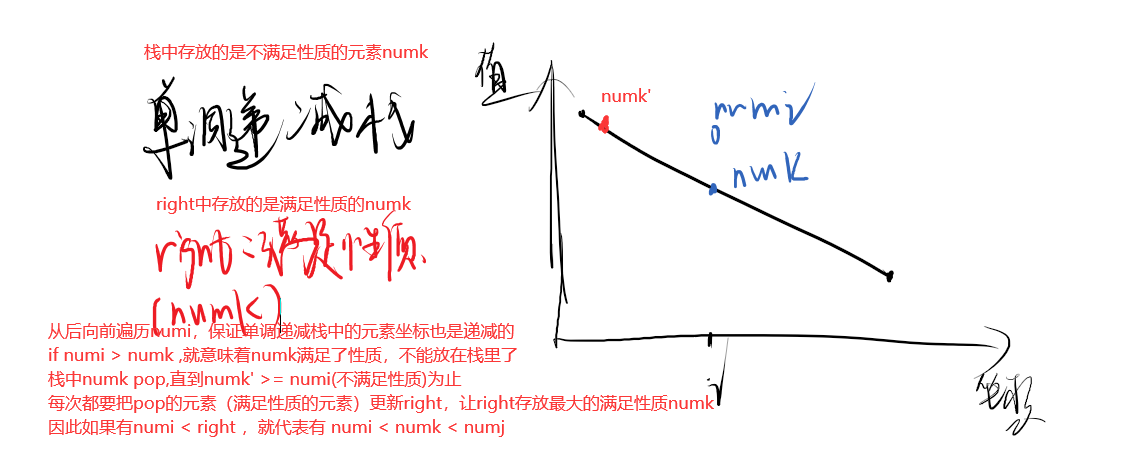
最后再把numi存入栈,保证每次操作存入的数都是递减的,这样整体栈单调递减
class Solution {
    public boolean find132pattern(int[] nums) {
        Stack<Integer> s = new Stack<Integer>();
        int right = Integer.MIN_VALUE;
        for (int i = nums.length - 1; i >= 0; i --){
            if (nums[i] < right) return true;
            while (!s.isEmpty() && nums[i] > s.peek()){
                right = Math.max(s.peek(), right);
                s.pop();
            }
            s.push(nums[i]);
        }
        return false;
    }
}
典型单调栈 + 循环数组503. 下一个更大元素 II
思路
这是一个典型的单调栈问题,我们只需要开两倍数组就可以了
要注意我将答案覆盖到原数组,因此需要将原数组的元素保存一下
class Solution {
    public int[] nextGreaterElements(int[] nums) {
        //典型的单调栈问题,不过增加了一个循环数组
        //对于循环数组来说,我们在区间dp中遇到过,开两倍的空间就可以了
        Stack<Integer> s = new Stack<Integer>();
        int n = nums.length;
        if (n == 0) return nums;
        int[] nums2 = new int[2 * n];
        int[] res = new int[n];
        for (int i = 0; i < n; i++){
            nums2[i] = nums[i];
            nums2[i + n] = nums[i];
        }
        for (int i = 2 * n - 1; i >= 0; i--){
            while (!s.isEmpty() && s.peek() <= nums2[i]) s.pop();
            int tmp = nums2[i];
            if (s.isEmpty()) nums2[i] = -1;
            else nums2[i] = s.peek();
            s.push(tmp);
        }
        for (int i = 0; i < n; i ++) res[i] = nums2[i];
        return res;
    }
}
栈中数据的意义 42. 栈的压入、弹出序列
我的思路
压入序列T, 弹出序列S, 当前数为t、s
将t压入栈,对当前栈顶元素t进行判断
- 如果 t == s,将t弹出栈, 两个序列都遍历下一个数
- 否则T遍历下一个数
将后一个数t压入栈,循环操作
- 如果遍历结束
正确思路
将t压入栈,循环当前栈顶元素t进行判断
- 如果 t == s,将t弹出栈, S序列遍历下一个数
- 遍历结束后,如果栈为空代表匹配,否则不匹配
能看出来,差别就是t、s判断的时候,我没有添加循环判断。循环判断保证当前序列的一致性,因此需要循环判断
本质上是对栈的认知不够,当t压入栈中,栈中存放的是t为首的弹出序列。因此要循环整个栈。
class Solution {
    public boolean isPopOrder(int [] pushV,int [] popV) {
        Stack<Integer> s = new Stack<Integer>();
        int l1 = pushV.length, l2 = popV.length;
        if (l1 == 0 && l2 == 0) return true;
        if (l1 != l2) return false;

        for (int i = 0, j = 0; i < l1; i++){
            s.push(pushV[i]);
            while (s.size() > 0 && s.peek() == popV[j]) {
                s.pop();
                j ++;
            }
        }
        if (s.size() == 0) return true;
        else return false;
    }
}
特殊单调栈42. 接雨水 - 力扣
class Solution {
    public int trap(int[] height) {
        //单调栈,每次先判断当前height[i] > height[stack.peek()]
        //如果stack的第二个栈顶left还存在,说明可能形成凹槽,计算宽度 i - left -1
        // 高度 min(h[i], h[left]) - h[peek]
        //计算完之后相当于把坑填平了,
        //peek pop出去,接着把i存入栈中
        int num = height.length;
        if (num == 0) return 0;
        Stack<Integer> s = new Stack<>();
        s.push(0); int res = 0;
        for (int i = 1; i < num; i ++){
            while (s.size() > 1 && height[i] > height[s.peek()]){
                int bottom = s.pop(), left = s.peek();
                int width = i - left - 1, h = Math.min(height[i], height[left]) - height[bottom];
                if (width > 0 && h > 0)
                    res += width * h;
            }
            s.push(i);
        }
        return res;
    }
}

若有收获,就点个赞吧
0 人点赞


