索引失效8-数目字符串不加单引号
数目字符串不加单引号索引失效。
mysql> SELECT * FROM staffs WHERE NAME=2000;+----+------+-----+-----+---------------------+| id | name | age | pos | add_time |+----+------+-----+-----+---------------------+| 3 | 2000 | 23 | dev | 2021-04-03 14:03:18 |+----+------+-----+-----+---------------------+1 row in set, 1 warning (0.00 sec)mysql> SELECT * FROM staffs WHERE NAME='2000';+----+------+-----+-----+---------------------+| id | name | age | pos | add_time |+----+------+-----+-----+---------------------+| 3 | 2000 | 23 | dev | 2021-04-03 14:03:18 |+----+------+-----+-----+---------------------+1 row in set (0.00 sec)mysql> explain SELECT * FROM staffs WHERE NAME=2000;+----+-------------+--------+------------+------+-------------------------+------+---------+------+------+----------+-------------+| id | select_type | table | partitions | type | possible_keys | key | key_len | ref | rows | filtered | Extra |+----+-------------+--------+------------+------+-------------------------+------+---------+------+------+----------+-------------+| 1 | SIMPLE | staffs | NULL | ALL | index_staffs_nameAgePos | NULL | NULL | NULL | 3 | 33.33 | Using where |+----+-------------+--------+------------+------+-------------------------+------+---------+------+------+----------+-------------+1 row in set, 3 warnings (0.00 sec)mysql> explain SELECT * FROM staffs WHERE NAME='2000';+----+-------------+--------+------------+------+-------------------------+-------------------------+---------+-------+------+----------+-------+| id | select_type | table | partitions | type | possible_keys | key | key_len | ref | rows | filtered | Extra |+----+-------------+--------+------------+------+-------------------------+-------------------------+---------+-------+------+----------+-------+| 1 | SIMPLE | staffs | NULL | ref | index_staffs_nameAgePos | index_staffs_nameAgePos | 74 | const | 1 | 100.00 | NULL |+----+-------------+--------+------------+------+-------------------------+-------------------------+---------+-------+------+----------+-------+1 row in set, 1 warning (0.00 sec)
索引失效9-用关键字OR
少用or,用它来连接时会索引失效。
mysql> explain SELECT * FROM staffs WHERE NAME='July' or name='z3';+----+-------------+--------+------------+------+-------------------------+------+---------+------+------+----------+-------------+| id | select_type | table | partitions | type | possible_keys | key | key_len | ref | rows | filtered | Extra |+----+-------------+--------+------------+------+-------------------------+------+---------+------+------+----------+-------------+| 1 | SIMPLE | staffs | NULL | ALL | index_staffs_nameAgePos | NULL | NULL | NULL | 3 | 66.67 | Using where |+----+-------------+--------+------------+------+-------------------------+------+---------+------+------+----------+-------------+1 row in set, 1 warning (0.00 sec)mysql> SELECT * FROM staffs WHERE NAME='July' or name='z3';+----+------+-----+---------+---------------------+| id | name | age | pos | add_time |+----+------+-----+---------+---------------------+| 1 | z3 | 22 | manager | 2021-04-03 14:03:18 || 2 | July | 23 | dev | 2021-04-03 14:03:18 |+----+------+-----+---------+---------------------+2 rows in set (0.00 sec)
索引失效10-小总结

索引面试题分析
新建SQL
create table test03(id int primary key not null auto_increment,c1 char(10),c2 char(10),c3 char(10),c4 char(10),c5 char(10));insert into test03(c1,c2,c3,c4,c5) values ('a1','a2','a3','a4','a5');insert into test03(c1,c2,c3,c4,c5) values ('b1','b2','b3','b4','b5');insert into test03(c1,c2,c3,c4,c5) values ('c1','c2','c3','c4','c5');insert into test03(c1,c2,c3,c4,c5) values ('d1','d2','d3','d4','d5');insert into test03(c1,c2,c3,c4,c5) values ('e1','e2','e3','e4','e5');create index idx_test03_c1234 on test03(c1,c2,c3,c4);
mysql> select * from test03;+----+------+------+------+------+------+| id | c1 | c2 | c3 | c4 | c5 |+----+------+------+------+------+------+| 1 | a1 | a2 | a3 | a4 | a5 || 2 | b1 | b2 | b3 | b4 | b5 || 3 | c1 | c2 | c3 | c4 | c5 || 4 | d1 | d2 | d3 | d4 | d5 || 5 | e1 | e2 | e3 | e4 | e5 |+----+------+------+------+------+------+5 rows in set (0.00 sec)mysql> show index from test03;+--------+------------+------------------+--------------+-------------+-----------+-------------+----------+--------+------+------------+---------+---------------+| Table | Non_unique | Key_name | Seq_in_index | Column_name | Collation | Cardinality | Sub_part | Packed | Null | Index_type | Comment | Index_comment |+--------+------------+------------------+--------------+-------------+-----------+-------------+----------+--------+------+------------+---------+---------------+| test03 | 0 | PRIMARY | 1 | id | A | 2 | NULL | NULL | | BTREE | | || test03 | 1 | idx_test03_c1234 | 1 | c1 | A | 5 | NULL | NULL | YES | BTREE | | || test03 | 1 | idx_test03_c1234 | 2 | c2 | A | 5 | NULL | NULL | YES | BTREE | | || test03 | 1 | idx_test03_c1234 | 3 | c3 | A | 5 | NULL | NULL | YES | BTREE | | || test03 | 1 | idx_test03_c1234 | 4 | c4 | A | 5 | NULL | NULL | YES | BTREE | | |+--------+------------+------------------+--------------+-------------+-----------+-------------+----------+--------+------+------------+---------+---------------+5 rows in set (0.00 sec)
问题:我们创建了复合索引idx_test03_c1234 ,根据以下SQL分析下索引使用情况?
1
explain select * from test03 where c1='a1';explain select * from test03 where c1='a1' and c2='a2';explain select * from test03 where c1='a1' and c2='a2' and c3='a3';explain select * from test03 where c1='a1' and c2='a2' and c3='a3' and c4='a4';
mysql> explain select * from test03 where c1='a1';+----+-------------+--------+------------+------+------------------+------------------+---------+-------+------+----------+-------+| id | select_type | table | partitions | type | possible_keys | key | key_len | ref | rows | filtered | Extra |+----+-------------+--------+------------+------+------------------+------------------+---------+-------+------+----------+-------+| 1 | SIMPLE | test03 | NULL | ref | idx_test03_c1234 | idx_test03_c1234 | 41 | const | 1 | 100.00 | NULL |+----+-------------+--------+------------+------+------------------+------------------+---------+-------+------+----------+-------+1 row in set, 1 warning (0.00 sec)mysql> explain select * from test03 where c1='a1' and c2='a2';+----+-------------+--------+------------+------+------------------+------------------+---------+-------------+------+----------+-------+| id | select_type | table | partitions | type | possible_keys | key | key_len | ref | rows | filtered | Extra |+----+-------------+--------+------------+------+------------------+------------------+---------+-------------+------+----------+-------+| 1 | SIMPLE | test03 | NULL | ref | idx_test03_c1234 | idx_test03_c1234 | 82 | const,const | 1 | 100.00 | NULL |+----+-------------+--------+------------+------+------------------+------------------+---------+-------------+------+----------+-------+1 row in set, 1 warning (0.00 sec)mysql> explain select * from test03 where c1='a1' and c2='a2' and c3='a3';+----+-------------+--------+------------+------+------------------+------------------+---------+-------------------+------+----------+-------+| id | select_type | table | partitions | type | possible_keys | key | key_len | ref | rows | filtered | Extra |+----+-------------+--------+------------+------+------------------+------------------+---------+-------------------+------+----------+-------+| 1 | SIMPLE | test03 | NULL | ref | idx_test03_c1234 | idx_test03_c1234 | 123 | const,const,const | 1 | 100.00 | NULL |+----+-------------+--------+------------+------+------------------+------------------+---------+-------------------+------+----------+-------+1 row in set, 1 warning (0.00 sec)mysql> explain select * from test03 where c1='a1' and c2='a2' and c3='a3' and c4='a4';+----+-------------+--------+------------+------+------------------+------------------+---------+-------------------------+------+----------+-------+| id | select_type | table | partitions | type | possible_keys | key | key_len | ref | rows | filtered | Extra |+----+-------------+--------+------------+------+------------------+------------------+---------+-------------------------+------+----------+-------+| 1 | SIMPLE | test03 | NULL | ref | idx_test03_c1234 | idx_test03_c1234 | 164 | const,const,const,const | 1 | 100.00 | NULL |+----+-------------+--------+------------+------+------------------+------------------+---------+-------------------------+------+----------+-------+1 row in set, 1 warning (0.00 sec)
2
换一下条件顺序
explain select * from test03 where c1='a1' and c2='a2' and c3='a3' and c4='a4';explain select * from test03 where c1='a1' and c2='a2' and c4='a4' and c3='a3';
mysql> explain select * from test03 where c1='a1' and c2='a2' and c3='a3' and c4='a4';+----+-------------+--------+------------+------+------------------+------------------+---------+-------------------------+------+----------+-------+| id | select_type | table | partitions | type | possible_keys | key | key_len | ref | rows | filtered | Extra |+----+-------------+--------+------------+------+------------------+------------------+---------+-------------------------+------+----------+-------+| 1 | SIMPLE | test03 | NULL | ref | idx_test03_c1234 | idx_test03_c1234 | 164 | const,const,const,const | 1 | 100.00 | NULL |+----+-------------+--------+------------+------+------------------+------------------+---------+-------------------------+------+----------+-------+1 row in set, 1 warning (0.00 sec)mysql> explain select * from test03 where c1='a1' and c2='a2' and c4='a4' and c3='a3';+----+-------------+--------+------------+------+------------------+------------------+---------+-------------------------+------+----------+-------+| id | select_type | table | partitions | type | possible_keys | key | key_len | ref | rows | filtered | Extra |+----+-------------+--------+------------+------+------------------+------------------+---------+-------------------------+------+----------+-------+| 1 | SIMPLE | test03 | NULL | ref | idx_test03_c1234 | idx_test03_c1234 | 164 | const,const,const,const | 1 | 100.00 | NULL |+----+-------------+--------+------------+------+------------------+------------------+---------+-------------------------+------+----------+-------+1 row in set, 1 warning (0.00 sec)
3
限定范围
explain select * from test03 where c1='a1' and c2='a2' and c3>'a3' and c4='a4';explain select * from test03 where c1='a1' and c2='a2' and c4>'a4' and c3='a3';
mysql> explain select * from test03 where c1='a1' and c2='a2' and c3>'a3' and c4='a4';+----+-------------+--------+------------+-------+------------------+------------------+---------+------+------+----------+-----------------------+| id | select_type | table | partitions | type | possible_keys | key | key_len | ref | rows | filtered | Extra |+----+-------------+--------+------------+-------+------------------+------------------+---------+------+------+----------+-----------------------+| 1 | SIMPLE | test03 | NULL | range | idx_test03_c1234 | idx_test03_c1234 | 123 | NULL | 1 | 20.00 | Using index condition |+----+-------------+--------+------------+-------+------------------+------------------+---------+------+------+----------+-----------------------+1 row in set, 1 warning (0.00 sec)mysql> explain select * from test03 where c1='a1' and c2='a2' and c4>'a4' and c3='a3';+----+-------------+--------+------------+-------+------------------+------------------+---------+------+------+----------+-----------------------+| id | select_type | table | partitions | type | possible_keys | key | key_len | ref | rows | filtered | Extra |+----+-------------+--------+------------+-------+------------------+------------------+---------+------+------+----------+-----------------------+| 1 | SIMPLE | test03 | NULL | range | idx_test03_c1234 | idx_test03_c1234 | 164 | NULL | 1 | 100.00 | Using index condition |+----+-------------+--------+------------+-------+------------------+------------------+---------+------+------+----------+-----------------------+1 row in set, 1 warning (0.00 sec)
4
mysql> explain select * from test03 where c1='a1' and c2='a2' and c4='a4' order by c3;+----+-------------+--------+------------+------+------------------+------------------+---------+-------------+------+----------+-----------------------+| id | select_type | table | partitions | type | possible_keys | key | key_len | ref | rows | filtered | Extra |+----+-------------+--------+------------+------+------------------+------------------+---------+-------------+------+----------+-----------------------+| 1 | SIMPLE | test03 | NULL | ref | idx_test03_c1234 | idx_test03_c1234 | 82 | const,const | 1 | 20.00 | Using index condition |+----+-------------+--------+------------+------+------------------+------------------+---------+-------------+------+----------+-----------------------+1 row in set, 1 warning (0.00 sec)
c3作用在排序而不是查找
mysql> explain select * from test03 where c1='a1' and c2='a2' order by c3;+----+-------------+--------+------------+------+------------------+------------------+---------+-------------+------+----------+-----------------------+| id | select_type | table | partitions | type | possible_keys | key | key_len | ref | rows | filtered | Extra |+----+-------------+--------+------------+------+------------------+------------------+---------+-------------+------+----------+-----------------------+| 1 | SIMPLE | test03 | NULL | ref | idx_test03_c1234 | idx_test03_c1234 | 82 | const,const | 1 | 100.00 | Using index condition |+----+-------------+--------+------------+------+------------------+------------------+---------+-------------+------+----------+-----------------------+1 row in set, 1 warning (0.00 sec)
上面两个explain的相同。
order by c3换成order by c4
mysql> explain select * from test03 where c1='a1' and c2='a2' order by c4;+----+-------------+--------+------------+------+------------------+------------------+---------+-------------+------+----------+---------------------------------------+| id | select_type | table | partitions | type | possible_keys | key | key_len | ref | rows | filtered | Extra |+----+-------------+--------+------------+------+------------------+------------------+---------+-------------+------+----------+---------------------------------------+| 1 | SIMPLE | test03 | NULL | ref | idx_test03_c1234 | idx_test03_c1234 | 82 | const,const | 1 | 100.00 | Using index condition; Using filesort |+----+-------------+--------+------------+------+------------------+------------------+---------+-------------+------+----------+---------------------------------------+1 row in set, 1 warning (0.00 sec)
5
mysql> explain select * from test03 where c1='a1' and c5='a5' order by c2,c3;+----+-------------+--------+------------+------+------------------+------------------+---------+-------+------+----------+------------------------------------+| id | select_type | table | partitions | type | possible_keys | key | key_len | ref | rows | filtered | Extra |+----+-------------+--------+------------+------+------------------+------------------+---------+-------+------+----------+------------------------------------+| 1 | SIMPLE | test03 | NULL | ref | idx_test03_c1234 | idx_test03_c1234 | 41 | const | 1 | 20.00 | Using index condition; Using where |+----+-------------+--------+------------+------+------------------+------------------+---------+-------+------+----------+------------------------------------+1 row in set, 1 warning (0.00 sec)
只用c1一个字段索引,但是c2、c3用于排序,无filesort。
将order by c2,c3换成order by c3,c2。
mysql> explain select * from test03 where c1='a1' and c5='a5' order by c3,c2;+----+-------------+--------+------------+------+------------------+------------------+---------+-------+------+----------+----------------------------------------------------+| id | select_type | table | partitions | type | possible_keys | key | key_len | ref | rows | filtered | Extra |+----+-------------+--------+------------+------+------------------+------------------+---------+-------+------+----------+----------------------------------------------------+| 1 | SIMPLE | test03 | NULL | ref | idx_test03_c1234 | idx_test03_c1234 | 41 | const | 1 | 20.00 | Using index condition; Using where; Using filesort |+----+-------------+--------+------------+------+------------------+------------------+---------+-------+------+----------+----------------------------------------------------+1 row in set, 1 warning (0.00 sec)
出现了filesort,我们建的索引是1234,它没有按照顺序来,3,2颠倒了。
6
mysql> explain select * from test03 where c1='a1' and c2='a2' order by c2,c3;+----+-------------+--------+------------+------+------------------+------------------+---------+-------------+------+----------+-----------------------+| id | select_type | table | partitions | type | possible_keys | key | key_len | ref | rows | filtered | Extra |+----+-------------+--------+------------+------+------------------+------------------+---------+-------------+------+----------+-----------------------+| 1 | SIMPLE | test03 | NULL | ref | idx_test03_c1234 | idx_test03_c1234 | 82 | const,const | 1 | 100.00 | Using index condition |+----+-------------+--------+------------+------+------------------+------------------+---------+-------------+------+----------+-----------------------+1 row in set, 1 warning (0.00 sec)mysql> explain select * from test03 where c1='a1' and c2='a2' and c5='a5' order by c2,c3;+----+-------------+--------+------------+------+------------------+------------------+---------+-------------+------+----------+------------------------------------+| id | select_type | table | partitions | type | possible_keys | key | key_len | ref | rows | filtered | Extra |+----+-------------+--------+------------+------+------------------+------------------+---------+-------------+------+----------+------------------------------------+| 1 | SIMPLE | test03 | NULL | ref | idx_test03_c1234 | idx_test03_c1234 | 82 | const,const | 1 | 20.00 | Using index condition; Using where |+----+-------------+--------+------------+------+------------------+------------------+---------+-------------+------+----------+------------------------------------+1 row in set, 1 warning (0.00 sec)
用c1、c2两个字段索引,但是c2、c3用于排序,无filesort
7
mysql> explain select * from test03 where c1='a1' and c2='a2' and c5='a5' order by c3,c2;+----+-------------+--------+------------+------+------------------+------------------+---------+-------------+------+----------+------------------------------------+| id | select_type | table | partitions | type | possible_keys | key | key_len | ref | rows | filtered | Extra |+----+-------------+--------+------------+------+------------------+------------------+---------+-------------+------+----------+------------------------------------+| 1 | SIMPLE | test03 | NULL | ref | idx_test03_c1234 | idx_test03_c1234 | 82 | const,const | 1 | 20.00 | Using index condition; Using where |+----+-------------+--------+------------+------+------------------+------------------+---------+-------------+------+----------+------------------------------------+1 row in set, 1 warning (0.00 sec)mysql> explain select * from test03 where c1='a1' and c5='a5' order by c3,c2;+----+-------------+--------+------------+------+------------------+------------------+---------+-------+------+----------+----------------------------------------------------+| id | select_type | table | partitions | type | possible_keys | key | key_len | ref | rows | filtered | Extra |+----+-------------+--------+------------+------+------------------+------------------+---------+-------+------+----------+----------------------------------------------------+| 1 | SIMPLE | test03 | NULL | ref | idx_test03_c1234 | idx_test03_c1234 | 41 | const | 1 | 20.00 | Using index condition; Using where; Using filesort |+----+-------------+--------+------------+------+------------------+------------------+---------+-------+------+----------+----------------------------------------------------+1 row in set, 1 warning (0.00 sec)
跳过c2,就用c3,就出翔Using filesort。
8
mysql> explain select * from test03 where c1='a1' and c4='a4' group by c2,c3;+----+-------------+--------+------------+------+------------------+------------------+---------+-------+------+----------+-----------------------+| id | select_type | table | partitions | type | possible_keys | key | key_len | ref | rows | filtered | Extra |+----+-------------+--------+------------+------+------------------+------------------+---------+-------+------+----------+-----------------------+| 1 | SIMPLE | test03 | NULL | ref | idx_test03_c1234 | idx_test03_c1234 | 41 | const | 1 | 20.00 | Using index condition |+----+-------------+--------+------------+------+------------------+------------------+---------+-------+------+----------+-----------------------+1 row in set, 1 warning (0.00 sec)mysql> explain select * from test03 where c1='a1' and c4='a4' group by c3,c2;+----+-------------+--------+------------+------+------------------+------------------+---------+-------+------+----------+--------------------------------------------------------+| id | select_type | table | partitions | type | possible_keys | key | key_len | ref | rows | filtered | Extra |+----+-------------+--------+------------+------+------------------+------------------+---------+-------+------+----------+--------------------------------------------------------+| 1 | SIMPLE | test03 | NULL | ref | idx_test03_c1234 | idx_test03_c1234 | 41 | const | 1 | 20.00 | Using index condition; Using temporary; Using filesort |+----+-------------+--------+------------+------+------------------+------------------+---------+-------+------+----------+--------------------------------------------------------+1 row in set, 1 warning (0.00 sec)
定值、范围还是排序,一般order by是给个范围
group by基本上都需要进行排序,会有临时表产生
一般性建议
- 对于单键索引,尽量选择针对当前query过滤性更好的索引。
- 在选择组合索引的时候,当前Query中过滤性最好的字段在索引字段顺序中,位置越靠前越好。
- 在选择组合索引的时候,尽量选择可以能够包含当前query中的where字句中更多字段的索引。
- 尽可能通过分析统计信息和调整query的写法来达到选择合适索引的目的。
索引优化答疑补充和总结口诀
继续上一章节mysql> explain select * from test03 where c1='a1' and c2 like 'kk%' and c3='a3';+----+-------------+--------+------------+-------+------------------+------------------+---------+------+------+----------+-----------------------+| id | select_type | table | partitions | type | possible_keys | key | key_len | ref | rows | filtered | Extra |+----+-------------+--------+------------+-------+------------------+------------------+---------+------+------+----------+-----------------------+| 1 | SIMPLE | test03 | NULL | range | idx_test03_c1234 | idx_test03_c1234 | 123 | NULL | 1 | 20.00 | Using index condition |+----+-------------+--------+------------+-------+------------------+------------------+---------+------+------+----------+-----------------------+1 row in set, 1 warning (0.00 sec)
mysql> explain select * from test03 where c1='a1' and c2 like '%kk' and c3='a3';+----+-------------+--------+------------+------+------------------+------------------+---------+-------+------+----------+-----------------------+| id | select_type | table | partitions | type | possible_keys | key | key_len | ref | rows | filtered | Extra |+----+-------------+--------+------------+------+------------------+------------------+---------+-------+------+----------+-----------------------+| 1 | SIMPLE | test03 | NULL | ref | idx_test03_c1234 | idx_test03_c1234 | 41 | const | 1 | 20.00 | Using index condition |+----+-------------+--------+------------+------+------------------+------------------+---------+-------+------+----------+-----------------------+1 row in set, 1 warning (0.00 sec)
mysql> explain select * from test03 where c1='a1' and c2 like '%kk%' and c3='a3';+----+-------------+--------+------------+------+------------------+------------------+---------+-------+------+----------+-----------------------+| id | select_type | table | partitions | type | possible_keys | key | key_len | ref | rows | filtered | Extra |+----+-------------+--------+------------+------+------------------+------------------+---------+-------+------+----------+-----------------------+| 1 | SIMPLE | test03 | NULL | ref | idx_test03_c1234 | idx_test03_c1234 | 41 | const | 1 | 20.00 | Using index condition |+----+-------------+--------+------------+------+------------------+------------------+---------+-------+------+----------+-----------------------+1 row in set, 1 warning (0.00 sec)
小总结mysql> explain select * from test03 where c1='a1' and c2 like 'k%kk%' and c3='a3';+----+-------------+--------+------------+-------+------------------+------------------+---------+------+------+----------+-----------------------+| id | select_type | table | partitions | type | possible_keys | key | key_len | ref | rows | filtered | Extra |+----+-------------+--------+------------+-------+------------------+------------------+---------+------+------+----------+-----------------------+| 1 | SIMPLE | test03 | NULL | range | idx_test03_c1234 | idx_test03_c1234 | 123 | NULL | 1 | 20.00 | Using index condition |+----+-------------+--------+------------+-------+------------------+------------------+---------+------+------+----------+-----------------------+1 row in set, 1 warning (0.00 sec)
假设index(a, b, c)
优化总结口诀
全值匹配我最爱, 最左前缀要遵守;
带头大哥不能死, 中间兄弟不能断;
索引列上少计算, 范围之后全失效;
LIKE 百分写最右, 覆盖索引不写 *;
不等空值还有 OR, 索引影响要注意;
VAR 引号不可丢, SQL 优化有诀窍。查询截取分析
小表驱动大表
通常SQL调优过程:
- 观察,至少跑1天,看看生产的慢SQL情况。
- 开启慢查询日志,设置阙值,比如超过5秒钟的就是慢SQL,并将它抓取出来。
- explain + 慢SQL分析。
- show profile。
- 运维经理 or DBA,进行SQL数据库服务器的参数调优。
总结:
- 慢查询的开启并捕获
- explain + 慢SQL分析
- show profile查询SQL在Mysql服务器里面的执行细节和生命周期情况
- SQL数据库服务器的参数调优。
优化原则:小表驱动大表,即小的数据集驱动大的数据集。
RBO原理
select * from A where id in (select id from B)等价于:for select id from Bfor select * from A where A.id = B.id
当B表的数据集必须小于A表的数据集时,用in优于exists。
select * from A where exists (select 1 from B where B.id = A.id)等价于:for select * from Afor select * from B where B.id = A.id
当A表的数据集系小于B表的数据集时,用exists优于in。
注意:A表与B表的ID字段应建立索引。
EXISTS关键字
SELECT ...FROM table WHERE EXISTS (subquery)
该语法可以理解为:将主查询的数据,放到子查询中做条件验证,根据验证结果(TRUE或FALSE)来决定主查询的数据结果是否得以保留。
提示
1.EXSTS(subquey)只返回TRUE或FALSE,因此子查询中的SELECT * 也可以是 SELECT 1 或select ‘X’,官方说法是实际执行时会忽略SELECT清单,因此没有区别。
2.EXISTS子查询的实际执行过程可能经过了优化而不是我们理解上的逐条对比,如果担忧效率问题,可进行实际检验以确定是否有效率问题。
3.EXISTS子查询往往也可以用条件表达式,其他子查询或者JOIN来替代,何种最优需要具体问题具体分析
in和exists
示例表:
mysql> select * from tbl_emp;+----+------+--------+| id | NAME | deptId |+----+------+--------+| 1 | z3 | 1 || 2 | z4 | 1 || 3 | z5 | 1 || 4 | w5 | 2 || 5 | w6 | 2 || 6 | s7 | 3 || 7 | s8 | 4 || 8 | s9 | 51 |+----+------+--------+8 rows in set (0.02 sec)mysql> select * from tbl_dept;+----+----------+--------+| id | deptName | locAdd |+----+----------+--------+| 1 | RD | 11 || 2 | HR | 12 || 3 | MK | 13 || 4 | MIS | 14 || 5 | FD | 15 |+----+----------+--------+5 rows in set (0.01 sec)
in和exists用法
mysql> select * from tbl_emp e where e.deptId in (select id from tbl_dept d);+----+------+--------+| id | NAME | deptId |+----+------+--------+| 1 | z3 | 1 || 2 | z4 | 1 || 3 | z5 | 1 || 4 | w5 | 2 || 5 | w6 | 2 || 6 | s7 | 3 || 7 | s8 | 4 |+----+------+--------+7 rows in set (0.00 sec)mysql> select * from tbl_emp e where exists (select 1 from tbl_dept d where d.id = e.deptId);+----+------+--------+| id | NAME | deptId |+----+------+--------+| 1 | z3 | 1 || 2 | z4 | 1 || 3 | z5 | 1 || 4 | w5 | 2 || 5 | w6 | 2 || 6 | s7 | 3 || 7 | s8 | 4 |+----+------+--------+7 rows in set (0.00 sec)mysql> select * from tbl_emp e where exists (select 'X' from tbl_dept d where d.id = e.deptId);+----+------+--------+| id | NAME | deptId |+----+------+--------+| 1 | z3 | 1 || 2 | z4 | 1 || 3 | z5 | 1 || 4 | w5 | 2 || 5 | w6 | 2 || 6 | s7 | 3 || 7 | s8 | 4 |+----+------+--------+7 rows in set (0.00 sec)
为排序使用索引OrderBy优化
ORDER BY子句,尽量使用Index方式排序,避免使用FileSort方式排序。
新建SQL
create table tblA(#id int primary key not null auto_increment,age int,birth timestamp not null);insert into tblA(age, birth) values(22, now());insert into tblA(age, birth) values(23, now());insert into tblA(age, birth) values(24, now());create index idx_A_ageBirth on tblA(age, birth);
mysql> select * from tblA;+------+---------------------+| age | birth |+------+---------------------+| 22 | 2021-04-04 19:31:45 || 23 | 2021-04-04 19:31:45 || 24 | 2021-04-04 19:31:45 |+------+---------------------+3 rows in set (0.00 sec)mysql> show index from tblA;+-------+------------+----------------+--------------+-------------+-----------+-------------+----------+--------+------+------------+---------+---------------+| Table | Non_unique | Key_name | Seq_in_index | Column_name | Collation | Cardinality | Sub_part | Packed | Null | Index_type | Comment | Index_comment |+-------+------------+----------------+--------------+-------------+-----------+-------------+----------+--------+------+------------+---------+---------------+| tbla | 1 | idx_A_ageBirth | 1 | age | A | 3 | NULL | NULL | YES | BTREE | | || tbla | 1 | idx_A_ageBirth | 2 | birth | A | 3 | NULL | NULL | | BTREE | | |+-------+------------+----------------+--------------+-------------+-----------+-------------+----------+--------+------+------------+---------+---------------+2 rows in set (0.00 sec)
mysql> EXPLAIN SELECT * FROM tblA where age > 20 order by age;+----+-------------+-------+------------+-------+----------------+----------------+---------+------+------+----------+--------------------------+| id | select_type | table | partitions | type | possible_keys | key | key_len | ref | rows | filtered | Extra |+----+-------------+-------+------------+-------+----------------+----------------+---------+------+------+----------+--------------------------+| 1 | SIMPLE | tblA | NULL | index | idx_A_ageBirth | idx_A_ageBirth | 9 | NULL | 3 | 100.00 | Using where; Using index |+----+-------------+-------+------------+-------+----------------+----------------+---------+------+------+----------+--------------------------+1 row in set, 1 warning (0.00 sec)mysql> EXPLAIN SELECT * FROM tblA where age>20 order by age,birth;+----+-------------+-------+------------+-------+----------------+----------------+---------+------+------+----------+--------------------------+| id | select_type | table | partitions | type | possible_keys | key | key_len | ref | rows | filtered | Extra |+----+-------------+-------+------------+-------+----------------+----------------+---------+------+------+----------+--------------------------+| 1 | SIMPLE | tblA | NULL | index | idx_A_ageBirth | idx_A_ageBirth | 9 | NULL | 3 | 100.00 | Using where; Using index |+----+-------------+-------+------------+-------+----------------+----------------+---------+------+------+----------+--------------------------+1 row in set, 1 warning (0.00 sec)mysql> EXPLAIN SELECT * FROM tblA where age>20 order by birth;+----+-------------+-------+------------+-------+----------------+----------------+---------+------+------+----------+------------------------------------------+| id | select_type | table | partitions | type | possible_keys | key | key_len | ref | rows | filtered | Extra |+----+-------------+-------+------------+-------+----------------+----------------+---------+------+------+----------+------------------------------------------+| 1 | SIMPLE | tblA | NULL | index | idx_A_ageBirth | idx_A_ageBirth | 9 | NULL | 3 | 100.00 | Using where; Using index; Using filesort |+----+-------------+-------+------------+-------+----------------+----------------+---------+------+------+----------+------------------------------------------+1 row in set, 1 warning (0.00 sec)mysql> EXPLAIN SELECT * FROM tblA where age>20 order by birth,age;+----+-------------+-------+------------+-------+----------------+----------------+---------+------+------+----------+------------------------------------------+| id | select_type | table | partitions | type | possible_keys | key | key_len | ref | rows | filtered | Extra |+----+-------------+-------+------------+-------+----------------+----------------+---------+------+------+----------+------------------------------------------+| 1 | SIMPLE | tblA | NULL | index | idx_A_ageBirth | idx_A_ageBirth | 9 | NULL | 3 | 100.00 | Using where; Using index; Using filesort |+----+-------------+-------+------------+-------+----------------+----------------+---------+------+------+----------+------------------------------------------+1 row in set, 1 warning (0.00 sec)
mysql> EXPLAIN SELECT * FROM tblA order by birth;+----+-------------+-------+------------+-------+---------------+----------------+---------+------+------+----------+-----------------------------+| id | select_type | table | partitions | type | possible_keys | key | key_len | ref | rows | filtered | Extra |+----+-------------+-------+------------+-------+---------------+----------------+---------+------+------+----------+-----------------------------+| 1 | SIMPLE | tblA | NULL | index | NULL | idx_A_ageBirth | 9 | NULL | 3 | 100.00 | Using index; Using filesort |+----+-------------+-------+------------+-------+---------------+----------------+---------+------+------+----------+-----------------------------+1 row in set, 1 warning (0.00 sec)mysql> EXPLAIN SELECT * FROM tblA WHERE birth > '2016-01-28 00:00:00' order by birth;+----+-------------+-------+------------+-------+---------------+----------------+---------+------+------+----------+------------------------------------------+| id | select_type | table | partitions | type | possible_keys | key | key_len | ref | rows | filtered | Extra |+----+-------------+-------+------------+-------+---------------+----------------+---------+------+------+----------+------------------------------------------+| 1 | SIMPLE | tblA | NULL | index | NULL | idx_A_ageBirth | 9 | NULL | 3 | 33.33 | Using where; Using index; Using filesort |+----+-------------+-------+------------+-------+---------------+----------------+---------+------+------+----------+------------------------------------------+1 row in set, 1 warning (0.00 sec)mysql> EXPLAIN SELECT * FROM tblA WHERE birth > '2016-01-28 00:00:00' order by age;+----+-------------+-------+------------+-------+---------------+----------------+---------+------+------+----------+--------------------------+| id | select_type | table | partitions | type | possible_keys | key | key_len | ref | rows | filtered | Extra |+----+-------------+-------+------------+-------+---------------+----------------+---------+------+------+----------+--------------------------+| 1 | SIMPLE | tblA | NULL | index | NULL | idx_A_ageBirth | 9 | NULL | 3 | 33.33 | Using where; Using index |+----+-------------+-------+------------+-------+---------------+----------------+---------+------+------+----------+--------------------------+1 row in set, 1 warning (0.00 sec)mysql> EXPLAIN SELECT * FROM tblA order by age, birth desc;+----+-------------+-------+------------+-------+---------------+----------------+---------+------+------+----------+-----------------------------+| id | select_type | table | partitions | type | possible_keys | key | key_len | ref | rows | filtered | Extra |+----+-------------+-------+------------+-------+---------------+----------------+---------+------+------+----------+-----------------------------+| 1 | SIMPLE | tblA | NULL | index | NULL | idx_A_ageBirth | 9 | NULL | 3 | 100.00 | Using index; Using filesort |+----+-------------+-------+------------+-------+---------------+----------------+---------+------+------+----------+-----------------------------+1 row in set, 1 warning (0.00 sec)
MySQL支持二种方式的排序,FileSort和lIndex,Index效率高,它指MySQL扫描索引本身完成排序。FileSort方式效率较低。
ORDER BY满足两情况,会使用Index方式排序:
1.ORDER BY语句使用索引最左前列。
2.使用where子句与Order BY子句条件列组合满足索引最左前列。
如果不在索引列上,mysql的filesort有两种算法:
1.双路排序
2.单路排序
双路排序
MySQL4.1之前是使用双路排序,字面意思就是两次扫描磁盘,最终得到数据,读取行指针和OrderBy列,对他们进行排序,然后扫描已经排序好的列表,按照列表中的值重新从列表中读对应的数据输出。
从磁盘取排序字段,在buffer进行排序,再从磁盘取其他字段。
取一批数据,要对磁盘进行了两次扫描,众所周知,I\O是很耗时的,所以在mysql4.1之后,出现了第二种改进的算法,就是单路排序。
单路排序
从磁盘读取查询需要的所有列,按照order by列在buffer对它们进行排序,然后扫描排序压的列表进行输出,它的效率更快一些,避免了第二次读取数据。并且把随机IO变成了顺序IO,但是它会使用更多的空间,因为它把每一行都保存在内存中了。
结论及引申出的问题
由于单路是后出的,总体而言好过双路
但是用单路有问题
在sort_buffer中,方法B比方法A要多占用很多空间,因为方法B是把所有字段都取出,所以有可能取出的数据的总大小超出了sort_buffer的容量,导致每次只能取sort_buffer容量大小的数据,进行排序(创建tmp文件,多路合并),排完再取取
sort_buffer容量大小,再排……从而多次I/O。
本来想省一次I/O操作,反而导致了大量的I/O操作,反而得不偿失。
优化策略
- 增大sort_buffer_size参数的设置
- 增大max_length_for_sort_data参数的设置
为什么设置sort_buffer_size、max_length_for_sort_data参数能优化排序?
提高Order By的速度
1.Order by时select 是一个大忌只Query需要的字段,这点非常重要。在这里的影响是;
(1)当Query的字段大小总和小于max_length_for_sort_data而且排序字段不是TEXT|BLOB类型时,会用改进后的算法——单路排序,否则用老算法——多路排序。
(2)两种算法的数据都有可能超出sort_buffer的容量,超出之后,会创建tmp文件进行合并排序,导致多次IO,但是用单路排序算法的风险会更大一些,所以要提高sort_buffer__size。
2.尝试提高sort_buffer_size,不管用哪种算法,提高这个参数都会提高效率,当然,要根据系统的能力去提高,因为这个参数是针对每个进程的。
3.尝试提高max_length_for_sort_data,提高这个参数,会增加用改进算法的概率。但是如果设的太高,数据总容量超出sort_buffer_size的概率就增大,明显症状是高的磁盘I/O活动和低的处理器使用率。
*小结
为排序使用索引
- MySql两种排序方式∶文件排序 或 扫描有序索引排序
- MySql能为 排序 与 查询 使用相同的索引
创建复合索引 a_b_c (a, b, c)
order by能使用索引最左前缀
- ORDER BY a
- ORDER BY a, b
- ORDER BY a, b, c
- ORDER BY a DESC, b DESC, c DESC
如果WHERE使用素引的最左前缀定义为常量,则order by能使用索引
- WHERE a = const ORDER BY b,c
- WHERE a = const AND b = const ORDER BY c
- WHERE a = const ORDER BY b, c
- WHERE a = const AND b > const ORDER BY b, c
不能使用索引进行排序
- ORDER BY a ASC, b DESC, c DESC //排序不—致
- WHERE g = const ORDER BY b, c //产丢失a索引
- WHERE a = const ORDER BY c //产丢失b索引
- WHERE a = const ORDER BY a, d //d不是素引的一部分
- WHERE a in (…) ORDER BY b, c //对于排序来说,多个相等条件也是范围查询
GroupBy优化与慢查询日志
GroupBy优化
- group by实质是先排序后进行分组,遵照索引建的最佳左前缀。
- 当无法使用索引列,增大max_length_for_sort_data参数的设置 + 增大sort_buffer_size参数的设置。
- where高于having,能写在where限定的条件就不要去having限定了。
慢查询日志
- MySQL的慢查询日志是MySQL提供的一种日志记录,它用来记录在MySQL中响应时间超过阀值的语句,具体指运行时间超过long_query_time值的SQL,则会被记录到慢查询日志中。
- 具体指运行时间超过long_query_time值的SQL,则会被记录到慢查询日志中。long_query_time的默认值为10,意思是运行10秒以上的语句。
- 由他来查看哪些SQL超出了我们的最大忍耐时间值,比如一条sql执行超过5秒钟,我们就算慢SQL,希望能收集超过5秒的sql,结合之前explain进行全面分析。
如何操作
默认情况下,MySQL数据库没有开启慢查询日速,需要我们手动来设置这个参数。
当然,如果不是调优需要的话,一般不建议启动该参数,因为开启慢查询日志会或多或少带来一定的性能影响。慢查询日志支持将日志记录写入文件。
查看是否开启及如何开启
- 默认 - SHOW VARIABLES LIKE ‘%slow_query_log%’;
- 开启 - set global slow_query_log=1;,只对当前数据库生效,如果MySQL重启后则会失效。 ```sql mysql> SHOW VARIABLES LIKE ‘%slow_query_log%’; +——————————-+—————————————+ | Variable_name | Value | +——————————-+—————————————+ | slow_query_log | OFF | | slow_query_log_file | DESKTOP-LNJQ0VF-slow.log | +——————————-+—————————————+ 2 rows in set, 1 warning (0.00 sec)
mysql> set global slow_query_log=1; Query OK, 0 rows affected (0.01 sec)
mysql> SHOW VARIABLES LIKE ‘%slow_query_log%’; +——————————-+—————————————+ | Variable_name | Value | +——————————-+—————————————+ | slow_query_log | ON | | slow_query_log_file | DESKTOP-LNJQ0VF-slow.log | +——————————-+—————————————+ 2 rows in set, 1 warning (0.00 sec)
如果要永久生效,就必须修改配置文件my.cnf(其它系统变量也是如此)<br />修改my.cnf文件,[mysqld]下增加或修改参数slow_query_log和slow_query_log_file后,然后重启MySQL服务器。也即将如下两行配置进my.cnf文件```sqlslow_query_log =1slow_query_log_file=/var/lib/mysqatguigu-slow.log
关于慢查询的参数slow_query_log_file,它指定慢查询日志文件的存放路径,系统默认会给一个缺省的文件host_name-slow.log(如果没有指定参数slow_query_log_file的话)
开启了慢查询日志后,什么样的SQL才会记录到慢查询日志里面呢?
这个是由参数long_query_time控制,默认情况下long_query_time的值为10秒,命令:SHOW VARIABLES LIKE ‘long_query_time%’;
mysql> SHOW VARIABLES LIKE 'long_query_time%';+-----------------+-----------+| Variable_name | Value |+-----------------+-----------+| long_query_time | 10.000000 |+-----------------+-----------+1 row in set, 1 warning (0.00 sec)
可以使用命令修改,也可以在my.cnf参数里面修改。
假如运行时间正好等于long_query_time的情况,并不会被记录下来。也就是说,在mysql源码里是判断大于long_query_time,而非大于等于。
设置慢SQL阈值时间:set global long_query_time=3;
mysql> SHOW VARIABLES LIKE 'long_query_time%';+-----------------+-----------+| Variable_name | Value |+-----------------+-----------+| long_query_time | 10.000000 |+-----------------+-----------+1 row in set, 1 warning (0.00 sec)mysql> set global long_query_time=3;Query OK, 0 rows affected (0.00 sec)mysql> SHOW VARIABLES LIKE 'long_query_time%';+-----------------+-----------+| Variable_name | Value |+-----------------+-----------+| long_query_time | 10.000000 |+-----------------+-----------+1 row in set, 1 warning (0.00 sec)
为什么设置后看不出变化?
需要重新连接或新开一个会话才能看到修改值。
记录慢SQL并后续分析
假设我们成功设置慢SQL阈值时间为3秒(set global long_query_time=3;)。
模拟超时SQL:
mysql> SELECT sleep(4);+----------+| sleep(4) |+----------+| 0 |+----------+1 row in set (4.00 sec)
日志记录:
查询当前系统中有多少条慢查询记录
mysql> show global status like '%Slow_queries%';+---------------+-------+| Variable_name | Value |+---------------+-------+| Slow_queries | 1 |+---------------+-------+1 row in set (0.00 sec)
在配置文件中设置慢SQL阈值时间
#[mysqld]下配置:slow_query_log=1;slow_query_log_file=/var/lib/mysql/atguigu-slow.loglong_query_time=3;log_output=FILE;
日志分析工具mysqldumpslow
在生产环境中,如果要手工分析日志,查找、分析SQL,显然是个体力活,MySQL提供了日志分析工具mysqldumpslow。
查看mysqldumpslow的帮助信息,mysqldumpslow —help。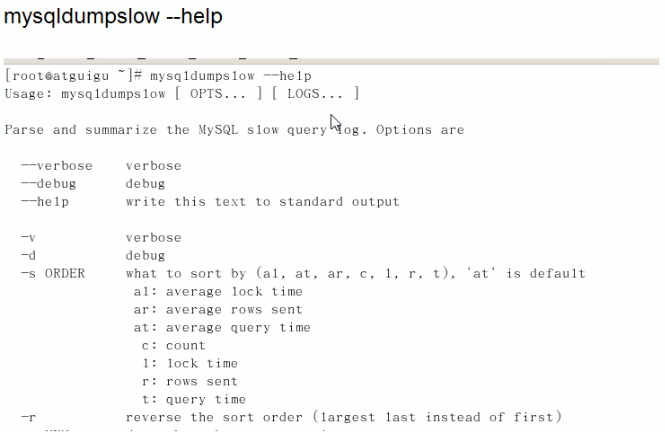
- s:是表示按照何种方式排序
- c:访问次数
- l:锁定时间
- r:返回记录
- t:查询时间
- al:平均锁定时间
- ar:平均返回记录数
- at:平均查询时间
- t:即为返回前面多少条的数据
- g:后边搭配一个正则匹配模式,大小写不敏感的
工作常用参考
得到返回记录集最多的10个SQL
mysqldumpslow -s r -t 10 /var/lib/mysql/atguigu-slow.log
得到访问次数最多的10个SQL
mysqldumpslow -s c -t 10 /var/lib/mysql/atguigu-slow.log
- 得到按照时间排序的前10条里面含有左连接的查询语句
mysqldumpslow -s t -t 10 -g “left join” /var/lib/mysql/atguigu-slow.log
- 另外建议在使用这些命令时结合│和more 使用,否则有可能出现爆屏情况
mysqldumpslow -s r-t 10 /ar/lib/mysql/atguigu-slow.log | more
批量插入数据脚本
创建SQL
create database bigData;use bigData;CREATE TABLE dept(id INT UNSIGNED PRIMARY KEY AUTO_INCREMENT,deptno MEDIUMINT UNSIGNED NOT NULL DEFAULT 0,dname VARCHAR(20)NOT NULL DEFAULT "",loc VARCHAR(13) NOT NULL DEFAULT "")ENGINE=INNODB DEFAULT CHARSET=utf8;CREATE TABLE emp(id int unsigned primary key auto_increment,empno mediumint unsigned not null default 0,ename varchar(20) not null default "",job varchar(9) not null default "",mgr mediumint unsigned not null default 0,hiredate date not null,sal decimal(7,2) not null,comm decimal(7,2) not null,deptno mediumint unsigned not null default 0)ENGINE=INNODB DEFAULT CHARSET=utf8;
设置参数log_bin_trust_function_creators
创建函数,假如报错:This function has none of DETERMINISTIC…
由于开启过慢查询日志,因为我们开启了bin-log,我们就必须为我们的function指定一个参数。
show variables like 'log_bin_trust_function_creators';set global log_bin_trust_function_creators=1;
这样添加了参数以后,如果mysqld重启,上述参数又会消失,永久方法:
- windows下my.ini[mysqld]加上log_bin_trust_function_creators=1
- linux下/etc/my.cnf 下my.cnf[mysqld]加上log_bin_trust_function_creators=1
创建函数,保证每条数据都不同
随机产生字符串
delimiter $$ # 两个 $$ 表示结束create function rand_string(n int) returns varchar(255)begindeclare chars_str varchar(100) default 'abcdefghijklmnopqrstuvwxyz';declare return_str varchar(255) default '';declare i int default 0;while i < n doset return_str = concat(return_str,substring(chars_str,floor(1+rand()*52),1));set i=i+1;end while;return return_str;end $$
随机产生部门编号
delimiter $$create function rand_num() returns int(5)begindeclare i int default 0;set i=floor(100+rand()*10);return i;end $$
运行结果
mysql> delimiter $$ # 两个 $$ 表示结束mysql> create function rand_string(n int) returns varchar(255)-> begin-> declare chars_str varchar(100) default 'abcdefghijklmnopqrstuvwxyz';-> declare return_str varchar(255) default '';-> declare i int default 0;-> while i < n do-> set return_str = concat(return_str,substring(chars_str,floor(1+rand()*52),1));-> set i=i+1;-> end while;-> return return_str;-> end $$Query OK, 0 rows affected (0.00 sec)mysql> select rand_string(2);-> ;-> $$+----------------+| rand_string(2) |+----------------+| af |+----------------+1 row in set (0.00 sec)mysql> delimiter $$mysql> create function rand_num() returns int(5)-> begin-> declare i int default 0;-> set i=floor(100+rand()*10);-> return i;-> end $$Query OK, 0 rows affected (0.00 sec)mysql> select rand_num()$$+------------+| rand_num() |+------------+| 105 |+------------+1 row in set (0.00 sec)
创建存储过程
创建往emp表中插入数据的存储过程
delimiter $$create procedure insert_emp(in start int(10),in max_num int(10))begindeclare i int default 0;set autocommit = 0;repeatset i = i+1;insert into emp(empno,ename,job,mgr,hiredate,sal,comm,deptno) values((start+i),rand_string(6),'salesman',0001,curdate(),2000,400,rand_num());until i=max_numend repeat;commit;end $$
创建往dept表中插入数据的存储过程
delimiter $$create procedure insert_dept(in start int(10),in max_num int(10))begindeclare i int default 0;set autocommit = 0;repeatset i = i+1;insert into dept(deptno,dname,loc) values((start+i),rand_string(10),rand_string(8));until i=max_numend repeat;commit;end $$
调用存储过程
往dept表中插入数据
mysql> DELIMITER ;mysql> CALL insert_dept(100, 10);Query OK, 0 rows affected (0.01 sec)
往emp表中插入50万数据
mysql> DELIMITER ;mysql> CALL insert_emp(100001, 500000);Query OK, 0 rows affected (27.00 sec)
运行结果
mysql> select * from dept;+----+--------+---------+--------+| id | deptno | dname | loc |+----+--------+---------+--------+| 1 | 101 | mqgfy | ck || 2 | 102 | wgighsr | kbq || 3 | 103 | gjgdyj | brb || 4 | 104 | gzfug | p || 5 | 105 | keitu | cib || 6 | 106 | nndvuv | csue || 7 | 107 | cdudl | tw || 8 | 108 | aafyea | aqq || 9 | 109 | zuqezjx | dpqoyo || 10 | 110 | pam | cses |+----+--------+---------+--------+10 rows in set (0.00 sec)mysql> select * from emp limit 20;+----+--------+-------+----------+-----+------------+---------+--------+--------+| id | empno | ename | job | mgr | hiredate | sal | comm | deptno |+----+--------+-------+----------+-----+------------+---------+--------+--------+| 1 | 100002 | xmbva | salesman | 1 | 2021-04-05 | 2000.00 | 400.00 | 108 || 2 | 100003 | aeq | salesman | 1 | 2021-04-05 | 2000.00 | 400.00 | 109 || 3 | 100004 | cnjfz | salesman | 1 | 2021-04-05 | 2000.00 | 400.00 | 105 || 4 | 100005 | wwhd | salesman | 1 | 2021-04-05 | 2000.00 | 400.00 | 100 || 5 | 100006 | e | salesman | 1 | 2021-04-05 | 2000.00 | 400.00 | 107 || 6 | 100007 | yjfr | salesman | 1 | 2021-04-05 | 2000.00 | 400.00 | 108 || 7 | 100008 | xlp | salesman | 1 | 2021-04-05 | 2000.00 | 400.00 | 102 || 8 | 100009 | mp | salesman | 1 | 2021-04-05 | 2000.00 | 400.00 | 102 || 9 | 100010 | tcdl | salesman | 1 | 2021-04-05 | 2000.00 | 400.00 | 107 || 10 | 100011 | akw | salesman | 1 | 2021-04-05 | 2000.00 | 400.00 | 106 || 11 | 100012 | re | salesman | 1 | 2021-04-05 | 2000.00 | 400.00 | 108 || 12 | 100013 | qip | salesman | 1 | 2021-04-05 | 2000.00 | 400.00 | 105 || 13 | 100014 | bvaf | salesman | 1 | 2021-04-05 | 2000.00 | 400.00 | 108 || 14 | 100015 | g | salesman | 1 | 2021-04-05 | 2000.00 | 400.00 | 106 || 15 | 100016 | qt | salesman | 1 | 2021-04-05 | 2000.00 | 400.00 | 102 || 16 | 100017 | bzy | salesman | 1 | 2021-04-05 | 2000.00 | 400.00 | 109 || 17 | 100018 | gf | salesman | 1 | 2021-04-05 | 2000.00 | 400.00 | 102 || 18 | 100019 | r | salesman | 1 | 2021-04-05 | 2000.00 | 400.00 | 108 || 19 | 100020 | ydokg | salesman | 1 | 2021-04-05 | 2000.00 | 400.00 | 100 || 20 | 100021 | ee | salesman | 1 | 2021-04-05 | 2000.00 | 400.00 | 107 |+----+--------+-------+----------+-----+------------+---------+--------+--------+20 rows in set (0.00 sec)
用Show Profile进行sql分析
Show Profile是mysql提供可以用来分析当前会话中语句执行的资源消耗情况。可以用于SQL的调优的测量。
官方文档
默认情况下,参数处于关闭状态,并保存最近15次的运行结果。
分析步骤
1.是否支持,看看当前的mysql版本是否支持。
mysql> show variables like 'profiling';+---------------+-------+| Variable_name | Value |+---------------+-------+| profiling | OFF |+---------------+-------+1 row in set, 1 warning (0.00 sec)
默认是关闭,使用前需要开启。
2.开启功能,默认是关闭,使用前需要开启。
mysql> set profiling=on;Query OK, 0 rows affected, 1 warning (0.00 sec)mysql> show variables like 'profiling';+---------------+-------+| Variable_name | Value |+---------------+-------+| profiling | ON |+---------------+-------+1 row in set, 1 warning (0.00 sec)
3.运行SQL
mysql> select * from emp group by id%10 limit 150000;+----+--------+-------+----------+-----+------------+---------+--------+--------+| id | empno | ename | job | mgr | hiredate | sal | comm | deptno |+----+--------+-------+----------+-----+------------+---------+--------+--------+| 10 | 100011 | akw | salesman | 1 | 2021-04-05 | 2000.00 | 400.00 | 106 || 1 | 100002 | xmbva | salesman | 1 | 2021-04-05 | 2000.00 | 400.00 | 108 || 2 | 100003 | aeq | salesman | 1 | 2021-04-05 | 2000.00 | 400.00 | 109 || 3 | 100004 | cnjfz | salesman | 1 | 2021-04-05 | 2000.00 | 400.00 | 105 || 4 | 100005 | wwhd | salesman | 1 | 2021-04-05 | 2000.00 | 400.00 | 100 || 5 | 100006 | e | salesman | 1 | 2021-04-05 | 2000.00 | 400.00 | 107 || 6 | 100007 | yjfr | salesman | 1 | 2021-04-05 | 2000.00 | 400.00 | 108 || 7 | 100008 | xlp | salesman | 1 | 2021-04-05 | 2000.00 | 400.00 | 102 || 8 | 100009 | mp | salesman | 1 | 2021-04-05 | 2000.00 | 400.00 | 102 || 9 | 100010 | tcdl | salesman | 1 | 2021-04-05 | 2000.00 | 400.00 | 107 |+----+--------+-------+----------+-----+------------+---------+--------+--------+10 rows in set (0.55 sec)mysql> select * from emp group by id%20 order by 5;+----+--------+-------+----------+-----+------------+---------+--------+--------+| id | empno | ename | job | mgr | hiredate | sal | comm | deptno |+----+--------+-------+----------+-----+------------+---------+--------+--------+| 1 | 100002 | xmbva | salesman | 1 | 2021-04-05 | 2000.00 | 400.00 | 108 || 3 | 100004 | cnjfz | salesman | 1 | 2021-04-05 | 2000.00 | 400.00 | 105 || 5 | 100006 | e | salesman | 1 | 2021-04-05 | 2000.00 | 400.00 | 107 || 7 | 100008 | xlp | salesman | 1 | 2021-04-05 | 2000.00 | 400.00 | 102 || 9 | 100010 | tcdl | salesman | 1 | 2021-04-05 | 2000.00 | 400.00 | 107 || 11 | 100012 | re | salesman | 1 | 2021-04-05 | 2000.00 | 400.00 | 108 || 13 | 100014 | bvaf | salesman | 1 | 2021-04-05 | 2000.00 | 400.00 | 108 || 15 | 100016 | qt | salesman | 1 | 2021-04-05 | 2000.00 | 400.00 | 102 || 17 | 100018 | gf | salesman | 1 | 2021-04-05 | 2000.00 | 400.00 | 102 || 19 | 100020 | ydokg | salesman | 1 | 2021-04-05 | 2000.00 | 400.00 | 100 || 2 | 100003 | aeq | salesman | 1 | 2021-04-05 | 2000.00 | 400.00 | 109 || 4 | 100005 | wwhd | salesman | 1 | 2021-04-05 | 2000.00 | 400.00 | 100 || 6 | 100007 | yjfr | salesman | 1 | 2021-04-05 | 2000.00 | 400.00 | 108 || 8 | 100009 | mp | salesman | 1 | 2021-04-05 | 2000.00 | 400.00 | 102 || 10 | 100011 | akw | salesman | 1 | 2021-04-05 | 2000.00 | 400.00 | 106 || 12 | 100013 | qip | salesman | 1 | 2021-04-05 | 2000.00 | 400.00 | 105 || 14 | 100015 | g | salesman | 1 | 2021-04-05 | 2000.00 | 400.00 | 106 || 16 | 100017 | bzy | salesman | 1 | 2021-04-05 | 2000.00 | 400.00 | 109 || 18 | 100019 | r | salesman | 1 | 2021-04-05 | 2000.00 | 400.00 | 108 || 20 | 100021 | ee | salesman | 1 | 2021-04-05 | 2000.00 | 400.00 | 107 |+----+--------+-------+----------+-----+------------+---------+--------+--------+20 rows in set (0.57 sec)
4.查看结果,show profiles;
mysql> show profiles;+----------+------------+-----------------------------------------------+| Query_ID | Duration | Query |+----------+------------+-----------------------------------------------+| 1 | 0.00204000 | show variables like 'profiling' || 2 | 0.55134250 | select * from emp group by id%10 limit 150000 || 3 | 0.56902000 | select * from emp group by id%20 order by 5 |+----------+------------+-----------------------------------------------+3 rows in set, 1 warning (0.00 sec)
5.诊断SQL,show profile cpu,block io for query 上一步前面的问题SQL数字号码;
mysql> show profile cpu,block io for query 3;+----------------------+----------+----------+------------+--------------+---------------+| Status | Duration | CPU_user | CPU_system | Block_ops_in | Block_ops_out |+----------------------+----------+----------+------------+--------------+---------------+| starting | 0.000049 | 0.000000 | 0.000000 | NULL | NULL || checking permissions | 0.000005 | 0.000000 | 0.000000 | NULL | NULL || Opening tables | 0.000012 | 0.000000 | 0.000000 | NULL | NULL || init | 0.000021 | 0.000000 | 0.000000 | NULL | NULL || System lock | 0.000009 | 0.000000 | 0.000000 | NULL | NULL || optimizing | 0.000003 | 0.000000 | 0.000000 | NULL | NULL || statistics | 0.000017 | 0.000000 | 0.000000 | NULL | NULL || preparing | 0.000008 | 0.000000 | 0.000000 | NULL | NULL || Creating tmp table | 0.000045 | 0.000000 | 0.000000 | NULL | NULL || Sorting result | 0.000004 | 0.000000 | 0.000000 | NULL | NULL || executing | 0.000002 | 0.000000 | 0.000000 | NULL | NULL || Sending data | 0.568704 | 0.546875 | 0.046875 | NULL | NULL || Creating sort index | 0.000048 | 0.000000 | 0.000000 | NULL | NULL || end | 0.000003 | 0.000000 | 0.000000 | NULL | NULL || query end | 0.000005 | 0.000000 | 0.000000 | NULL | NULL || removing tmp table | 0.000006 | 0.000000 | 0.000000 | NULL | NULL || query end | 0.000003 | 0.000000 | 0.000000 | NULL | NULL || closing tables | 0.000004 | 0.000000 | 0.000000 | NULL | NULL || freeing items | 0.000061 | 0.000000 | 0.000000 | NULL | NULL || cleaning up | 0.000015 | 0.000000 | 0.000000 | NULL | NULL |+----------------------+----------+----------+------------+--------------+---------------+20 rows in set, 1 warning (0.00 sec)
参数备注
- ALL:显示所有的开销信息。
- BLOCK IO:显示块lO相关开销。
- CONTEXT SWITCHES :上下文切换相关开销。
- CPU:显示CPU相关开销信息。
- IPC:显示发送和接收相关开销信息。
- MEMORY:显示内存相关开销信息。
- PAGE FAULTS:显示页面错误相关开销信息。
- SOURCE:显示和Source_function,Source_file,Source_line相关的开销信息。
- SWAPS:显示交换次数相关开销的信息。
日常开发需要注意的结论
- converting HEAP to MyISAM 查询结果太大,内存都不够用了往磁盘上搬了。
- Creating tmp table 创建临时表,拷贝数据到临时表,用完再删除
- Copying to tmp table on disk 把内存中临时表复制到磁盘,危险!
- locked
全局查询日志
永远不要在生产环境开启这个功能。
配置文件启用。在mysql的my.cnf中,设置如下:
#开启general_log=1#记录日志文件的路径general_log_file=/path/logfile#输出格式log_output=FILE
编码启用。命令如下:
- set global general_log=1;
- set global log_output=’TABLE’; ```sql mysql> set global general_log=1; Query OK, 0 rows affected (0.01 sec)
mysql> set global log_output=’TABLE’; Query OK, 0 rows affected (0.00 sec)
此后,你所编写的sql语句,将会记录到mysql库里的geneial_log表,可以用下面的命令查看:```sqlmysql> select * from mysql.general_log;+----------------------------+------------------------------+-----------+-----------+--------------+---------------------------------+| event_time | user_host | thread_id | server_id | command_type | argument |+----------------------------+------------------------------+-----------+-----------+--------------+---------------------------------+| 2021-04-05 19:57:28.182473 | root[root] @ localhost [::1] | 5 | 1 | Query | select * from mysql.general_log |+----------------------------+------------------------------+-----------+-----------+--------------+---------------------------------+1 row in set (0.00 sec)
MySQL锁机制
数据库锁理论概述
锁是计算机协调多个进程或线程并发访问某一资源的机制。
在数据库中,除传统的计算资源(如CPU、RAM、I/O等)的争用以外,数据也是一种供许多用户共享的资源。如何保证数据并发访问的一致性、有效性是所有数据库必须解决的一个问题,锁冲突也是影响数据库并发访问性能的一个重要因素。从这个角度来说,锁对数据库而言显得尤其重要,也更加复杂。
类比:网上购物
打个比方,我们到淘宝上买一件商品,商品只有一件库存,这个时候如果还有另一个人买,那么如何解决是你买到还是另一个人买到的问题?
这里肯定要用到事务,我们先从库存表中取出物品数量,然后插入订单,付款后插入付款表信息,然后更新商品数量。在这个过程中,使用锁可以对有限的资源进行保护,解决隔离和并发的矛盾。
锁的分类
从对数据操作的类型(读\写)分
- 读锁(共享锁):针对同一份数据,多个读操作可以同时进行而不会互相影响。
- 写锁(排它锁):当前写操作没有完成前,它会阻断其他写锁和读锁。
从对数据操作的粒度分
- 表锁
- 行锁
读锁案例讲解
表锁(偏读)
特点:偏向MyISAM存储引擎,开销小,加锁快;无死锁;锁定粒度大,发生锁冲突的概率最高,并发度最低。
案例分析
建表SQL ```sql create table mylock ( id int not null primary key auto_increment, name varchar(20) default ‘’ ) engine myisam;
insert into mylock(name) values(‘a’); insert into mylock(name) values(‘b’); insert into mylock(name) values(‘c’); insert into mylock(name) values(‘d’); insert into mylock(name) values(‘e’);
select * from mylock;
运行结果```sqlmysql> create table mylock (-> id int not null primary key auto_increment,-> name varchar(20) default ''-> ) engine myisam;Query OK, 0 rows affected (0.01 sec)mysql>mysql> insert into mylock(name) values('a');Query OK, 1 row affected (0.00 sec)mysql> insert into mylock(name) values('b');Query OK, 1 row affected (0.00 sec)mysql> insert into mylock(name) values('c');Query OK, 1 row affected (0.00 sec)mysql> insert into mylock(name) values('d');Query OK, 1 row affected (0.00 sec)mysql> insert into mylock(name) values('e');Query OK, 1 row affected (0.00 sec)mysql>mysql> select * from mylock;+----+------+| id | name |+----+------+| 1 | a || 2 | b || 3 | c || 4 | d || 5 | e |+----+------+5 rows in set (0.00 sec)
手动增加表锁
lock table 表名字 read(write), 表名字2 read(write), 其他;
mysql> lock table mylock read;Query OK, 0 rows affected (0.00 sec)
查看表上加过的锁
mysql> show open tables;+--------------------+------------------------------------------------------+--------+-------------+| Database | Table | In_use | Name_locked |+--------------------+------------------------------------------------------+--------+-------------+| performance_schema | events_waits_summary_by_user_by_event_name | 0 | 0 || performance_schema | events_waits_summary_global_by_event_name | 0 | 0 || performance_schema | events_transactions_summary_global_by_event_name | 0 | 0 || performance_schema | replication_connection_status | 0 | 0 || mysql | time_zone_leap_second | 0 | 0 || mysql | columns_priv | 0 | 0 || my | test03 | 0 | 0 || bigdata | mylock | 1 | 0 |...
释放锁
mysql> unlock tables;Query OK, 0 rows affected (0.00 sec)

读锁案例讲解2
为mylock表加write锁(MylSAM存储引擎的写阻塞读例子)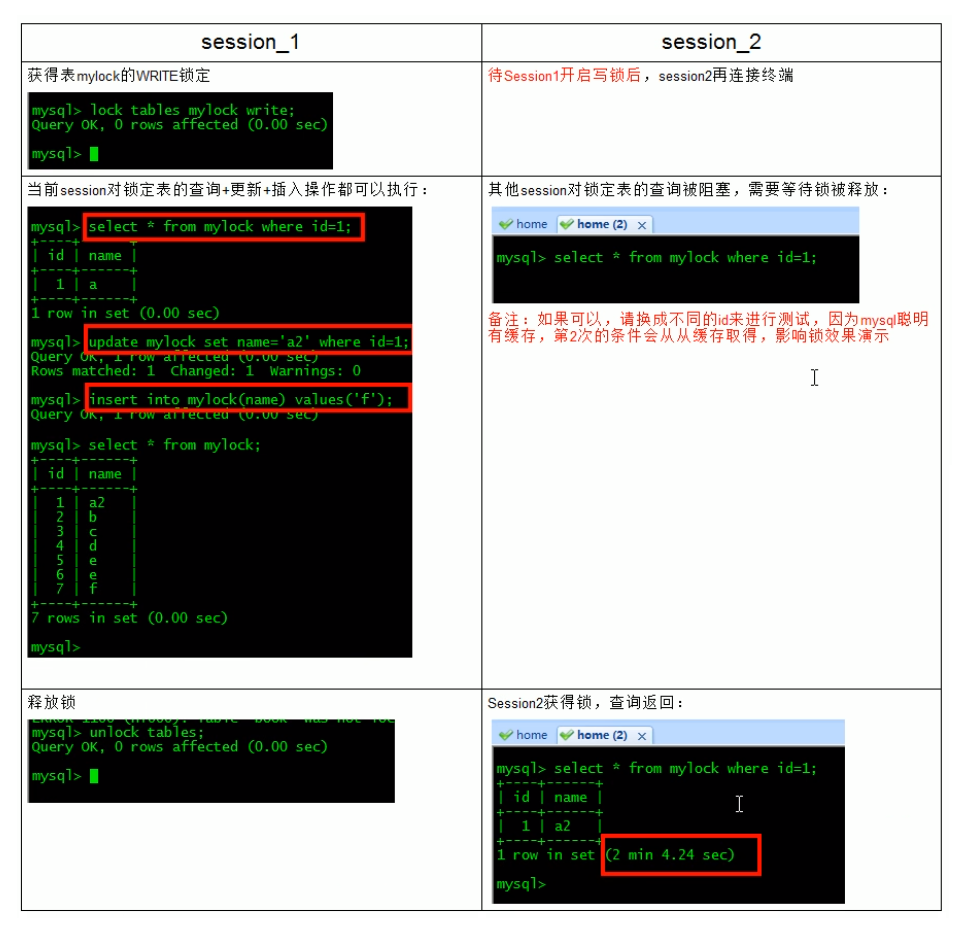
案例结论
MyISAM在执行查询语句(SELECT)前,会自动给涉及的所有表加读锁,在执行增删改操作前,会自动给涉及的表加写锁。
MySQL的表级锁有两种模式:
- 表共享读锁(Table Read Lock)
- 表独占写锁(Table Write Lock)

结合上表,所以对MyISAM表进行操作,会有以下情况:
1.对MyISAM表的读操作(加读锁),不会阻塞其他进程对同一表的读请求,但会阻塞对同一表的写请求。只有当读锁释放后,才会执行其它进程的写操作。
2.对MyISAM表的写操作〈加写锁),会阻塞其他进程对同一表的读和写操作,只有当写锁释放后,才会执行其它进程的读写操作。
简而言之,就是读锁会阻塞写,但是不会堵塞读。而写锁则会把读和写都堵塞。
表锁分析
看看哪些表被加锁了
mysql> show open tables;
如何分析表锁定
可以通过检查table_locks_waited和table_locks_immediate状态变量来分析系统上的表锁定。
mysql> show status like 'table_locks%';+-----------------------+-------+| Variable_name | Value |+-----------------------+-------+| Table_locks_immediate | 170 || Table_locks_waited | 0 |+-----------------------+-------+2 rows in set (0.00 sec)
这里有两个状态变量记录MySQL内部表级锁定的情况,两个变量说明如下:
Table_locks_immediate:产生表级锁定的次数,表示可以立即获取锁的查询次数,每立即获取锁值加1 ;
Table_locks_waited:出现表级锁定争用而发生等待的次数(不能立即获取锁的次数,每等待一次锁值加1),此值高则说明存在着较严重的表级锁争用情况;
此外,MyISAM的读写锁调度是写优先,这也是MyISAM不适合做写为主表的引擎。因为写锁后,其他线程不能做任何操作,大量的更新会使查询很难得到锁,从而造成永远阻塞。
行锁理论
偏向InnoDB存储引擎,开销大,加锁慢;会出现死锁;锁定粒度最小,发生锁冲突的概率最低,并发度也最高。
InnoDB与MyISAM的最大不同有两点:一是支持事务(TRANSACTION);二是采用了行级锁。
由于行锁支持事务,复习老知识
- 事务(Transaction)及其ACID属性
- 并发事务处理带来的问题
- 事务隔离级别
事务是由一组SQL语句组成的逻辑处理单元,事务具有以下4个属性,通常简称为事务的ACID属性:
- 原子性(Atomicity):事务是一个原子操作单元,其对数据的修改,要么全都执行,要么全都不执行。
- 一致性(Consistent):在事务开始和完成时,数据都必须保持一致状态。这意味着所有相关的数据规则都必须应用于事务的修改,以保持数据的完整性;事务结束时,所有的内部数据结构〈如B树索引或双向链表)也都必须是正确的。
- 隔离性(lsolation):数据库系统提供一定的隔离机制,保证事务在不受外部并发操作影响的“独立”环境执行。这意味着事务处理过程中的中间状态对外部是不可见的,反之亦然。
- 持久性(Durable):事务完成之后,它对于数据的修改是永久性的,即使出现系统故障也能够保持。
并发事务处理带来的问题
- 更新丢失(Lost Update)
- 脏读(Dirty Reads)
- 不可重复读(Non-Repeatable Reads)
- 幻读(Phantom Reads)
更新丢失(Lost Update)
当两个或多个事务选择同一行,然后基于最初选定的值更新该行时,由于每个事务都不知道其他事务的存在,就会发生丢失更新问题――最后的更新覆盖了由其他事务所做的更新。
例如,两个程序员修改同一java文件。每程序员独立地更改其副本,然后保存更改后的副本,这样就覆盖了原始文档。最后保存其更改副本的编辑人员覆盖前一个程序员所做的更改。
如果在一个程序员完成并提交事务之前,另一个程序员不能访问同一文件,则可避免此问题。
脏读(Dirty Reads)
一个事务正在对一条记录做修改,在这个事务完成并提交前,这条记录的数据就处于不一致状态;这时,另一个事务也来读取同一条记录,如果不加控制,第二个事务读取了这些“脏”数据,并据此做进一步的处理,就会产生未提交的数据依赖关系。这种现象被形象地叫做”脏读”。
一句话:事务A读取到了事务B已修改但尚未提交的的数据,还在这个数据基础上做了操作。此时,如果B事务回滚,A读取的数据无效,不符合一致性要求。
不可重复读(Non-Repeatable Reads)
一个事务在读取某些数据后的某个时间,再次读取以前读过的数据,却发现其读出的数据已经发生了改变、或某些记录已经被删除了!这种现象就叫做“不可重复读”。
一句话:事务A读取到了事务B已经提交的修改数据,不符合隔离性。
幻读(Phantom Reads)
一个事务接相同的查询条件重新读取以前检索过的数据,却发现其他事务插入了满足其查询条件的新数据,这种现象就称为“幻读“。
一句话:事务A读取到了事务B体提交的新增数据,不符合隔离性。
多说一句:幻读和脏读有点类似,
脏读是事务B里面修改了数据,
幻读是事务B里面新增了数据。
事务隔离级别
”脏读”、“不可重复读”和“幻读”,其实都是数据库读一致性问题,必须由数据库提供一定的事务隔离机制来解决。
数据库的事务隔离越严格,并发副作用越小,但付出的代价也就越大,因为事务隔离实质上就是使事务在一定程度上“串行化”进行,这显然与“并发”是矛盾的。同时,不同的应用对读一致性和事务隔离程度的要求也是不同的,比如许多应用对“不可重复读”和“幻读”并不敏感,可能更关心数据并发访问的能力。
常看当前数据库的事务隔离级别:show variables like ‘tx_isolation’;
mysql> show variables like 'tx_isolation';+---------------+-----------------+| Variable_name | Value |+---------------+-----------------+| tx_isolation | REPEATABLE-READ |+---------------+-----------------+1 row in set, 1 warning (0.00 sec)
行锁案例讲解
新建SQL
CREATE TABLE test_innodb_lock (a INT(11),b VARCHAR(16))ENGINE=INNODB;INSERT INTO test_innodb_lock VALUES(1,'b2');INSERT INTO test_innodb_lock VALUES(3,'3');INSERT INTO test_innodb_lock VALUES(4, '4000');INSERT INTO test_innodb_lock VALUES(5,'5000');INSERT INTO test_innodb_lock VALUES(6, '6000');INSERT INTO test_innodb_lock VALUES(7,'7000');INSERT INTO test_innodb_lock VALUES(8, '8000');INSERT INTO test_innodb_lock VALUES(9,'9000');INSERT INTO test_innodb_lock VALUES(1,'b1');CREATE INDEX test_innodb_a_ind ON test_innodb_lock(a);CREATE INDEX test_innodb_lock_b_ind ON test_innodb_lock(b);
运行结果
mysql> select * from test_innodb_lock;+------+------+| a | b |+------+------+| 1 | b2 || 3 | 3 || 4 | 4000 || 5 | 5000 || 6 | 6000 || 7 | 7000 || 8 | 8000 || 9 | 9000 || 1 | b1 |+------+------+9 rows in set (0.00 sec)mysql> show index from test_innodb_lock;+------------------+------------+------------------------+--------------+-------------+-----------+-------------+----------+--------+------+------------+---------+---------------+| Table | Non_unique | Key_name | Seq_in_index | Column_name | Collation | Cardinality | Sub_part | Packed | Null | Index_type | Comment | Index_comment |+------------------+------------+------------------------+--------------+-------------+-----------+-------------+----------+--------+------+------------+---------+---------------+| test_innodb_lock | 1 | test_innodb_a_ind | 1 | a | A | 8 | NULL | NULL | YES | BTREE | | || test_innodb_lock | 1 | test_innodb_lock_b_ind | 1 | b | A | 9 | NULL | NULL | YES | BTREE | | |+------------------+------------+------------------------+--------------+-------------+-----------+-------------+----------+--------+------+------------+---------+---------------+2 rows in set (0.00 sec)

行锁演示答疑补充
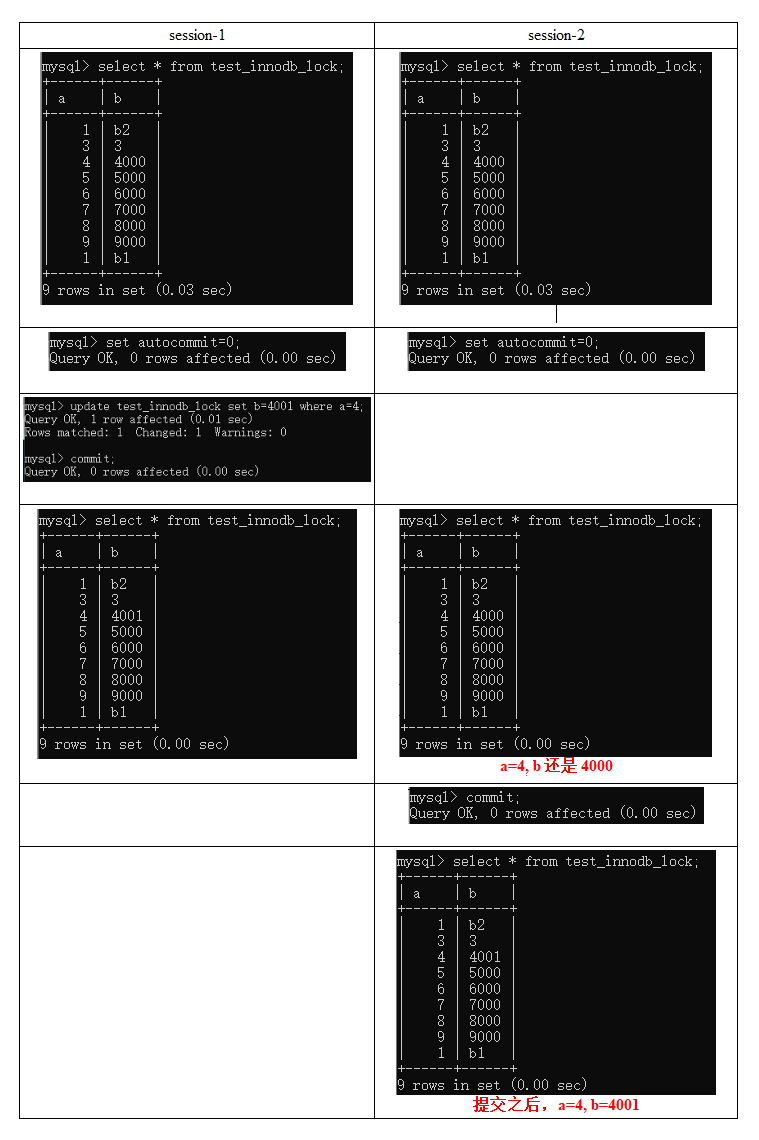
索引失效行锁变表锁
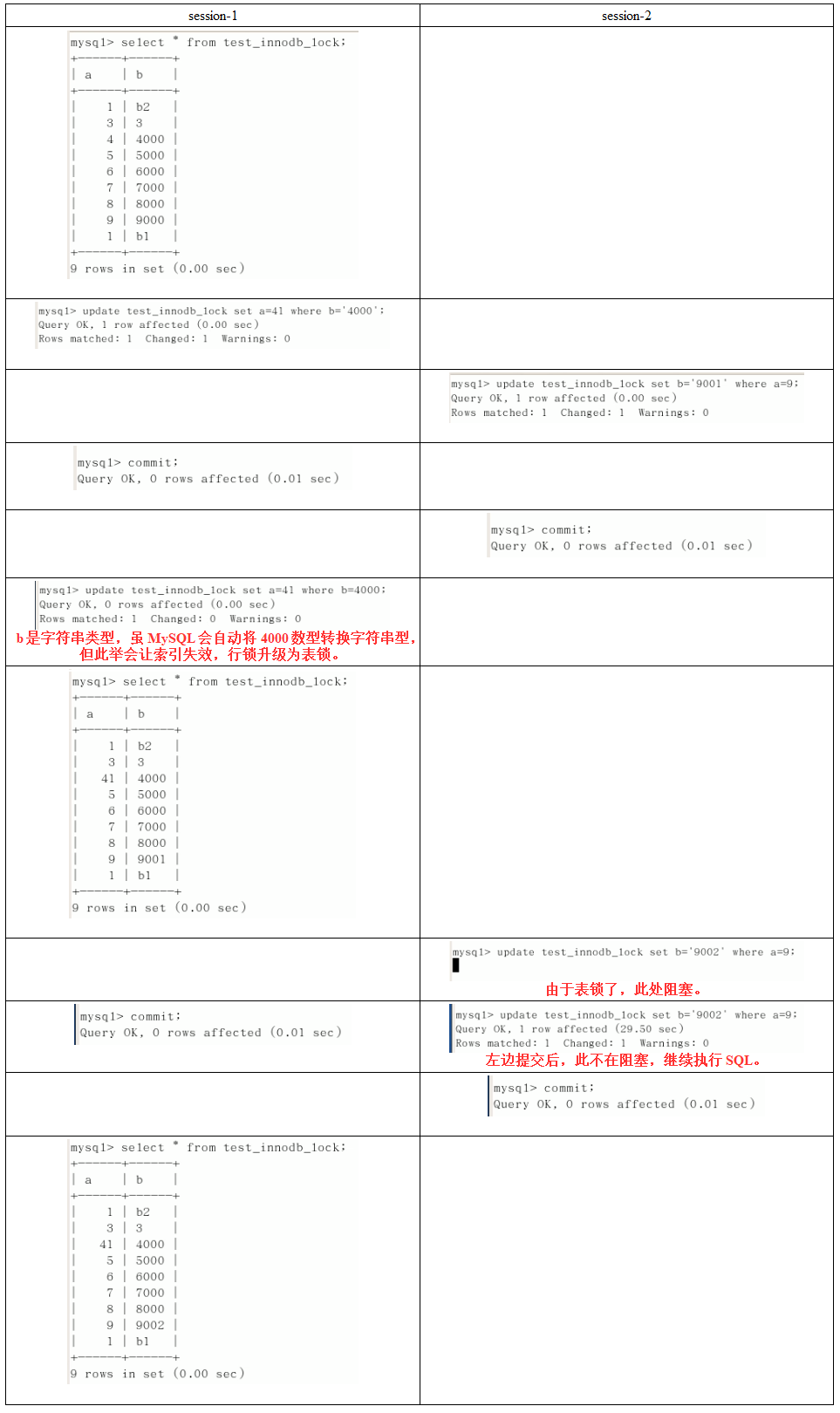
间隙锁危害

什么是间隙锁
当我们用范围条件而不是相等条件检索数据,并请求共享或排他锁时,InnoDB会给符合条件的已有数据记录的索引项加锁,对于键值在条件范围内但并不存在的记录,叫做“间隙(GAP)”。
InnoDB也会对这个“间隙”加锁,这种锁机制就是所谓的间隙锁(Next-Key锁)。
危害
因为Query执行过程中通过过范围查找的话,他会锁定整个范围内所有的索引键值,即使这个键值并不存在。
间隙锁有一个比较致命的弱点,就是当锁定一个范围键值之后,即使某些不存在的键值也会被无辜的锁定,而造成在锁定的时候无法插入锁定键值范围内的任何数据。在某些场景下这可能会对性能造成很大的危害。
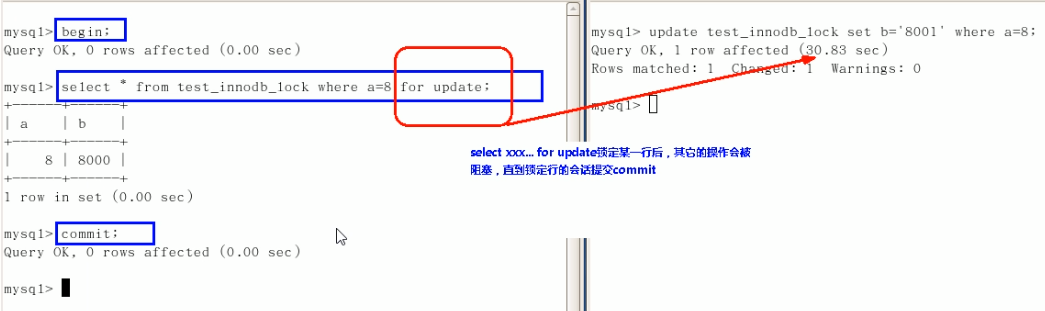
如何锁定一行
行锁总结与页锁
Innodb存储引擎由于实现了行级锁定,虽然在锁定机制的实现方面所带来的性能损耗可能比表级锁定会要更高一些,但是在整体并发处理能力方面要远远优于MyISAM的表级锁定的。当系统并发量较高的时候,Innodb的整体性能和MylISAM相比就会有比较明显的优势了。
但是,Innodb的行级锁定同样也有其脆弱的一面,当我们使用不当的时候,可能会让Innodb的整体性能表现不仅不能比MyISAM高,甚至可能会更差。
行锁分析
如何分析行锁定
通过检查lnnoDB_row_lock状态变量来分析系统上的行锁的争夺情况
mysql> show status like 'innodb_row_lock%';+-------------------------------+-------+| Variable_name | Value |+-------------------------------+-------+| Innodb_row_lock_current_waits | 0 || Innodb_row_lock_time | 0 || Innodb_row_lock_time_avg | 0 || Innodb_row_lock_time_max | 0 || Innodb_row_lock_waits | 0 |+-------------------------------+-------+5 rows in set (0.00 sec)
对各个状态量的说明如下:
- Innodb_row_lock_current_waits:当前正在等待锁定的数量;
- Innodb_row_lock_time:从系统启动到现在锁定总时间长度;
- Innodb_row_lock_time_avg:每次等待所花平均时间;
- Innodb_row_lock_time_max:从系统启动到现在等待最常的一次所花的时间;
- Innodb_row_lock_waits:系统启动后到现在总共等待的次数;
对于这5个状态变量,比较重要的主要是
- Innodb_row_lock_time_avg(等待平均时长)
- lnnodb_row_lock_waits(等待总次数)
- lnnodb_row_lock_time(等待总时长)这三项。
尤其是当等待次数很高,而且每次等待时长也不小的时候,我们就需要分析系统中为什么会有如此多的等待,然后根据分析结果着手指定优化计划。
优化建议
- 尽可能让所有数据检索都通过索引来完成,避免无索引行锁升级为表锁。
- 合理设计索引,尽量缩小锁的范围
- 尽可能较少检索条件,避免间隙锁
- 尽量控制事务大小,减少锁定资源量和时间长度
- 尽可能低级别事务隔离
页锁
开销和加锁时间界于表锁和行锁之间;会出现死锁;锁定粒度界于表锁和行锁之间,并发度一般。(了解一下即可)
主从复制
主从复制
复制的基本原理
slave会从master读取binlog来进行数据同步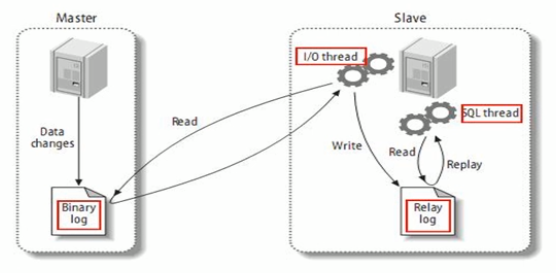
三步骤+原理图
MySQL复制过程分成三步
1.master将改变记录到二进制日志(binary log)。这些记录过程叫做二进制日志事件,binary log events;
2.slave将master的binary log events拷贝到它的中继日志(relay log) ;
3.slave重做中继日志中的事件,将改变应用到自己的数据库中。MySQL复制是异步的且串行化的
复制的基本原则
- 每个slave只有一个master
- 每个slave只能有一个唯一的服务器ID
- 每个master可以有多个salve
一主一从常见配置
mysql版本一致且后台以服务运行
主从都配置在[mysqld]结点下,都是小写
主机修改my.ini配置文件
1.[必须]主服务器唯一ID
1.server-id=1
2.[必须]启用二进制日志
1.log-bin=自己本地的路径/mysqlbin
2.log-bin=D:/devSoft/MySQLServer5.5/data/mysqlbin
3.[可选]启用错误日志
1.log-err=自己本地的路径/mysqlerr
2.log-err=D:/devSoft/MySQLServer5.5/data/mysqlerr
4.[可选]根目录
1.basedir=“自己本地路径”
2.basedir=“D:/devSoft/MySQLServer5.5/”
5.[可选]临时目录
1.tmpdir=“自己本地路径”
2.tmpdir=“D:/devSoft/MySQLServer5.5/”
6.[可选]数据目录
1.datadir=“自己本地路径/Data/”
2.datadir=“D:/devSoft/MySQLServer5.5/Data/”
7.主机,读写都可以
1.read-only=O
8.[可选]设置不要复制的数据库
1.binlog-ignore-db=mysql
9.[可选]设置需要复制的数据库
- binlog-do-db=需要复制的主数据库名字
从机修改my.cnf配置文件
- [必须]从服务器唯一ID
- [可选]启用二进制日志
配置文件,请主机+从机都重启后台mysql服务
- service mysql stop
- service mysql start
主机从机都关闭防火墙
- windows手动关闭
- 关闭虚拟机linux防火墙 service iptables stop
在Windows主机上建立帐户并授权slave
- GRANT REPLICATION SLAVE ON . TO ‘zhangsan’@‘从机器数据库IP’ IDENTIFIED BY ‘123456’;
- flush privileges;//刷新
- 查询master的状态
- show master status;
- 记录下File和Position的值
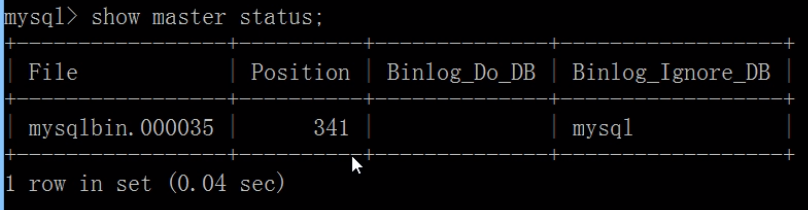
- 执行完此步骤后不要再操作主服务器MYSQL,防止主服务器状态值变化
在Linux从机上配置需要复制的主机
CHANGE MASTER TO MASTER_HOST=’主机
IP’, MASTER_USER=‘zhangsan’, MASTER_PASSWORD=’123456’, MASTER_LOG_FILE=’File名字’,
MASTER_LOG_POS=Position数字;启动从服务器复制功能
- start slave;
- show slave status\G
- 下面两个参数都是Yes,则说明主从配置成功!
- Slave_IO_Running:Yes
- Slave_SQL_Running:Yes
主机新建库、新建表、insert记录,从机复制
如何停止从服务复制功能
- stop slave;

若有收获,就点个赞吧
0 人点赞


