为其他对象提供 一种代理以控制对这个对象的访问
代理类和被代理类实现相同的接口(或继承同一个抽象类)
public interface ISubject {void a();void b();}public class ConcreteSubject implements ISubject{@Overridepublic void a() {}@Overridepublic void b() {}}public class Proxy implements ISubject{private ISubject iSubject;public Proxy(ISubject iSubject) {this.iSubject = iSubject;}@Overridepublic void a() {this.before();iSubject.a();this.after();}@Overridepublic void b() {this.before();iSubject.b();this.after();}private void before(){}private void after(){}}
强制代理:从真实对象访问代理对象
动态代理:通过反射生成代理类
静态代理需要手动创建代理类和手动实现代理方法,而动态代理可以动态的自动生成代理类和实现代理方法
- jdk动态代理,实现invocationHandler接口
- cglib动态代理
动态代理和静态代理
(1)静态代理只能通过手动完成代理操作,如果被代理类增加了新的方法,则代理类需要同步增加,违背开闭原则。
(2)动态代理采用在运行时动态生成代码的方式,取消了对被代理类的扩展限制,遵循开闭原则。
(3)若动态代理要对目标类的增强逻辑进行扩展,结合策略模式,只需要新增策略类便可完成,无须修改代理类的代码。
jdk动态代理
public class ProxyInvocationHandler implements InvocationHandler {private Object target;public Object getTarget() {return target;}public void setTarget(Object target) {this.target = target;}//动态生成代理类Object getProxy(){return Proxy.newProxyInstance(target.getClass().getClassLoader(), target.getClass().getInterfaces(),this);}//动态调用代理方法@Overridepublic Object invoke(Object proxy, Method method, Object[] args) throws Throwable {before();//jdk序列化是通过method对象反射调用的Object result = method.invoke(target,args);after();return result;}private void before(){System.out.println("before");}private void after(){System.out.println("after");}}public class Client {public static void main(String[] args){ISubject subject = new ConcreteSubject();ProxyInvocationHandler proxyInvocationHandler = new ProxyInvocationHandler();//设置被代理对象proxyInvocationHandler.setTarget(subject);//动态生成代理对象ISubject proxy = (ISubject) proxyInvocationHandler.getProxy();//调用方法proxy.a();}}
jdk动态代理采用字节码重组,重新生成对象代替原始对象。
(1)获取被代理对象的引用,并且获取它的所有接口,反射获取。
(2)JDK动态代理类重新生成一个新的类,同时新的类要实现被代理类实现的所有接口。
(3)动态生成Java代码,新加的业务逻辑方法由一定的逻辑代码调用(在代码中体现)。
(4)编译新生成的Java代码.class文件。
(5)重新加载到JVM中运行。
ClassPath以$开头的.class文件是自动生成的,jdk动态代理生成的代理类需要实现被代理类的所有接口(也就是说被代理的类至少需要实现一个接口,没有实现接口的类不能进行jdk动态代理)
proxyclass在第一次生成代理对象的时候由ProxyClassFactory构建,然后放入缓存中,后续生成代理对象的时候直接从缓存获取
cglib动态代理
cglib动态代理通过动态继承目标对象实现动态代理,覆盖父类方法(也就是说cglib不能代理final的方法)
MethodInterceptor
| jdk | cglib | |
|---|---|---|
| 实现方法 | 读取接口信息并实现 | 继承,覆盖父类方法 |
| 对被代理类的要求 | 被代理类必须要实现至少一个接口 | 可以是任意一个普通类 |
| 效率 | 生成字节码效率高,执行效率较低,每次都要通过Method反射机制调用 | 生成FastClass效率低,执行效率较高,生成FastClass后不需要通过Method反射调用 |
| final | 只可以代理接口的方法 | 不可以代理final方法 |
import org.springframework.cglib.proxy.MethodProxy;import java.lang.reflect.Method;public class CGLibInterceptor implements MethodInterceptor {public Object getProxy(Class<?> clazz){Enhancer enhancer = new Enhancer();enhancer.setSuperclass(clazz);enhancer.setCallback(this);return enhancer.create();}@Overridepublic Object intercept(Object o, Method method, Object[] objects, MethodProxy methodProxy) throws Throwable {before();Object object = methodProxy.invokeSuper(o,objects);after();return object;}private void before(){System.out.println("before");}private void after(){System.out.println("after");}}
CGlib生成三个.class,其中fastClass会在第一次调用invoke()或者invokeSuper()的时候通过反射创建,然后放入缓存中
- 代理类
- 代理类的fastClass
- 被代理类的fastClass
fastClass为每一个代理类/被代理类的方法分配一个index,调用invoke的时候,根据index直接定位到要调用的方法并进行调用,不需要经过反射。也就是说,jdk动态代理的每次invoke都需过Method对象反射调用,而cglib动态代理的invoke方法有一个switch(index) case的操作
cglib中的.class文件public Object invoke(int i,Object obj,Object[] args){siwtch(i){case 0:goto _L1;break;case 1:goto _L2;break;..._L1:a();return null;_L1:b();return null;}}
存储fastClass的缓存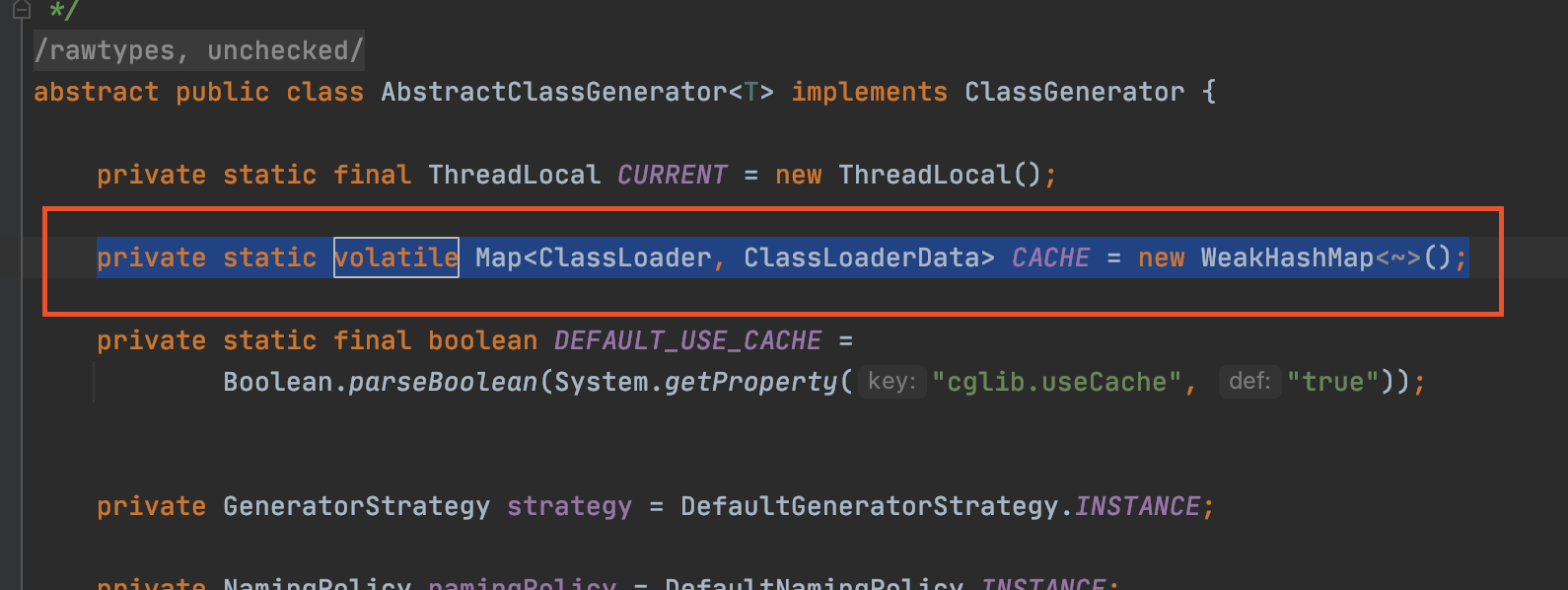
package org.springframework.cglib.proxy;import java.lang.reflect.InvocationTargetException;import java.lang.reflect.Method;import org.springframework.cglib.core.AbstractClassGenerator;import org.springframework.cglib.core.CodeGenerationException;import org.springframework.cglib.core.GeneratorStrategy;import org.springframework.cglib.core.NamingPolicy;import org.springframework.cglib.core.Signature;import org.springframework.cglib.reflect.FastClass;/*** Classes generated by {@link Enhancer} pass this object to the* registered {@link MethodInterceptor} objects when an intercepted method is invoked. It can* be used to either invoke the original method, or call the same method on a different* object of the same type.* @version $Id: MethodProxy.java,v 1.16 2009/01/11 20:09:48 herbyderby Exp $*/@SuppressWarnings({"rawtypes", "unchecked"})public class MethodProxy {private Signature sig1;private Signature sig2;private CreateInfo createInfo;private final Object initLock = new Object();private volatile FastClassInfo fastClassInfo;/*** For internal use by {@link Enhancer} only; see the {@link org.springframework.cglib.reflect.FastMethod} class* for similar functionality.*/public static MethodProxy create(Class c1, Class c2, String desc, String name1, String name2) {MethodProxy proxy = new MethodProxy();proxy.sig1 = new Signature(name1, desc);proxy.sig2 = new Signature(name2, desc);proxy.createInfo = new CreateInfo(c1, c2);return proxy;}private void init() {/** Using a volatile invariant allows us to initialize the FastClass and* method index pairs atomically.** Double-checked locking is safe with volatile in Java 5. Before 1.5 this* code could allow fastClassInfo to be instantiated more than once, which* appears to be benign.*///用dcl保证只在init的时候创建,并且只创建一次,volatile禁用指令重排序,不会使fastClassInfo没进行初始化就被使用if (fastClassInfo == null) {synchronized (initLock) {if (fastClassInfo == null) {CreateInfo ci = createInfo;FastClassInfo fci = new FastClassInfo();fci.f1 = helper(ci, ci.c1);fci.f2 = helper(ci, ci.c2);fci.i1 = fci.f1.getIndex(sig1);fci.i2 = fci.f2.getIndex(sig2);fastClassInfo = fci;createInfo = null;}}}}private static class FastClassInfo {FastClass f1;FastClass f2;int i1;int i2;}//创建fastclassprivate static FastClass helper(CreateInfo ci, Class type) {FastClass.Generator g = new FastClass.Generator();g.setType(type);// SPRING PATCH BEGINg.setContextClass(type);// SPRING PATCH ENDg.setClassLoader(ci.c2.getClassLoader());g.setNamingPolicy(ci.namingPolicy);g.setStrategy(ci.strategy);g.setAttemptLoad(ci.attemptLoad);return g.create();}private MethodProxy() {}/*** Invoke the original method, on a different object of the same type.* @param obj the compatible object; recursion will result if you use the object passed as the first* argument to the MethodInterceptor (usually not what you want)* @param args the arguments passed to the intercepted method; you may substitute a different* argument array as long as the types are compatible* @throws Throwable the bare exceptions thrown by the called method are passed through* without wrapping in an <code>InvocationTargetException</code>* @see MethodInterceptor#intercept*/public Object invoke(Object obj, Object[] args) throws Throwable {try {init();FastClassInfo fci = fastClassInfo;return fci.f1.invoke(fci.i1, obj, args);}catch (InvocationTargetException ex) {throw ex.getTargetException();}catch (IllegalArgumentException ex) {if (fastClassInfo.i1 < 0)throw new IllegalArgumentException("Protected method: " + sig1);throw ex;}}/*** Invoke the original (super) method on the specified object.* @param obj the enhanced object, must be the object passed as the first* argument to the MethodInterceptor* @param args the arguments passed to the intercepted method; you may substitute a different* argument array as long as the types are compatible* @throws Throwable the bare exceptions thrown by the called method are passed through* without wrapping in an <code>InvocationTargetException</code>* @see MethodInterceptor#intercept*/public Object invokeSuper(Object obj, Object[] args) throws Throwable {try {init();FastClassInfo fci = fastClassInfo;return fci.f2.invoke(fci.i2, obj, args);}catch (InvocationTargetException e) {throw e.getTargetException();}}}
框架:
spring aop
JdkDynamicAopProxy类和CglibAopProxy类
- 当bean实现了接口,使用jdk动态代理
- bean没有实现接口,使用cglib动态代理
- 使用
Mybatis的MapperProxyFactory
MapperProxyFactory生成MapperProxy和代理对象,代理对象(Mapper)调用方法,从缓存中获取MapperMethod对象,MapperMethod调用excute方法,SqlSession的成员变量SqlCommand记录了sql的类型,MedthodSignature解析将参数值转换为Map<Key,Value>的映射,Key是方法的参数名称,Value是参数值。Configuration保存sql语句。
代理模式的优点
(1)代理模式能将代理对象与真实被调用目标对象分离。
(2)在一定程度上降低了系统的耦合性,扩展性好。
(3)可以起到保护目标对象的作用。
(4)可以增强目标对象的功能。
代理模式的缺点
(1)代理模式会造成系统设计中类的数量增加。
(2)在客户端和目标对象中增加一个代理对象,会导致处理请求的速度变慢。
(3)增加了系统的复杂度。

若有收获,就点个赞吧
0 人点赞


