一、链表
1、回文链表
判断一个链表是否为回文结构:给定一个链表的头结点head,请判断该链表是否回文结构,例如:1 -> 2 ->
1,返回true。1 ->2 ->3, 返回false。
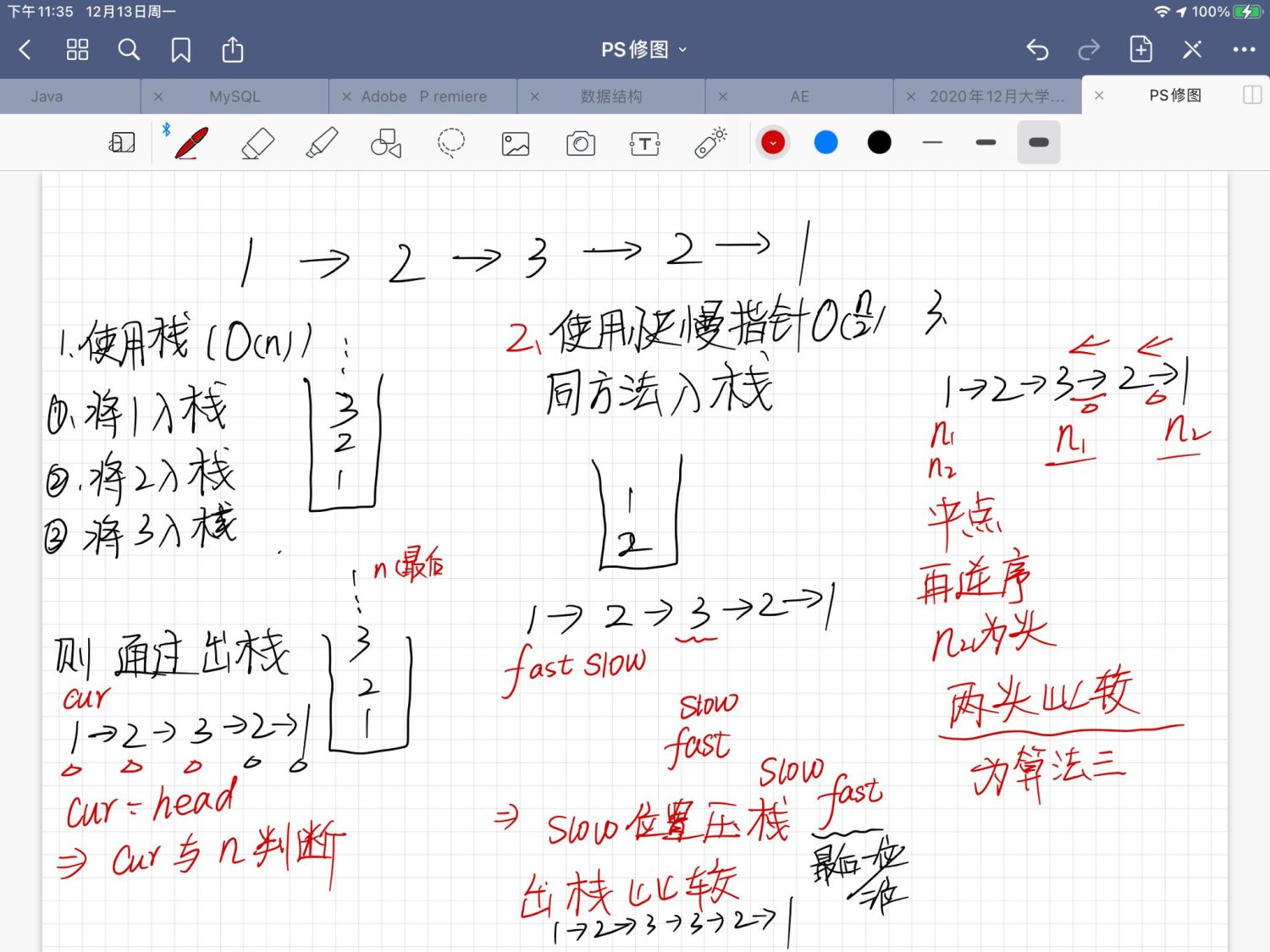
算法一:遍历链表,将node加入栈中,再遍历栈,和原始链表比对,如果相等,说明是回文链表。
算法一增强版:
- 快慢指针:当快指针走到结尾的时候,慢指针走到中点的下一个位置
- 将慢指针和之后的节点压栈
- 弹栈,和链表的前半部分比较
算法二:
- 快慢指针:当快指针走到结尾的时候,慢指针走到中点
- 逆序从慢指针开始的后半部分
- 新建两个指针从头和尾遍历,到终点node为止
- 如果都相等,返回true,否则返回false
- 最后再将后半部分恢复回来
public class Palindrome {public static void main(String[] args) {Node head = linkGenerator(new int[]{1,2,3,4,5,5,4,3,2,1});System.out.println(head);System.out.println(isPalindrome3(head));}//空间复杂度为npublic static boolean isPalindrome1(Node head){Stack<Integer> stack = new Stack<>();Node pointer = head;while (pointer!=null){stack.push(pointer.val);pointer = pointer.next;}pointer = head;while (!stack.isEmpty()){if (stack.pop()!=pointer.val){return false;}pointer = pointer.next;}return true;}//空间复杂度为n/2public static boolean isPalindrome2(Node head){if (head == null || head.next == null){return true;}Node slow = head.next;//注意这里慢指针的初始位置Node fast = head;//当循环终止时,fast在最后一位(奇数),或者在倒数第二位(偶数)//slow在中间位置的下一位(奇数)1->2->3->(2)->1,或者在中间相等两数的第二个数(偶数)1->2->3->(3)->2->1while(fast.next!=null&&fast.next.next!=null){slow = slow.next;fast = fast.next.next;}//将此时从slow开始的链表压栈Stack<Integer> stack = new Stack<>();while (slow!=null){stack.push(slow.val);slow = slow.next;}while(!stack.isEmpty()){if (head.val != stack.pop()){return false;}head = head.next;}return true;}//空间复杂度为O(1)public static boolean isPalindrome3(Node head){if (head == null || head.next == null){return true;}Node n1 = head;//慢指针Node n2 = head;//快指针//慢指针移动到中点,或者中间偏左的位置(偶数)while(n2.next!=null&&n2.next.next!=null){n1 = n1.next;n2 = n2.next.next;}//开始反转后半部分的链表n2 = n1.next;n1.next = null;//mid.next = nullNode n3 = null;while(n2!=null){n3 = n2.next;n2.next = n1;n1 = n2;n2 = n3;}//两个节点分别从两端遍历,查看每个节点的相等情况n3 = n1;n2 = head;boolean res = true;while (n1!=null&&n2!=null){if (n1.val!=n2.val){res = false;break;}n1 = n1.next;n2 = n2.next;}//再将后半部分的链表反转回来n1 = n3.next;n3.next = null;while(n1!=null){n2 = n1.next;n1.next = n3;n3 = n1;n1 = n2;}return res;}}
2、链表节点的移动
要求:给定一个链表和一个数字,将比这个数字小的节点放在左边,比这个数字大的节点放在右边,和这个数字相等的节点放在中间
时间复杂度为O(N),空间复杂度为O(1)
算法一:
通过定义6个结点分别表示每一段链表的头结点和尾节点,最后将生成的链表段连接。

public class Code02_SmallerEqualBigger {public static class Node{public int value;public Node next;public Node(int value) {this.value = value;}}/*** 分成3个链表实现三块区域的局部链表在连接**/public static Node listPartition(Node head, int pivot){//创建6个参数Node sH = null; // small headNode sT = null; // small TailNode eH = null; // equal headNode eT = null; // equal TailNode mH = null; // big headNode mT = null; // big TailNode next = null; // save next nodewhile (head != null){next = head.next;head.next = next;if (head.value < pivot){if(sH == null){sH = head;sT = head;}else {sT.next = head;sT = head;}}else if (head.value == pivot){if(eH == null){eH = head;eT = head;}else {eT.next = head;eT = head;}}else {if(mH == null){mH = head;mT = head;}else {mT.next = head;mT = head;}}head = next;}// 如果有小于区域if (sT != null){sT.next = eH;eT = eT == null ? sT : eT;}//如果有小于和等于区域if(eT != null){eT.next = mH;}return sH != null ? sH : (eH != null ? eH : mH);}
3、链表的Copy
题目:在链表的结点中,除了val,next之外,还有一个类型为Node的随机指针,它可能指向链表中的任何一个节点,也可能指向null。
1、算法一:
使用HashMap :
- 将原链表中的节点作为key,将copy后的节点作为value,放入HashMap中。
- 重建新的链表
- 通过映射关系,重建rand关系:1’和 2’之间的关系可以通过1和2之间的关系得到
需要额外空间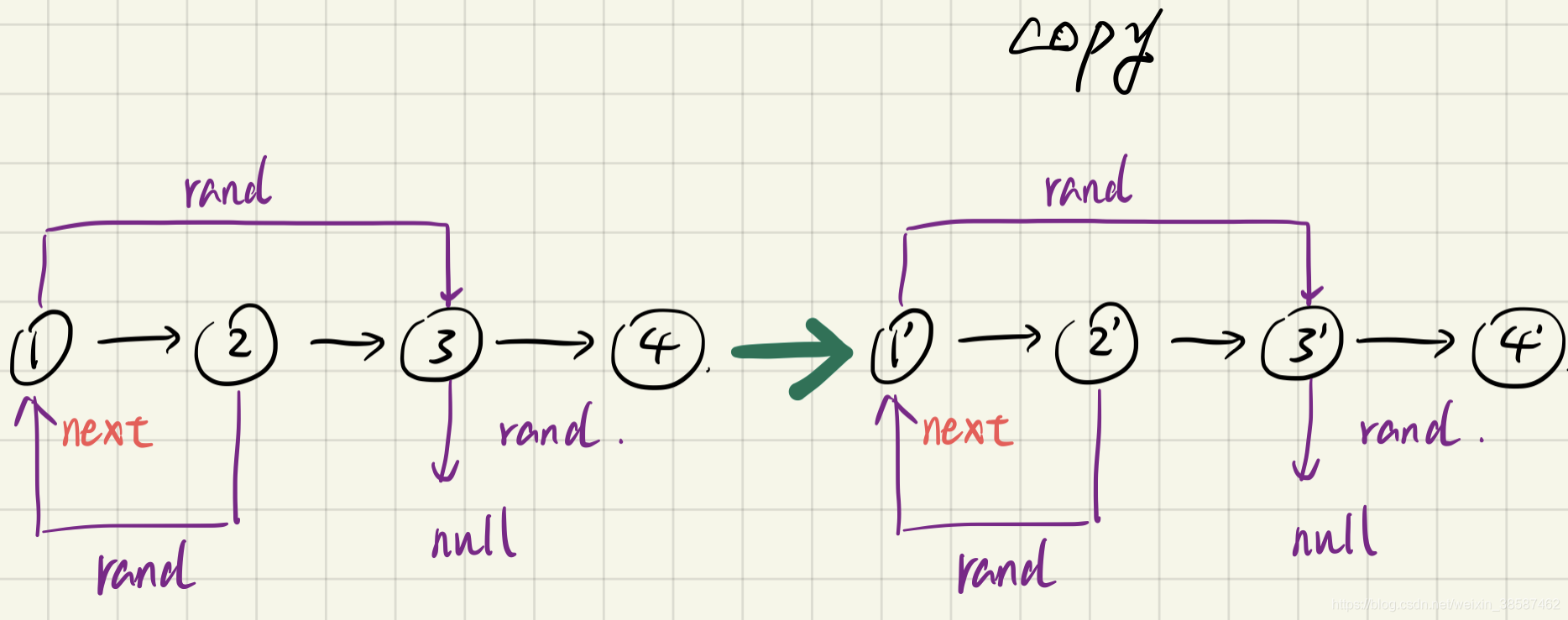
代码:
public class DeepCopy {public static void main(String[] args) {Node head = new Node(1);head.next = new Node(2);head.next.next = new Node(3);head.next.rand = head;head.next.next.rand = null;}//需要额外的存储空间public static Node copyListWithRand1(Node head){HashMap<Node, Node> map = new HashMap<>();Node cur = head;while(cur!=null){map.put(cur, new Node(cur.val));cur = cur.next;}cur = head;while(cur!=null){map.get(cur).next = map.get(cur.next);map.get(cur).rand = map.get(cur.rand);cur = cur.next;}return map.get(head);}}class Node{int val;Node next;Node rand;public Node(int val) {this.val = val;}}
算法2:不用HashMap
空间复杂度为O(1)
- 通过第一次遍历,将原来的链表:
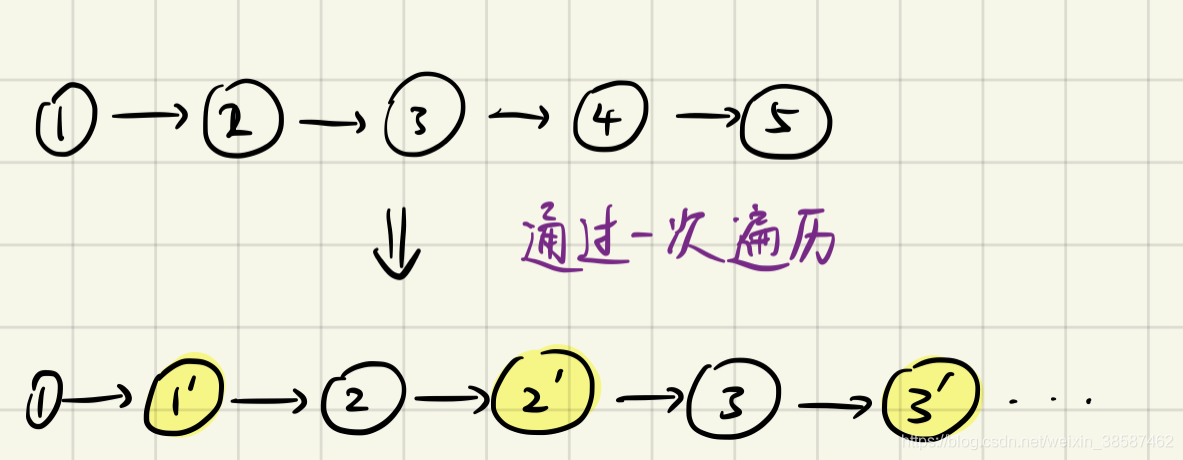 每个copy节点都连接在原节点的后面
- 当确定rand或者next关系的时候,首先通过原来链表的rand关系找到(1找到2),因为2’就在2的下一位,所以1’可以直接找到2’(通过这种结构关系,巧妙地避免了HashMap的使用)
- 最后,分离混合的链表(在这里面重新确定next关系)
//不需要额外的存储空间public static Node copyListWithRand2(Node head){Node cur = head;Node next = null;//构造出 1 -> 1 -> 2 -> 2 -> 3 -> 3 这种结构while(cur!=null){next = cur.next;cur.next = new Node(cur.val);cur.next.next = next;cur = next;}cur = head;Node curCopy = null;//设置 “复制Node”的rand指针while(cur!=null){next = cur.next.next;curCopy = cur.next;curCopy.rand = cur.rand == null? null:cur.rand.next;cur = next;}Node res = head.next;cur = head;//分离混合在一起的链表while(cur!=null){next = cur.next.next;curCopy = cur.next;cur.next = next;curCopy.next = next==null?null:next.next;cur = next;}return res;}
4、合并k个升序链表
给你一个链表数组,每个链表都已经按升序排列。
请你将所有链表合并到一个升序链表中,返回合并后的链表。
方法一:使用分治思想 来实现合并,将其分为多个双链表的合并;
/**
 * Definition for singly-linked list.
 * public class ListNode {
 *     int val;
 *     ListNode next;
 *     ListNode() {}
 *     ListNode(int val) { this.val = val; }
 *     ListNode(int val, ListNode next) { this.val = val; this.next = next; }
 * }
 */
class Solution {
    public ListNode mergeKLists(ListNode[] lists) {
        // 如果没有链表则返回null
        if (lists.length == 0) return null;
        return mergeSort(lists,0,lists.length -1);
    }

    public ListNode mergeSort(ListNode[] lists,int left,int right){
        // 停止递  实现归
        if (left == right) return lists[left];
        // 二分法来实现归并
        int mid = (left + right)/2;
        ListNode l1 = mergeSort(lists,left,mid);
        ListNode l2 = mergeSort(lists,mid + 1, right);
        return merge(l1,l2);
    }

    // 下面的方法为两个链表实现合并
    public ListNode merge(ListNode l1,ListNode l2){

        ListNode preNode = new ListNode(0);
        ListNode list = preNode;
        while (l1 != null && l2 != null){
            // 比较大小合并
            if (l1.val <= l2.val){
                list.next = l1;
                l1 = l1.next;
            }else if(l1.val > l2.val){
                list.next = l2;
                l2 = l2.next;
            }

            list = list.next;
        }
        // 将剩余的节点连接(因为已经是升序了)
        list.next = l1 == null ? l2:l1;
        return preNode.next;
    }
}
5、两两交换链表中的节点
将链表中的节点两两交换
方法一:使用双指针实现节点的交换
/**
 * Definition for singly-linked list.
 * public class ListNode {
 *     int val;
 *     ListNode next;
 *     ListNode() {}
 *     ListNode(int val) { this.val = val; }
 *     ListNode(int val, ListNode next) { this.val = val; this.next = next; }
 * }
 */
class Solution {
    public ListNode swapPairs(ListNode head) {
        ListNode dummy = new ListNode(0);
        dummy.next = head;
        ListNode pre = temp;
        while (pre.next != null && pre.next.next != null){
            // 保存需要交换的两个节点
            ListNode first = pre.next;
            ListNode second = pre.next.next;
            // pre为上一个交换的 的first  相当于first为上一个节点的结尾节点
            // 1->2->3->4->5  交换一轮后pre-> 2->1->3->4->5  1为first  pre保存当前节点
            pre.next = second;
            first.next = second.next;
            second.next = first;
            // 下一个循环
            pre = first;
        }
        // 返回自己定义的链表
        return dummy.next;
    }
}
方法二:使用递归解法
class Solution {
    public ListNode swapPairs(ListNode head) {
        //递归的终止条件
        if(head==null || head.next==null) {
            return head;
        }
        //假设链表是 1->2->3->4
        //这句就先保存节点2
        ListNode tmp = head.next;
        //继续递归,处理节点3->4
        //当递归结束返回后,就变成了4->3
        //于是head节点就指向了4,变成1->4->3
        head.next = swapPairs(tmp.next);
        //将2节点指向1
        tmp.next = head;
        return tmp;
    }
}
6、实现k个结点逆转
和5的解法相似将一个链表循环k个结点为一个链表来逆转再连接
/**
 * Definition for singly-linked list.
 * public class ListNode {
 *     int val;
 *     ListNode next;
 *     ListNode() {}
 *     ListNode(int val) { this.val = val; }
 *     ListNode(int val, ListNode next) { this.val = val; this.next = next; }
 * }
 */
class Solution {
    public ListNode reverseKGroup(ListNode head, int k) {
        if (head == null || head.next == null) return head;
        ListNode dummy = new ListNode(0);
        // 创建一个头头结点 dummy -> head ->
        dummy.next = head;

        ListNode pre = dummy;
        ListNode end = dummy;

        // 判断是否需要进行循环
        while (end.next != null){
            //通过 k 的长度获取每个循环的 最后一个节点
            for(int i = 0;i<k && end != null;i++) end = end.next;
            // 如果当前的end为null则退出循环
            if (end == null) break;
            // start 存 第一个位置  next 存 下一个循环的第一个位置
            ListNode start = pre.next;
            ListNode next = end.next;
            //断开当前循环
            end.next = null;

            // 逆转链表 dummy -> 1 -> 2 逆转成 dummy -> 2 -> 1  pre为每个循环前一个节点 相当于dummy
            pre.next = reverse(start);
            // 将 1 -> 的next  为next
            start.next = next;

            // 这个是将下一个循环准备
            pre = start;
            end = start;
        }
        return dummy.next;
    }

    public ListNode reverse(ListNode temp){
        ListNode left = temp;
        ListNode pre = null;
        while (left != null){
            // 将next放到第一位
            ListNode next = left.next;

            // 第一个的next指向null
            left.next = pre;
            // 移动
            pre = left;
            // 循环到下一个
            left = next;
        }
        return pre;
    }
}
7、旋转链表
给你一个链表的头节点 head ,旋转链表,将链表每个节点向右移动 k 个位置。
解法:将链表首尾连接 再获取链表长度 通过余数循环链表找到该链表断开首尾链表
/**
 * Definition for singly-linked list.
 * public class ListNode {
 *     int val;
 *     ListNode next;
 *     ListNode() {}
 *     ListNode(int val) { this.val = val; }
 *     ListNode(int val, ListNode next) { this.val = val; this.next = next; }
 * }
 */
class Solution {
    public ListNode rotateRight(ListNode head, int k) {
        ListNode temp = head;
        ListNode left = head;
        ListNode right = head;
        if (head == null) return null;
        // 计算链表长度
        ListNode count = head;
        int n = 1;
        while (count.next != null){
            count = count.next;
            n++;
        }
        // 获取余数 只跑一圈以内
        k = k % n;
        // 判断
        if (k <=0 || head.next == null) return head;
        // 双指针 找到k的位置
        for (int i = 0; i<k && right.next != null;i++){
            right = right.next;
        }
        // 将链表成环
        while (right.next != null){
            left = left.next;
            // 为k的位置
            right = right.next;
        }
        ListNode resNode = left.next;
        right.next = temp;
        left.next = null;
        return resNode;
    }
}
8、删除排序链表的重复元素
给定一个已排序的链表的头 head , 删除原始链表中所有重复数字的节点,只留下不同的数字 。返回 已排序的链表 。
/**
 * Definition for singly-linked list.
 * public class ListNode {
 *     int val;
 *     ListNode next;
 *     ListNode() {}
 *     ListNode(int val) { this.val = val; }
 *     ListNode(int val, ListNode next) { this.val = val; this.next = next; }
 * }
 */
class Solution {
    public ListNode deleteDuplicates(ListNode head) {
        if (head == null || head.next == null) return head;

        // 当前节点和下一节点的比较
        if (head.val != head.next.val){
            head.next = deleteDuplicates(head.next);
            return head;
        }else{
            // 查找重复的个数  找到下下个
            // 1->2->3->3->4->4->5
            // 当前节点为第三个 3  比较当前节点和后一个节点 如果相等 则获取4 然后返回返回4的当前节点
            ListNode notDup = head.next.next;
            while (notDup != null && notDup.val == head.val){
                notDup = notDup.next;
            }
            return deleteDuplicates(notDup);
        }
    }
}
删除重复元素只保存一个元素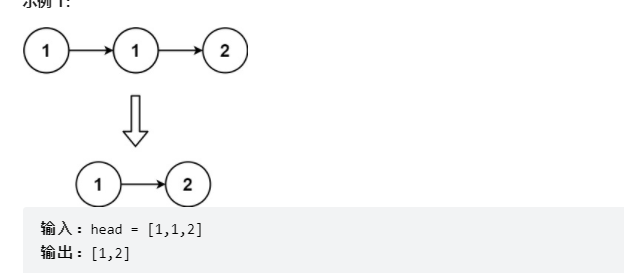
/**
 * Definition for singly-linked list.
 * public class ListNode {
 *     int val;
 *     ListNode next;
 *     ListNode() {}
 *     ListNode(int val) { this.val = val; }
 *     ListNode(int val, ListNode next) { this.val = val; this.next = next; }
 * }
 */
class Solution {
    public ListNode deleteDuplicates(ListNode head) {
        // 判断
        if (head == null) return null;
        // 代替
        ListNode right = head;
        // 判断是否为空
        // 保存  一个节点
        // 1 -> 1 -> 2-> 3-> 3
        // 比较 第1个和第二个是否相等 如果相等 则删除下一个
        while (right.next != null){
            if (right.val == right.next.val){
                right.next = right.next.next;
            }else{
                right = right.next;
            }
        }
        return head;
    }
}
9、分隔链表
给你一个链表的头节点 head 和一个特定值_ _x ,请你对链表进行分隔,使得所有 小于 x 的节点都出现在 大于或等于 x 的节点之前。
这个算法的解法思路:将x的大小分为2个链表再连接起来 两个dummy 然后再首尾连接
/**
 * Definition for singly-linked list.
 * public class ListNode {
 *     int val;
 *     ListNode next;
 *     ListNode() {}
 *     ListNode(int val) { this.val = val; }
 *     ListNode(int val, ListNode next) { this.val = val; this.next = next; }
 * }
 */
class Solution {
    public ListNode partition(ListNode head, int x) {
        ListNode dummy1 = new ListNode(0);
        ListNode dummy2 = new ListNode(0);
        ListNode pre = dummy1;
        ListNode last = dummy2;

        while (head != null){
            if (head.val < x){
                pre.next = head;
                pre = pre.next;
            }else{
                last.next = head;
                last = last.next;
            }
            head = head.next;
        }
        last.next = null;
        pre.next = dummy2.next;
        return dummy1.next;

    }
}

若有收获,就点个赞吧
0 人点赞


