题目
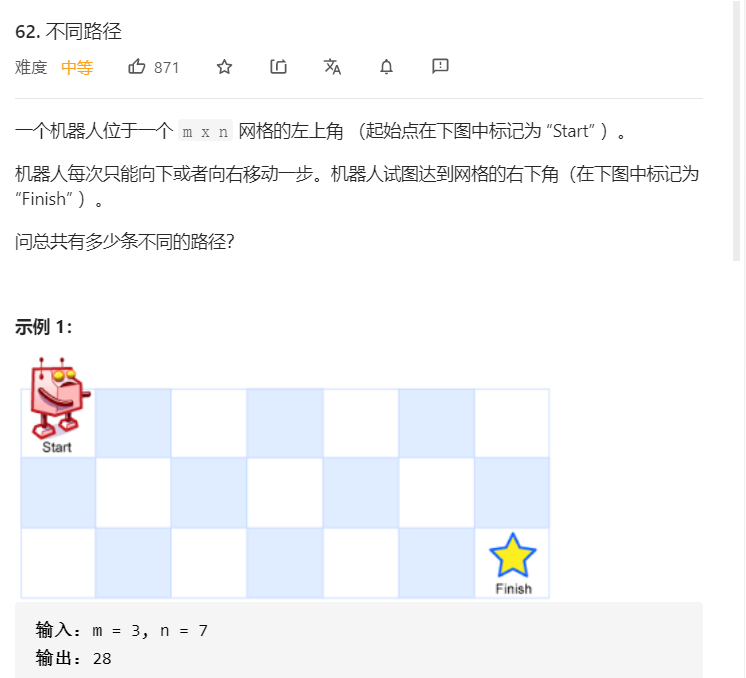
思路
- 可以理解为斐波那契额类型题目
- 思路一:暴力递归,想要达到(m,n)位置,只要计算去到(m-1, n)和(m, n - 1)位置可能性之和即可,因此得到了递归条件。什么时候结束呢,很明显当m==1或者n==1时,只有一种选择。
- 思路二:备忘录递归,使用容器记录已经走过的(m,n)避免重复计算
思路三:动态规划,从递归思路我们知道计算(m,n)位置,要先计算(m-1,n)和(m,n-1),也就是说,如果已知(m-1,n)和(m,n-1),就可以计算(m,n),那么现在已知(1,j)=1和(i,1)=1,i在1~m,j在1~n。遍历整个二维dp数组就可知道各个(i,j)的值 | i\j | 1 | 2 | 3 | | —- | —- | —- | —- | | 1 | 1 | 1 | 1 | | 2 | 1 | 1+1=2 | 2+1=3 | | 3 | 1 | 1+2=3 | 3+3=6 | | 4 | 1 | 1+3=4 | 4+6=10 |
思路四:动态规划优化dp数组,通过上述表格可以发现每次只是用到了上次遍历的一列而已,所以可以将二维数组优化为一维数组,记录上次的值即可
代码
//1. 暴力递归,超时public int uniquePaths(int m, int n) {if (m == 1 || n == 1) return 1;return uniquePaths(m - 1, n) + uniquePaths(m, n - 1);}//2. 备忘录Map<String, Integer> table = new HashMap<>();public int uniquePaths(int m, int n) {if (m == 1 || n == 1) return 1;String key1 = m + "-" + n;String key2 = n + "-" + m;if (table.containsKey(key1) || table.containsKey(key2))return table.containsKey(key1) ? table.get(key1) : table.get(key2);int count = uniquePaths(m - 1, n) + uniquePaths(m, n - 1);if (!table.containsKey(key1) && !table.containsKey(key2))table.put(key1, count);return count;}//3. 动态规划public int uniquePaths(int m, int n) {if (m == 1 || n == 1) return 1;int[][] dp = new int[m][n];for (int i = 1; i < m; i++) {for (int j = 1; j < n; j++) {if (i - 1 == 0) dp[i - 1][j] = 1;if (j - 1 == 0) dp[i][j - 1] = 1;dp[i][j] = dp[i - 1][j] + dp[i][j - 1];}}return dp[m - 1][n - 1];}//4. 优化动态规划的dp数组public int uniquePaths(int m, int n) {if (m == 1 || n == 1) return 1;int[] dp = new int[n];for (int i = 0; i < n; i++) {dp[i] = 1;}for (int i = 1; i < m; i++) {for (int j = 1; j < n; j++) {dp[j] += dp[j - 1];}}return dp[n - 1];}

若有收获,就点个赞吧
0 人点赞


