智能指针
本质上并不神秘,其实就是 RAII 资源管理功能的自然展现而已
//基本智能指针类class shape_wrapper{public:explicit shape_wrapper(shape *ptr = nullptr): ptr_(ptr){}~shape_wrapper(){delete ptr_;}shape* get() const{return ptr_;}private:shape* ptr_;}
缺点:
- 这个类只适用于 shape 类
- 该类对象的行为不够像指针
-
更改1:采用类模板
template<typename T>class smart_ptr{public:explicit smart_ptr(T *ptr = nullptr):ptr_(ptr){}~smart_ptr(){delete ptr_;}T* get()const{return ptr_;}private:T* ptr_;}//类模板使用smart_ptr<shape> =====》 shape_wrapper
缺点:
它不能用 * 运算符解引用
- 它不能用 -> 运算符指向对象成员
- 它不能像指针一样用在布尔表达式里
更改2:增加成员函数
//通过重载符号,使其看起来像指针。template <typename T>class smart_ptr {public:…T& operator*() const { return *ptr_; }T* operator->() const { return ptr_; }operator bool() const { return ptr_; }}
更改3:拷贝构造和赋值
使用智能指针的目的就是要减少对象的拷贝,在拷贝时转移指针所有权 ```cpp
template
在拷贝构造函数中,通过调用 other 的 release 方法来释放它对指针的所有权。在赋值函数中,则通过拷贝构造产生一个临时对象并调用 swap 来交换对指针的所有权。<br />** 赋值分为拷贝构造和交换两步,异常只可能在第一步发生;而第一步如果发生异常的话,this 对象完全不受任何影响。无论拷贝构造成功与否,结果只有赋值成功和赋值没有效果两种状态,而不会发生因为赋值破坏了当前对象这种场景**。<a name="ijxsX"></a>### 更改4:同时提供移动,拷贝构造函数,增加子类往基类指针转换```cpptemplate <typename T>class smart_ptr {…smart_ptr(smart_ptr&& other) //移动构造函数{ptr_ = other.release();}smart_ptr& operator=(smart_ptr rhs) //赋值函数 ,不需要生成临时对象{rhs.swap(*this);return *this;}…};
如果提供了移动构造函数而没有手动提供拷贝构造函数,那后者自动被禁用。
//通过模板构造函数的方式,兼容指针类型
  template <typename U>
  smart_ptr(smart_ptr<U>&& other) //不是移动构造函数
  {
    ptr_ = other.release();
  }
- 这里的模板参数smart_ptr<U<&&是万能引用,既可以引用左值,又可以引用右值,万能引用在【完美转发】中大有用武之地。 因此上面这段代码所表达的是一个构造函数模板,实例化后可能是拷贝构造函数,也可能是移动构造函数。 ——————————————————————————————————— 补充:在函数模板中,如果参数列表是带“&&”的模板参数,那么这个参数的类型不是右值引用,而是万能引用。
- 如果提供了移动构造函数而没有同步提供拷贝构造函数,则后者被默认删除。但是上面这个例子不算是提供了移动构造函数,所以需要手动标明删除拷贝构造函数。
引用计数
unique_ptr 算是一种较为安全的智能指针了。但是,一个对象只能被单个 unique_ptr 所拥有,这显然不能满足所有使用场合的需求。一种常见的情况是,多个智能指针同时拥有一个对象;当它们全部都失效时,这个对象也同时会被删除。这也就是 shared_ptr。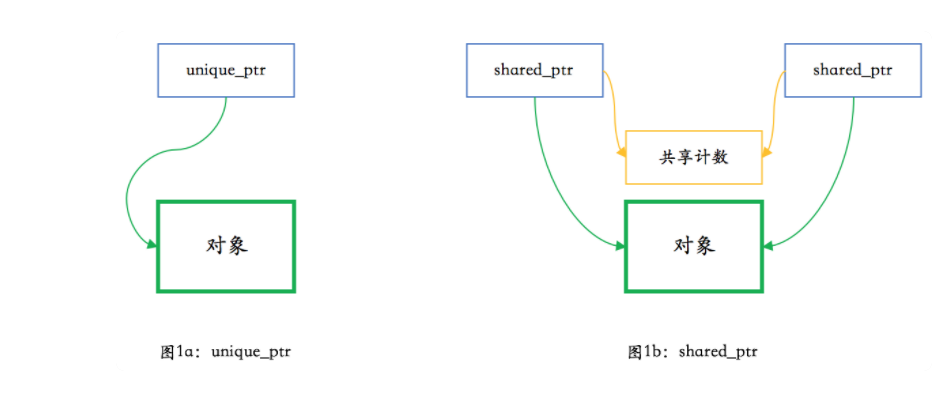
共享计数接口
class shared_count{
public:
  shared_count():count_(1){}
  void add_count{
      ++count_;
  }
  long reduce_count{
      return --count_;
  }
  long get_count{
      return count_;
  }
private:
  long count_;
}
引用智能指针实现
```cpp
template
private: T ptr_; shared_count sharedcount; };
<a name="AUjPC"></a>
### 更改拷贝,移动构造函数
```cpp

  smart_ptr(const smart_ptr& other)
  {
    ptr_ = other.ptr_;
    if (ptr_) {
      other.shared_count_
        ->add_count();
      shared_count_ =
        other.shared_count_;
    }
  }
//实现指针兼容
  template <typename U>
  smart_ptr(const smart_ptr<U>& other)
  {
    ptr_ = other.ptr_;
    if (ptr_) {
      other.shared_count_
        ->add_count();
      shared_count_ =
        other.shared_count_;
    }
  }
  template <typename U>
  smart_ptr(smart_ptr<U>&& other)
  {
    ptr_ = other.ptr_;
    if (ptr_) {
      shared_count_ =
        other.shared_count_;
      other.ptr_ = nullptr;
    }
  }
问题:模板的各个实例间并不天然就有 friend 关系,因而不能互访私有成员 ptr 和 shared_count。
友元类声明
template <typename U>
friend class smart_ptr;
指针类型转换
完整代码实现
#include <utility>  // std::swap

class shared_count {
public:
  shared_count() noexcept
    : count_(1) {}
  void add_count() noexcept
  {
    ++count_;
  }
  long reduce_count() noexcept
  {
    return --count_;
  }
  long get_count() const noexcept
  {
    return count_;
  }

private:
  long count_;
};

template <typename T>
class smart_ptr {
public:
  template <typename U>
  friend class smart_ptr;

  explicit smart_ptr(T* ptr = nullptr)
    : ptr_(ptr)
  {
    if (ptr) {
      shared_count_ =
        new shared_count();
    }
  }
  ~smart_ptr()
  {
    if (ptr_ &&
      !shared_count_
         ->reduce_count()) {
      delete ptr_;
      delete shared_count_;
    }
  }

  smart_ptr(const smart_ptr& other)
  {
    ptr_ = other.ptr_;
    if (ptr_) {
      other.shared_count_
        ->add_count();
      shared_count_ =
        other.shared_count_;
    }
  }
  template <typename U>
  smart_ptr(const smart_ptr<U>& other) noexcept
  {
    ptr_ = other.ptr_;
    if (ptr_) {
      other.shared_count_->add_count();
      shared_count_ = other.shared_count_;
    }
  }
  template <typename U>
  smart_ptr(smart_ptr<U>&& other) noexcept
  {
    ptr_ = other.ptr_;
    if (ptr_) {
      shared_count_ =
        other.shared_count_;
      other.ptr_ = nullptr;
    }
  }
  template <typename U>
  smart_ptr(const smart_ptr<U>& other,
            T* ptr) noexcept
  {
    ptr_ = ptr;
    if (ptr_) {
      other.shared_count_
        ->add_count();
      shared_count_ =
        other.shared_count_;
    }
  }
  smart_ptr&
  operator=(smart_ptr rhs) noexcept
  {
    rhs.swap(*this);
    return *this;
  }

  T* get() const noexcept
  {
    return ptr_;
  }
  long use_count() const noexcept
  {
    if (ptr_) {
      return shared_count_
        ->get_count();
    } else {
      return 0;
    }
  }
  void swap(smart_ptr& rhs) noexcept
  {
    using std::swap;
    swap(ptr_, rhs.ptr_);
    swap(shared_count_,
         rhs.shared_count_);
  }

  T& operator*() const noexcept
  {
    return *ptr_;
  }
  T* operator->() const noexcept
  {
    return ptr_;
  }
  operator bool() const noexcept
  {
    return ptr_;
  }

private:
  T* ptr_;
  shared_count* shared_count_;
};

template <typename T>
void swap(smart_ptr<T>& lhs,
          smart_ptr<T>& rhs) noexcept
{
  lhs.swap(rhs);
}

template <typename T, typename U>
smart_ptr<T> static_pointer_cast(
  const smart_ptr<U>& other) noexcept
{
  T* ptr = static_cast<T*>(other.get());
  return smart_ptr<T>(other, ptr);
}

template <typename T, typename U>
smart_ptr<T> reinterpret_pointer_cast(
  const smart_ptr<U>& other) noexcept
{
  T* ptr = reinterpret_cast<T*>(other.get());
  return smart_ptr<T>(other, ptr);
}

template <typename T, typename U>
smart_ptr<T> const_pointer_cast(
  const smart_ptr<U>& other) noexcept
{
  T* ptr = const_cast<T*>(other.get());
  return smart_ptr<T>(other, ptr);
}

template <typename T, typename U>
smart_ptr<T> dynamic_pointer_cast(
  const smart_ptr<U>& other) noexcept
{
  T* ptr = dynamic_cast<T*>(other.get());
  return smart_ptr<T>(other, ptr);
}

若有收获,就点个赞吧
0 人点赞


