输入int类型的01,默认输入1
for(int i=0;~b;i++) 这里的~b为b!=-1
memset(数组名,赋的初值,sizeof 数组名) 初始化数组
单链表
在解决图和树的数据结构问题时,常常用邻接表来存储。邻接表是由很多条单链表构成的,而单链表的实现方式有很多,如数组,结构体,vector等容器实现,在这些实现方式中,静态数组的速度是最快的。
传统结构体表示链表
struct Node{int value;Node* next;}
每次创建新的链表节点,都需要new一个新的结构体,在竞赛级别的算法题目里,链表的长度都是十万百万级,如果每次创建一个新节点都new一次,光创建出这个链表就已经超时了。
静态数组表示
这里的静态和动态其实是指是否需要重复开辟空间。提前开辟好空间以后用这些空间去表示称为静态,与之对应的每次都需要开辟空间称为动态。
那,如何表示呢?
e[N], ne[N], head, idx来表示一个单链表!
e[N] 存放每一个节点的值,ne[N]存放下一个节点的下标,head指向头结点,idx表示已经用到了数组中的哪个节点。
- 具体操作 ```cpp // 初始化 void init() { head = -1; idx = 0; }
// 将x插到头结点 void add_to_head(int x) { e[idx] = x, ne[idx] = head, head = idx ++ ; }
// 将x插到下标是k的点后面 void add(int k, int x) { e[idx] = x, ne[idx] = ne[k], ne[k] = idx ++ ; }
// 将下标是k的点后面的点删掉 void remove(int k) { ne[k] = ne[ne[k]]; }
<a name="XApYp"></a>### 邻接表<a name="Vfhyr"></a>#### 用邻接表表示一棵树用idx,h[N],ne[N],e[N]表示<br />h[N]用于存放邻接表的表头<br />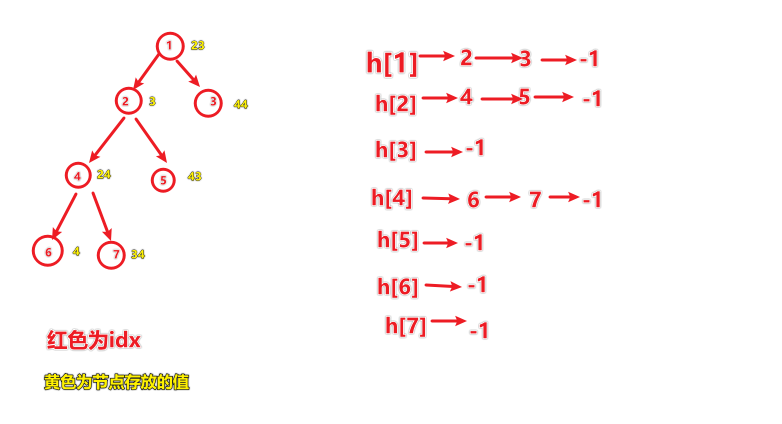<br />构建树```cppadd(int parent_id,int child_id){ //为值为parent_id的父节点添加一个值为child_id的子节点e[idx] = child_id,ne[idx]=h[parent_id],h[parent_id] = idx++;}
- 前序遍历,中序遍历,后续遍历(DFS)
- 前序遍历 (preorder) 根左右
- 中序遍历 (inorder)左跟右
- 后续遍历 (postorder)左右跟
倒推—

- 前序的第一个是root,后序的最后一个是root。
- 先确定跟节点,然后根据中序遍历,在根左边的为左子树,根右边的为右子树
- 对于每一个子树可以看成一个全新的树,仍然遵循上面的规律。
划重点!!根据上面的推论,只要确定了根节点的位置,根据中序遍历我们就能确定左右子树的位置,递归从而构建出整个二叉树。也就是说,我们知道一颗二叉树前序遍历和中序遍历或者后续遍历和中序遍历,就能构建二叉树,而知道前序遍历和后续遍历则不行。
// 一边建树一边遍历#include<bits/stdc++.h>using namespace std;const int N = 50010;unordered_map<int,int> l,r,pos;int in[N],pre[N],n;vector <int> post;int build(int il,int ir,int pl,int pr){int root = pre[pl];int k = pos[root];if(il<k) l[root] = build(il,k-1,pl+1,pl+1+k-1-il);if(k<ir) r[root] = build(k+1,ir,pl+1+k-il,pr);// 一边建树 一边遍历post.push_back(root);return root;}int main(){cin>>n;for(int i=0;i<n;i++){cin>>pre[i];}for(int i=0;i<n;i++){cin>>in[i];pos[in[i]]=i;}int root=build(0,n-1,0,n-1);cout<<post[0];return 0;}
- 层序遍历(BFS)
//p存放层序遍历的结果,l存放父节点的左儿子,r存放父节点的右儿子void bfs(int root){p[0] = root;int hh=0,kk=0;while(hh<=kk){int t = p[hh++];if(l.count(t)) p[++kk] = l[t];if(r.count(t)) p[++kk] = r[t];}cout<<p[0];for(int i=1;i<n;i++) cout<<' '<<p[i];}
并查集
- 并查集有思维巧妙,代码简短的特点,是面试热点问题。
简单描述一下并查集
现在有两个集合a和b,从这两个集合中取出任意一个元素,如何判断该元素属于哪个集合?以及如何快速将两个集合合并?
—常见思路—
定义一个belong[]数组存储元素归属
if(belong[x]=='a') puts('a');else puts('b');
定义数组操作,查询元素归属的时间复杂度是O(1);但合并两个操作呢?
只能在定义一个新的数组,然后把每个集合中的元素都存进去,时间复杂度为O(n)!
有没有什么办法实现这两个操作且时间复杂度低?
并查集可以在近乎O(1)的时间复杂度下实现这两个操作!!
- 将集合中的元素存在树中,定义一颗树的跟节点为这个集合的id,定义一个数组p[]存取每个元素的父节点, x的父节点是p[x],而根节点的父节点就是其本身,即p[x]=x,所以我们只要一直不断向上查询这个元素的根节点,就能知道归属。
- 对于合并集合,由于这两个集合是以两颗树的形式存在,我们只要让一颗树的根节点的父节点为另一颗树的根节点,即可把这两颗树连起来。

代码实现
- p[]数组存放每个元素的父节点,即x的父节点是p[x]
- find(int x):查找某一元素的根节点
- 判断归属 if( find(a) == find(b) ) 属于同一个集合
- 合并 p[find(a)] = find(b)
- 如何实现find()函数 ```cpp //常规思路,由于每次都要while一遍,所以查找根节点的时间复杂度是个问题 int find(int x){ while(p[x]!=x) x = p[x]; return x; }
// 采用路径压缩优化,路径压缩就是在查询根节点的过程中,将路径上的每一个节点的父节点都 //重新设置为根节点,避免重复查找,这样时间复杂度可以近乎缩减为O(1); int find(int x) { if (p[x] != x) p[x] = find(p[x]); return p[x]; }
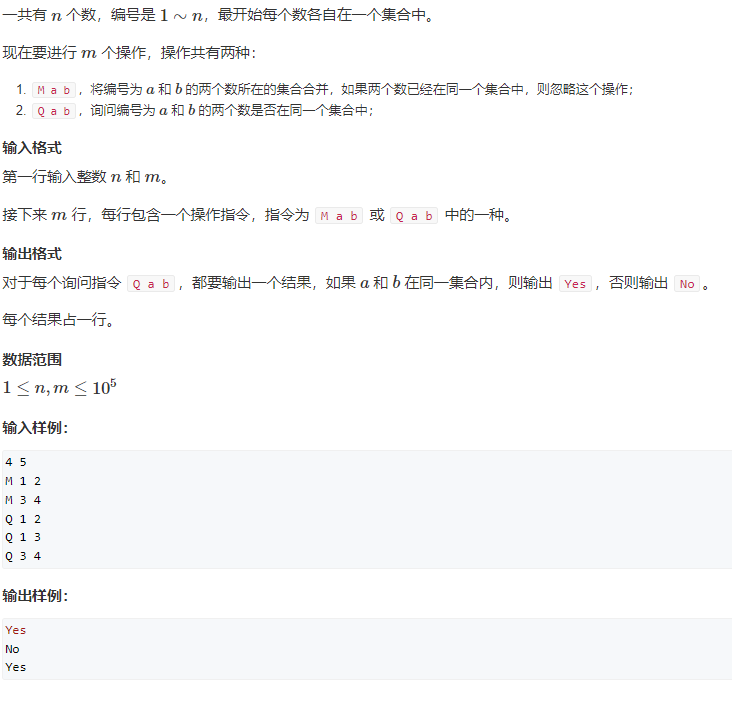```cpp#include<bits/stdc++.h>using namespace std;const int N = 100010;int p[N];int find(int x) // 返回x的祖宗节点 + 路径压缩{if (p[x] != x) p[x] = find(p[x]);return p[x];}int main(){int n,m;cin>>n>>m;for(int i=1;i<=n;i++){p[i] = i;}while(m--){char ins;int a,b;cin>>ins>>a>>b;if(ins=='M') p[find(a)] = find(b);else{if(find(a)==find(b)) puts("Yes");else puts("No");}}return 0;}
二叉树
二叉树可以用两个数组 l[N] , r[N] 来表示, N 为节点数量,l[i] 记录节点 i 的左儿子,r[i] 记录节点i的右儿子
二叉树三种深度遍历
// k用来记录当前位置,满足pat空格检测输出void dfs_pre(int root,int &k){if(root == -1) return;if(++k == n) cout<<root;else cout<<root<<' ';dfs_pre(l[root],k);dfs_pre(r[root],k);}void dfs_in(int root,int &k){if(root == -1) return;dfs_in(l[root],k);if(++k == n) cout<<root;else cout<<root<<' ';dfs_in(r[root],k);}void dfs_post(int root,int &k){if(root == -1) return;dfs_post(l[root],k);dfs_post(r[root],k);if(++k == n) cout<<root;else cout<<root<<' ';}
二叉树的广度优先遍历
void bfs(int root){q[0] = root;int hh=0,tt=0;while(hh<=tt){int t = q[hh++];if(l[t]!=-1) q[++tt] = l[t];if(r[t]!=-1) q[++tt] = r[t];}}
二叉搜索树
二叉搜索树 (BST) 递归定义为具有以下属性的二叉树:
- 若它的左子树不空,则左子树上所有结点的值均小于它的根结点的值
- 若它的右子树不空,则右子树上所有结点的值均大于或等于它的根结点的值
- 它的左、右子树也分别为二叉搜索树
如果是一棵二叉搜索树,那么其中序遍历必然为一组升序排列的数列!
c++里set容器就是用二叉搜索树实现的
完全二叉树可以用一维数组存储
反转二叉树

#include<bits/stdc++.h>using namespace std;const int N = 11;int l[N],r[N],q[N],n;bool has_father[N];void dfs_re(int root){if(root == -1) return;dfs_re(l[root]);dfs_re(r[root]);swap(l[root],r[root]);}void bfs(int root){q[0] = root;int hh=0,tt=0;while(hh<=tt){int t = q[hh++];if(l[t]!=-1) q[++tt] = l[t];if(r[t]!=-1) q[++tt] = r[t];}cout<<root;for(int i=1;i<n;i++){cout<<' '<<q[i];}cout<<endl;}void dfs_in(int root,int &k){if(root == -1) return;dfs_in(l[root],k);if(++k == n) cout<<root;else cout<<root<<' ';dfs_in(r[root],k);}int main(){// 初始化memset(r,-1,sizeof r);memset(l,-1,sizeof l);// 读入数据cin>>n;for(int i=0;i<n;i++){char a,b;cin>>a>>b;if(a!='-'){l[i]=a-'0';has_father[l[i]] = true;}if(b!='-'){r[i]=b-'0';has_father[r[i]] = true;}}int root = 0;// 寻找根节点while(has_father[root]) root++;// 反转二叉树dfs_re(root);// 输出层序遍历bfs(root);// 输出中序遍历int k = 0; // 负责记录当前位置来判断是否需要输出空格dfs_in(root,k);return 0;}

若有收获,就点个赞吧
0 人点赞


