layout: pattern
title: Factory
folder: factory
permalink: /patterns/factory/
categories: Creational
tags:
- Gang of Four
Also known as
- Simple Factory
- Static Factory Method
Intent
Providing a static method encapsulated in a class called factory, in order to hide the
implementation logic and makes client code focus on usage rather then initialization new objects.
Explanation
Real world example
Lets say we have a web application connected to SQLServer, but now we want to switch to Oracle. To do so without modifying existing source code, we need to implements Simple Factory pattern, in which a static method can be invoked to create connection to a given database.
Wikipedia says
Factory is an object for creating other objects – formally a factory is a function or method that returns objects of a varying prototype or class.
Programmatic Example
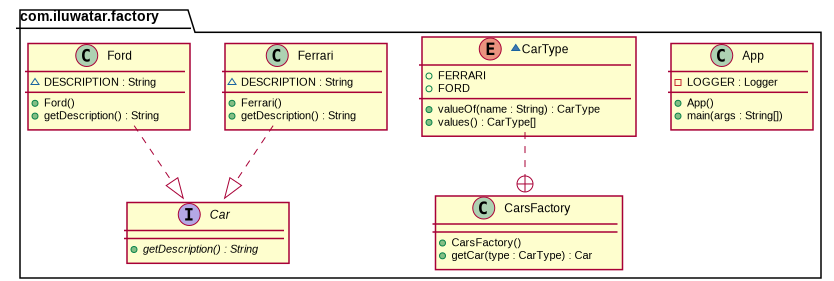
We have an interface Car and two implementations Ford and Ferrari.
public interface Car {String getDescription();}public class Ford implements Car {static final String DESCRIPTION = "This is Ford.";@Overridepublic String getDescription() {return DESCRIPTION;}}public class Ferrari implements Car {static final String DESCRIPTION = "This is Ferrari.";@Overridepublic String getDescription() {return DESCRIPTION;}}
Enumeration above represents types of cars that we support (Ford and Ferrari).
public enum CarType {FORD(Ford::new),FERRARI(Ferrari::new);private final Supplier<Car> constructor;CarType(Supplier<Car> constructor) {this.constructor = constructor;}public Supplier<Car> getConstructor() {return this.constructor;}}
Then we have the static method getCar to create car objects encapsulated in the factory classCarsFactory.
public class CarsFactory {public static Car getCar(CarType type) {return type.getConstructor().get();}}
Now on the client code we can create different types of cars using the factory class.
var car1 = CarsFactory.getCar(CarType.FORD);var car2 = CarsFactory.getCar(CarType.FERRARI);LOGGER.info(car1.getDescription());LOGGER.info(car2.getDescription());
Program output:
This is Ford.This Ferrari.
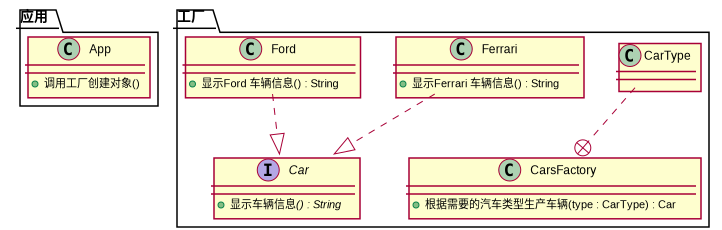
Class Diagram
Applicability
Use the Simple Factory pattern when you only care about the creation of an object, not how to create
and manage it.
Pros
- Allows keeping all objects creation in one place and avoid of spreading ‘new’ keyword across codebase.
- Allows to write loosely coupled code. Some of its main advantages include better testability, easy-to-understand code, swappable components, scalability and isolated features.
Cons
- The code becomes more complicated than it should be.

若有收获,就点个赞吧
0 人点赞


