- 刷题资源
- 1. Two Sum
- 2. Add Two Numbers
- 3. Longest Substring Without Repeating Characters
- 4. Median of Two Sorted Arrays
- 5. Longest Palindromic Substring
- 6. Zigzag Conversion
- 7. Reverse Integer
- 8. String to Integer
- 9. Palindrome Number
- 11. Container With Most Water
- 14. Longest Common Prefix
- 19. Remove Nth Node From End of List
- 21. Merge Two Sorted Lists
- 23. Merge k Sorted Lists
- 24. Swap Nodes in Pairs
- 25. Reverse Nodes in k-Group
- 26. Remove Duplicates from Sorted Array
- 39. Combination Sum
- 41. First Missing Positive
- 42. Trapping Rain Water
- 45. Jump Game II
- 46. Permutations
- 48. Rotate Image
- 51. N-Queens
- 54. Spiral Matrix
- 55. Jump Game
- 98. Validate Binary Search Tree
- 100. Same Tree
- 101. Symmetric Tree
- 104. Maximum Depth of Binary Tree
- 105. Construct Binary Tree from Preorder and Inorder Traversal
- 107. Binary Tree Level Order Traversal II
- 110. Balanced Binary Tree
- 112. Path Sum
- 113. Path Sum II
刷题资源
LeetCode题目链接:https://leetcode.com/problems/two-sum/
参考的刷题博客:https://leetcode.wang/
1. Two Sum
Given an array of integers nums and an integer target, return indices of the two numbers such that they add up to target.
You may assume that each input would have exactly one solution, and you may not use the same element twice.
You can return the answer in any order.
Approach 1: Brute Force
The brute force approach is simple. Loop through each element x and find if there is another value that equals to [target - x]
class Solution {// 方法1:暴力搜索public int[] twoSum(int[] nums, int target) {for (int i = 0; i < nums.length; i++) {for (int j = i + 1; j < nums.length; j++) {if (nums[i] + nums[j] == target) {return new int[]{i, j};}}}return null;}}
Approach 2: Two-pass Hash Table
To improve our runtime complexity, we need a more efficient way to check if the complement exists in the array. If the complement exists, we need to get its index. What is the best way to maintain a mapping of each element in the array to its index? A hash table.
We can reduce the lookup time from O(n)O(n) to O(1)O(1) by trading space for speed. A hash table is well suited for this purpose because it supports fast lookup in near constant time. I say “near” because if a collision occurred, a lookup could degenerate to O(n)O(n) time. However, lookup in a hash table should be amortized O(1)O(1) time as long as the hash function was chosen carefully.
A simple implementation uses two iterations. In the first iteration, we add each element’s value as a key and its index as a value to the hash table. Then, in the second iteration, we check if each element’s complement (target - nums[i]target−nums[i]) exists in the hash table. If it does exist, we return current element’s index and its complement’s index. Beware that the complement must not be nums[i]nums[i] itself!
class Solution {public int[] twoSum(int[] nums, int target) {HashMap<Integer, Integer> map = new HashMap<>();for (int i = 0; i < nums.length; i++) {map.put(nums[i], i);}for (int i = 0; i < nums.length; i++) {int complement = target - nums[i];// 要注意这种特殊情况,当遍历到i 位置,i索引元素的两倍,刚好等于target// 那么就会返回两个相同的索引,导致不符合题意if (map.containsKey(complement) && map.get(complement) != i){return new int[]{i, map.get(complement)};}}return null;}}
Approach 3: One-pass Hash Table
It turns out we can do it in one-pass. While we are iterating and inserting elements into the hash table, we also look back to check if current element’s complement already exists in the hash table. If it exists, we have found a solution and return the indices immediately.
class Solution {public int[] twoSum(int[] nums, int target) {HashMap<Integer, Integer> map = new HashMap<>();for (int i = 0; i < nums.length; i++) {int complement = target - nums[i];// 1. 因为访问到这里,i索引还没添加到哈希表中,所以不用判断target等于两倍nums[i]的特殊情况了if (map.containsKey(complement) ){int index = map.get(complement);return new int[]{i, index};}// 2. 不管是否匹配到,都要把当前加入到哈希表中map.put(nums[i], i);}return null;}}
2. Add Two Numbers
You are given two non-empty linked lists representing two non-negative integers. The digits are stored in reverse order, and each of their nodes contains a single digit. Add the two numbers and return the sum as a linked list.
You may assume the two numbers do not contain any leading zero, except the number 0 itself.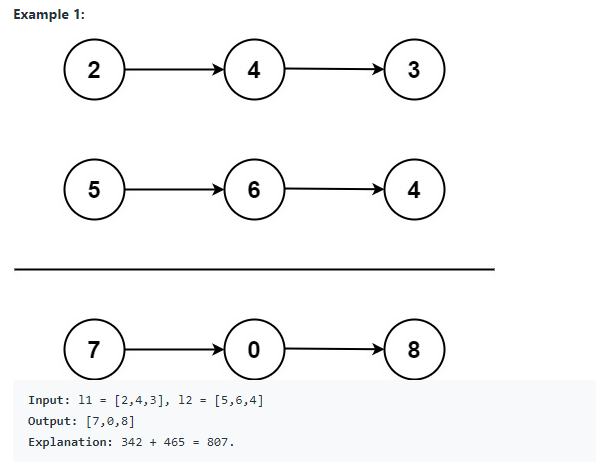
方法1:虚拟头结点顺序添加。
class Solution {// Solution 中的参考代码public ListNode addTwoNumbers(ListNode l1, ListNode l2) {// 1. 虚拟头结点,最后返回 dummyHead.nextListNode dummyHead = new ListNode(0);ListNode p = l1;ListNode q = l2;ListNode cur = dummyHead;int carry = 0;// 2. 有一个不为空就可以遍历while (p != null || q != null) {int x = (p != null) ? p.val : 0;int y = (q != null) ? q.val : 0;int sum = carry + x + y;carry = sum / 10;cur.next = new ListNode(sum % 10);cur = cur.next;if (p != null) {p = p.next;}if (q != null) {q = q.next;}}// 3. 最后还有进位,创建一个结点存放进位,并和链表连接if (carry > 0) {cur.next = new ListNode(carry);}return dummyHead.next;}}
方法2:求两个链表长度了,复杂度较高。
class Solution {// 两个链表相加public static ListNode addTwoNumbers(ListNode head1, ListNode head2) {int len1 = listLength(head1);int len2 = listLength(head2);// 1. 遍历得到链表长度,分辨出长短ListNode l = len1 >= len2 ? head1 : head2;ListNode s = l == head1 ? head2 : head1;ListNode curL = l;ListNode curS = s;ListNode last = curL;int carry = 0;int curNum = 0;// 2. 一起走过短链表的长度while (curS != null) {// 2.1 带进位相加,结果存储到长链表上,并计算进位项curNum = curL.val + curS.val + carry;curL.val = (curNum % 10);carry = curNum / 10;// last 唯一的作用是记录最后的结点last = curL;curL = curL.next;curS = curS.next;}// 3. 短链表走完了,开始走长链表while (curL != null) {curNum = curL.val + carry;curL.val = (curNum % 10);carry = curNum / 10;last = curL;curL = curL.next;}// 4. 当长链表走到null,但还是有进位的时候,if (carry != 0) {// 4.1 创建一个结点对象,把进位的1赋值给它,并把last 指向它last.next = new ListNode(1);}// 5. 链表相加的结果赋值给长链表了,返回长链表的头结点return l;}// 求链表长度public static int listLength(ListNode head) {int len = 0;while (head != null) {len++;head = head.next;}return len;}}
3. Longest Substring Without Repeating Characters
Given a string s, find the length of the longest substring without repeating characters.
Input: s = “abcabcbb”
Output: 3
Explanation: The answer is “abc”, with the length of 3.
Approach 1: Brute Force
public class Solution {public int lengthOfLongestSubstring(String s) {int n = s.length();int res = 0;for (int i = 0; i < n; i++) {for (int j = i; j < n; j++) {if (checkRepetition(s, i, j)) {res = Math.max(res, j - i + 1);}}}return res;}private boolean checkRepetition(String s, int start, int end) {int[] chars = new int[128];for (int i = start; i <= end; i++) {char c = s.charAt(i);chars[c]++;if (chars[c] > 1) {return false;}}return true;}}
Approach 2: Sliding Window
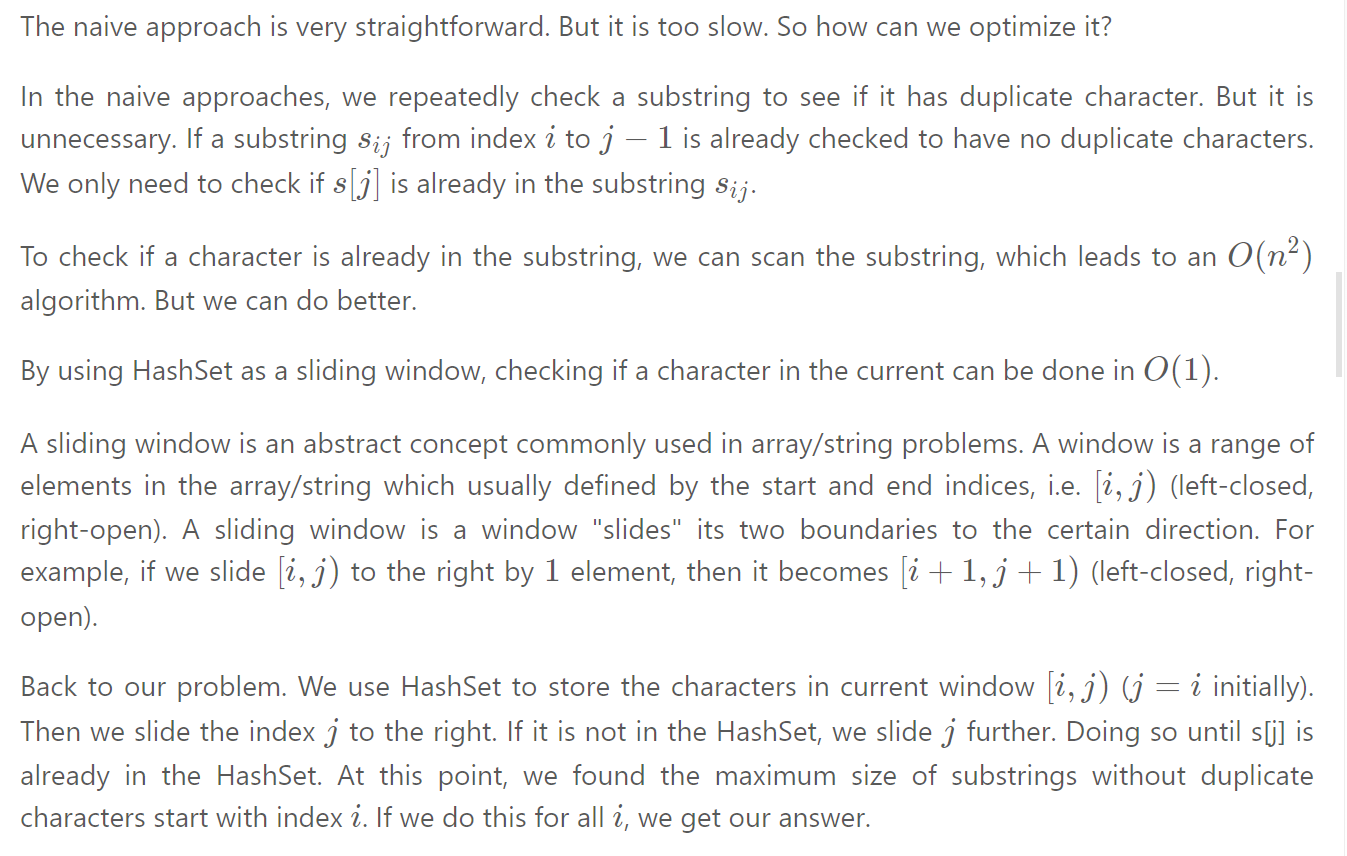
这个方法真的很妙啊,用两个变量就能抽象出一个滑动窗口对象,这个滑动窗口向右滑动,左侧边界控制窗口大小,每次把最长不重复字符串大小保存到变量中,最后返回最大值。
class Solution {public int lengthOfLongestSubstring(String s) {// 1.int[] chars = new int[128];int left = 0;int right = 0;int res = 0;while(right < s.length() ) {char r = s.charAt(right);chars[r]++; // 从0增加,记录该索引字符出现次数// 如果元素出现次数大于1,意味着滑动窗口中有这个元素// 就一直增加左边界索引,缩小滑动窗口while(chars[r] > 1) {char lf = s.charAt(left); // 滑动窗口最左侧元素chars[lf]--; // 滑动窗口缩小,最左侧元素所出现的次数减1left++; // 滑动窗口左侧边界往右扩展}res = Math.max(res, right - left + 1);right++; // 滑动窗口右移}return res;}}
Approach 3: Sliding Window Optimized
The above solution requires at most 2n steps. In fact, it could be optimized to require only n steps. Instead of using a set to tell if a character exists or not, we could define a mapping of the characters to its index. Then we can skip the characters immediately when we found a repeated character.
The reason is that if s[j]s[j] have a duplicate in the range [i, j)[i,j) with index j’j′, we don’t need to increase ii little by little. We can skip all the elements in the range [i, j’][i,j′] and let ii to be j’ + 1j′+1 directly.
使用哈希表做缓存:
public class Solution {public static int lengthOfLongestSubstring(String s) {int n = s.length();int ans = 0;Map<Character, Integer> map = new HashMap<>(); // current index of character// abcabcb// try to extend the range [i, j]for (int i = 0, k = 0; i < n; i++) {if (map.containsKey(s.charAt(i))) {int index = map.get(s.charAt(i));// k 代表的意思始终没有弄明白k = Math.max(index, k);}ans = Math.max(ans, i - k + 1);map.put(s.charAt(i), i + 1);}return ans;}}
4. Median of Two Sorted Arrays
Given two sorted arrays nums1 and nums2 of size m and n respectively, return the median of the two sorted arrays.
The overall run time complexity should be O(log (m+n)).
这道题看着没意思,暂时没关注。。。
5. Longest Palindromic Substring
Given a string s, return the longest palindromic substring in s.
参考:https://leetcode.wang/leetCode-5-Longest-Palindromic-Substring.html
这道题很难啊,暂时先放下。
6. Zigzag Conversion
The string “PAYPALISHIRING” is written in a zigzag pattern on a given number of rows like this: (you may want to display this pattern in a fixed font for better legibility)
方法1:顺序遍历。
按照 Z的轨迹,遍历每个字符的同时,将字符存到对应的行,用一个变量控制遍历的方向,到达边界时就改变方向。
class Solution {public String convert(String s, int numRows) {if (numRows == 1) {return s;}// 1. list容器,存储每层的字符串List<StringBuilder> level = new ArrayList<>();for (int i = 0; i < Math.min(s.length(), numRows); i++) {level.add(new StringBuilder());}int curRow = 0;boolean goingDown = false;char[] chars = s.toCharArray();// 2. 顺序遍历for (int i = 0; i < chars.length; i++) {// 3. 把字符添加到它所在的这层容器StringBuilder sb = level.get(curRow);sb.append(chars[i]);// 4. 到达边界就反转方向if (curRow == 0 || curRow == numRows - 1) {goingDown = !goingDown;}// 5. 根据方向标志,控制遍历脚步的正负curRow += goingDown ? 1 : -1;}// 6. 把各层结果汇总,最后返回StringBuilder ret = new StringBuilder();for (StringBuilder row :level) {ret.append(row);}return ret.toString();}}
7. Reverse Integer
Given a signed 32-bit integer x, return x with its digits reversed. If reversing x causes the value to go outside the signed 32-bit integer range [-2^31, 2^31 - 1], then return 0.
Assume the environment does not allow you to store 64-bit integers (signed or unsigned).
这道题考虑的细节有好几处呢:在Java中,int基本数据类型范围是 -2147483648~2147483647
对于大于 intMax 的讨论,此时 x 一定是正数,pop 也是正数。
- 如果 rev > intMax / 10 ,那么没的说,此时肯定溢出了。
- 如果 rev == intMax / 10 = 2147483647 / 10 = 214748364 ,此时 rev * 10 就是 2147483640 如果 pop 大于 7 ,那么就一定溢出了。但是!如果假设 pop 等于 8,那么意味着原数 x 是 8463847412 了,输入的是 int ,而此时是溢出的状态,所以不可能输入,所以意味着 pop 不可能大于 7 ,也就意味着 rev == intMax / 10 时不会造成溢出。
- 如果 rev < intMax / 10 ,意味着 rev 最大是 214748363 , rev * 10 就是 2147483630 , 此时再加上 pop ,一定不会溢出。
class Solution {public int reverse(int x) {int rev = 0;while (x != 0) {int pop = x % 10; // x 的末尾数字x /= 10; // 更新xif (rev > Integer.MAX_VALUE/10 ) {return 0;}if (rev < Integer.MIN_VALUE/10 ) {return 0;}rev = rev * 10 + pop; // 依次把x每位数字反转}return rev;}}
8. String to Integer
Implement the myAtoi(string s) function, which converts a string to a 32-bit signed integer (similar to C/C++’s atoi function).
这种题有点难啊。
方法1:
class Solution {public int myAtoi(String input) {int sign = 1;int result = 0;int index = 0;int n = input.length();// Discard all spaces from the beginning of the input string.while (index < n && input.charAt(index) == ' ') {index++;}// sign = +1, if it's positive number, otherwise sign = -1.if (index < n && input.charAt(index) == '+') {sign = 1;index++;} else if (index < n && input.charAt(index) == '-') {sign = -1;index++;}// Traverse next digits of input and stop if it is not a digitwhile (index < n && Character.isDigit(input.charAt(index))) {int digit = input.charAt(index) - '0';// Check overflow and underflow conditions.if ((result > Integer.MAX_VALUE / 10) ||(result == Integer.MAX_VALUE / 10 && digit > Integer.MAX_VALUE % 10)) {// If integer overflowed return 2^31-1, otherwise if underflowed return -2^31.return sign == 1 ? Integer.MAX_VALUE : Integer.MIN_VALUE;}// Append current digit to the result.result = 10 * result + digit;index++;}// We have formed a valid number without any overflow/underflow.// Return it after multiplying it with its sign.return sign * result;}}
9. Palindrome Number
Given an integer x, return true if x is palindrome integer.
An integer is a palindrome when it reads the same backward as forward.
- For example, 121 is a palindrome while 123 is not.
Approach 1: Revert half of the number
class Solution {public boolean isPalindrome(int x) {// Special cases:// As discussed above, when x < 0, x is not a palindrome.// Also if the last digit of the number is 0, in order to be a palindrome,// the first digit of the number also needs to be 0.// Only 0 satisfy this property.if (x < 0) {return false;}if (x % 10 == 0 && x != 0) {return false;}int rev = 0;while (x > rev) {rev = rev * 10 + x % 10;x /= 10;}// When the length is an odd number, we can get rid of the middle digit by revertedNumber/10// For example when the input is 12321, at the end of the while loop we get x = 12, revertedNumber = 123,// since the middle digit doesn't matter in palidrome(it will always equal to itself), we can simply get rid of it.return x == rev || x == rev / 10;}}
方法2:也是同样的方法,但细节不一样。
class Solution {public boolean isPalindrome(int x) {if (x < 0) {return false;}// 1. 得到原数字有多少位int digit = (int) (Math.log(x) / Math.log(10) + 1); //总位数int revert = 0;int pop = 0;// 2. 反转一半for (int i = 0; i < digit / 2; i++) {pop = x % 10;revert = revert * 10 + pop;x /= 10;}// 3. 如果是偶数位if (digit % 2 == 0 && x == revert) {return true;}// 4. 奇数情况 x 除以 10 去除 1 位if (digit % 2 != 0 && x / 10 == revert) {return true;}return false;}}
11. Container With Most Water
You are given an integer array height of length n. There are n vertical lines drawn such that the two endpoints of the ith line are (i, 0) and (i, height[i]).
Find two lines that together with the x-axis form a container, such that the container contains the most water.
Return the maximum amount of water a container can store.
Notice that you may not slant the container.
Input: height = [1,8,6,2,5,4,8,3,7]
Output: 49
Explanation: The above vertical lines are represented by array [1,8,6,2,5,4,8,3,7]. In this case, the max area of water (blue section) the container can contain is 49.
Approach 1: Brute Force
public int maxArea(int[] height) {int maxarea = 0;for (int left = 0; left < height.length; left++) {for (int right = left + 1; right < height.length; right++) {int width = right - left;int high= Math.min(height[left], height[right]);int curArea = width * high;maxarea = Math.max(maxarea, curArea);}}return maxarea;}
Approach 2: Two Pointer Approach
public class Solution {public int maxArea(int[] height) {int maxarea = 0;int left = 0;int right = height.length - 1;while(left < right) {int high = Math.min(height[left], height[right]);int area = (right - left) * high;maxarea = Math.max(maxarea, area);if (height[left] < height[right]) {left++;} else {right--;}}return maxarea;}}
14. Longest Common Prefix
Write a function to find the longest common prefix string amongst an array of strings.
If there is no common prefix, return an empty string “”.
Approach 1: Horizontal scanning
public String longestCommonPrefix(String[] strs) {if (strs.length == 0) {return "";}// 把第一个字符串作为LCPString prefix = strs[0];// 2. 依次与其他字符串比较for (int i = 1; i < strs.length; i++) {while (strs[i].indexOf(prefix) != 0) {// LCP 缩小一个字符prefix = prefix.substring(0, prefix.length() - 1);// 直到为空都没有LCP,那就返回空串if (prefix.isEmpty() ) {return "";}}}return prefix;}
19. Remove Nth Node From End of List
Given the head of a linked list, remove the nth node from the end of the list and return its head.
方法1:用容器存放结点,空间换时间。
class Solution {public ListNode removeNthFromEnd(ListNode head, int n) {// 1. 空间换时间,创建一个list容器List<ListNode> list = new ArrayList<>();ListNode original = head;int len = 0;// 2. 遍历链表,得到结点、长度等信息while (head != null) {list.add(head);len++;head = head.next;}if (len == 1) {return null;}// 题意是删除倒数第n个结点,只删除这一个节点if (len == n) {return original.next;}// 4. 从list中取出要删除结点的前一个结点int remove = len - n;ListNode pre = list.get(remove - 1);pre.next = pre.next.next; // 修改链接return original;}}
方法2:快慢双指针。
- 注意while循环条件,如果有空指针异常,会导致程序出错的。
要面对好几种特殊输入情况,代码细节挺难写的。
class Solution {public ListNode removeNthFromEnd(ListNode head, int n) {// 1. 虚拟头结点,指向原头结点ListNode dummy = new ListNode(0);dummy.next = head;// 2. 双指针// slow is at dummy not at head because we need to reach 1 node before the node we want to deleteListNode fast = head;ListNode slow = dummy;// 3. 快指针走 n 步for (int i = 0; i < n; i++) {fast = fast.next;}// 4. 快慢指针同步遍历,走到while (fast != null) {fast = fast.next;slow = slow.next;}// 5. 修改链接slow.next = slow.next.next;return dummy.next;}}
21. Merge Two Sorted Lists
You are given the heads of two sorted linked lists list1 and list2.
Merge the two lists in a one sorted list. The list should be made by splicing together the nodes of the first two lists.
Return the head of the merged linked list.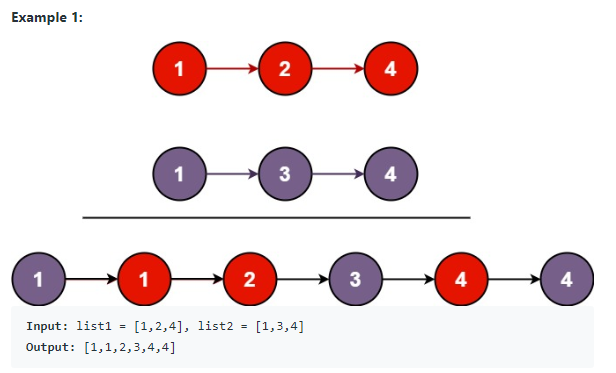
方法1:递归。
public class Solution {public ListNode mergeTwoLists(ListNode list1, ListNode list2) {if(list1 == null){return list2;}if(list2 == null){return list1;}ListNode mergeHead;if(list1.val < list2.val){mergeHead = list1;mergeHead.next = mergeTwoLists(list1.next, list2);} else{mergeHead = list2;mergeHead.next = mergeTwoLists(list1, list2.next);}return mergeHead;}}
方法2:迭代
class Solution {public static ListNode mergeTwoLists(ListNode head1, ListNode head2) {if (head1 == null || head2 == null) {return head1 == null ? head2 : head1;}// 1. 链表是升序,找到较小的作为新链表的头结点ListNode head = head1.val <= head2.val ? head1 : head2;// 2. 找到两个链表的起始位置ListNode cur1 = head.next;ListNode cur2 = head == head1 ? head2 : head1;ListNode pre = head;// 3. 两个链表都不为空,进行合并操作while (cur1 != null && cur2 != null) {if (cur1.val <= cur2.val) {pre.next = cur1;cur1 = cur1.next;} else {pre.next = cur2;cur2 = cur2.next;}pre = pre.next;}// 4. 遍历完一个链表,对另一个直接合并pre.next = cur1 != null ? cur1 : cur2;// 5. 返回新链表的头结点return head;}}
23. Merge k Sorted Lists
You are given an array of k linked-lists lists, each linked-list is sorted in ascending order.
Merge all the linked-lists into one sorted linked-list and return it.
class Solution {// 比较器类// 自己创建的类,要排序就需要实现比较器接口或使用其他方法public static class ListNodeComparator implements Comparator<ListNode> {// 重写compare方法,定义排序规则@Overridepublic int compare(ListNode o1, ListNode o2) {return o1.val - o2.val;}}// 合并k 个有序链表public static ListNode mergeKLists(ListNode[] lists) {if (lists == null) {return null;}// 1. 用Java内置数据结构创建一个优先级队列,默认是小根堆,需要传入一个比较器对象作为参数PriorityQueue<ListNode> heap = new PriorityQueue<>(new ListNodeComparator());// 2. 把列表中每个链表的头结点添加到堆for (int i = 0; i < lists.length; i++) {if (lists[i] != null) {heap.add(lists[i]);}}// if (heap.isEmpty()){// return null;// }// 3. 小根堆,推出堆顶元素,作为头结点// 发现链表问题不用递归的话都是这个步骤:// 第一步:单独处理头结点;// 第二步:在循环体中进行与第一步相似的步骤ListNode head = heap.poll();// 4. pre结点,并把下一个结点添加到堆,让小根堆保持固定的大小ListNode pre = head;if (pre.next != null) {heap.add(pre.next);}// 5. 小根堆的顶部是最小的元素,每次推出堆顶元素,并把pre的next指向它,链表就连接起来了,// 然后把它的next再添加到堆,元素在堆里面会再调整,把新的最小的元素移动到顶部,如此循环往复while (!heap.isEmpty()) {// 5.1 推出小根堆的堆顶元素ListNode cur = heap.poll();// 5.2 把它和前面排好序的链表建立链接关系,并移动prepre.next = cur;pre = cur;// 5.3 next不为空就添加到堆,堆会再动态调整的if (cur.next != null) {heap.add(cur.next);}}// 6. 最后一步当然是返回头结点了return head;}}
24. Swap Nodes in Pairs
Given a linked list, swap every two adjacent nodes and return its head. You must solve the problem without modifying the values in the list’s nodes (i.e., only nodes themselves may be changed.)
方法1:迭代。
class Solution {public ListNode swapPairs(ListNode head) {// 1. 避免单独讨论头结点的情况,申请虚拟头结点ListNode dummy = new ListNode(0);dummy.next = head;ListNode point = dummy;// 2. 遍历while (point.next != null && point.next.next != null) {ListNode swap1 = point.next;ListNode swap2 = point.next.next;// 3. 修改三个结点之间的链接point.next = swap2;swap1.next = swap2.next;swap2.next = swap1;// 4. 移动位置point = swap1;}return dummy.next;}}
方法2:递归。
一定要多看看,掌握这个方法。
public ListNode swapPairs(ListNode head) {// 1. 递归的basecaseif ((head == null)||(head.next == null)) {return head;}// 递归到最后,head是一对结点的第一个,// 先保存它的next结点,再改变它的指向,接着让它原来的next结点指向它,这时候就反转好了,最后返回保存的那个next结点// 2. 保存下一个结点ListNode n = head.next;// 3. 修改链接head.next = swapPairs(head.next.next);// 4. 反转原next的链接,让它指向headn.next = head;// 5. 返回反转后的头结点return n;}
25. Reverse Nodes in k-Group
Given the head of a linked list, reverse the nodes of the list k at a time, and return the modified list.
k is a positive integer and is less than or equal to the length of the linked list. If the number of nodes is not a multiple of k then left-out nodes, in the end, should remain as it is.
You may not alter the values in the list’s nodes, only nodes themselves may be changed.
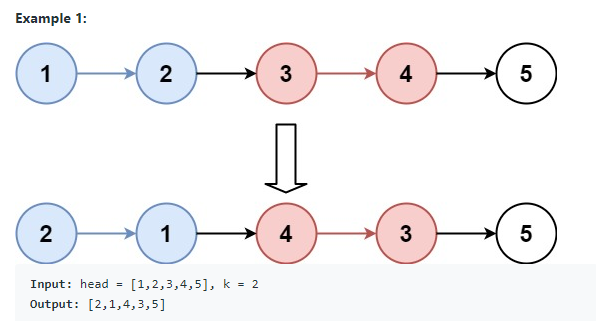
方法1:递归。
很巧妙,运行流程大概懂了,但写不出来。以k 个结点为一组进行反转,上面那道题是k 等于2的时候的特例。
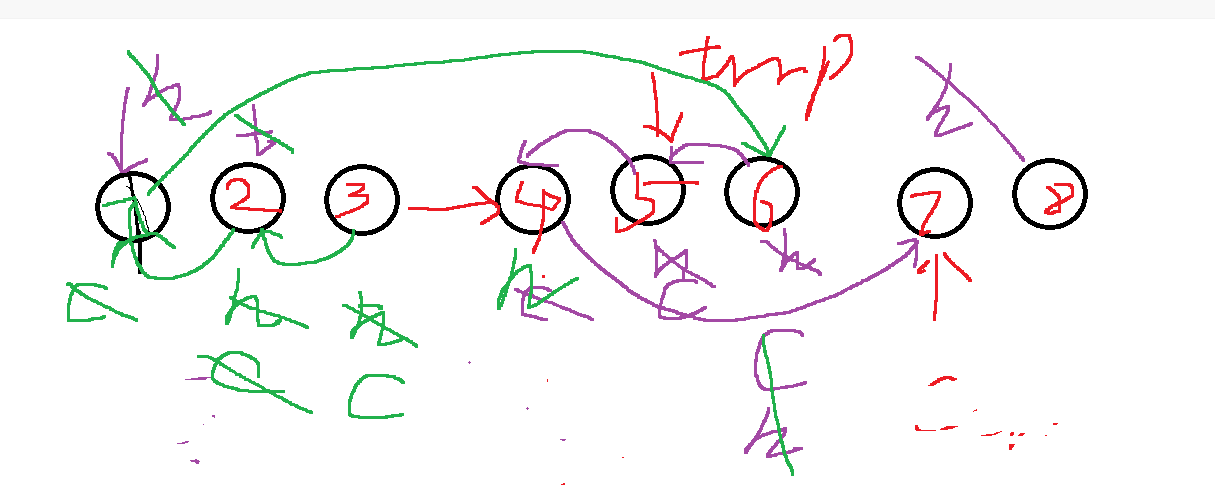
class Solution {// https://leetcode.com/problems/reverse-nodes-in-k-group/discuss/11423/Short-but-recursive-Java-code-with-comments// 代码很短,但是比较难理解,要创建几个结点并结合画图走一遍代码public static ListNode reverseKGroup(ListNode head, int k) {ListNode cur = head;int count = 0;// 1. 先走k 步while(cur != null && count != k) {cur = cur.next;count++;}// 2. 等于k说明成功走过k 个结点,到下一段的头结点了if(count == k) {// 2.1 一直递归到尾部,// 最后一段小于k 步,那就不会走第2步,到第3步,传入的参数head 原样返回cur = reverseKGroup(cur, k);// 2.2 反转链表while(count-- > 0) {ListNode tmp = head.next;head.next = cur;cur = head;head = tmp;}// 2.3 把head 复位head = cur;}// 3. 两种情况,小于k 步,最后一段不用反转,直接返回传入的参数head;或者是执行完第二步了return head;}}
方法2:迭代。
class Solution {public static ListNode reverseKGroup(ListNode head, int k) {// 1. 找到第一段要反转的两端结点ListNode start = head;ListNode end = getKGroupEnd(start, k);// 2. 判断是否能做反转,如果end为空,说明链表长度小于k,不用反转了if (end == null) {return head;}// 3. 保存反转后的头结点,就是第一段的endhead = end;// 4. 开始对第一段进行反转reverse(start, end);// 第一组的start,反转后变成最后一个结点ListNode lastEnd = start;// 5. 当第一组的尾部结点的next 不为空时while (lastEnd.next != null) {// 6. 找到这组的start 和endstart = lastEnd.next;end = getKGroupEnd(start, k);// 7. 和第2步一样,判断这组长度是否足够来反转if (end == null) {return head;}// 8. 对当前这段进行反转reverse(start, end);// 9. 反转后start 是尾,end 是头,使上一段的尾部指向end,start成为新的lastEndlastEnd.next = end;lastEnd = start;}// 10. 返回第3步保存好的头结点headreturn head;}// 找到链表从start开始的第k 个结点public static ListNode getKGroupEnd(ListNode start, int k) {while (start != null && --k != 0 ) {start = start.next;}return start;}// 反转链表,范围包含start 和endpublic static void reverse(ListNode start, ListNode end) {// 1. end 跳到下一段的开头结点位置end = end.next;ListNode pre = null;ListNode cur = start;ListNode next = null;while (cur != end) {next = cur.next;cur.next = pre;pre = cur;cur = next;}// 5. 此时start是反转后的尾部结点,修改它的next就是把这段链表和下一段连接起来start.next = end;}}
26. Remove Duplicates from Sorted Array
Given an integer array nums sorted in non-decreasing order, remove the duplicates in-place such that each unique element appears only once. The relative order of the elements should be kept the same.
Since it is impossible to change the length of the array in some languages, you must instead have the result be placed in the first part of the array nums. More formally, if there are k elements after removing the duplicates, then the first k elements of nums should hold the final result. It does not matter what you leave beyond the first k elements.
Return k after placing the final result in the first _k slots of _nums.
Do not allocate extra space for another array. You must do this by modifying the input array in-place with O(1) extra memory.
方法1:双指针。
class Solution {public int removeDuplicates(int[] nums) {if (nums.length == 0) {return 0;}int i = 0;for (int j = 1; j < nums.length; j++) {if (nums[j] != nums[i]) {i++;nums[i] = nums[j];}}return i + 1;}}
39. Combination Sum
Given an array of distinct integers candidates and a target integer target, return a list of all unique combinations of _candidates where the chosen numbers sum to target._ You may return the combinations in any order.
The same number may be chosen from candidates an unlimited number of times. Two combinations are unique if the frequency of at least one of the chosen numbers is different.
It is guaranteed that the number of unique combinations that sum up to target is less than 150 combinations for the given input.
Input: candidates = [2,3,6,7], target = 7
Output: [[2,2,3],[7]]
Explanation: 2 and 3 are candidates, and 2 + 2 + 3 = 7. Note that 2 can be used multiple times. 7 is a candidate, and 7 = 7. These are the only two combinations.
方法1:回溯法
class Solution {public List<List<Integer>> combinationSum(int[] candidates, int target) {List<List<Integer>> list = new ArrayList<>();backtrack(list, new ArrayList<>(), candidates, target, 0);return list;}private void backtrack(List<List<Integer>> list, List<Integer> res, int[] arr, int remain, int start) {// 1. 递归的basecase:小于0,无解if (remain < 0) {return;}// 2. 递归的basecase:等于0,刚好有一组解if (remain == 0) {list.add(new ArrayList<>(res ));} else {// 3. 没有凑够目标sum,才会继续试探// 试探所有情况,得到解或者走不通的时候就会回头for (int i = start; i < arr.length; i++) {// 添加,递归,移除,三句代码。递归的remain - arr[i]不能提出到外面res.add(arr[i]);backtrack(list, res, arr, remain - arr[i], i);// 关键步骤:找到解或者无解,回头移除末尾元素,继续尝试res.remove(res.size() - 1);}}}}
41. First Missing Positive
Given an unsorted integer array nums, return the smallest missing positive integer.
You must implement an algorithm that runs in O(n) time and uses constant extra space.
参考:https://leetcode.com/problems/first-missing-positive/discuss/17071/My-short-c++-solution-O(1
核心思想是:Put each number in its right place. For example: When we find 5, then swap it with A[4].At last, the first place where its number is not right, return the place + 1.
方法1:有点像桶排序哦。就是第一步判断那里,有一点绕。
class Solution {public int firstMissingPositive(int[] nums) {int n = nums.length;// 1. 遍历每个数字,放到合适的位置for (int i = 0; i < n; i++) {//判断交换回来的数字// 这里的判断好绕啊,分不清哪儿是哪儿了while (nums[i] > 0 && nums[i] <= n && nums[i] != nums[nums[i] - 1]) {//第 nums[i] 个位置的下标是 nums[i] - 1swap(nums, i, nums[i] - 1);}}// 2. 找出第一个 nums[i] != i + 1 的位置for (int i = 0; i < n; i++) {if (nums[i] != i + 1) {return i + 1;}}// 3. 如果之前的数都满足就返回 n + 1return n + 1;}private void swap(int[] nums, int i, int j) {int temp = nums[i];nums[i] = nums[j];nums[j] = temp;}}
42. Trapping Rain Water
Given n non-negative integers representing an elevation map where the width of each bar is 1, compute how much water it can trap after raining.
方法1:暴力破解。
class Solution {public int trap(int[] height) {int sum = 0;//最两端的列不用考虑,因为一定不会有水。所以下标从 1 到 length - 2for (int i = 1; i < height.length - 1; i++) {int max_left = 0;// 1. 找出左边最高for (int j = i - 1; j >= 0; j--) {if (height[j] > max_left) {max_left = height[j];}}int max_right = 0;// 2. 找出右边最高for (int j = i + 1; j < height.length; j++) {if (height[j] > max_right) {max_right = height[j];}}// 3. 找出两端较小的int min = Math.min(max_left, max_right);// 4. 只有较小的一段大于当前列的高度才会有水,其他情况不会有水if (min > height[i]) {sum = sum + (min - height[i]);}}return sum;}}
方法2:动态规划。
In brute force, we iterate over the left and right parts again and again just to find the highest bar size upto that index. But, this could be stored. Voila, dynamic programming.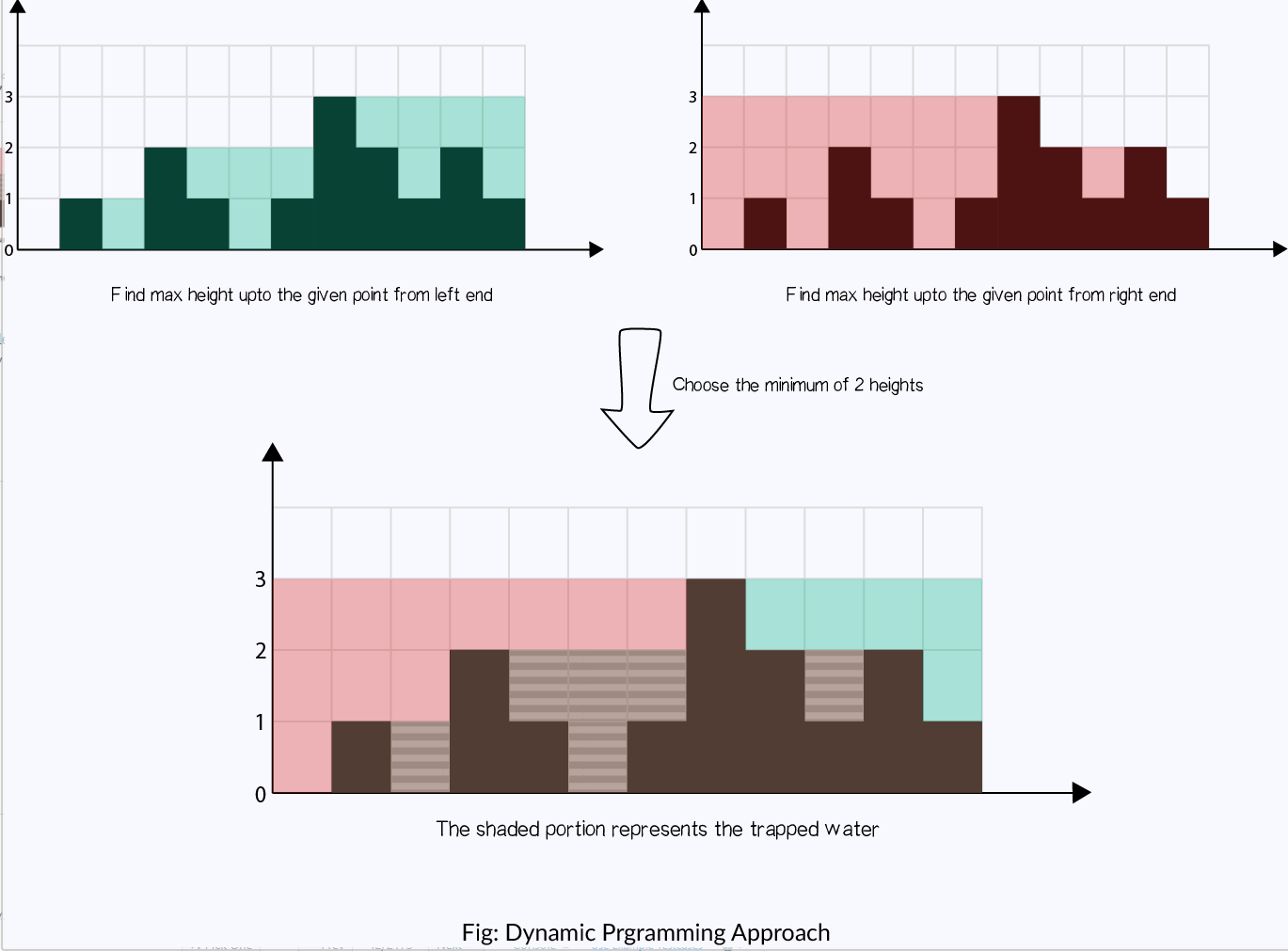
class Solution {public int trap(int[] height) {int sum = 0;// 1. 建立两个缓存数组,其中的元素代表 i 索引之前最高高度int[] max_left = new int[height.length];int[] max_right = new int[height.length];// 2. 遍历数组,得到关键信息。// height 中 i-1 和 i+1,是要包含端点的高度数据for (int i = 1; i < height.length - 1; i++) {max_left[i] = Math.max(max_left[i - 1], height[i - 1]);}for (int i = height.length - 2; i >= 0; i--) {max_right[i] = Math.max(max_right[i + 1], height[i + 1]);}// 3. 根据木桶效应,求出当前 i 索引上能存储多少容量的水for (int i = 1; i < height.length - 1; i++) {int min = Math.min(max_left[i], max_right[i]);if (min > height[i]) {sum = sum + (min - height[i]);}}return sum;}}
方法3:双指针。
class Solution {public int trap(int[] height) {int sum = 0;int max_left = 0;int max_right = 0;int left = 1;int right = height.length - 2; // 加右指针进去while (left -1 < right + 1) {//从左到右更if (height[left - 1] < height[right + 1]) {max_left = Math.max(max_left, height[left - 1]);int min = max_left;if (min > height[left]) {sum = sum + (min - height[left]);}left++;} else {max_right = Math.max(max_right, height[right + 1]);int min = max_right;if (min > height[right]) {sum = sum + (min - height[right]);}right--;}}return sum;}}
45. Jump Game II
Given an array of non-negative integers nums, you are initially positioned at the first index of the array.
Each element in the array represents your maximum jump length at that position.
Your goal is to reach the last index in the minimum number of jumps.
You can assume that you can always reach the last index.
Input: nums = [2,3,1,1,4]
Output: 2
Explanation: The minimum number of jumps to reach the last index is 2. Jump 1 step from index 0 to 1, then 3 steps to the last index.
方法1:贪心算法。
class Solution {public int jump(int[] nums) {int steps = 0;int end = 0; // 右边界int maxPosition = 0; // 最远能到达的位置for (int i = 0; i < nums.length - 1; i++) {maxPosition = Math.max(maxPosition, i + nums[i]);if (i == end) {end = maxPosition;steps++;}}return steps;}}
B站上也有部分LeetCode刷题讲解:https://www.bilibili.com/video/BV1Ag41137GQ?from=search&seid=15005845447613607360&spm_id_from=333.337.0.0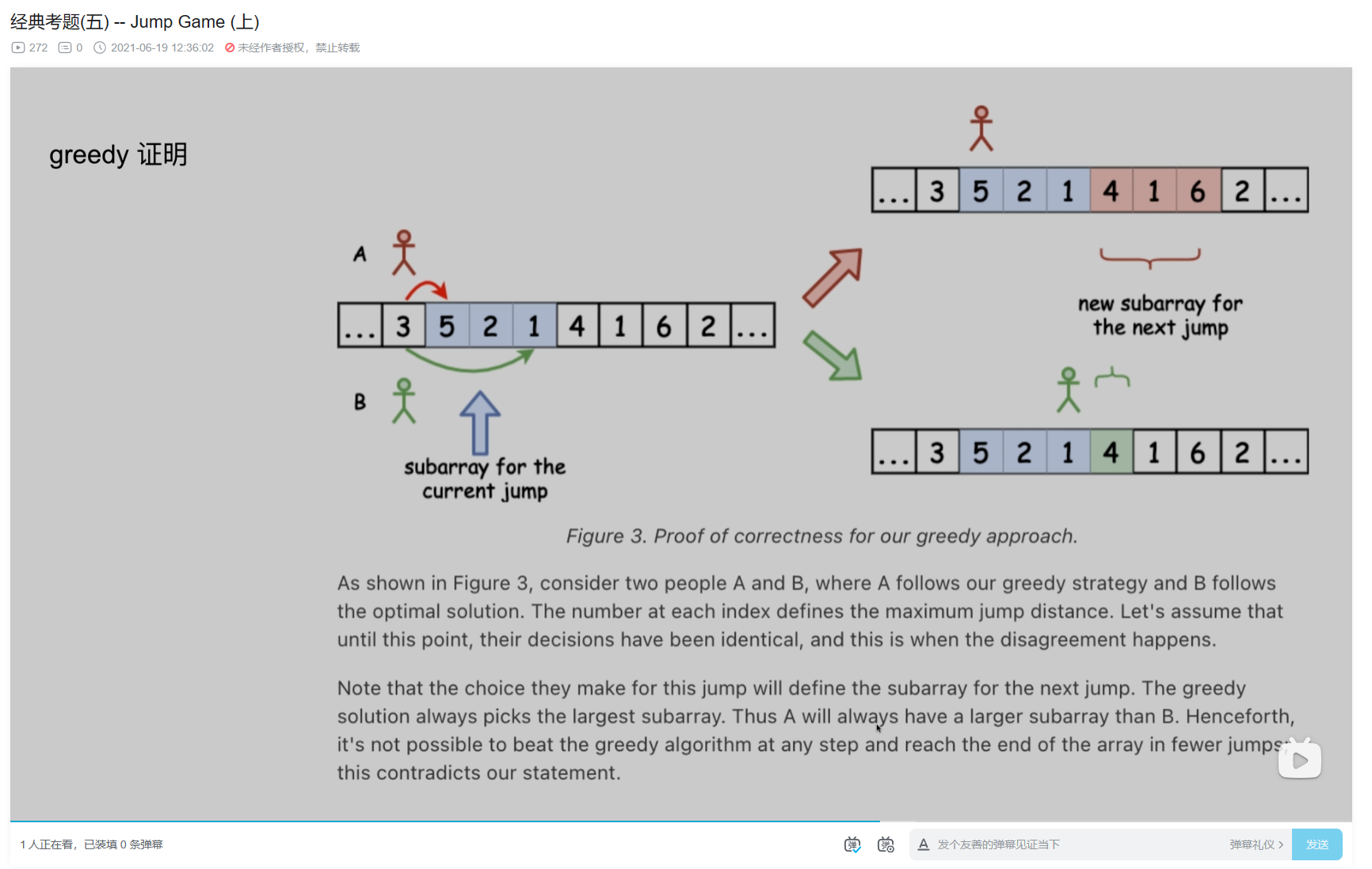
46. Permutations
Given an array nums of distinct integers, return all the possible permutations. You can return the answer in any order.
class Solution {public List<List<Integer>> permute(int[] nums) {List<List<Integer>> list = new ArrayList<>(); // 所有结果集backtrack(list, new ArrayList<>(), nums); // 调用方法return list;}private void backtrack(List<List<Integer>> list, List<Integer> tempList, int[] nums){// 1. 方法入口处,设置递归结束条件if(tempList.size() == nums.length){list.add(new ArrayList<>(tempList));}// 2. 遍历的同时,尝试所有情况,递归,并回退for(int i = 0; i < nums.length; i++){if(tempList.contains(nums[i])) {continue; // 已经存在的元素,跳过}tempList.add(nums[i]); // 2.1 将当前元素加入backtrack(list, tempList, nums); // 2.2 向后继续添加tempList.remove(tempList.size() - 1); // 2.3 将 tempList 刚添加的元素去掉,尝试新的元素}}}
48. Rotate Image
You are given an n x n 2D matrix representing an image, rotate the image by 90 degrees (clockwise).
You have to rotate the image in-place, which means you have to modify the input 2D matrix directly. DO NOT allocate another 2D matrix and do the rotation.
方法1:两次变换。
class Solution {public void rotate(int[][] matrix) {transpose(matrix);reflect(matrix);}//1. 以斜对角线为轴,交换元素,方向是\public void transpose(int[][] matrix) {int len = matrix.length;for (int i = 0; i < len; i++) {for (int j = 0; j < i; j++) {int temp = matrix[i][j];matrix[i][j] = matrix[j][i];matrix[j][i] = temp;}}}// 2. 以竖对称轴为中心,交换两侧的列public void reflect(int[][] matrix) {int len = matrix.length;int right = matrix.length - 1;for (int i = 0; i < len / 2; i++) {for (int k = 0; k < len; k++) {int temp = matrix[k][i];matrix[k][i] = matrix[k][right];matrix[k][right] = temp;}right--;}}}
方法2:由外向内按圈交换。
交换步骤如图所示: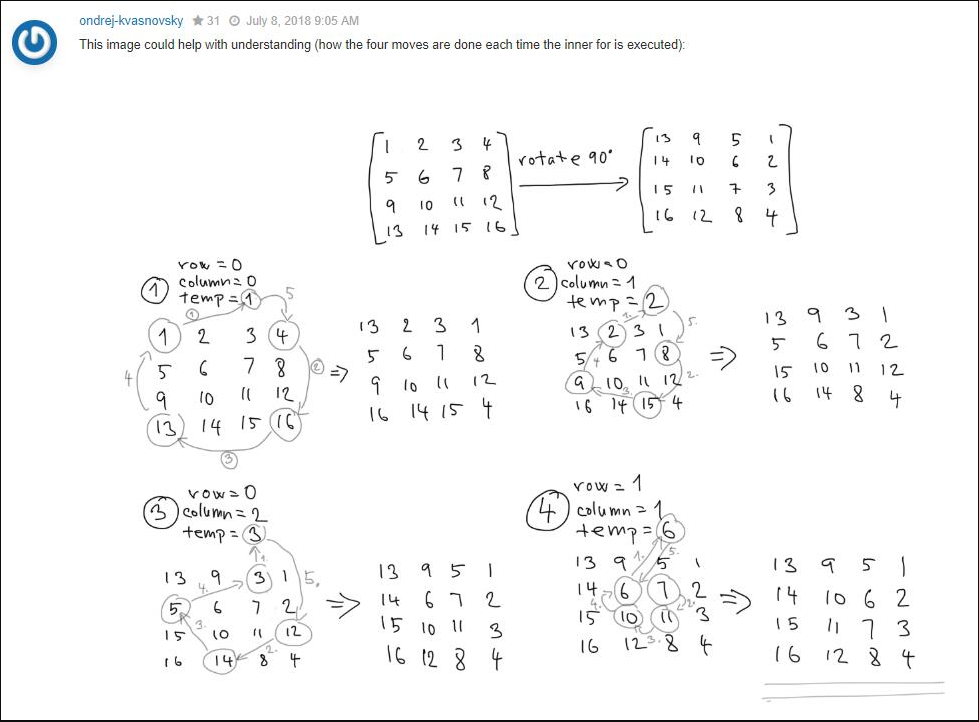
class Solution {public void rotate(int[][] matrix) {int n = matrix.length;// 控制层次for (int i = 0; i < n / 2; i++) {// 控制当前层,保证所有结点都要交换for (int j = i; j < n - 1 - i; j++) {// 1. 先保存一个点int tmp = matrix[i][j];// 2. 依次交换元素matrix[ i ][j] = matrix[n-1-j][i];matrix[n-1-j][i] = matrix[n-1-i][n-1-j];matrix[n-1-i][n-1-j] = matrix[j][n-1-i];matrix[j][n-1-i] = tmp;}}}}
51. N-Queens
The n-queens puzzle is the problem of placing n queens on an n x n chessboard such that no two queens attack each other.
Given an integer n, return all distinct solutions to the n-queens puzzle. You may return the answer in any order.
Each solution contains a distinct board configuration of the n-queens’ placement, where ‘Q’ and ‘.’ both indicate a queen and an empty space, respectively.
方法1:回溯法。
比较经典的回溯问题了,我们需要做的就是先在第一行放一个皇后,然后进入回溯,放下一行皇后的位置,一直走下去,如果已经放的皇后的数目等于 n 了,就加到最后的结果中。然后再回到上一行,变化皇后的位置,然后去找其他的解。
期间如果遇到当前行所有的位置都不能放皇后了,就再回到上一行,然后变化皇后的位置。再返回到下一行。我们只判断了列冲突和对角线冲突,至于行冲突,由于我们采取一行一行加皇后,所以一行只会有一个皇后,不会产生冲突。
class Solution {public List<List<String>> solveNQueens(int n) {List<List<String>> ans = new ArrayList<>();backtrack(n, ans, new ArrayList<Integer>());return ans;}private void backtrack(int n, List<List<String>> ans, List<Integer> currentQueen) {// 当前皇后的个数是否等于 n 了,等于的话就加到结果中if (currentQueen.size() == n) {List<String> temp = new ArrayList<>();for (int i = 0; i < n; i++) {char[] t = new char[n];Arrays.fill(t, '.');t[currentQueen.get(i)] = 'Q';temp.add(new String(t));}ans.add(temp);return;}// 尝试每一列for (int col = 0; col < n; col++) {// 当前列是否冲突if (!currentQueen.contains(col)) {// 判断对角线是否冲突if (isDiagonalAttack(currentQueen, col)) {continue;}// 将当前列的皇后加入currentQueen.add(col);// 去考虑下一行的情况backtrack(n, ans, currentQueen);// 将当前列的皇后移除,去判断下一列// 进入这一步就是两种情况,下边的行走不通了回到这里或者就是已经拿到了一个解回到这里currentQueen.remove(currentQueen.size() - 1);}}}private boolean isDiagonalAttack(List<Integer> currentQueen, int i) {int current_row = currentQueen.size();int current_col = i;//判断每一行的皇后的情况for (int row = 0; row < currentQueen.size(); row++) {//左上角的对角线和右上角的对角线,差要么相等,要么互为相反数,直接写成了绝对值if (Math.abs(current_row - row) == Math.abs(current_col - currentQueen.get(row))) {return true;}}return false;}}
class Solution {public List<List<String>> solveNQueens(int n) {char[][] chess = new char[n][n];for (int i = 0; i < n; i++) {for (int j = 0; j < n; j++) {chess[i][j] = '.';}}List<List<String>> res = new ArrayList<>();solve(res, chess, 0);return res;}private void solve(List<List<String>> res, char[][] chess, int row) {if (row == chess.length) {res.add(construct(chess));return;}for (int col = 0; col < chess.length; col++) {if (valid(chess, row, col)) {chess[row][col] = 'Q';solve(res, chess, row + 1);chess[row][col] = '.';}}}private boolean valid(char[][] chess, int row, int col) {// check all colsfor (int i = 0; i < row; i++) {if (chess[i][col] == 'Q') {return false;}}//check 45 degreefor (int i = row - 1, j = col + 1; i >= 0 && j < chess.length; i--, j++) {if (chess[i][j] == 'Q') {return false;}}//check 135for (int i = row - 1, j = col - 1; i >= 0 && j >= 0; i--, j--) {if (chess[i][j] == 'Q') {return false;}}return true;}private List<String> construct(char[][] chess) {List<String> path = new ArrayList<>();for (int i = 0; i < chess.length; i++) {path.add(new String(chess[i]));}return path;}}
54. Spiral Matrix
Given an m x n matrix, return all elements of the matrix in spiral order.
class Solution {public List<Integer> spiralOrder(int[][] matrix) {List<Integer> result = new LinkedList<>();if(matrix == null || matrix.length == 0) {return result;}int startRow = 0, endRow = matrix.length-1;int startCol = 0, endCol = matrix[0].length - 1;int dir = 0;while(startRow <= endRow && startCol <= endCol) {switch(dir) {case 0: //RIGHTfor(int col = startCol; col <= endCol; col++)result.add(matrix[startRow][col]);startRow++;break;case 1: //DOWNfor(int row = startRow; row <=endRow; row++)result.add(matrix[row][endCol]) ;endCol--;break;case 2://LEFTfor(int col = endCol; col >= startCol; col --)result.add(matrix[endRow][col]);endRow--;break;case 3://UPfor(int row = endRow; row >= startRow; row--)result.add(matrix[row][startCol]);startCol++;break;}dir = (dir + 1) % 4;}return result;}}
55. Jump Game
You are given an integer array nums. You are initially positioned at the array’s first index, and each element in the array represents your maximum jump length at that position.
Return true if you can reach the last index, or _false otherwise_.
public boolean canJump(int[] nums) {int max = 0;for (int i = 0; i < nums.length; i++) {if (i > max) {return false;}max = Math.max(max, nums[i] + i);}return true;}
98. Validate Binary Search Tree
Given the root of a binary tree, determine if it is a valid binary search tree (BST).
A valid BST is defined as follows:
- The left subtree of a node contains only nodes with keys less than the node’s key.
- The right subtree of a node contains only nodes with keys greater than the node’s key.
- Both the left and right subtrees must also be binary search trees.
class Solution {public boolean isValidBST(TreeNode root) {return validate(root, null, null);}public boolean validate(TreeNode root, Integer low, Integer high) {// Empty trees are valid BSTs.if (root == null) {return true;}// The current node's value must be between low and high.if ((low != null && root.val <= low) || (high != null && root.val >= high)) {return false;}// The left and right subtree must also be valid.return validate(root.left, low, root.val) && validate(root.right, root.val, high) ;}}
100. Same Tree
Given the roots of two binary trees p and q, write a function to check if they are the same or not.
Two binary trees are considered the same if they are structurally identical, and the nodes have the same value.
class Solution {public boolean isSameTree(TreeNode p, TreeNode q) {// 1. p 和q 都为空if (p == null && q == null) {return true;}// 2. p 和q 只有一个为空if (p == null || q == null) {return false;}// 3. 比较两个根结点if (p.val != q.val) {return false;}// 4. 比较左右子树boolean isSameLeft = isSameTree(p.left, q.left);boolean isSameRight = isSameTree(p.right, q.right);return isSameLeft && isSameRight;}}
101. Symmetric Tree
Given the root of a binary tree, check whether it is a mirror of itself (i.e., symmetric around its center).
class Solution {public boolean isSymmetric(TreeNode root) {return isMirror(root, root);}public static boolean isMirror(TreeNode h1, TreeNode h2) {// 1. 两个根节点都为空if (h1 == null && h2 == null) {return true;}// 2. 其中有一个为空if (h1 == null || h2 == null) {return false;}// 3. 判断值是否相同if (h1.val != h2.val){return false;}// 4. 相当于在同时检查镜像的两个点return isMirror(h1.left, h2.right) && isMirror(h1.right, h2.left);}}
104. Maximum Depth of Binary Tree
Given the root of a binary tree, return its maximum depth.
A binary tree’s maximum depth is the number of nodes along the longest path from the root node down to the farthest leaf node.
class Solution {// 以root为头的树,最大高度是多少返回!public static int maxDepth(TreeNode root) {// 1. 递归调用的basecase,即到最后一次调用,进入方法后根据基础条件返回给上一级调用者的信息if (root == null) {return 0;}return Math.max(maxDepth(root.left), maxDepth(root.right)) + 1;}}
105. Construct Binary Tree from Preorder and Inorder Traversal
Given two integer arrays preorder and inorder where preorder is the preorder traversal of a binary tree and inorder is the inorder traversal of the same tree, construct and return the binary tree.
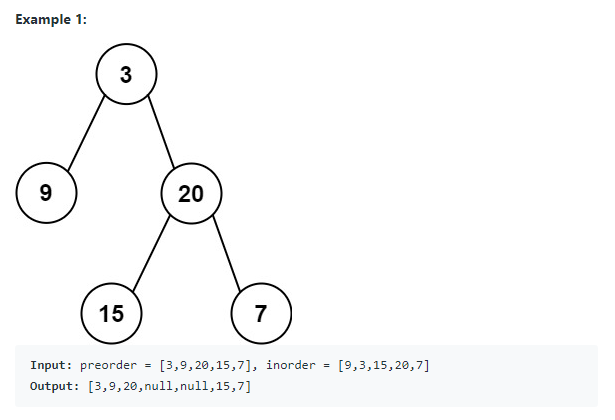
class Solution {// 类的静态变量,每次加一public static int preIndex;public static TreeNode buildTree(int[] preorder, int[] inorder) {// 1. 指针初始化为0preIndex = 0;// 2. build a hashmap to store value -> its index relationsHashMap<Integer, Integer> map = new HashMap<>();for (int i = 0; i < inorder.length; i++) {map.put(inorder[i], i);}// 3. 把哈希表作为参数传递return arrayToTree(preorder, 0, preorder.length - 1, map);}// 根据数组创建二叉树private static TreeNode arrayToTree(int[] preorder, int left, int right, HashMap<Integer, Integer> map) {// 1. if there are no elements to construct the treeif (left > right) {return null;}// 2. select the preIndex element as the root and increment itint rootValue = preorder[preIndex++];// 3. 有参构造,创建根节点TreeNode root = new TreeNode(rootValue);// 4. build left and right subtree// excluding map[rootValue] element because it's the root// 刚好不用考虑麻烦的边界了,更深层的原因还没理解root.left = arrayToTree(preorder, left, map.get(rootValue) - 1, map);root.right = arrayToTree(preorder, map.get(rootValue) + 1, right, map);// 5. 返回根节点给调用者return root;}}
107. Binary Tree Level Order Traversal II
Given the root of a binary tree, return the bottom-up level order traversal of its nodes’ values. (i.e., from left to right, level by level from leaf to root).
class Solution {// 二叉树宽度遍历public List<List<Integer>> levelOrderBottom(TreeNode root) {List<List<Integer>> res = new LinkedList<>();if (root == null) {return res;}Queue<TreeNode> queue = new LinkedList<>();queue.add(root);while (!queue.isEmpty()) {int size = queue.size();List<Integer> level = new LinkedList<>();for (int i = 0; i < size; i++) {TreeNode node = queue.poll();level.add(node.val);if (node.left != null) {queue.add(node.left);}if (node.right != null) {queue.add(node.right);}}res.add(0, level);}return res;}}
110. Balanced Binary Tree
Given a binary tree, determine if it is height-balanced.
For this problem, a height-balanced binary tree is defined as:a binary tree in which the left and right subtrees of every node differ in height by no more than 1.
参考思路:https://leetcode.com/problems/balanced-binary-tree/discuss/35691/The-bottom-up-O(N)-solution-would-be-better-solution-would-be-better)
方法1:自顶向下
严格按照平衡二叉树的定义来判断:左右子树的高度差不超过1,而且左右子树也是平衡的。对于当前每个结点,调用depth方法求他的左右孩子的同时,都不得不访问下面所有的孩子结点,时间复杂度是O(N);我们需要把二叉树的所有结点都访问一次,所以整体的复杂度是O(N ^ 2)。
// 方法2:自顶向下// 按照平衡二叉树的定义来判断public static boolean isBalanced(TreeNode root) {if (root == null) {return true;}int left = depth(root.left);int right = depth(root.right);if (Math.abs(left - right) > 1) {return false;}return isBalanced(root.left) && isBalanced(root.right);}private static int depth(TreeNode root) {if (root == null) {return 0;}int left = depth(root.left);int right = depth(root.right);return Math.max(left, right) + 1;}
方法2:自底向上。
DFS,也是二叉树的先序遍历,每个结点只会访问一次。在DFS 递归时返回当前结点的高度,如果当前结点是平衡的,就返回一个非负数,否则返回-1。根据左右孩子的高度,它们的父节点也可以判断出是否是平衡的,并得出它应该向上返回的值。
class Solution {// 方法1:DFS// 从底往上,每个结点只访问一次// LeetCode上的解答:https://leetcode.com/problems/balanced-binary-tree/discuss/35691/The-bottom-up-O(N)-solution-would-be-betterpublic static boolean isBalanced(TreeNode root) {return dfsTree(root) != -1;}private static int dfsTree(TreeNode root) {// 1. 空结点if (root == null) {return 0;}// 2. 遍历左右子树// 如果高度为-1,不是平衡的,直接返回。这个-1应该是第3步返回的结果int leftHeight = dfsTree(root.left);if (leftHeight == -1) {return -1;}int rightHeight = dfsTree(root.right);if (rightHeight == -1) {return -1;}// 3. 判断是否是平衡二叉树if (Math.abs(leftHeight - rightHeight) > 1) {return -1;}// 4. 返回当前树的高度给上一层return Math.max(leftHeight, rightHeight) + 1;}}
112. Path Sum
Given the root of a binary tree and an integer targetSum, return true if the tree has a root-to-leaf path such that adding up all the values along the path equals targetSum.
A leaf is a node with no children.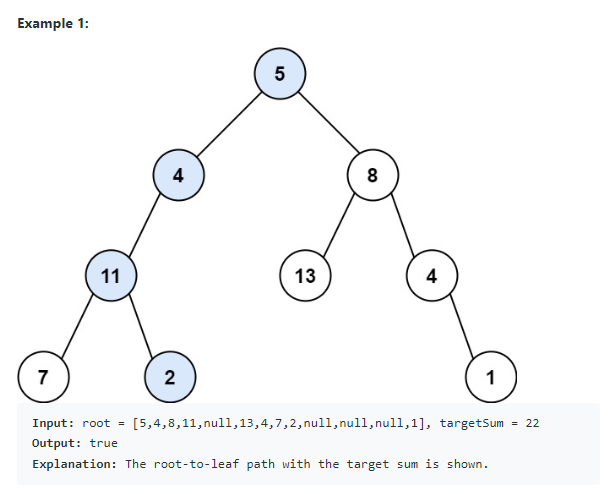
class Solution {public static boolean hasPathSum(TreeNode root, int targetSum) {if (root == null) {return false;}if (root.left == null && root.right == null) {if (targetSum - root.val == 0) {return true;}return false;}boolean lf = hasPathSum(root.left, targetSum - root.val);boolean rt = hasPathSum(root.right, targetSum - root.val);return (lf || rt);}}
113. Path Sum II
Given the root of a binary tree and an integer targetSum, return all root-to-leaf paths where the sum of the node values in the path equals _targetSum. Each path should be returned as a list of the node values, not node references_.
A root-to-leaf path is a path starting from the root and ending at any leaf node. A leaf is a node with no children.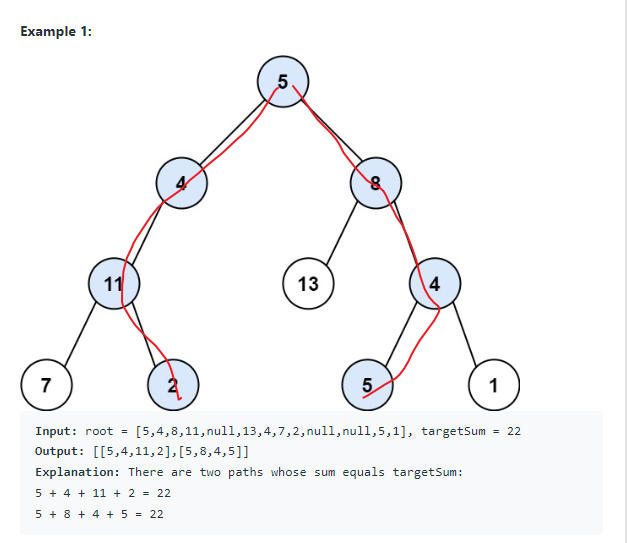
方法1:DFS 深度优先搜索。
在二叉树中,先序遍历其实就是深度优先搜索的特殊情况。
class Solution {public List<List<Integer>> pathSum(TreeNode root, int targetSum) {// 1. res是结果集List<List<Integer>> res = new ArrayList<>();if (root == null) {return res;}// 2. path是路径集,存储的是一条完整的路径List<Integer> path = new ArrayList<>();// 3. 调用方法,dfsProcess(root, path, targetSum, res);// 4. 返回结果集return res;}private void dfsProcess(TreeNode root, List<Integer> path, int targetSum, List<List<Integer>> res) {// 1. basecase: 为空if (root == null) {return;}// 2. basecase:叶子结点if (root.left == null && root.right == null) {if (targetSum - root.val == 0) {path.add(root.val);// 这里传入path对吗,之后path 的内容会改变的res.add(new ArrayList<>(path));path.remove(path.size() - 1);}// 访问过叶子结点后,返回return;}// 3. 遍历根节点,path 列表添加结点的值path.add(root.val);// 4. 遍历根节点的左右孩子dfsProcess(root.left, path,targetSum-root.val, res);dfsProcess(root.right, path,targetSum-root.val, res);// 5. 遍历完删除列表尾部元素,向上返回path.remove(path.size() - 1);}}

若有收获,就点个赞吧
0 人点赞


