FIFO:first in first out 先进先出 ——> 队列 首先处理数据结构的第一个元素
LIFO: last in first out 后进先出 ——>栈 首先处理数据结构中的最后一个元素
一、队列
1.关于队列的一些要点:
- 新元素总是添加在队列的末尾。
- 移除元素总是移除队列的第一个元素。
2.基本队列的实现示例及其缺点:
1.用动态数组和指向头部的索引实现(Java):
```java // “static void main” must be defined in a public class.
class MyQueue {
// store elements
private List
// a pointer to indicate the start position
private int p_start;
public MyQueue() {
data = new ArrayList
/ Delete an element from the queue. Return true if the operation is successful. /
public boolean deQueue() {
if (isEmpty() == true) {
return false;
}
p_start++;
return true;
}
/** Get the front item from the queue. /
public int Front() {
return data.get(p_start);
}
/* Checks whether the queue is empty or not. /
public boolean isEmpty() {
return p_start >= data.size();
}
};
public class Main { public static void main(String[] args) { MyQueue q = new MyQueue(); q.enQueue(5); q.enQueue(3); if (q.isEmpty() == false) { System.out.println(q.Front()); } q.deQueue(); if (q.isEmpty() == false) { System.out.println(q.Front()); } q.deQueue(); if (q.isEmpty() == false) { System.out.println(q.Front()); } } }
<a name="yN66v"></a>##### 2.缺点:随着起始指针的移动,浪费了越来越多的空间。<a name="AQSVr"></a>##### 3.解决方案:循环队列。<a name="cv4Xu"></a>#### 3.循环队列的实现:<a name="A740B"></a>##### 1.链表法实现:```javaclass Node {public int value;public Node nextNode;public Node(int value) {this.value = value;this.nextNode = null;}}class MyCircularQueue {private Node head, tail;private int count;private int capacity;/** Initialize your data structure here. Set the size of the queue to be k. */public MyCircularQueue(int k) {this.capacity = k;}/** Insert an element into the circular queue. Return true if the operation is successful. */public boolean enQueue(int value) {if (this.count == this.capacity)return false;Node newNode = new Node(value);if (this.count == 0) {head = tail = newNode;} else {tail.nextNode = newNode;tail = newNode;}this.count += 1;return true;}/** Delete an element from the circular queue. Return true if the operation is successful. */public boolean deQueue() {if (this.count == 0)return false;this.head = this.head.nextNode;this.count -= 1;return true;}/** Get the front item from the queue. */public int Front() {if (this.count == 0)return -1;elsereturn this.head.value;}/** Get the last item from the queue. */public int Rear() {if (this.count == 0)return -1;elsereturn this.tail.value;}/** Checks whether the circular queue is empty or not. */public boolean isEmpty() {return (this.count == 0);}/** Checks whether the circular queue is full or not. */public boolean isFull() {return (this.count == this.capacity);}}
2.数组法实现:
class MyCircularQueue {private int[] queue;private int headIndex;private int count;private int capacity;/** Initialize your data structure here. Set the size of the queue to be k. */public MyCircularQueue(int k) {this.capacity = k;this.queue = new int[k];this.headIndex = 0;this.count = 0;}/** Insert an element into the circular queue. Return true if the operation is successful. */public boolean enQueue(int value) {if (this.count == this.capacity)return false;this.queue[(this.headIndex + this.count) % this.capacity] = value;this.count += 1;return true;}/** Delete an element from the circular queue. Return true if the operation is successful. */public boolean deQueue() {if (this.count == 0)return false;this.headIndex = (this.headIndex + 1) % this.capacity;this.count -= 1;return true;}/** Get the front item from the queue. */public int Front() {if (this.count == 0)return -1;return this.queue[this.headIndex];}/** Get the last item from the queue. */public int Rear() {if (this.count == 0)return -1;int tailIndex = (this.headIndex + this.count - 1) % this.capacity;return this.queue[tailIndex];}/** Checks whether the circular queue is empty or not. */public boolean isEmpty() {return (this.count == 0);}/** Checks whether the circular queue is full or not. */public boolean isFull() {return (this.count == this.capacity);}}
4.Java内置库的队列:
1.初始化:
Queue<Integer> queue=new LinkedList<>();Deque<Integer> deque=new LinkedList<>();
2.常用方法:
queue.push(1);int i=queue.peek();//i=1int j=queue.poll();//j=1boolean b=queue.isEmpty();//b=truedeque.addLast(1);int i1=deque.getFirst();//i1=1int j1=deque.removeFirst();//j1=1;boolean bo=deque.isEmpty();//bo=true
5.队列的高级应用:广度优先搜索(BFS)
1.BFS : Breadth First Search
2.BFS的解释:
首先搜索和s距离为k的所有顶点,然后再去搜索和S距离为k+l的其他顶点。
3.BFS的应用:
4.BFS的优化:
广度搜索的判断重复如果直接判断十分耗时,我们一般借助哈希表来优化时间复杂度。
5.BFS一般框架实现代码(伪代码):
// 计算从起点 start 到终点 target 的最近距离int BFS(Node start, Node target) {Queue<Node> q; // 核心数据结构Set<Node> visited; // 避免走回头路q.offer(start); // 将起点加入队列visited.add(start);int step = 0; // 记录扩散的步数while (q not empty) {int sz = q.size();/* 将当前队列中的所有节点向四周扩散 */for (int i = 0; i < sz; i++) {Node cur = q.poll();/* 划重点:这里判断是否到达终点 */if (cur is target)return step;/* 将 cur 的相邻节点加入队列 */for (Node x : cur.adj())if (x not in visited) {q.offer(x);visited.add(x);}}/* 划重点:更新步数在这里 */step++;}}
6.经典题举例:
(1)leetcode279 完全平方数: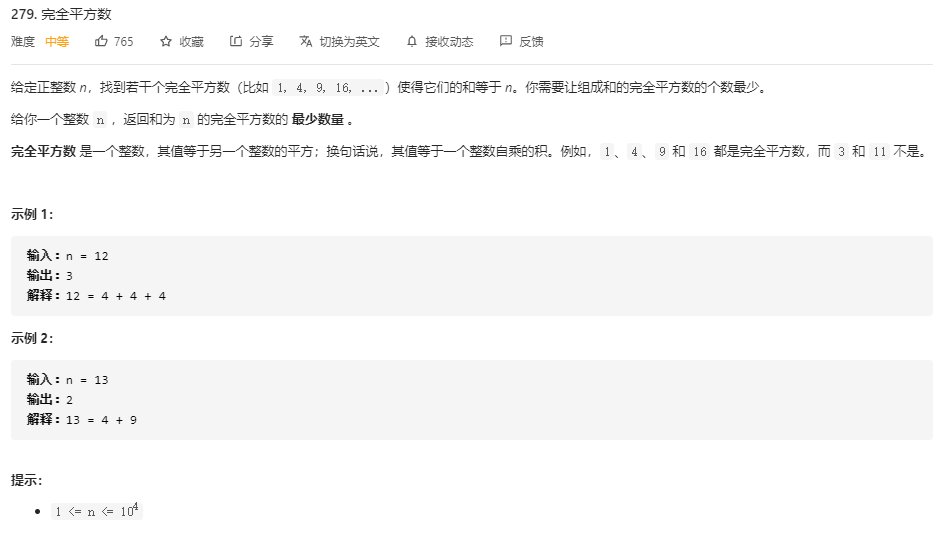
class Solution {public int numSquares(int n) {Queue<Integer> queue = new LinkedList<>();Set<Integer> visited = new HashSet<>();queue.add(0);visited.add(0);int distance = 0;while (!queue.isEmpty()) {distance++;int size = queue.size();for (int i = 0; i < size; i++) {int curr = queue.poll();for (int j = 1; j * j + curr <= n; j++) {int next = j * j + curr;if (next == n) return distance;if (next < n && !visited.contains(next)) {queue.add(next);visited.add(next);}}}}return distance;}}
(2)leetcode200 岛屿数量:
class Solution {public int numIslands(char[][] grid) {int count = 0;for(int i = 0; i < grid.length; i++) {for(int j = 0; j < grid[0].length; j++) {if(grid[i][j] == '1'){bfs(grid, i, j);count++;}}}return count;}private void bfs(char[][] grid, int i, int j){Queue<int[]> list = new LinkedList<>();list.add(new int[] { i, j });while(!list.isEmpty()){int[] cur = list.remove();i = cur[0]; j = cur[1];if(0 <= i && i < grid.length && 0 <= j && j < grid[0].length && grid[i][j] == '1') {grid[i][j] = '0';list.add(new int[] { i + 1, j });list.add(new int[] { i - 1, j });list.add(new int[] { i, j + 1 });list.add(new int[] { i, j - 1 });}}}}
6.BFS升级:双向BFS
二、栈
1.关于栈的一些要点:
- 在栈这种数据结构中,我们首先处理的是最新元素。
- 删除时首先删除最新元素。
- 插入时也直接插到末尾。
2.基本栈的实现示例:
```java // “static void main” must be defined in a public class. class MyStack { private Listdata; // store elements public MyStack() {
} /* Insert an element into the stack. / public void push(int x) {data = new ArrayList<>();
} /* Checks whether the queue is empty or not. / public boolean isEmpty() {data.add(x);
} /* Get the top item from the queue. / public int top() {return data.isEmpty();
} /* Delete an element from the queue. Return true if the operation is successful. / public boolean pop() {return data.get(data.size() - 1);
} };if (isEmpty()) {return false;}data.remove(data.size() - 1);return true;
public class Main { public static void main(String[] args) { MyStack s = new MyStack(); s.push(1); s.push(2); s.push(3); for (int i = 0; i < 4; ++i) { if (!s.isEmpty()) { System.out.println(s.top()); } System.out.println(s.pop()); } } }
<a name="at0fv"></a>#### 3.Java内置库的栈:<a name="NPi3o"></a>##### 1.初始化:```javaStack<Integer> stack1=new LinkedList<>();Deque<Integer> stack2=new LinkedList<>();
2.常用方法:
stack1.push(1);stack2.addFirst(1);int i=stack1.peek();//i=1int j=stack2.getFirst();//j=1int k=stack1.poll();//k=1int l=stack2.removeFirst();//l=1stack1.peek();//nullstack2.getFirst();//null
4.栈的高级应用:深度优先搜索(DFS)
1.DFS:Depth First Search
2.DFS解释:
(1)访问顶点v;
(2)依次从v的未被访问的邻接点出发,对图进行深度优先遍历;直至图中和v有路径相通的顶点都被访问;
(3)若此时图中尚有顶点未被访问,则从一个未被访问的顶点出发,重新进行深度优先遍历,直到图中所有顶点均被访问过为止。
3.DFS应用:
4.DFS的缺点:
5.DFS一般框架实现代码(伪代码):
(递归方案)
/** Return true if there is a path from cur to target.*/boolean DFS(Node cur, Node target, Set<Node> visited) {return true if cur is target;for (next : each neighbor of cur) {if (next is not in visited) {add next to visted;return true if DFS(next, target, visited) == true;}}return false;}
(显式栈方案)
/** Return true if there is a path from cur to target.*/boolean DFS(int root, int target) {Set<Node> visited;Stack<Node> s;add root to s;while (s is not empty) {Node cur = the top element in s;return true if cur is target;for (Node next : the neighbors of cur) {if (next is not in visited) {add next to s;add next to visited;}}remove cur from s;}return false;}
6.经典题举例:
leetcode 200 岛屿数量:
class Solution {public int numIslands(char[][] grid) {int count = 0;for(int i = 0; i < grid.length; i++) {for(int j = 0; j < grid[0].length; j++) {if(grid[i][j] == '1'){dfs(grid, i, j);count++;}}}return count;}private void dfs(char[][] grid, int i, int j){if(i < 0 || j < 0 || i >= grid.length || j >= grid[0].length || grid[i][j] == '0') return;grid[i][j] = '0';dfs(grid, i + 1, j);dfs(grid, i, j + 1);dfs(grid, i - 1, j);dfs(grid, i, j - 1);}}
leetcode 133 克隆图(图的深拷贝)
/*// Definition for a Node.class Node {public int val;public List<Node> neighbors;public Node() {val = 0;neighbors = new ArrayList<Node>();}public Node(int _val) {val = _val;neighbors = new ArrayList<Node>();}public Node(int _val, ArrayList<Node> _neighbors) {val = _val;neighbors = _neighbors;}}*/class Solution {public Node cloneGraph(Node node) {Map<Node, Node> lookup = new HashMap<>();return dfs(node, lookup);}private Node dfs(Node node, Map<Node,Node> lookup) {if (node == null) return null;if (lookup.containsKey(node)) return lookup.get(node);Node clone = new Node(node.val, new ArrayList<>());lookup.put(node, clone);for (Node n : node.neighbors)clone.neighbors.add(dfs(n,lookup));return clone;}}
leetcode 494 目标和:
class Solution {int count = 0;public int findTargetSumWays(int[] nums, int S) {dfs(nums,0,0,S);return count;}public void dfs(int[] nums,int i,int sum,int S){if(i==nums.length){if(sum==S){count++;}}else {dfs(nums,i+1,sum+nums[i],S);dfs(nums,i+1,sum-nums[i],S);}}}
三、BFS模板
1.如果不需要确定当前遍历到了哪一层,BFS 模板如下
while queue 不空:cur = queue.pop()for 节点 in cur的所有相邻节点:if 该节点有效且未访问过:queue.push(该节点)
2.如果需要确定,如下
这里增加了 level 表示当前遍历到二叉树中的哪一层了,也可以理解为在一个图中,现在已经走了多少步了。size 表示在当前遍历层有多少个元素,也就是队列中的元素数,我们把这些元素一次性遍历完,即把当前层的所有元素都向外走了一步。
level = 0while queue 不空:size = queue.size()while (size --) {cur = queue.pop()for 节点 in cur的所有相邻节点:if 该节点有效且未被访问过:queue.push(该节点)}level ++;

若有收获,就点个赞吧
0 人点赞


