146. LRU Cache
需要注意的地方:任意BiListNode实例不仅存在于双向链表中,还存在于**LRUcache**中,添加和删除的时候必须同步进行。
class BiListNode:def __init__(self, key=0, value=0):self.key = keyself.value = valueself.next = Noneself.prev = Noneclass LRUCache:def __init__(self, capacity: int):self.LRU = dict() # 存放key:BiListNode(key,value)的字典self.capacity = capacityself.size = 0self.head = BiListNode() # 避免空判断,伪头尾节点self.tail = BiListNode()self.head.next = self.tail # 靠近头部的为最近使用(get, put)的节点,反之亦然self.tail.prev = self.headdef get(self, key: int) -> int:if key not in self.LRU:return -1node = self.LRU[key]self.delete_node(node)self.add_to_head(node)return node.valuedef put(self, key: int, value: int) -> None:if key in self.LRU:node = self.LRU[key]node.value = value # 存储的是节点,会一并更改self.delete_node(node)self.add_to_head(node)else:node = BiListNode(key, value)self.LRU[key] = node # 不要忘记加入LRU缓存!self.add_to_head(node)self.size += 1if self.size > self.capacity:tail_node = self.tail.prevself.delete_node(tail_node)self.LRU.pop(tail_node.key) # 不要忘记删除LRU缓存!self.size -= 1def delete_node(self, node):node.prev.next = node.nextnode.next.prev = node.prevdef add_to_head(self, node):node.next, node.prev = self.head.next, self.headself.head.next = nodenode.next.prev = node
- 时间复杂度:
get和put均为
- 空间复杂度:

208. Implement Trie (Prefix Tree)
Approach I** 建立TrieNode节点
每个TrieNode节点拥有一个children数组,指向26**个字母,is_end则代表是否为单词尾部。
class TrieNode:def __init__(self):self.children = [None] * 26self.is_end = Falseclass Trie:def __init__(self):self.root = TrieNode()def insert(self, word: str) -> None:node = self.rootfor ch in word:index = ord(ch) - ord('a')if not node.children[index]:node.children[index] = TrieNode()node = node.children[index]node.is_end = Truedef search(self, word: str) -> bool:node = self.rootfor ch in word:index = ord(ch) - ord('a')if not node.children[index]:return Falsenode = node.children[index]return node.is_enddef startsWith(self, prefix: str) -> bool:node = self.rootfor ch in prefix:index = ord(ch) - ord('a')if not node.children[index]:return Falsenode = node.children[index]return True
- 时间复杂度:初始化
 ,每次查询或插入为
 ,
, 是字符串或前缀的长度
 - 空间复杂度:
 ,
, 是字符串长度之和,
 是字符集大小(26)
Approach II** 直接使用字典**
class Trie:def __init__(self):self.lookup = {} # 查询字典(树的根节点)def insert(self, word: str) -> None:node = self.lookupfor ch in word:if ch not in node:node[ch] = {}node = node[ch]node['#'] = '#' # 单词尾部标记def search(self, word: str) -> bool:node = self.lookupfor ch in word:if ch not in node:return Falsenode = node[ch]return True if '#' in node else Falsedef startsWith(self, prefix: str) -> bool:node = self.lookupfor ch in prefix:if ch not in node:return Falsenode = node[ch]return True
440. K-th Smallest in Lexicographical Order
**字典树**应用题。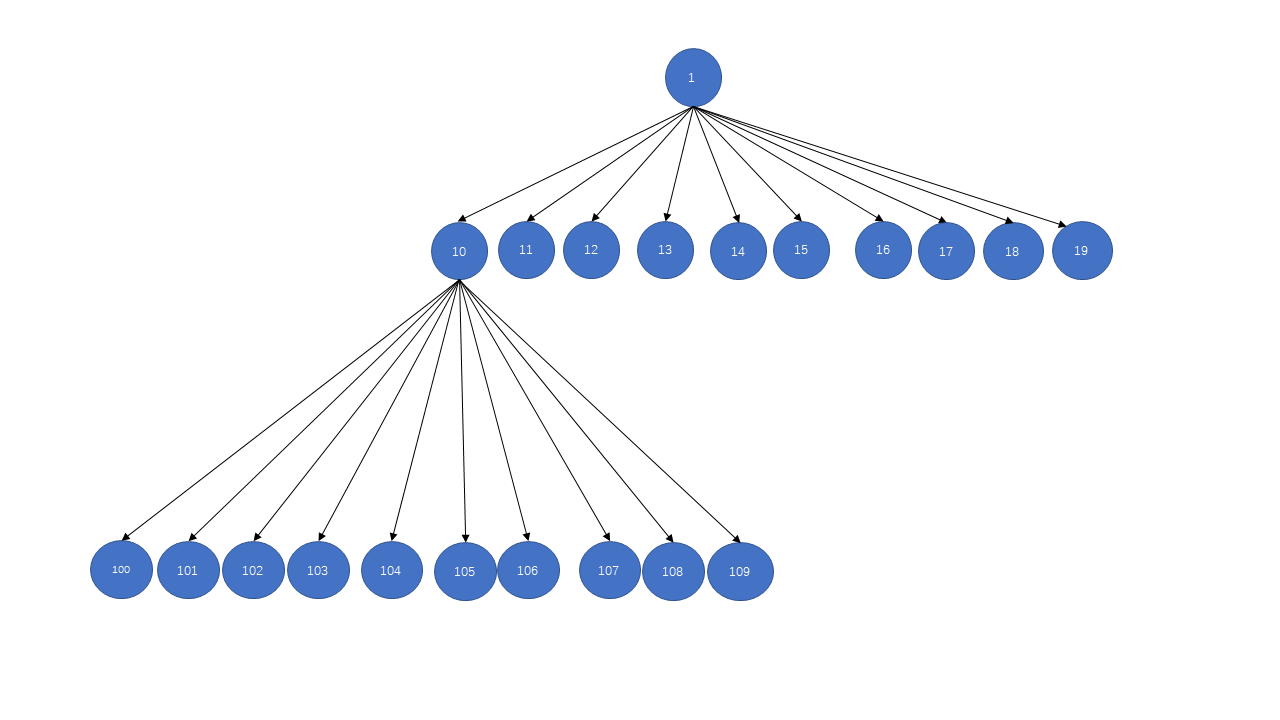
核心:按照字典序的定义,以i开头的所有数字必定位于以i+1开头的所有数字前面。
class Solution:def findKthNumber(self, n: int, k: int) -> int:def count(cur) -> int:"""返回以cur开头的(包括)且 ≤n 的数字数量"""cnt = 0low, high = cur, curwhile low <= n:cnt += min(high, n) - low + 1low *= 10high = 10 * high + 9return cntcur = 1k -= 1while k:if (cnt := count(cur)) <= k:k -= cntcur += 1else:k -= 1cur *= 10return cur
- 时间复杂度:

- 空间复杂度:

295. Find Median from Data Stream
使用大根堆与小根堆(Python默认)来实现。对于大根堆,add和get都需要取反。
class MedianFinder:def __init__(self):self.A = [] # 小根堆(优先存储,较大数)self.B = [] # 大根堆(较小数)self.N = 0 # 已存储的数字个数def addNum(self, num: int) -> None:if self.N & 1:heapq.heappush(self.B, -heapq.heappushpop(self.A, num))else:heapq.heappush(self.A, -heapq.heappushpop(self.B, -num))self.N += 1def findMedian(self) -> float:return self.A[0] if self.N & 1 else (self.A[0] - self.B[0]) / 2.0
- 时间复杂度:
find操作是 ,
,add操作(堆的插入与弹出)是
- 空间复杂度:

Follow up
- If all integer numbers from the stream are in the range [0, 100], how would you optimize your solution?
如果数据流中所有整数都在 0~100 范围内,那么我们可以利用计数排序统计每一类数的数量,并使用双指针维护中位数。
- If 99% of all integer numbers from the stream are in the range [0, 100], how would you optimize your solution?
如果数据流中 99% 的整数都在 0~100 范围内,那么我们依然利用计数排序统计每一类数的数量,并使用双指针维护中位数。对于超出范围的数,我们可以单独进行处理,建立两个数组,分别记录小于 0 的部分的数的数量和大于 100 的部分的数的数量即可。当小部分时间,中位数不落在区间 [0,100] 中时,我们在对应的数组中暴力检查即可。

若有收获,就点个赞吧
0 人点赞


