🐭 std::move 的使用规则
std::move 应该只作用于右值引用,当需要多次使用该值的时候,应该只在最后一处使用 std::move。在编码的时候,尤其是在老代码后面添加新代码的时候,需要注意这种情况。另外,这个规则同样适用于按值返回的函数的返回值。
代码示例 :
#include <iostream>struct X {X(std::string_view sv) : name_(sv) { std::cout << sv << '\n'; }// the parameter rhs is a lvalue// even though its type is rvalue reference to XX(X &&rhs) {std::cout << rhs.name_ << '\n'; // use the rhs 1st timename_ = std::move(rhs.name_); // use the rhs 2nd timestd::cout << rhs.name_.empty() << '\n'; // true}std::string name_;};int main() {std::cout << std::boolalpha;// 1. std::move cast the ms1 to rvalue reference// 2. and then std::string's move ctor will move ms1's content to ms2std::string ms1{"hello"};std::string ms2 = std::move(ms1);std::cout << ms1.empty() << '\n'; // trueX x1{"x1"};X x2(std::move(x1));// does not use the x1 any moreX x3(X{"x3"}); // copy elision, calls the ctor directlyreturn 0;}
🐂 std::forward 使用规则
std::forward 应该只作用于通用引用,当需要多次使用该值的时候,应该只在最后一处使用 std::forward。在编码的时候,尤其是在老代码后面添加新代码的时候,需要注意这种情况。另外,这个规则同样适用于按值返回的函数的返回值。
代码示例 :
#include <iostream>struct X {X(std::string_view sv) : name_(sv) {}// forwarding (universal) referencetemplate <typename T> void set_name(T &&name) {std::cout << name << '\n'; // use the rhs 1st timename_ = std::forward<T>(name); // use the rhs 2nd time// name_ = std::forward<std::string>(name); // wrong usage, never do thisstd::cout << name.empty() << '\n'; // true / false}std::string name_;};int main() {std::cout << std::boolalpha;// 1. pass rvalue to set_nameusing std::string_literals::operator""s;X x4{"x4"};x4.set_name("hello"s);// 2. pass lvalue to set_namestd::string s{"world"};x4.set_name(s);std::cout << s.empty() << '\n'; // falsereturn 0;}
:::tips
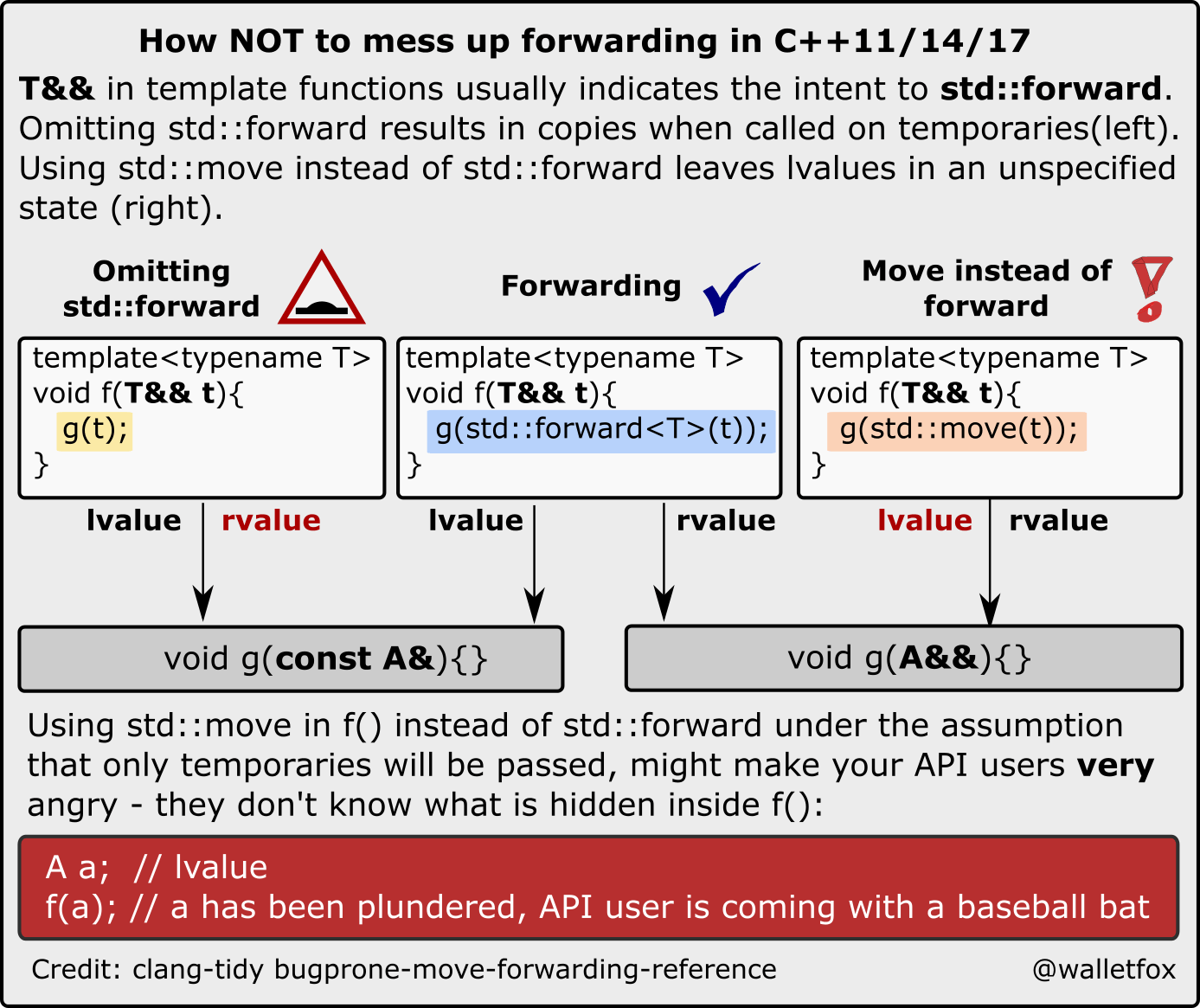
- std::forward 涉及到类型推导,而 std::move 不涉及类型推导
- std::forward 的类型参数 U 必须为模板参数 T,而不能是具体的类型,否则就相当于 std::move
- std::move 作用于右值,std::forward 作用于通用引用,不要张冠李戴
- 对于按值返回的函数,对于右值引用返回值执行 std::move, 对于通用引用返回值执行 std::forward
:::
std::move 与 std::forward 张冠李戴:
🐯 RVO 与 NRVO
返回值优化,避免创建临时对象,这个技术比较反直觉,习惯就好。返回值优化使得设计按值返回的函数不再被认为是低效的,这个技术可以让我们不用设计带输出参数的函数。
RVO: 无名返回值优化,C++17 对此有增强
NRVO:具名返回值优化
代码示例 : ```cppinclude
include
include
struct X {
X() { std::cout << “X::X\n”; }
X(const X &) { std::cout << “X(const X&)\n”; }
X(X &&) { std::cout << “X(X&&)\n”; }
~X() { std::cout << “~X\n”; }
};
X Create0() {
// return value optimisation (RVO)
return X();
// std::move and std::forward will preevents RVO
// return std::move(X());
// return std::forward
struct NonMoveable {
NonMoveable(int v) : v(v) {}
NonMoveable(const NonMoveable &) = delete; // non-copyable
NonMoveable(NonMoveable &&) = delete; // non-movable
std::array
int main() { // RVO / NRVO construct the X object directly in memory of x0 or x1 // No copy, no move { // RVO auto x0 = Create0(); } std::cout << std::string(4, ‘=’) << std::endl; { // NRVO auto x1 = Create1(); } std::cout << std::string(4, ‘=’) << std::endl;
{ // construct the non-movable/non-copyable object (C++17) // No copy, no move auto obj = make(-1024); }
🐰 总结
- 对右值引用,在最后一次使用的地方 std::move 右值引用
- 对通用引用,在最后一次使用的地方 std::forward 通用引用
- 不要对临时变量乱用 std::move 与 std::forward,进而无意中阻止了返回值优化与拷贝消除

若有收获,就点个赞吧
0 人点赞


