1. 引言
LZ77算法是采用字典做数据压缩的算法,由以色列的两位大神Jacob Ziv与Abraham Lempel在1977年发表的论文《A Universal Algorithm for Sequential Data Compression》中提出。
基于统计的数据压缩编码,比如Huffman编码,需要得到先验知识——信源的字符频率,然后进行压缩。但是在大多数情况下,这种先验知识是很难预先获得。因此,设计一种更为通用的数据压缩编码显得尤为重要。LZ77数据压缩算法应运而生,其核心思想:利用数据的重复结构信息来进行数据压缩。举个简单的例子,比如 Ctrl+Alt+N。
取之以仁义,守之以仁义者,周也。取之以诈力,守之以诈力者,秦也。
取之以、仁义、,、者、守之以、也、诈力、。均重复出现过,只需指出其之前出现的位置,便可表示这些词。为了指明出现位置,我们定义一个相对位置,如图
相对位置之后的消息串为 取之以诈力,守之以诈力者,秦也。 ,若能匹配相对位置之前的消息串,则编码为以其匹配的消息串的起始与末端index;若未能匹配上,则以原字符编码。相对位置之后的消息串可编码为:[(1-3),(诈力),(6),(7-9),(诈力),(12),(6),(秦),(15-16)],如图所示:
上面的例子展示如何利用索引值来表示词,以达到数据压缩的目的。LZ77算法的核心思想亦是如此,其具体的压缩过程不过比上述例子稍显复杂而已。
2. 原理
本文讲主要讨论LZ77算法如何做压缩及解压缩,关于LZ77算法的唯一可译、无损压缩(即解压可以不丢失地还原信息)的性质,其数学证明参看原论文[1]。
滑动窗口
至于如何描述重复结构信息,LZ77算法给出了更为确切的数学解释。首先,定义字符串S的长度为N,字符串S的子串
 。对于前缀子串
 记
记 为首字符
为首字符 的子串与首字符
 的子串最大匹配的长度,即:

我们称字符串  匹配了字符串
  ,且匹配长度为
 。如图所示,存在两类情况:
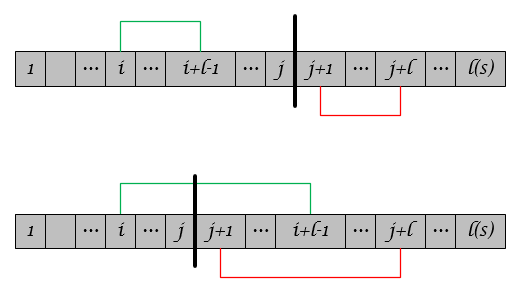
定义  为所有情况下的最长匹配的
 值,即
值,即
比如,字符串  且
且 ,则有
,则有
 ,因为
,因为
 ,因为
,因为
 ,因为
,因为
因此, 且最长匹配的长度
  . 从上面的例子中可以看出:子串
  是可以由
是可以由  生成,因而称之为 的再生扩展(reproducible extension)。LZ77算法的核心思想便源于此——用历史出现过的字符串做词典,编码未来出现的字符,以达到数据压缩的目的。在具体实现中,用滑动窗口(Sliding Window)字典存储历史字符,Lookahead Buffer存储待压缩的字符,Cursor作为两者之间的分隔,如图所示:
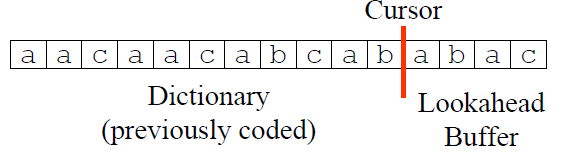
并且字典与Lookahead Buffer的长度是固定的。
压缩
用  表示Lookahead Buffer中字符串的最长匹配结果,其中
 表示最长匹配时,字典中字符开始时的位置(相对于Cursor位置),
- 为最长匹配字符串的长度,
 指Lookahead Buffer最长匹配结束时的下一字符
压缩的过程,就是重复输出 ,并将Cursor移动至  ,伪代码如下:
Repeat:Output (p,l,c),Cursor --> l+1Until to the end of string
压缩示例如图所示:
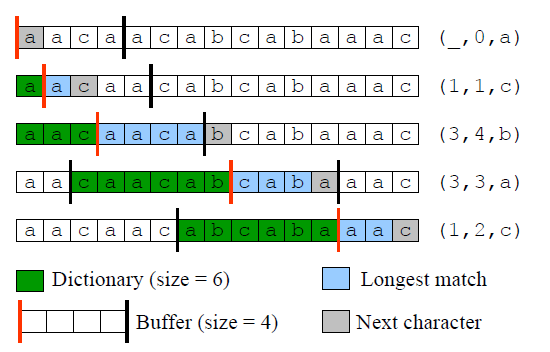
解压缩
为了能保证正确解码,解压缩时的滑动窗口长度与压缩时一样。在解压缩,遇到 大致分为三类情况:
 且
且  ,即初始情况,直接解码 ;
 ,解码为字典 dict[p:p+l+1];
 ,即出现循环编码,需要从左至右循环拼接,伪代码如下:
for(i = p, k = 0; k < length; i++, k++)out[cursor+k] = dict[i%cursor]
比如,dict=abcd,编码为(2,9,e),则解压缩为 output=abcdcdcdcdcdce。
3. 实现
bitarray的实现请参看A Python LZ77-Compressor,下面给出简单的python实现。
# coding=utf-8class LZ77:"""A simplified implementation of LZ77 algorithm"""def __init__(self, window_size):self.window_size = window_sizeself.buffer_size = 4def longest_match(self, data, cursor):"""find the longest match between in dictionary and lookahead-buffer"""end_buffer = min(cursor + self.buffer_size, len(data))p = -1l = -1c = ''for j in range(cursor+1, end_buffer+1):start_index = max(0, cursor - self.window_size + 1)substring = data[cursor + 1:j + 1]for i in range(start_index, cursor+1):repetition = len(substring) / (cursor - i + 1)last = len(substring) % (cursor - i + 1)matchedstring = data[i:cursor + 1] * repetition + data[i:i + last]if matchedstring == substring and len(substring) > l:p = cursor - i + 1l = len(substring)c = data[j+1]# unmatched string between the twoif p == -1 and l == -1:return 0, 0, data[cursor + 1]return p, l, cdef compress(self, message):"""compress message:return: tuples (p, l, c)"""i = -1out = []# the cursor move until it reaches the end of messagewhile i < len(message)-1:(p, l, c) = self.longest_match(message, i)out.append((p, l, c))i += (l+1)return outdef decompress(self, compressed):"""decompress the compressed message:param compressed: tuples (p, l, c):return: decompressed message"""cursor = -1out = ''for (p, l, c) in compressed:# the initializationif p == 0 and l == 0:out += celif p >= l:out += (out[cursor-p+1:cursor+1] + c)# the repetition of dictionaryelif p < l:repetition = l / plast = l % pout += (out[cursor-p+1:cursor+1] * repetition + out[cursor-p+1:last] + c)cursor += (l + 1)return outif __name__ == '__main__':compressor = LZ77(6)origin = list('aacaacabcabaaac')pack = compressor.compress(origin)unpack = compressor.decompress(pack)print packprint unpackprint unpack == 'aacaacabcabaaac'
4. 参考资料
[1] Ziv, Jacob, and Abraham Lempel. “A universal algorithm for sequential data compression.” IEEE Transactions on information theory 23.3 (1977): 337-343.
[2] guyb, 15-853:Algorithms in the Real World.

若有收获,就点个赞吧
0 人点赞


