 Cinema: The Movement-Image
吉勒・德勒兹(Gilles Deleuze)说:
上一次我们看到两个柏格森对运动的论点。那就像是第一章,……而我们也开始思考柏格森对运动的第 3 个论点。他的这些论点,又一次,……在哲学中总是这样;……这些论点共处于相同的篇章里,并且通过逐渐转变,从一个层次转到另一层次——他对运动的 3 个论点,就像分析运动的 3 个层次。 而在这个第 3 个论点的层次上,显然也是最复杂的层次上,……而这个层次的陈述,说的是——这是我上一次试着做和说的东西——如果我要好好总结一下它的话,不仅仅是,瞬间是运动的一个静态截面,而且运动是绵延的一个活动截面。那我会告诉你们为什么这是一个复杂的论点,因为我们已经离开了最传统的、最为人所知的柏格森主义……就是把运动和绵延放一边,把空间和瞬间放另一边,然后告诉我们,你们不要再用经过的空间来重建运动,就像你们不能用各个瞬间重建绵延一样。
The last time we saw two Bergson theses on movement. And it was like a first chapter, … and we started considering Bergson’s third thesis on movement. His theses, once again, … it’s like always in philosophy; … all this coexists on the same pages, that it shifts from one level to another. His three theses on movement are like three levels of analysis of movement. And at the level of this third thesis, the most complex obviously, … this one would consist in saying — that’s what I tried to do, to say last time — not only, if I really try to summarize it, not only is the instant an immobile section of movement, but movement is a mobile section of duration. So, I am going to state the extent to which this is a complex thesis because we have moved away from the most traditional, the best-known Bergsonism… the one which puts movement and duration on one side, and space and instant on the other, and which tells us, you will not reconstitute movement with space traveled any more than you will reconstitute duration with instants.
研讨班简介
在思考电影、哲学的第一年,德勒兹通过汲取柏格森对知觉的论题、C・S・皮尔士(C.S. Peirce)对图像和符号的分类,发展了精神分析、符号学的方法以外的一种电影研究的可能。这一年,他主要致力于他认为是 20 世纪上半页的电影的首要特征——运动-图像,并在年底作结时强调,二战后向时间-图像主导电影的这个转变很重要。
SEMINAR INTRODUCTION
In the first year of Deleuze’s consideration of cinema and philosophy, he develops an alternative to the psychoanalytic and semiological approaches to film studies by drawing from Bergson’s theses on perception and C.S. Peirce’s classification of images and signs. While he devotes this first year predominantly to what he considers to be the primary characteristic of cinema of the first half of the 20th century, the movement-image, he finishes the year by emphasizing the importance of the post-World War II shift toward the domination of the time-image in cinema.
**
在第一讲结尾,德勒兹问:“这个理念适用于所有电影吗:延伸的运动作为截面,可延伸的运动作为一个绵延的截面?这在电影图像的意义上意味着什么?”上一讲讨论了柏格森头两个论点后,这些问题让德勒兹发展了柏格森的第 3 个论点(见《运动-图像》第 1 章,第 9~11 页)。一开始,德勒兹就在回答一些学生提问时特别提到爱森斯坦,而此后他把第 3 个论点陈述为:瞬间是运动的一个静态截面,但运动是绵延的一个活动截面,而他在这里还以一个公式方程表示。
他发展了第 2 个论述(以及等式的第 2 部分),把运动理解为一个全有的变化,尤其考察了这样一个变化的不同方面,并以一个更完整的表述表达了这一点:运动作为各部分的关系,显露的变化就是一个全有的触动。
德勒兹重新检视了这个术语“全有”的各个方面(比如开放和封闭的系统,以及“开放”的方面),并补充说对柏格森重要的(参见《绵延和同时性》[1922]),是一种关于真实时间的形而上学,而非一种永恒的形而上学,而这就走向了柏格森提出的一个“流的同时性”(simultaneity of flows)。
接着,他把方向从柏格森哲学转到了电影技术,来检验哲学元素能否应用于实际的电影的层面。德勒兹思考了取景的技术,提到帕索里尼说的构成一个镜头的各个元素——“影素”(cineme),以此标志着转到《运动-图像》的第 2 章,同时他也定义了“镜头”和“分镜”。
鉴于这一点,他反思了具体的电影人怎么理解全有以及柏格森的其他术语与前面这些技术的关系——主要是帕索里尼、爱森斯坦、比利・怀德、文德斯、希区柯克、茂瑙、罗塞里尼、里维特、普多夫金、冈斯、格黑米永(Grémillon)、艾普施坦(Epstein)、施特罗海姆(Stroheim)。
At the end of the first session, Deleuze asked: “is it not to all cinema that the idea would apply: movement in extension as section (coupe), the extensive movement as section of a duration? What would that mean in terms of the cinema image?” Having discussed Bergson’s first two theses in the previous session, these questions lead Deleuze to develop Bergson’s third thesis (located also in chapter 1 of The Movement-Image, _pp. 9-11). After initially addressing some students’ questions with particular references to Eisenstein, Deleuze states the third thesis as: the instant is an immobile section of movement, but movement is a mobile section of duration, which he also articulates here with a formulaic equation. He develops the second statement (and second part of the equation), and considers movement as transformation of a Whole, especially examining diverse aspects of such transformation, and expressing this with a more complete formula: movement as relation between parts expresses change as affection of a Whole. Deleuze reexamines different facets of this term, “the Whole” (e.g. open and closed systems, aspect of “the Open”), and he adds that what mattered for Bergson (cf. _Duration and Simultaneity [1922]) was to undertake a metaphysics of real time rather than one of the eternal, leading to Bergson’s proposal of a “simultaneity of flows.” Then, he shifts direction from Bergson’s philosophy to cinema technique as a way of determining if the philosophical elements work on the actual, cinematographic level. Marking a shift toward The Movement-Image, chapter 2, Deleuze considers the technique of framing, and offering Pasolini’s term for elements that compose a shot, the “cineme”, he also defines “shot” and “cutting”. In this light, he reflects on specific filmmakers understanding of “the Whole” as well as other Bergsonian terms in relation to these techniques (notably, Pasolini, Eisenstein, Wilder, Wenders, Hitchcock, Murnau, Rossellini, Rivette, Pudovkin, Gance, Grémillon, Epstein, Stroheim).
关于这一讲
吉勒・德勒兹电影研讨班:运动-图像
第 2 课,“德勒兹之声”网(La voix de Deleuze),1981 年 11 月 17 日(电影课第 2 节)
录音听写:由克洛伊・莫丽娜-菲(Chloé Molina-Vée)负责第 1 部分,时长 1:12:10,吕西・玛尔沙迪耶(Lucie Marchadié)负责第 2 部分,时长 1:01:08;听写增改、法译英,由夏尔乐・J・斯蒂法乐(Charles J. Stivale)负责。
(以下中译根据法语。英译与法语小有出入,谨供参考。文末附有法语原文)
Gilles Deleuze
Seminar on Cinema: The Movement-Image
Lecture 02, La Voix de Deleuze, 17 November 1981
Transcribed by Chloé Molina-Vée (Part 1, 1:12:10) and Lucie Marchadié (Part 2, 1:01:08), transcription augmented, Charles J. Stivale
Translation: Charles J. Stivale
第 1 部分
(录音开始时,德勒兹已在回答提问了)
……最终,这是艺术的特点,艺术总体上的特点,总之,是许多艺术形式的特点,而你把它和另一个运动的重建对立起来了,并宣称这是两种不同性质的重建;运动的另一种重建不再按照优先瞬间(privileged instants)来重建运动,而是按照任意瞬间(whatever instant),根据任意瞬间。
Part 1
[The transcription begins in media res with Deleuze responding to an intervention made before the recording began]
… as a characteristic, finally, of art, of art in general, in the end, of many forms of art, and you have opposed it to another reconstitution of the movement of which you claimed that these were two reconstitutions of different kinds, another reconstitution of the movement which consisted in reconstituting movement, no longer as a function of privileged instants, but as a function of any instants whatever, as a function of the whatever instant (l’instant quelconque).
而这,我说的,是事实上,这就是电影,而在电影之前,那就是小说,即运动与任意瞬间的关系,而非与各个优先瞬间的关系。于是他反对我的是——这其实不是一个反对,这还是……——这等于说:我们不能讲得太急,因为毕竟,一个像爱森斯坦这么重要、这么奠基性的电影人,如果不是从各个优先瞬间来重建一个运动,他又干了什么呢?看,这听起来像一个反对意见,但他从未对我提出反对,谢天谢地,这肯定不是一个反对意见。(有人提问)这恰恰相反,恰恰相反,是给出一个方向让人分析。
And that, I was saying, in fact, that is cinema, and before cinema, that’s what the novel was, the relation of movement to any instant whatever and no longer to privileged instants. So, the objection he is making to me is — it’s not an objection, in fact, it’s nonetheless … — it amounts to saying: we must not go so fast because after all, a man of cinema as important and as fundamental as Eisenstein, what is he doing if not a reconstitution of movement starting from privileged instants? See, it sounds like an objection, but since he never makes objections to me, thank goodness, that certainly must not be one. [The participant’s voice is heard, inaudible] On the contrary, it’s the invitation of a direction to be analyzed.
这里让我感兴趣的第 2 个问题,也是更技术的问题,就是——这很怪——如果柏格森真的想定义——但我们没有很清楚地看到这一点——想通过开放(译注:the Open,又译敞开)来定义全有(the Whole)、整体(totality),而对于大多数人,全有却恰恰相反,是种封闭的东西。这很怪,这其中有个意思,你们随口就说出这样的话:“全有,又不难懂,它就是开放。”问题是,如果柏格森真这么说,很奇怪也有其他人这么说,有海德格尔,有里尔克。里尔克关于开放有一些很美的诗篇。柏格森式的理念与海德格尔、里尔克或赫尔德林会有联系吗?
A second question that interests me here, but which would be more technical, is — this is very strange – if it’s true that Bergson tends to define — but we have not seen that clearly — tends to define the Whole, the totality by the Open, whereas for most people, the Whole is, on the contrary, something closed, it’s weird, it means something; you pronounce expressions like “Well, the Whole is not difficult, it is the Open”. The question is, if it’s true that Bergson says that, oddly there is someone else who said that as well, and it’s Heidegger, and it’s Rilke. There are some very beautiful poems by Rilke on the Open. And might there be a connection between the Bergsonian idea and Heidegger or Rilke or Hölderlin?
好,我只想回答第 2……第 1 个问题,或者试着回答第 1 个问题,因为它有关的是我会认为已完成的某个东西,而这,事实上造成了问题。好,如果我们看一部爱森斯坦的片子,发生了什么?总之,事实上,它是运动;甚至是电影中最美的运动,然而怎能不认识到它是按照优先瞬间、完完全全按照危机点(crisis points)进行的运动的一个再生产(reproduction)、一个重建呢?好,我想说的是,这只是在表面上是一个反对意见,我认为,因为事实上,发生的是什么?当我说电影,它不是简单地由运动的再生产来定义的,而是由这个定义的:当运动的再生产来自对运动的一个分析时,就有了电影,好,这一样是在说,有了按照任意瞬间来进行的运动的再生产,就有了电影。
Fine, I just want to answer the second… the first question, or try to answer the first question because it refers to something that I can consider already finished, and that, indeed, that creates a problem. So, if we see an Eisenstein film, what is happening? But after all, indeed, this is movement; it is even among the most beautiful movements in cinema, but how can we not recognize that it is a reproduction, a reconstitution of movement as a function of privileged instants, and literally, as a function of crisis points? Okay, I am saying, this is only an objection on the surface, I believe, because what is happening? When I said cinema is not defined simply by the reproduction of movement, that it is defined by this: there is cinema when the reproduction of movement results from an analysis of movement, fine, this amounts to saying, cinema exists when there is reproduction of movement as a function of any instants whatever.
为什么?因为只有当运动不是按照各个优先瞬间来分割,而是按照各个快照(snapshots)来分割时,你们才有对运动的一个分析。快照,是任意瞬间。一个给定的任意瞬间,那么这具体来说是什么意思?你们感觉到任意瞬间,事实上是一个关系,是两个瞬间的一个关系;否则,任意瞬间,就是一个抽象思维(abstraction)。有人会说,任意瞬间是什么?它不会什么都不是,对吧;它是什么?
Why? Because you only have an analysis of movement when the movement is not cut according to privileged instants but cut according to snapshots. The snapshot is any instant whatever. With any given instant whatever, so what does that mean in concrete terms? You indeed sense that any instant whatever is, in fact, a relation, it is a relation between two instants; otherwise, it is an abstraction, any instant whatever. We will say, what is any instant whatever? It’s not nothing, right, so what is it?
事实上,任意瞬间,是极为具体、明确的概念。如果我这么说“任意瞬间”,指的是一个不确定的瞬间,一个均等的(法语 égalique)瞬间。所以怎么确定任意瞬间?任意瞬间是完美地确定为两个瞬间之间的等距。所以,你们就有了等距瞬间。从此,你们对运动的分析就配得上“对运动的分析”这个说法,因为它思考的是等距截面(sections)。这时候,就有了对运动的分析。
In fact, any instant whatever is a perfectly concrete and determinable notion. If I say “any instant whatever” like that, this means an indeterminate instant, an equal instant (instant égalique). So how do you determine the any instant whatever? Any instant whatever is perfectly determined as the equidistance between two instants. So, you have equidistant instants. Henceforth, your analysis of movement deserves the name “analysis of movement” since it considers equidistant sections (coupes). At that moment, there is analysis of movement.
你们看,这些都不是优先瞬间;你们可以具体地定义、具体地区分任意瞬间和优先瞬间。这显然不是一个优先瞬间,因为任意瞬间指示的只是两个瞬间的关系,其特征完全不意味着一个高潮、运动的一个最小值和最大值,或者运动的一个奇点(singularity),而只是对于瞬间、对于另一个瞬间是等距的。好。
You see that these are not privileged moments here; you can concretely define and concretely distinguish any instant whatever and the privileged instant. This is obviously not a privileged instant since the any instant whatever designates only the relation between two instants whose characteristic in no way meant to imply a vertex, a minimum or a maximum of movement or even a singularity of movement, but only being equidistant from the instant, from the other instant. Fine.
于是,我要说,我相信可以断言,如果运动不是按照任意瞬间,也就是说,不是按照等距瞬间再生产的,那么不会有电影,连电影的可能性也不会有。好。而这,这是对的……(克莱尔・帕尔奈开始评论)……对于作为可确定的(assignable)技术的电影,的的确确。
So, I am saying, and I believe I can maintain that if movement is not reproduced as a function of any instants whatever, that is, as a function of equidistant instants, there is no cinema nor a possibility of cinema. Fine. And that, it remains true for … [beginning of a comment by Claire Parnet] … literally, cinema insofar as being an assignable technique.
克莱尔・帕尔奈(Claire Parnet):那视频呢?
但在那里,(简短地回答帕尔奈)——哦,视频,那不是电影——在那里,(帕尔奈称“是”)在那里……任意瞬间,也就是等距瞬间,是以老方法选中,来与优先瞬间重合的,这是完全可能的。有些人可能记得爱森斯坦的论点,想想他那种方法——乃至于我们甚至会自问,为什么他要这么坚持?——对黄金分割的数值上的论述,不仅仅在每个图像中,而且在图像的连续性中,在连续性的所有的运动的量性特征中。
Claire Parnet: And video?
But on that, [short answer from Parnet] — Oh video, it’s not cinema — But on that, [short reply from Parnet, who says, “yes”] On that …, [Pause] that any instants whatever, that is, equidistant instants, are chosen so as to coincide with [Pause] privileged instants in the old way, that is perfectly possible. For those who remember Eisenstein’s theses, think of the way he has — it’s even to a point where you say to yourself, but why is he insisting on this ? — on the numerical considerations of the golden ratio, not only in each image but in the succession of images, all its quantitative character of movement.
对,对于爱森斯坦我会说他完完全全、显而易见是一个为电影而生的人。这不用多说。但他恶魔般的诡计之一,是重现一个史诗世界和一个悲剧世界。重现一个史诗世界和一个悲剧世界,我指的是一个史诗世界和一个悲剧世界,的确是重建了运动的世界,但却是基于优先瞬间的。爱森斯坦创造了电影。他创造了电影,他和所有人一样,也就是说,他只能、也必须以这个激进的新路子重建运动,按照等距瞬间来,从而也就是按照任意瞬间。
Yes, I would say about Eisenstein that he is completely, obviously, a man of cinema. That goes without saying. But one of his diabolical tricks is to restore an epic world and a tragic world. By restoring an epic world and a tragic world, I mean an epic world and a tragic world were indeed worlds that reconstituted movement but starting from privileged instants. Eisenstein creates cinema. Insofar as he creates cinema, he is like everyone else, that is, he can reconstitute movement and he must reconstitute movement only in this radically new way, as a function of equidistant instants, therefore of any instants whatever.
但爱森斯坦的令人惊奇之处,是他用电影手段来还原一个史诗的和悲剧的新世界,也就是说,他计算了这个世界的各个等距,如此使得等距复原了优先瞬间。你总是可以这么办,但手段还是按照黄金分割、黄金比例的关系来保持等距的。我回答了你的疑问吗?(有人答:“当然了。”)
But what’s astonishing about Eisenstein is that he uses the cinematographic method to restore a new epic and tragic world, that is, he calculates its equidistances in such a way that they resuscitate privileged moments. And here, you can always, but the process will still be to maintain equidistance according to the relations of the golden ratio, the golden section. Have I answered that? [Reply, “Yes indeed” in the room]
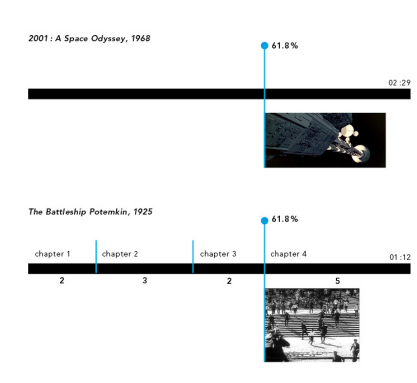
《2001:太空漫游》《战舰波将金号》中图像之间的黄金分割,后者为爱森斯坦作品。
那就好。那么,好,我们继续,继续。上一次,我很坚持……我是真的需要对我们要做的事编许多号码,这样当我们推进时……然后我这么说不是好让你们这么多人每次都来上课,而是好让你们少些人来。你们来的话,必须一直来,ok?必须这样,因为今年我干的事情没法分割。所以你们要是那样子上课就是一个错误。
There you go. So, good, let’s continue, let’s continue. Last time, and I am insisting a lot on … my need really to enumerate a lot what we are doing so that when we move forward …, and then I am not saying it so that so many of you always come to class, but I am saying it so that fewer of you come. When you come, you must come all the time, ok?, you have to, because what I am doing this year is not divisible. So, it’s a mistake for you to come to class in that way.
但你们看,上一次我们看到两个柏格森对运动的论点。那就像第一章,方便起见先这么说。那就是柏格森对运动的论点,(其中我们)知道了运动能否成就电影。我们看到了两个论点。今天我说完想说的,就会小结一下。我们将着手于柏格森对运动的第 3 个论点。
But you see, the last time we saw two Bergson theses on movement. And it was like a first chapter, to give it a convenient name. It was Bergson’s theses on movement, if, knowing whether it can emerge for cinema. We saw two of them. I’ll provide a recap when I finish what I want to do today. And we started considering Bergson’s third thesis on movement.
他的论点,又一次,变得复杂了,因为这些论点不是——什么事情都一样,在哲学中也总是这样;没有说从哪一页到哪一页或者在哪个时候,柏格森改变了论点;而是这些论点共处于相同的篇章里,并且通过逐渐转变,从一个层次转到另一层次——他对运动的 3 个论点,就像分析运动的 3 个层次。而在这个第 3 个论点的层次上,显然也是最复杂的层次上,变得……很难懂,可能比其他论点有趣多了。但正是有了其他论点,才能到达这个论点的陈述。
His theses, once again, get complicated because they are not — it’s like everything, it’s like always in philosophy; there is no particular page, on a particular page or at a certain moment that Bergson changes his thesis; all this coexists on the same pages, that it shifts from one level to another. — His three theses on movement are like three levels of analysis of movement. And at the level of this third thesis, the most complex obviously, it becomes … very difficult, perhaps much more interesting than the other theses. But precisely the other theses were necessary to arrive at the statement of this one.
而这个层次的陈述,说的是——这是我上一次试着做和说的东西——如果我要好好总结一下它的话,不仅仅是,瞬间是运动的一个静态截面,而且运动是绵延的一个活动截面。那我会告诉你们为什么这是一个复杂的论点,因为我们已经离开了最传统的、最为人所知的柏格森主义。最为人所知的柏格森主义,就是把运动和绵延放一边,把空间和瞬间放另一边,然后告诉我们,你们不要再用经过的空间来重建运动,就像你们不能用各个瞬间重建绵延一样。但在这里,你们看,不是要重复这么说。也不是要反驳这句话,但多亏有了第 1 个论点,他转到了一个远为复杂的分析的层面。
And the statement of this one would consist in saying — that’s what I tried to do, to say last time — [Pause] not only, if I really try to summarize it, not only is the instant an immobile section of movement, but movement is a mobile section of duration. So, I am going to state the extent to which this is a complex thesis because we have moved away from the most traditional, the best-known Bergsonism. The best-known Bergsonism is the one which puts movement and duration on one side, and space and instant on the other, and which tells us, you will not reconstitute movement with space traveled any more than you will reconstitute duration with instants. But here, you see, it’s not about saying that anymore. It’s not about contradicting that, but thanks to the first thesis, he moves on to a much more complex level of analysis.
这个“以同样的方式”是什么意思?瞬间是运动的一个静态截面,而以同样的方式,运动是绵延的一个活动截面。因而,这个论点,我告诉你们的是,几乎可以用一个所谓的类比的关系来呈现,这个类比关系可以这么陈述: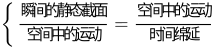
他这么说没错;显然,他是这么说的。
What does it mean “in the same way that”? In the same way that the instant is an immobile section of movement, well, motion is a mobile section of duration. As a result here, this thesis, I told you, we could almost present it in the form of a so-called analogic relation, an analogic relation which we would state thus: instantaneous immobile section, instantaneous immobile section over movement in space equals movement in space over duration. [Pause] It’s okay for him to say that; obviously he states this.
下面这句话我会很慢地读,来自《创造的进化论》:“移动(displacements)”——我会读得很慢,这样你们跟得上——
在物理学和化学中所研究的物质和分子的纯粹表面性质的移动,相对于
——他设置了一个条件,他很小心——
相对于内在之中变异(transformation)的、而不是移位(translation)的生命运动而言,将变成某一运动体的停止状态与它在空间的运动状态之间的关系, 相对于内在之中变异的、而不是移位的生命运动而言,将变成某一运动体的停止状态与它在空间的运动状态之间的关系”。 (译注:中译按《创造的进化论》[Creative Evolution] 第二章,陈圣生译,漓江出版社,2012 年。有改动)
所以他明确向我们提出了类同之处:“停止状态”(stationary position)。(录音中断)
Here is a sentence that I will read slowly, taken from Creative Evolution: [Pause] “the displacements” — I am reading slowly so that you follow well — “the wholly superficial displacements of mass and molecules studied by physics and the chemistry would become” — he puts in a conditional, he is very careful - “would become, by relation to the inner vital movement (which is transformation and no longer translation) what the position of a moving object is to the movement of that object in space”, “would become, by relation to the inner vital movement (which is transformation and no longer translation) what the position of a moving object is to the movement of that object in space”.[1] So, he explicitly offers us the analogy: “stationary position”. [Interruption of the recording]
好,我补充一下,但这不好;我补充一句,而这不好;这是什么意思,“这不好”?意思就是,我关心的是柏格森,是柏格森让我操心,而这对柏格森不好。因为柏格森不停地说,总是不停地说:你们无权用静态截面来重建运动。所以,在我的等式第一部分的一边,这不好。第二部分——“空间中的运动 / 绵延”,当我说,“停止状态之于运动,正如运动之于绵延”,于是,我的等式的第二个部分,也就是“空间中的运动显露了绵延”,这很好,但不是对于柏格森而言。这里,情感的系数(affective coefficient)表示这很好,这是好的。我们能感到这个说法“这很好”也就是“这很好,这行得通”。
Okay — and I’m adding — and that’s not good; I’m adding, and that’s not good; what does that mean, “and that’s not good”? That means — I’m focusing on Bergson, it’s Bergson who concerns me — it’s not good for Bergson. For Bergson has not stopped saying and never will stop saying: you have no right to reconstitute movement with immobile sections. So, on the side of, first segment of my equation: this is not good. The second segment: “movement in space expresses duration”, when I say, “what the immobile position is to movement, movement is to duration”, so, the second term in my equation, which is: “movement in space expresses duration”, not for Bergson, that’s indeed right. Here, the affective coefficient says that this is indeed right, that’s it. We have a feeling of the expression “that’s good,” namely “that’s indeed right, and it works”.
所以,当我打了这个类比关系时,同时,会有一个情动的转变,从“这行不通”到“这行得通”。运动正是绵延的一个活动截面。因而我们的第一个问题就是:这个很有趣的柏格森式的论点是什么意思?因为总之,尽管我们可以不那么费力了,已经提前知道了这一切;比如说最终,好,经过的空间和运动,那是不可简化的等等,这些我们都知道了。但现在,他在跟我们说截然不同的东西。我怀疑他说的只是让我们看起来很简单,而我们之前搞懂了是那么高兴……永远要小心哲学家们:当我们觉得自己懂了很高兴的时候,这表明我们懂的,只是我们还没懂的一个东西的一个条件罢了。所以……我是说,总是些多层次的文本。所以,关于这个第 3 论点,我现在的问题是:这具体来说到底是什么意思呢,“空间中的运动是绵延的一个活动截面”?
So, when I set up my analogic relation, there is at the same time an affective slippage from “it doesn’t work” to “it works”. Movement is indeed a mobile section of duration. As a result, our first problem is: what does this very curious Bergsonian thesis mean, because in the end, as much as we could be at ease, relatively, we knew all that in advance; that finally, well, the space traveled and movement were irreducible, all that, we knew all that. But now, he’s telling us something quite different. And I doubt that what he said seemed so simple to us, but we were so happy to have understood … — One always must be wary of philosophers: when we are very happy to have understood, it means that what we have understood is a condition for understanding yet another thing that we have not understood. So … I mean, these are always multi-level texts. — So, my question now regarding this third thesis is: what can it indeed mean concretely, “movement in space is a mobile section of duration”?
好,我们慢慢来。这是说,某种程度上,运动是什么,空间中的运动?空间中的运动,我会说,就像常说的,运动本质上是相对的。这是什么意思:“运动是相对的?”意思是不管你们所知的动力有多强,你们都可以把运动想象成纯粹相对性的;也就是说,是通过、是关于纯粹的相对性,运动才产生了,而你们总是可以说或者认为纯粹的相对性就是相对于此时作为静物的运动体,在运动的东西。你们也可以说你们相对于风景在运动,或者风景相对于你们在运动。我不是说你们可以这样觉到,但在一些例子中,你们是会这么觉得。不过你们可以这么想象。这是要说什么呢?
Well, let’s take it slowly. That means, in a certain way, that [Pause] movement, what is movement in space? [Pause] Movement in space, I would say, as is said, movement is essentially relative. What does it mean: “movement is relative”? It means that however strong you know what the motive is, you can still think of movement as purely relative; that is, that by which, that in relation to which a movement occurs, you can as well say or think that this is what moves in relation to the mobile object posed in its turn as immobile, the relativity of movement. You can say as well that you are moving relative to the landscape or that the landscape is moving relative to you. I’m not saying you can sense it like that, and in some cases, you sense it like that. But you can think so. Which amounts to saying what? [Coughing in the room] [Pause]
关于运动我会说,它在根本上是各部分的一个关系。我说的是运动显露了绵延。什么意思呢?这就是我们试着要再一次评论柏格森的地方。“运动显露了绵延”是什么意思?绵延,是什么?是变化的东西。而柏格森终究从没有给绵延另一个定义。绵延,是变化的东西;就是变化的、持续变化的东西。我们前进一点了。
I would say of movement that it is fundamentally a relation between parts. [Pause] I am saying movement expresses duration. What does this mean? That’s what we’re trying to comment on, once again, in Bergson. What does “movement expresses duration” mean? Duration, what is it? It’s what is changing. And in the end, Bergson never gave another definition to duration. Duration is what changes; it’s what is changing and what keeps changing. We are moving forward a bit.
什么是变化?有些原因只有到之后才说得清——我必须在这个分析中提前一些——柏格森会向我们展示,变化是全有的一个触动(affection)。运动:各部分的关系;变化:全有的触动。虽然大家还不理解,还不完全理解我们往哪去,我们也是有方向的——运动显露了绵延,也就是说,各部分的一份关系显露了全有的一个触动。变化,是全有的触动;运动,是各部分的关系,好。一个运动显露了一份变化。运动显露了绵延,也就是说,运动作为各部分的关系,显露的一份变化就是全有的触动。
What is change? For reasons that we will only understand later — I must get ahead of myself in this analysis — Bergson will show us that change is an affection of the Whole. Movement: a relation between parts; change: an affection of the Whole. Without understanding yet, I mean, without fully understanding where we are going — we are going somewhere — movement expresses duration, that is, a relation between parts expresses an affection of the Whole. Change is the affection of the Whole; movement is the relation between parts, fine. A movement expresses a change. Movement expresses duration, meaning that movement as a relation between parts expresses a change as affection of the Whole.
我们至少给了柏格森的论点一个更详尽的论述。这是真的吗?这会是什么意思呢?一个运动,因此显露了一个更深的变化。柏格森有时候表达得很无情的,就是……当他要取消任何连续的顺序时,他会说,一个移位最终显露了一个变异;变异,比移位——也就是运动作为各部分的关系——更内在,是作为一个全有的变化。
We have at least given a more detailed body to the Bergsonian thesis. Is this true? What can that mean? A movement, therefore, expresses a deeper change. What Bergson translates sometimes very harshly, very … when he wants to suppress any successive order, he says, a translation ultimately expresses a transformation; transformation, deeper than translation, that is, movement as a relation between parts, there is transformation as a change of a Whole. [Pause]
不仅如此,在《创造的进化论》的一个篇章中,他说:
必须超越移位的力学,想象一种变异的力学。 (柏格森原文:“这样类型的科学可称为变化的力学;而这里所说的移位的力学只是其中的特殊情况,或是前者的简化形式,或是在纯数量层面上投射。”)
好。必须……越是复杂,哲学就越是要马上用很简单、很具体的效果来划节奏。这听起来已经很复杂、很形而上了。事实上,他想说的不也是很简单的东西吗,这不是互不相容的,其中最复杂的东西以一种下落(译注:法语 chute,具体论述见德勒兹,《弗兰西斯・培根:感觉的逻辑》[Francois Bacon. Logique de la sensation, Paris, Seuil , 2002, pp. 78—79] ,中译本见第 95—97 页)与最简单的东西重合了?是啊,我认为,他想说的是很简单的东西。
Moreover, in a text from Creative Evolution, he will say: “beyond the mechanics of translation, we had to imagine a mechanics of transformation.”[2] (In fact, Bergson says: “Such a science would be a mechanics of transformation, of which our mechanics of translation would become a particular case, a simplification, a projection on the plane of pure quantity.”) Good. [Pause] We should … The more it gets complicated, the more the philosophy must suddenly be punctuated by very simple, very concrete spinoffs. That already sounds very complicated, very metaphysical. In fact, doesn’t he mean something very simple too, which doesn’t exclude itself, where the most complex really coincides with the simplest, in a kind of descent? Well yes, I think he means something very simple.
运动,拿运动的例子来说:我出门了。我出门,散了个步。
第 2 个例子:鸟飞走了。
第 3 个例子:我跑起来,因为我看到 10 米外有东西吃。
谁会否认所有这些,都是运动?你们不至于否认这一点吧?但不仅如此。事实上,这些是真正的运动。因为物理学家,他们会告诉我们什么呢?比方说,如果我来到在 17 世纪物理学家那里,他们会跟我们说什么呢?会说到台球。我的问题就是这个。
Movement, let’s take examples of movement: I go out. I go out, I take my little walk. Second example: the bird flies away. Third example: I am running because I saw something to eat 10 meters away. Who will deny that all of this is movement? You certainly aren’t going to deny that, right? But, furthermore, in fact, this is real movement. Because what do physicists talk to us about? If I am, for example, at the level of the physicists of the XVIIth century, what do they speak to us about? Billiard balls. That’s my question.
你们明白,人们想进步的时候,是取决于想取得什么进步的,但往往要好好选择你们的例子。我说:运动显露了绵延,也就是说,运动作为各部分的关系,显露的变化就是全有的触动。目前来说,这完全一样,在数学上却不尽相同——感受一下,这……我可以从一个说法转到另一个。从这个简单却难以理解的表达——运动显露了绵延,我转到了——试着定义地更好一点——“运动作为各部分的关系,显露的变化就是全有的触动”。对,所以这并不明显……完全取决于我怎么举我的例子。
You understand, when you want to progress, it depends on what progress you are aiming for, but you generally have to choose your examples well. I say: movement expresses duration, that is, movement as relation between parts expresses change as affection of the Whole. This is exactly the same, yet, it’s not the same mathematically – feel this — it’s … I can switch from one expression to another. From the expression, simple but difficult to understand, movement expresses duration, I moved on to — trying a little better to define it — to “movement as a relation between parts expresses a change as affection of the Whole ”. Yeah, so it’s not obvious if … it all depends on how I tailor my examples.
如果我提到我的台球,是因为这是运动。所有 17 世纪关于运动的交流的物理学,都是从这种例子来的。两个运动的物体相遇,发生了什么?在什么情况下,两个中的一个弹开另一个?在什么情况下,一个会拉动另一个?按照什么法则,一个会拉动另一个?等等。好,这些是运动的例子,但是为了什么目的呢?运动的例子很美,但是有其确定的目的,也就是要建立关于运动以及运动之交流的一个量性的科学(译注:应为质性的科学,可能是口误)。所以无怪乎我们处理的是这种类型的运动。如果我问一个完全不同的问题:空间中的运动显露的东西有另一个本质吗?这很可能就需要其他例子。
If I bring forth my billiard balls, it’s movement. All the physics of communication of movement in the seventeenth century was created from examples of this type. Two moving bodies meet, what’s going on? In what case does each of the two bounce off the other? In what case does one move the other along? According to what laws does one result in the other, etc.? So, these are examples of movement, for and in what purpose? The example of movement is beautiful but with a specific purpose, [Pause] namely to make a quantitative science of movement and the communication of movement. So, it’s no wonder we’re addressing this type of movement. When I ask a completely different question, is movement in space expressing something of a different nature? It is very likely that more examples will be needed.
然而,我还是要继续:我出门日常散步。假设我是个依赖习惯的人。即使……一到 5 点钟,到了 5 点,伊玛努艾尔・康德(Immanuel Kant)每天都会出去散个小步。当夜幕降临,吸血鬼飞走了。吸血鬼起来了,夜幕降临的时候。这些都是什么意思呢?你们可以继续添加例子。不用多说,如果这关系到的是真实运动,而非像台球这样已经被人工条件抓住了的抽象运动,如果这关系到真实运动,它是在什么意义上显露了绵延呢?我不是什么时候、怎么样都会出门的;我不会在空间中那样作一个移位。我在空间中的移位真正是什么制造的呢?当夜幕降临,我出门了。换句话说,这是全有的一份变化。
So, I keep going: I go out for my daily walk. Let’s assume that I am a creature of habit (un être d’habitude). Even if … At 5 o’clock, at 5 o’clock, Emmanuel Kant went out every day for his little walk. When night falls, the vampire flies away. The vampire gets up when night falls. What does all this mean? You can multiply the examples. It goes without saying that when it is a question of real movements and not of abstract movements already captured in artificial conditions like billiard balls, when it is a question of real movements, it expresses duration, in what sense ? I don’t go out just at any time, just casually; I don’t translate in space in that way. What is it that literally produces my translation in space? When night falls, I go out. In other words, it is a change in the Whole.
你们告诉我,这个全有是什么?我们讲得很慢很慢了。作为一个全有的触动,这是一个可确定的变化——整个城市的全有,全天的全有,整个乡村的全有。它召唤着移位,以至于我的移位仅仅显露了全有中的这个变化。这不用多说吧。既使我出门,如果我是在好好干完了活以后出门散个小步,好,这也是一回事。有必要说:全有中一个可确定的变化就像移位运动的充分理由。这就是运动的起动装置。
You will tell me, what is this Whole? We’re going very, very slowly. This is a change assignable as affection of a Whole, the Whole of the city, the Whole of the day (journée), the Whole of the countryside (campagne). It beckons me to translation to the point that my translation only expresses this change in the Whole. [Pause] This goes without saying. And even if I go out, if I take my little walk after having done good work, fine, same thing. It would be necessary to say: an assignable change in the Whole is like the sufficient reason for the movement of translation. That’s what the release mechanism (déclencheur) is for movement.
鸟飞走了——假设这是一个迁徙——这就有了一个具体的运动,一个真正的运动。这不是在它们的孤立系统里的台球,台球在纯物理上运动的交流的例子中,应该自己就可以动。假设鸟飞走了,去迁徙。很明显迁徙作为移位运动,显露了全有中一份变化,也就是一个气候变化。
The bird flies away – let’s assume this is about migration – that’s it, a concrete movement, a real movement. It is not the billiard balls in their isolated system, billiard balls that are supposed to move on their own, in the example of the pure physics of the communication of movement. The bird flies away and migrates, let’s assume. It is quite obvious that migration as a movement of translation expresses a change in the Whole, namely a change of climate. [Pause]
我跑了起来,因为看到食物,饿了;空间中的移位,这意味着什么呢?而这正像是,在我的饥饿和食物之间——用物理术语说,我几乎能同化(assimilate)这两者,为的是又回到物理上的一个电势差(译注:即电压,可以衡量电势不同产生的能量差,类似水位高低造成的水压)——一个电势差在一个全有中,也就是我的知觉域(perceptual field)的整体中,形成了。一个电势差形成于我的饥饿感和对于食物这个对象的知觉之间。空间中的运动在这个电势差中找到了自身存在的理由,因为运动给自己提供的正是电势的一种均衡化( equalization),比如我消化食物。到那时,另一个电势差会在全有中形成。我会从全有的一个状态转到全有的另一个状态。
I run ahead having seen food, being hungry; translation in space, which implies what? But it’s exactly as if, between my hunger and food, — I could almost assimilate them in terms of physics then, again to come back to physics, to a difference of potential — a difference of potential was dug into a Whole, that is, into the set of my perceptual field. A difference in potential arose between my feeling of hunger, the perception of the food object. Movement in space finds its reason in this difference in potential since it offers itself precisely [Pause] a kind of equalization of potential in the sense that I absorb food. At that moment, another difference of potential will be dug into the Whole. I will have gone from one state of the Whole to another state of the Whole.
如果你们明白了这么简单的一些例子,那么好,发生了什么?说到底,世界上从没有纯粹状态中的移位运动。移位运动本质上总是显露了全有的种种变化。换句话说,空间中的运动、移位运动总是反射了质性的或演变的(evolutionary)变化。这一切看起来很简单,但我之所以这么强调,是要你们从这个角度跟着柏格森思想,其中他强调的正是极为简单的东西,而没有它们,我们什么都搞不懂。
If you understand such simple examples, well, what happens? Ultimately, there is never a pure state of movement of translation in the world. Movements of translation, by nature, always express the changes of the Whole. [Pause] In other words, movements in space, movements of translation always refer to qualitative or evolutionary changes. That all seems very simple, but if I insist so much, it is to make you follow the kind of path of Bergsonian thought in this regard, where precisely he emphasizes extremely simple things but without which we do not understand at all.
现在,我差不多可以说出来了,我可以把具体的东西重新引入科学了。而这一次,是我第一次引《材料与记忆》的一个篇章。“问题不再是知道……”第……最后一章,第 4 章,“问题不再是要知道在材料的已确定的部分中,位置变化是怎么产生的”——注意“在材料的已确定的部分中,位置变化”,这有关的是要知道一个方面的变化怎么在全有中完成的,而这个变化,我们仍需要确定其本质。(译注:原文为
这已经不是怎么在材料的确定部分内产生运动,而是一个质变怎么在全有中完成)
而且,在同一章里,在一个更清晰的句子里,他最后告诉我们,就连物理学家们听了也会高兴……必须要涉及涡流一类的运动。尽管物理学家把运动分解到底,他们最终得到的也总是涡流运动。
然而,(这些运动)指示的方向不容怀疑;它们(这些运动)逐渐充满了具体范围(extensity),向我们显示了改变、扰乱,以及压力或能量的变化
——这就是我刚说的种种电势差——“仅此而已”,也就是说,你们没有一个移位运动不指向一个扰乱、一个改变、一个压力或能量的变化。
And there, I can almost say it, there, I can reintroduce something concrete into science. [Pause] And this time, it’s the first time that I’m quoting a text from Matter and Memory: [Pause] “the question would no longer be…”, chapter … last chapter, chapter 4, “the question would no longer be how are produced in given parts of matter changes of position”[3] — notice “in given parts of matter changes of position”, but it is a question of knowing how a change of aspect is accomplished in the Whole, a change for which we would still need to determine the nature. [Pause] And, in the same chapter, an even clearer sentence, he finally tells us, even physicists must be well pleased…, must indeed invoke movements of the whirlpool type. Although they may break down movement to the extreme, they always end up with whirlpool movements. “Now the direction which [these movements] indicate is obvious; they show us, pervading concrete extensity, modifications, perturbations, changes of tension or of energy” — this is what I called earlier differences of potential - “and nothing else”, that is, you do not have a movement of translation that does not refer to a perturbation, a modification, a change in tension or energy.
看,说“运动显露了绵延”,或者说“运动作为各部分的关系,显露的一份变化就是全有的触动”,这是一回事,看,这说的就是任何移位在触动了全有或一个全有的一个扰乱、在一个改变、在一个压力或能量的变化中找到了自身存在的理由。好了,然后,我得非常非常……为什么会感觉不到这点,为什么会觉得、会相信空间中的运动的一种自主性(autonomy)?因为一个很简单的理由,我认为,而且柏格森对此分析得很好。这是因为、是因为同样的原因:最后,我们总是对事情采取静态的视角,即静态截面。
You see, to say “movement expresses duration”, or to say, which amounts to the same thing, “movement as a relation between parts expresses a change as affection of the Whole”, see, it amounts exactly to saying any translation finds its reason in a perturbation, in a modification, in a change of tension or energy which affects the Whole or which affects a Whole. There you go, then, I have to be very, very… Why don’t we feel it? Why do we feel it and believe in a kind of autonomy of movement in space? For a very simple reason, I believe, and one that Bergson analyzed very well. It’s because, [Pause] it’s for the same reason that, in the end, you always take immobile views, immobile sections on things.
事实上,最终我可以把世界一分为二。我可以区分性质和数量。性质,比如说,红色,我认为红色是简单的东西,是一个简单的感知,而作为简单的感知,它在我的意识中。现在,我是以同样的方式,把简单的质性感知赋予我的意识,同时把无限可分的量性判断赋予这个事物。我把性质作为简单的东西放入我的意识,并且把事物看作无限可分的运动。而它基于的是我擦肩而过的这个二元论,是的,一切质性的,都是我的意识,是我的质性感知;而等同于事物的——这有点像是笛卡尔主义的世界——等同于事物的,是无限可分的运动。但事实上,这并不简单。如果我自问什么是一个性质,一个性质是什么?
In fact, I am ultimately dividing the world in two. I am distinguishing qualities and quantities. Quality, for example, is red, and I think red is something simple, that it is a simple sensation and, as a simple sensation, it is in my consciousness. Now, it is in the same way and it is at the same time that I attribute simple qualitative sensations to my consciousness, and that I attribute infinitely divisible quantitative determinations to the thing. I put qualities in my consciousness as something simple, and I refer to things as infinitely divisible movements. And, it is on the basis of this dualism that I come close [to saying], well, yes, all that is qualitative; it is my consciousness; it is my qualitative sensation, and what returns to things, this is somewhat the universe, it’s somewhat the universe of, uh, Cartesianism, and what returns to things is infinitely divisible movement. But in fact, this is not easy either. If I am questioning what a quality is, what is a quality?
一个性质,是一次扰乱。一个性质,是一个压力变化,是一个能量变化;一个性质,是一次振动,或者是百万次、亿万次振动。一个性质,可能很好地作为一个简单的感知,而存在于我的意识,但它是作为振动和振动方式存在于材料中。红色,是一种振动的模式,蓝色则是另一种。那么关于这个运动能说什么呢?灯变红了。我用“变红”这个词显露的这个运动是什么呢?灯变红了,或者从红变蓝了。这都是振动的种种变化。这个振动的运动,完全超越了一个假设是简单的感知和一个假设是充分的移位运动之间的二元性。事实上,有两个抽象思维:简单的感知,以及假设是充分的运动。具体的,是什么呢?就是运动找到了自身存在的理由,找到了它产生的法则,那是在什么之中?在一份变化中。灯变蓝了,变红了,从红变蓝。灯从一个颜色变成了另一个,等等等等。
A quality is a perturbation. A quality is a change of tension, it is a change of energy; a quality is a vibration or it’s millions and trillions of vibrations. A quality may well exist in my consciousness as a simple sensation, but it exists in matter as a vibration and a way of vibrating. Red is one mode of vibration, blue is another. What then do we say about this movement? The light turns [37: 00] red. What is this movement that I express in the term “blushing”? Light turns red or, from red, it turns blue. These are variations of vibrations. This vibrational movement completely exceeds the duality between a supposedly simple sensation and a supposedly sufficient movement of translation. In fact, these are two abstracts: simple sensation and supposedly sufficient movement. What is concrete, what is it? It is movement as finding its reason, as finding its principle of production, in what? In a change. It turns blue, it turns red, it changes from red to blue. Light changes from one color to another, etc., etc.
好,目前为止我干的是什么呢?我刚试着评论了一下这是什么意思——空间中的运动显露了绵延。但我有时候还是讲得太快。“空间中的运动显露了绵延”,我马上把这句变成了“运动作为各部分的关系,显露的一份变化就是全有的触动”。那么,这是可能发生的,因为运动是自己流动的,但现在我们要后退一点。怎么回事,这是什么意思?所以,我有权引入这么复杂的一些概念吗?又是为什么?
Fine, so, what have I been doing up to now? I’ve just tried to comment on, what can that mean, movement in space expresses duration. But nonetheless, I’ve gone too fast sometimes. “Movement in space expresses duration”, I have immediately transformed that into “movement as a relation between parts expresses a change as affection of the Whole”. So, that could happen because that flowed on its own, but now we are going back a bit. How, what does that mean? So, did I have the right to introduce such complex concepts, and why?
假设你们同意我这么干,好——从这个角度说,不是说你们自己同意了,但你们之后会看到,你们先要理解——假设你们同意,变化显露了绵延。你们会说,是啊,当我傍晚 5 点出门,我的移位意味着一份变化。然而,绵延,是变化的东西。那么,好,到此为止,都行得通。但要怎么引入这些概念:“运动作为各部分的关系,显露的变化就是全有的一个触动”?
I assume you’d grant me that, okay — from that point of view, that doesn’t mean you agree yourself, but you’ll see later, you first have to understand – let’s assume that you grant me that, in fact, change expresses duration. [Pause] You say, yes in fact, when I go out at 5 o’clock in the evening, my translation refers to a change. But the duration is what changes. So, okay, up to there, that works. But how do we introduce these notions then, “movement as relation between parts expresses change as affection of a Whole”?
这里,就得相信柏格森了,而这其实很难。你们会感到他的这一切都围绕着这一点,某种程度上都在说:你们知道,全有和各部分,这是不在一个层次的两个概念。好。换句话说,不是把各部分叠加起来,就得到了一个全有。对吧。就像柏格森说的,他不会是第一个,也不会最后一个这么说的;许多作者都跟我们解释了,全有和各部分,是不在一个层次上的。让我们感兴趣的,或者应该让我们感兴趣的,是对他来说,它们不在一个层次上,而在这点上,我认为,柏格森是很独特的。因为他的理念很简单;就是在说:“对,这不是在一个层次上,因为各部分总是在空间中,而全有则是真实时间”。而这,这是很新的。就像“全有,和各部分之和不是一回事”的理念是很常见的一样——太常见了,但两个层次的分布,各部分和全有以“各部分是空间,而全有是真实时间”的方式而分布,这很有意思。因为,他想说什么呢?
Here, we also have to trust Bergson, and that’s very hard after all. You sense that everything he’s getting at is a certain way of saying: you know, the Whole and the parts are two notions that are not on the same level. Fine. In other words, it is not by adding up the parts that we arrive at a Whole. Okay. As Bergson puts it, he wouldn’t be the first or the last to say it; many authors have explained to us that the Whole and the parts are not on the same level. What will interest us, or what ought to interest us, is the manner in which, for him, this is not on the same level in which, there, I believe, Bergson is very unique. Because his idea is very simple; it consists in saying, “well, yes, it’s not on the same plane, because the parts are always in space whereas the Whole is real time”. And that is very new. As much as the idea that “the Whole is something other than the sum of its parts” is a very common idea, quite common, but the distribution of the two planes, of the parts and of the Whole in the form “the parts are space and the Whole is real time”, that’s very odd. Because, what does he mean?
你们记得,在这里——我不想在这里后退太多——上一次我试着向你们展现为什么按照柏格森,全有不是给定的。事实上,全有不是给定的。什么是给定的?给定的,可以说,是物体。这些物体,无疑可以是各个部分,可以是各部分;什么东西的各部分?我会说,物体……你们总是可以算的,你们总是可以,比如,把一个物体放入一个系统。之后我们会看到——但得等一等——这对于电影,有多重要。你们总是可以创造一个系统。而且,你们总是可以封闭一个系统。你们建立了一个封闭系统,比如,桌上的东西,然后你们决定不考虑其余的东西。注意,即使当我说,这是一个全有,那么不确定的东西,比如,一个集合是一个定性的(qualified)集合:它是在这张桌上各物体的集合。同样,如果我说各个红色物体的集合,这也是一个定性的集合。定性指什么?指的就是这个集合是被它排斥的东西所定义的——非红色的物体。但当我说“全有”——所有红色物体——先要接受“全有”有一个意义这个理念,接受这个说法有意义。所有这张桌上的物体,也是如此,先要接受这样一个说法是有意义的。
You remember, here — I wouldn’t want to go back over this too much — that last time I tried to show why, according to Bergson, the Whole was not given. The Whole is not given, in fact. What is given? What is given, let’s say, are objects. These objects, no doubt, can be parts, can be parts; parts of what? I would say, objects… You can still do calculations, you can always, for example, place an object into a system. Much later, we will see, but we have to wait, how important that is for cinema. You can still create a system. Moreover, you can always close a system. You set up a closed system, for example, what’s on the table, and you decide not to consider the rest. [Pause] Notice, even if I was saying that is a Whole, what is not certain, say, an set is a qualified set: it is the set of objects that are on this table. Likewise, if I say the set of red objects, this is a qualified set. Qualified in what sense? In the sense that this set is defined by what it excludes, non-red objects. But, when I say, “the Whole” — all red objects — let’s accept the idea that it has a sense, that this expression makes sense. All the objects that are on this table, again, let’s accept that such an expression makes sense.
但如果我说“全有”,全有,仅仅如此——这有意义吗?全有,仅仅如此,很明显既不是给定的,也不是可以给出的。这张桌上各个物体的集合,是给定的,各个红色物体的集合是可给出的。但全有呢?给得或者可以给出得如此少,以至于许多作者认为,“全有”这个说法是一个空泛的概念或者一个无意义的话,好,认为它是无稽之谈,“全有”的说法严格上讲毫无意义。
But if I say, “the Whole”, the Whole, period, does that make sense? It is quite obvious that the Whole is neither given nor even giveable. The set of objects that are on this table is given, the set of red objects is giveable. But the Whole? It is so little given or even giveable that many authors have thought that the expression “the Whole” was an empty concept or nonsense, [Pause] fine, that it was nonsense, that the expression “the Whole” made strictly no sense. [Pause]
在柏格森那里,这很有意思。他推进的方式很……我们就怕还没明白怎么样和为什么,就成了柏格森主义者。因为他差不多是在告诉我们这个:全有不是给定的,也不是可给出的,好吧。我应该从中得出结论说全有没有意义吗?不。这就是说全有和给定的东西不是一类。对。那会是哪一类呢?就是发生着、并持续发生的那一类。你们记得吧,这又回到我们上一次看到的东西,发生的、又持续发生的东西——那,就是绵延。那是时时刻刻的对新事物的创造。那是下一刻接着上一刻,而不是再生产上一刻。那就是新事物的生产。全有,柏格森会说,必然既不是给定的,也不是可给出的。再说一遍,那是发生的东西,也就是绵延。那是发生的东西;这一切都很有意思。要明白,当他说,全有,是开放时,他不是在说一个更复杂的事情。全有,就是开放。
In Bergson’s works, this is very curious. He goes his way very… And we risk ending up as a Bergsonian before understanding how or why. Because he tells us more or less this: the Whole is not given, nor giveable, fine. Should I draw the conclusion that the Whole does not make sense? No. This means that it is not on the order of the given. Yes. So, on what order could it be? It is on the order of what occurs and does not cease occurring. You remember, that refers to things that we saw the last time, what occurs and does not cease occurring: that’s duration. It’s creating something new every moment. It is the next instant that continues the previous instant instead of reproducing it. It is the production of something new. The Whole, he will say, necessarily is neither given nor giveable. Once again, it’s what occurs, that is, it is duration. It’s what occurs; all that is very odd. Understand, he doesn’t mean a more complicated thing; when he says, the Whole, it’s the Open. The Whole is the Open.
有柏格森的几个篇章,在其中,要小心;有时候会有印象,觉得某一页让人想起别的作者写的东西。然后,你们意识到事实上正相反。我是说,有一个系列,有一个比喻在思想史上流传了下来,也就是这个比喻在于联系了一者与另一者,联系了生命体(living)与宇宙全有。这是说,是的,如果生命体像个什么的话,那不会是无生命的的东西,不会是一个物体。如果生命体像个什么的话,要比较它,也不是跟一个死了的物体,而要跟宇宙全有来比较。这就是著名的小宇宙理论。生命体是一个小宇宙,也就是说,一个小世界;它不是世界上的一个物体,而是自身就是一个小世界。换句话说,要把它跟世界、跟全有比较。
And there are pages of Bergson, there too, you have to be careful; sometimes it feels like one page reminds you of a page from another author. And then, you realize that, in fact, it’s just the opposite. I mean, there is a series, there is a metaphor that runs throughout the history of thought, namely, it is a metaphor that consists in relating one to another, the living and the Whole of the universe. And to say, yes, if the living thing looks like something, it is not something inanimate, it is not an object. If the living thing looks like something, you have to compare it, not to a dead object, you have to compare it to the Whole of the universe. This is the famous microcosm theory. The living thing is a microcosm, that is, a small world; it is not an object in the world, it is itself a small world. In other words, it has to be compared to the world, to the Whole.
而这,这就是传遍街头的一个论点,哲学家们对此已经作了很多发展。比如……(听不清)直到柏格森,这个论点又怎么得到诠释呢?这个广为人知的论点是在说,就像全有是最具延伸性的整体,也就是所有集合的集合,也就是说,就像全有被封闭于自身中,就像全有是绝对的封闭,生命体是自然地封闭于自身中。当然,生命体不是完全封闭的;它是全有的一个图像。
And there, this is a thesis that has been around, that philosophers have developed a lot. These are … [Noises near microphone, incomprehensible word] Until Bergson, how was that interpreted? This well-known thesis consisted in saying, just as the Whole is the most extensible totality, that is, the set of all the sets, that is, just as the Whole is closed onto itself, just as the Whole is absolute closure, the living thing is naturally closed onto itself. Of course, it’s not completely closed; it is an image of the Whole.
在这里柏格森重拾了一个老观点:生命体作为小宇宙,也就是说,生命体与一个物体不好比较,与全有不好比较。但他完全逆转了这个论点的意义(法语 signes)。他彻底更新一个很老的观点所用的方法,这有趣吧,嗯,这很美,因为你们看,他要说的是,如果生命体可以和全有比较,那是因为全有作为发生的事情,就是开放,而生命体是自然地开放的。它向什么开放呢?生命体的本义就是向着开放(the Open)而开放。它是向着全有而开放,但全有本身,是开放的。
Here Bergson takes up an old thesis: the living things as microcosm, that is, the living thing is not comparable to an object, it is comparable to the Whole. But he completely reverses this thesis. It’s curious, eh, it’s quite beautiful, the way in which he completely renews a very old theme, because you see, what he is going to say, if the living thing is comparable to the Whole, it is because the Whole, which occurs, that is, it is the Open, and the living thing is naturally open. What is it open to? Well, the characteristic of the living thing is to be open onto the Open. It is open onto the Whole, but the whole itself is the Open. [Pause]
正是这里,柏格森在《创造的进化论》中打了个比方,而这对我们之后对待电影很有用,所以我不得不读一下这一页。他解释说,当然了,总是可以封闭一个系统。看,我总是可以封闭一个系统。这等于说什么呢?我就孤立了一些东西。比如,我把这样那样的物体放在桌上,然后我说,只是这些让我感兴趣。你们会告诉我,这是思想上进行的孤立,但我也可以更好地来孤立,我把它们放一个盒子里。我孤立好了。或者,我可以清空盒子,我还可以更好地孤立。但既然科学对这个构造(constitution)很感兴趣, 并把它作为前提,那我就不用“全有”一词了,在这里,我不会在柏格森的意义上用这个词了——也就是封闭的整体或封闭的系统的构造。
And this is where Bergson offers, in Creative Evolution, an example that will serve us greatly later for cinema, so I am forced to read the page. [Pause] He explains that, of course, you can always close a system. See, I can always close a system. What does that amount to? Well, there are certain things that I isolate. For example, I put such and such an object on the table, and then I say, that’s all that interests me. You will tell me, this is isolation through thought, but I can also isolate better, I put them in a box. I isolate. Or else, I can empty out the box, I will have isolated even better. But since science is very interested in and with this constitution as a condition, I will not use the word “Whole” there, where I will no longer use it in the Bergsonian sense: constitution of a closed set or of a closed system.
而事实上,你们当然可以只是通过把现象联系到一个封闭系统,来在科学上研究一个现象。为什么?因为你们只能这样量化现象;所以你们会明白柏格森想说什么。这就是为什么科学完全无法把移位运动把握为对于一个更内在的变化的显露。科学,按照柏格森,只能通过孤立这些现象来研究它们,也就是说,不是通过从现象中创造各个全有,而是把现象从全有中挖取。从全有中挖取东西,就是构建一个封闭系统,也就是一个集合。在这里,我们终于试着区分了两个概念——“集合”和“全有”。
And in fact, you can probably study a phenomenon, scientifically, only by relating it to a closed system. Why? Because you can only quantify it in that way; you can see what Bergson means. This is why science is quite unable to grasp the movement of translation as an expression of deeper change. Science, according to Bergson, can only study these phenomena by isolating them, that is, not by creating Wholes out of them, but by tearing them away from the Whole. To tear something from the Whole is to constitute a closed system, that is, a set. Here, we are finally trying to distinguish between the two concepts “set” and “Whole”.
然而为什么科学如此运行呢?因为它只有用使一个等式成立的东西来把握一个现象时,才可以量化。是什么使一个等式得以成立?唯一能使一个等式成立的,只有一个坐标系——横坐标、纵坐标。对于一个现象得有东西可以操作,你们得有东西可以作为横坐标,得有东西可以作为纵坐标。但不可以过分,这显而易见,这是很明显、很明显、很明显的。这是什么呢,横坐标和纵坐标?这些是数学术语,但为什么呢?为什么数学可以运用于物理,这没什么好问的。
And why does science proceed like this? Because it can only quantify when it grasps a phenomenon, in relation to something which can then make an equation possible. What can make an equation possible? The only thing that can make an equation possible is a system of coordinates, abscissa and ordinate. Something has to serve in relation to a phenomenon, you have to have something that can serve as an abscissa and something that can serve as an ordinate. But one must not overdo it, that’s obvious, that’s obvious, obvious, obvious. What are the abscissa and the ordinate? These are mathematical terms, but why? There is no need to wonder why mathematics works in physics anyway.
这些横坐标和纵坐标是数学概念,而马上会让我们想到物理上,想到什么呢?想到一个封闭系统。从此,基于这些条件你们建立了一个封闭系统,在横坐标和纵坐标中,这不得不把移位运动从它指向的东西中分开来。于是……在一个封闭系统里,同时发生了什么?时间不会磨损(法语 mord)。时间不会磨损;这不是柏格森说的真实时间。然而,大家都知道时间会影响甚至一个封闭系统。是的,因为系统仅仅是差不多封闭的。不管它把自身连接到一个全有的线索有多牢,总有一个线索把系统连接到一个全有,而且是通过这个线索、只有通过这个线索,真实时间就会影响系统。系统必须在某个地方开放,不管开放得多微薄,也是通过这一开放,真实时间才会真正影响系统,对系统有所作用。
These abscissas and ordinates are mathematical notions which immediately refer to what in physics? To a closed system. Henceforth, under the conditions in which you have established a closed system, by abscissa and ordinate, it’s indeed forced to have cut off the movement of translation from what it refers to. So … In a closed system, at the same time, what’s going on? Well, time does not bite. Time does not bite; it is not real time as Bergson says. And yet, everyone knows that time bites even onto a closed system. Yes, because it is only closed practically. However strong its thread which connects it to a Whole, there is a thread which connects it to a Whole, and it is by this thread and it is only by this thread that real time bites onto the system. The system has to be open somewhere, however thin the opening, and it is through this opening that real time actually bites, has a hold onto the system.
于是就有了柏格森的这个名句:
虽然对孤立系统的推导中,可能会让我们认为它们的过去、现在和将来的历史可以像一把扇子一样即刻打开 (译注:见《创造进化论》第一章)
——一切都给定了;我们好像是在给定的一切中行事——
这种历史也要逐渐展示出来,似乎也存在着我们人类所拥有的绵延。
“似乎也存在着我们人类所拥有的绵延”,也就是说真实时间还是有影响的。
Hence this famous page from Bergson, “Though our reasoning on isolated systems may imply that their history, past, present, and future, might be instantaneously unfurled like a fan,” — Everything is given; we act as if everything was given — “this history, in point of fact, unfolds itself gradually, as if it occupied a duration like our own.”[4] As if it occupied a similar duration to our own, that is, real time bites anyway.
而这就是那个著名的例子:
要是想调一杯糖水 …… 要是想调一杯糖水,怎么也要等糖溶解。
这个柏格森的名言,很有趣,因为有些东西你们不得不欣赏。“我想调”——他说,“要等糖溶解”。明白他是什么意思了?这个例子很恰当地说明了他的意思:我拿了我的杯子,我放水和糖进去。我造了一个人工的封闭系统,杯子作为一个容器,孤立了水,而我把糖放入水。很好。如果系统完全封闭,好了,时间就会像一种连续的东西一样,其中下一刻再生产了上一刻。(可)事情不是这样的。要等糖溶解。
And here is the famous example: “If I want to make myself a glass of sweetened water… If I want to make myself a glass of sweetened water, whatever I do, I have to wait for the sugar to dissolve.”[5] This famous excerpt from Bergson is very curious because you have to admire something. “I’m getting ready…,” and he says, “we have to wait for the sugar to dissolve.” See what he means; the example fits very well what he means: I have my glass, I put in water and a sugar. I have built an artificially closed system, the glass as a container, which isolates the water, and I put sugar into the water. Good. If the system were completely closed, well, there you have it, time would be like a sort of succession in which the next instant replicates the previous instant. That’s not what it is. You have to wait for the sugar to dissolve.
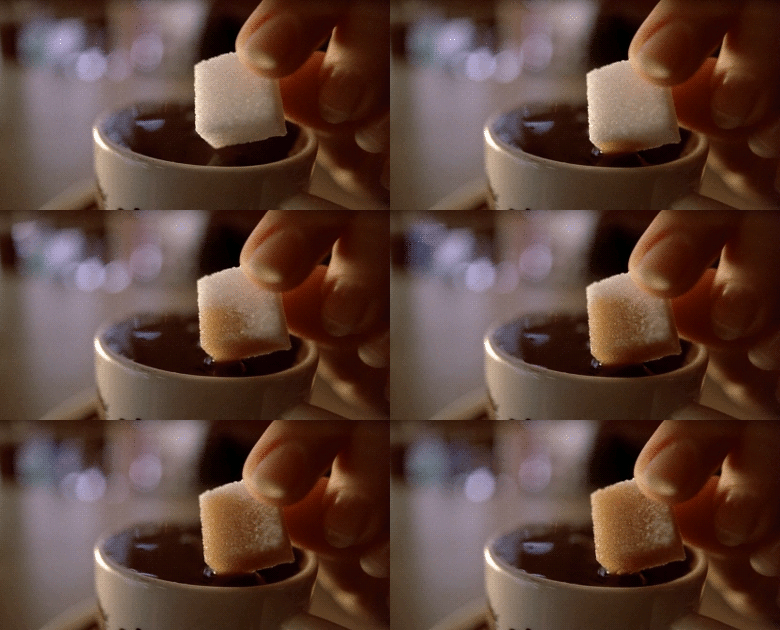
电影《蓝白红三部曲之蓝》中,导演让工作人员找遍全城,就为了这块溶解最慢的方糖。
他说的很有意思——总之,这是第一反应,是吧,但他在说什么呢?众所周知,用一个勺子可以加快……对,是这样。“让糖溶解”,是什么意思?这是一个移位运动。糖块的粒子,在那里散开了,掉到了杯底;尽管你们用你们的勺子好好搅了搅,你们会加快了时间,但还是要等糖溶解。也就是说,在一个封闭系统中,总是有一个开口;有时候真实时间会对系统有所作用。
What he is saying here is very odd because, well, the first reaction, yes, but what is he talking about? It is well known that with a teaspoon one can create … Yes, it is true. What does it mean to “let the sugar dissolve”? It is a movement of translation. The particles of the lump of sugar, there, break apart, fall to the bottom; although you can stir it with your teaspoon, you will move time along, but you have to wait for the sugar to dissolve. That is, in a closed system, there is always an opening; sometimes time takes hold of the system.
因而,从这个角度上,你们会说——在这里我们又会回到对柏格森的逐字的评论上——你们可以说:移位运动,糖的粒子从糖块分开——这仍然是移位运动——标志着从全有的第一个状态过渡到全有的第二个状态,也就是说,从你们有“糖在水中”的一个状态过渡到你们有“糖水”的另一个状态。从一个状态过渡到另一个状态,真实时间是必不可少的。
As a result, from this point of view, you will say — here, we are going to fall right back on Bergson’s literal commentary — you will be able to say: the movement of translation, the sugar particles which break apart from the piece – this is movement of translation once again — marks the passage from a first state of the Whole to a second state of the Whole, [Pause] that is, the passage from a state in which you have “sugar in water” to another state of the Whole where you have “sweetened water”. Real time was necessary to move from one to the other.
柏格森没有继续问。得有一个开口来连接人工的封闭系统,也就是说,系统只是人工地封闭了。但它与开放、有时候是与真实时间,保持了一个联系……得等糖溶解。这一切是想说什么?在什么意义上,最终柏格森可以把绵延、全有(Whole)、那个全有(the Whole)和一个全有这些概念作为相当的东西来处理呢?最后是在什么条件下呢?在真正分开“集合”和“全有”两个概念的条件下。集合,是什么?在我看来,按照柏格森主义的字面意思,必须得说“集合,是一个人工的封闭系统里各部分的一个汇集”。而移位运动是各部分的一个关系,这是很对的。
Bergson doesn’t ask for more. There has to be an opening that connects the artificially closed system, that is, the system is only artificially closed. But that it keeps a connection with the Open, sometimes in real time… you have to wait for the sugar to dissolve. All this to say what? The sense in which, finally, Bergson can treat as equivalent the notions of duration, of Whole, of the Whole and a Whole. On what condition finally? On the condition of indeed separating the two concepts of “set” and “Whole”. What is the set? It seems to me, according to the letter of Bergsonism, one must say that “the set” is a joining of parts in an artificially closed system. [Pause] And it’s quite true that movement of translation is a relation between parts. [Pause]
“全有”,是什么?全有,就是开放;是系统和开放的关系。也就是说,它是真实时间或者绵延。“绵延”等于“全有”。因此,应该就清楚了刚才那个复杂的说法:“运动作为各部分的关系,显露的一份变化就是全有的触动。”因此,说到底……
What is the “Whole”? The “Whole” is the Open; it is the relation of the system with the Open. That is, it is real time or duration. [Pause] “Duration” equals “Whole”. By the same token, the complex expression from earlier should become clear: “movement as a relation between parts expresses a change as an affection of the Whole”. [Pause] As a result, at the extreme …
一个学生:(插嘴)
德勒兹:什么?……等一下,你可以迟点说要是有……说到底,如果要试着理解这整个柏格森对运动的第 3 个论点,我们的结论会是什么呢?那等于就是说:听好了,要区分 3 个层次。必须区分 3 层。我现在试着,我试着给了你们刚刚够用的资料,来理解这个复杂的论点。
A student: [Someone begins talking, but Deleuze says]
Deleuze: What? … One second, you will speak later if there is … At the extreme, what would our conclusion be, in order to try to see the entirety of this third Bergsonian thesis on movement? It would be like saying: listen, we have to distinguish three levels. We must distinguish three levels. There we are. I’m trying now, I’m trying to give you just enough data to understand this complicated thesis.
3 层,会是哪 3 层呢?我准备了我今天要讲的东西,除此之外,我知之甚少,但那也许之后我们会有兴趣,也许 3 层都属于必须被称为图像的东西。但不要紧。这 3 层,是什么呢?
- 第 1 层:空间中的物体,而这些物体是各个部分。(录音至此 59: 35)
Three levels, which would be three levels of what? I am preparing what I still have to say today, apart, perhaps, I do not really know, but that is what will interest us later, perhaps three levels which belong to what must be called the image, but no matter. What would these three levels be? First level: objects in space, objects that are parts. [End of tape] [59: 35]
……但与逻辑学家相反,他会说“全有”仍有一个意义。简单地说,全有,不是所有集合的集合,而是关于绵延的,也就是说,关于开放或者关于变化的。
… But in contrast to logicians, he would say the “Whole” still has a meaning. Simply, it is not the set of all sets, the Whole, which is of duration, that is, of the Open or of change. [Pause]
- 第 2 层:运动,本质上有关于空间中的物体;移位运动有关空间中的物体,但也把空间中这些物体联系到了绵延上,其中:空间中的运动显露了绵延。
因此现在,我并不满足于说,你们看这 3 层,我并不满足于……这 3 层……我恰恰觉得……在物体和人工封闭的集合这个层次上,这 3 层是什么?这就等同于他之前说的静态截面了。这和瞬间的静态截面是等同的。
Second level: movement, which is essentially relative to objects in space, movement of translation, which is relative to objects in space, but which relates these objects in space to duration, hence: movement in space expresses duration. [Pause] As a result now, it won’t be enough for me to say, see how these three levels, I will not be satisfied… these three levels… I find exactly… At the level of objects and artificially closed sets, what are they? This is the equivalent of what he earlier called the immobile sections (coupes immobiles). This is the equivalent of instantaneous immobile sections. [Pause]
- “全有”,即第 3 层,是等同于绵延的,而我会问,在什么意义上,移位运动,也就是空间中的运动,在什么意义上空间中的运动显露了绵延,或者能显露绵延吗?
现在,我可以更好地表述:它显露了绵延,以至于空间中的运动把各个物体——在各个物体之间建立起了运动——连接到了绵延上,也就是连接到了全有上。移位显露了一个更内在的扰乱。
The “Whole”, the third level, is the equivalent of duration, and I would ask, in what sense, the movement of translation, that is, the movement in space, in what sense movement in space expresses duration or does it express duration? Now, I can state it better: it expresses duration exactly to the extent that movement in space relates the objects between which it is established to duration, that is, to the Whole. Translation expresses a deeper perturbation.
看,这次,我有了一个三合一式的区分。运动,是联系了空间中的物体和绵延的东西,也是联系了绵延和空间中的物体的东西。运动,是使空间中的物体在绵延的东西,不管怎样,不管我思考这些物体的这个人工系统有多封闭。同时,那是导致绵延不仅关系到在我身上发生了什么,而且关系到在事物上发生了什么。所以,空间中的运动,在那里就有了双重的、转折的境遇——这就是为什么是第 2 层——把空间中的物体联系到全有上,也就是联系到绵延上,而且把全有联系到空间中的物体上。正是在这个意义上,移位运动从而显露了变化或者绵延。
See, this time around, I have a triadic distinction. Movement is what relates objects in space to duration and what relates duration to objects in space. Movement is what makes objects in space endure despite everything, however closed the artificial system in which I consider them may be. And at the same time, that’s what results in duration concerning not only what is going on in me, but what is going on in things. So, movement in space, there, has the double, has the pivotal situation — that’s why it was level two — of relating objects in space to the Whole, that is, to duration, and the Whole to objects in space. [Pause] So, it is exactly in this sense that movement in translation expresses change or duration.
是的。在一个条件下——我们快说完了,但还没完全结束——在一个条件下。看,如果我的 3 层相联,这才行得通。我的 3 层必须相联。移位运动必须这样,不停地操作,就是说在空间中可分割的物体联系到了绵延上,而绵延也联系到了物体上。换句话说,要是绵延本身没有一个奇怪的力量来既分开自身又汇集自身,还要持续地分开自身、汇集自身,那么系统中什么都会行不通。绵延把本身分成那么多的小绵延(sub-durations)。它把自身分割为同样多的节奏和小绵延,因为有空间中的物体是关系到运动、关系到某一个运动,而且相反地,这些物体在同一个绵延中汇集了。绵延从不停止……分开自身又汇集自身的运动,片刻不停。
Yeah. On one condition - we are almost done, but not quite finished - on one condition. It would only work, see, if my three levels are connected. My three levels must be communicating. The movement of translation must operate in such a way that, ceaselessly, the objects which can be detached in space are related to duration and duration related to the objects. In other words, nothing would work in the system if duration did not of itself have a strange power to divide and reunite and keep dividing and reuniting. It divides itself into so many sub-durations. It divides itself into as many rhythms, sub-durations, as there are objects in space concerned by movement, concerned by a particular movement, and conversely, these objects come together in one and the same duration. Duration never ceases to be… at every moment, the movement of dividing and reuniting.
然而,那是什么意思?那是在说什么?这些例子,我们会用得上的;这就是为什么我坚持要连着用这些例子。前面的一杯水。另一个例子出现在柏格森写的一本很奇特的书里,书的历史说来话长,叫《绵延与同时性》。《绵延与同时性》,我想说,我会很快地补充一下——这是一本在柏格森的著作整体中很特别的书,因为这本书中,柏格森想要直面爱因斯坦的相对论,他好像在批判这个相对论。而这本书同时也颇令人困惑,因为我们得到的印象是,这有问题,行不通。然后,我们往往也会对有些好得不一般的时刻赞叹不已,但总体上,口气是这样的:“爱因斯坦不明白。”什么东西爱因斯坦不明白、而柏格森想让他知道呢?
And what is this? What is that? All these examples, we will need them; that is why I insist on the succession of examples. The glass of water there. Another example arises in a very strange book by Bergson, which has a long history, called Duration and Simultaneity. Duration and Simultaneity, I am saying here – I’m open a parenthesis very quickly — it is a very special book in all of Bergson’s books, because it is a book in which Bergson claims to be confronting Einstein’s theory of relativity, and he seems to criticize this theory of relativity. And this book is at once very disconcerting because one has the impression that something is not right, that it is not right. And then we are sometimes dazzled then as well by moments that work out extraordinarily well. But overall, the tone is, “Well, Einstein didn’t get it.” What did Einstein not grasp, and that Bergson wants to know?
柏格森能和爱因斯坦在科学上,也就是在物理上来争论吗?能,当然。大概吧,他很博学,柏格森。他对数学、物理知之甚多,也正因为如此,我会很不舒服,当人们……《绵延与同时性》有问题,(但)当人们从柏格森有关科学数据的不充分性来说明问题的时候,我对此很难信服因为……这些科学数据,我认为……如果有东西行不通,也不应该是这些东西。那么为什么有东西行不通?
Is Bergson able to talk with Einstein scientifically, that is, about physics? Yes, no doubt. No doubt Bergson was very learned. He knew a lot about mathematics, physics, that’s why it bothers me when people… What is wrong with Duration and Simultaneity, when it’s interpreted regarding the insufficiency of Bergson’s scientific data. I hardly believe it because… this scientific data, I think that… That’s not how it has to go if something’s doesn’t work. And why is something not working?
是柏格森自己放弃了这本书,拒绝在生前作任何重印。可即使,即使就在最近,尽管……即使在他的遗嘱里,他禁止重印这本书,然而,幸运的是,书还是重印了。我觉得……这很幸运,但这就有了一个问题。这就提出了一个道德问题,让我们觉得难办。不过书是重印了,所以这本书找得到的。
It is because Bergson himself repudiated this book, refused any reprint during his lifetime. And it is even, it is even quite recently, that despite… Even in his will, he prohibited reprinting it, and then, it had been reprinted, fortunately. I find … It is … fortunately, and that creates a problem. This creates a moral problem that will occupy us. But it was reprinted, so this book is available.
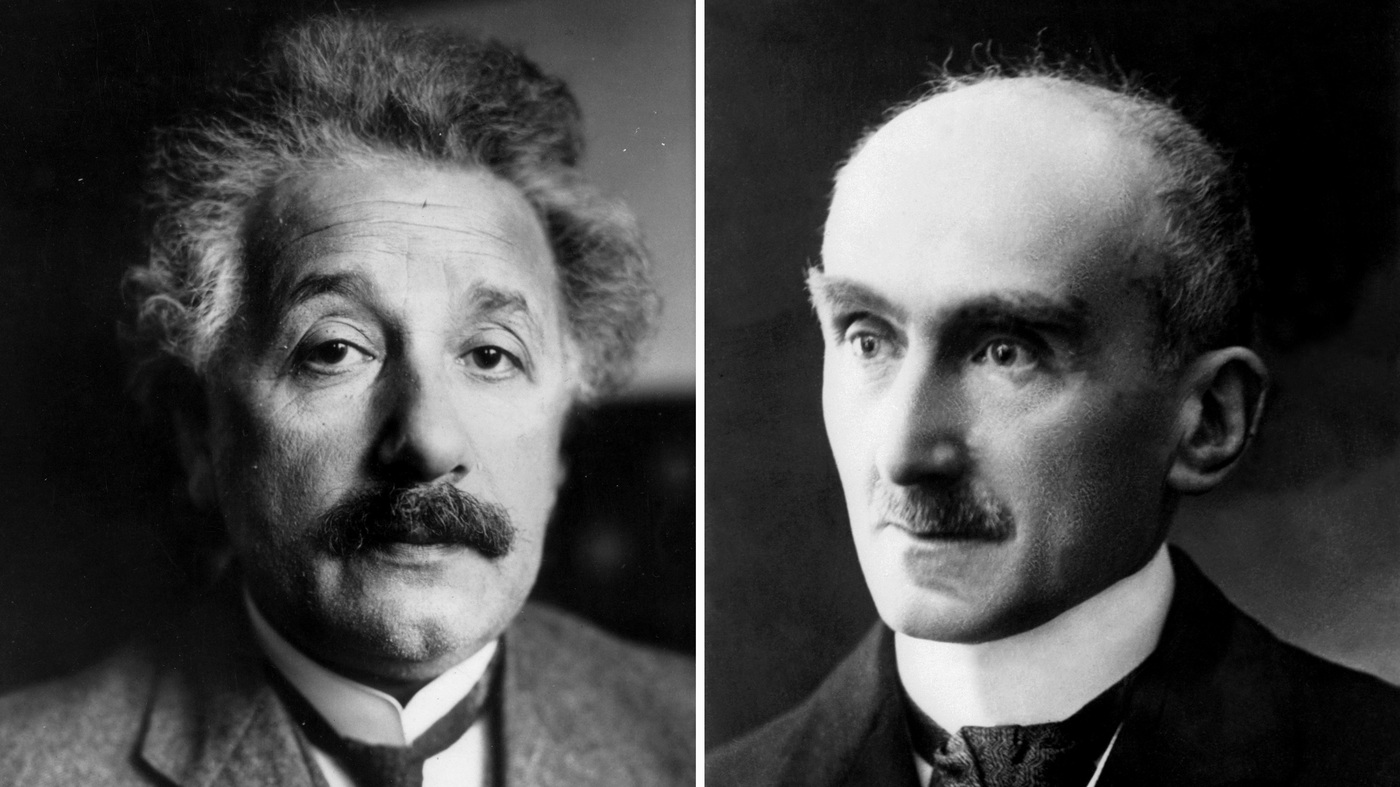
爱因斯坦 v 柏格森
事实上令人不安的,是我们不太确知,柏格森,科学的批判者,柏格森作为爱因斯坦的批判者,是不是还有很怪的一面?我们……注意,在上一讲后,我们有更多的武器来理解他在《绵延与同时性》中显然是想要什么了。对他来说,这不是关于批判相对论,完全不是;那是差得离谱。他想要的,是非常非常不同的东西,就是:提出、设立相对论的形而上学。
And what is disturbing, in fact, is that we do not know very well, is this Bergson, critic of science, Bergson critic of Einstein, but there would even be a very weird side? We … Notice that since the last session, we are better equipped to understand what he obviously wanted in Duration and Simultaneity. For him, it was not about criticizing relativity, not at all; that would be a crazy idea. What he wanted was quite different: to propose and create the metaphysics of relativity.
你们记得他的理念吧。有一个现代科学与古代科学不同。而“现代科学”、“古代科学”之别陈述起来非常非常简单:这是关于优先瞬间的故事。现代科学,是运动与任意瞬间的关系。古代科学,是运动与优先瞬间的关系。而他补充说,柏格森补充道:但这很奇怪。如果现代科学,是的确如此,也就是说,把时间当作自变量(译注:independent variable,指用來解释其他变量的变量),那么这样一门科学的形而上学从未有过。因为所谓现代的形而上学最终加在了古代形而上学里头。它错过了大好机会。它的大好机会,本来是设立对应于这门科学、对应于新科学的新的形而上学。因为,现代世界带来了一门新科学,这个科学在于把时间视为自变量,也就是说,从任意瞬间来重建运动,那么,就需要一个新的形而上学,也就是说,关于时间、而非关于永恒的一个形而上学。这就是柏格森想干的,想用绵延来干的,用一个真实时间的形而上学来替代关于永恒的一个形而上学。
You remember his idea. There is a modern science that differs from ancient science. And the “modern science”-“ancient science” distinction is extremely easy to state: this is the story of privileged moments. Modern science is the relation of movement to any instant whatever. Ancient science is the relation of movement to the privileged instant. And Bergson added, well this is strange. If modern science is indeed that, namely: grasping time as an independent variable, the metaphysics of that science has never been undertaken. For so-called modern metaphysics was finally grafted onto ancient metaphysics. It missed its big opportunity. Its great opportunity would have been to create the metaphysics that corresponded to that science, a new science, a new metaphysics. Since the modern world brought along a new science, the science that consisted of treating time as an independent variable, that is, to reconstitute movement from any instant whatever, well then, a new metaphysics was needed, that is, a metaphysics of time and not of the eternal. That’s what Bergson preferred, uh, claimed to do with duration, a metaphysics of real time instead of a metaphysics of the eternal.
于是,他与爱因斯坦冲突,很正常。因为相对论是……是现代科学的演进中的一种优先时刻。对于柏格森,这不是要不要批判相对论;而是要自问什么形而上学可以对应相对论这样新的一个理论。
So, it’s normal that he confronts Einstein. Because the theory of relativity is… it’s kind of a privileged moment in the evolution of modern science. For Bergson, it is not a question of criticizing the theory of relativity; it is a question of asking what metaphysics can correspond to a theory as new as the theory of relativity.
而这些都是在这样一本书的框架里,我们会看到,能看到为什么这么久以后,柏格森是在这样一本书的框架中告诉我们这个的。他说,你们知道,爱因斯坦,他只跟我们说各个瞬间的同时性……而相对论,在某种程度上,是关于瞬间的同时性的一个理论。在什么时候、什么意义上,可以说两个瞬间是同时的?但柏格森说,如果先有了其他东西,就绝不会,绝不会想到瞬间的同时性这个理念。正是在这里,他提出了他的理念:各个瞬间的任何同时性首先预设了另一种同时性,也就是各股流(flows)的同时性。柏格森就此提出了流的同时性这个概念。
And, it is in the context of such a book, we will see, and we will only be able to see why much later, it is in the context of such a book that Bergson tells us this. He says, you know, Einstein, he only tells us about the simultaneity of instants and … and the theory of relativity is, in a way, a theory of simultaneity of the instant. When is it and in what sense can we say that two instants are simultaneous? But, says Bergson, never would we, never would we come to the idea of a simultaneity of instants if there was something else first. And this is where he launched his idea: any simultaneity of instants first presupposes another type of simultaneity which is the simultaneity of flows. And Bergson brings forth the notion of simultaneity of flows. [Pause]
而对于流的同时性,他给了我们一个例子,对于我们是和“一杯糖水”一样好、一样宝贵的,我们之后会发现的。他说好了,我呢,我在岸上,我站在岸上,那里有很多流。流水——第一股流:流水。第二股流:我的内在生命。今天我们可以说——“内在生命”,有些人可能不喜欢这么说——今天我们可以说一种内在独白——其实是一回事。但“独白”太像语言了;“内在生命”好些,我的“内在生命”;不是说它很巨大,它只是一股流。然后,一只鸟。一只鸟飞过。3 股流。为什么要至少 3 股流?注意,这 3 股流,这是一个很多变的形态。因为一会儿我把它们把握为一体——一种幻想,其中我的内在生命的持续、水的流动,鸟的穿越或者飞行都倾向于在同一个节奏中合并,一会儿,我又随即把它们视为三者。
And with the simultaneity of flow, we have the example that he gives us which is as good, as precious to us, as we will see later, as a glass of sweetened water. He says there we are; I am, I am on the shore, I am on the shore, and there are flows, the flowing water. First flow: the passing water. Second flow: my inner life. Today we would say “inner life” (for those who wouldn’t like it), today we would say (but it’s exactly the same) a kind of internal monologue. But “monologue” is too much language; it is better, “inner life”, my “inner life”; it’s not that it’s great, it’s a flow. And then, a bird. A passing bird. Three flows. Why do you need at least three flows? Well then notice, it’s a very variable figure, these three flows. For sometimes I grasp them as one, a kind of reverie there, in which the continuity of my inner life, the flow of water, and the crossing or the flight of the bird tend to be united in the same rhythm. Then, sometimes, I consider them as three.
为什么需要三者?因为总是需要三者,因为总是有……两股流给定了,需要第 3 股来体现两者的同时性有没有可能,也就是两者在同一个第三者中汇集或者两者彼此分开的可能性。汇集或者分开的可能性。(录音至此 72: 36)
Why do you always need three? Well, we always need three because there are always … two flows being given, we need a third one to embody the possibility of their simultaneity or not, namely, the possibility that they are united in the same third or that they are divide. Possibility of joining or division. [End of the cassette] [72: 36]
第 2 部分
然而,这个汇集、分离的可能性属于流的概念,那么它在3 股流合成的我的内在生命的流之中是依存于什么呢?是我的内在独白一会儿合并了这 3 股流,其中包括(独白)本身,一会儿又通过把其他两股流把握为我的内在生命或者我的绵延之外在,来分开这 3 股流。这是一种绵延的“我在”(cogito),不再是以“我思”的形式来表达,而是“我绵延着(法语 dure)”,也就是说在同一个绵延里,有时候我合并各股流,有时候我分开它们。为什么我要引入这个?因为这样,我们就有了完整的表述。如果我的绵延是这个在流中分开自身、再分开自身、或者把各股流汇集在一起的能力,你们可以看到我的意识怎么成了使我暂且称为图像的这 3 个层次去交流的积极因素。
Part 2
… And this possibility of joining-division which belongs to the notion of flows, what does it depends on in the three flows of the flow of my inner life? It is my internal monologue which sometimes brings together the three flows including [the monologue] itself, sometimes dividing the three flows by grasping the other two as external to my inner life, to my duration. It is a kind of cogito of duration which would no longer be expressed in the form “I think”, but “I endure”, that, sometimes I bring together and sometimes I separate the flows in the same duration. In other words, it is through the intermediary of my consciousness that I have the power to grasp the flows, sometimes as one and sometimes as many. Why am I introducing this? Because here, then, we have the complete formula. If my duration is this capacity to divide, to subdivide into flows, or to unite the flows into one, you can indeed see how my consciousness is like the active element that causes the three levels, of what I call provisionally the image, to communicate. [Pause]
你们记得吧,图像的这 3 层,又一次,成了从各个集合——也就是说从人工的封闭系统——里取出的物体;全有在另一方面,在另一头,是作为绵延、作为变化、作为扰乱的,因为全有只能按照这些扰乱来定义。全有根本上是过渡;全有根本上是压力变化,而一个压力变化正是不可确定位置的(localisable)。一个压力变化,一个电势差,是不可确定位置的。可以确定位置的,是那两个极限(terms),而差异建立于两个极限之间。但这个差异本身关系到的是一个全有。全有通过差异来实现。它通过差异来实现,所以全有,也就是开放、变化、绵延。
Remember, the three levels of the image are, again, objects taken in sets, that is, in artificially closed systems; [Pause] the Whole, on the other hand, [is] at the other end, as duration, as change, as perturbation, since the Whole can only be defined as a function of these perturbations. The Whole is fundamentally a passage; the Whole is fundamentally a change in tension, and precisely a change in tension cannot be localized. A change in tension, a difference in potential, is not localizable. What is localizable are the two terms between which the difference is established. But the very difference concerns a Whole. The Whole works through difference. It works through difference, this, the Whole, that is, the Open, the changing, duration.
第 3 点或者应该是第 2 点:运动,空间中的运动、移位运动,我想说的是移位运动把物体联系到绵延上,又把绵延联系到了物体上。当各个物体与绵延有联系时,就像各股流汇集一体;当绵延、全有与物体有联系时,相反地,就像绵延分成了各个小绵延,分成了各个分流,这样你们就有了持续运动,通过这个运动,各股流分开又汇集。换句话说,这就像我的意识,在最最心理学的意义上,是我的心理意识保证了三层之间在通气(ventilation)。因而我现在可以说,而且这不是碰巧的,正像我刚说的那样,生命体与全有有一个相似性,而各种精神(psychic)系统,更是如此,与全有有着一个相似性。
Movement, third or rather second in between these, movement in space, movement of translation, I am saying that movement of translation relates objects to duration and relates duration to objects. When objects are related to duration, it is as if the flows were united in one; when duration, the Whole, are related to objects, it is as if, on the contrary, duration was divided into sub-durations, divided into distinct flows, and you have the perpetual movement through which the streams are divided and through which the flows come together. In other words, it is like my consciousness, in the most psychological sense possible, it is my psychological consciousness that guarantees ventilation for the three levels. As a result, I can say now, and it is not by chance, that just as I said the living has an affinity with the Whole, psychic systems, all the more so, have an affinity with the Whole.
因此以一种很怪的方式来推进到极致的话,我就可以组合出(compose)许多个生命体和精神存在——后者更是如此了,我可以在它们之间组合出它们,直到我达到同一个大全有(the Whole with a capital W)。不管怎样,现在,我们刚评论了柏格森的这个第 3 个论点,也就是不仅瞬间是运动的一个静态截面,而且运动则是绵延的一个活动截面——这个论点重拾了集合,因为运动是绵延的一个活动截面。是的,因为它把孤立的或者可以孤立的物体联系到了作为全有而运行着的绵延上,把作为全有而运行着的绵延联系到了物体上,而在这些物体中,绵延被分成了小绵延。
As a result, at the very extreme of kind of very bizarre progressive manner, I could compose the living and, all the more so, psychic beings, I could compose them among themselves all the way to reaching a one and same duration which will be the Whole with a capital W. In any case, for the moment, we have just commented on this third thesis from Bergson, namely not only the instant is an immobile section of movement, but movement is a mobile section of duration, a thesis which takes up the set since movement is a mobile section of duration. Yes, because it relates isolated or isolable objects to duration functioning as the Whole and relates duration functioning as the Whole to objects in which duration will be divided into sub-durations. [Pause]
所以在你们休息之前我想说的是,好,我们还有什么要讲?总之很明显,假如你们都听下来了,我认为这没那么那么难。
So, what I would like to say before you take a break is, fine, well then, what do we have left? Well obviously, that assumes you followed all this, but I think it wasn’t all that difficult.
现在留给我们的,是要问一个问题,有点……我们和柏格森离远一点来面对面,也就是说,好:这一切,有什么后果吗——好,我简化一下我说的各层次的变化——这对电影、对电影图像造成了什么后果?毕竟,电影几乎是来检验今年我想处理的主题的。这是什么意思呢?我会告诉你们这是要思考什么的。但如果它行得通连一点证明都没有,我们是无法思考的。所以这一切都得靠你们。
What we have left now is to ask a question a bit … we can take a bit of distance vis-à-vis Bergson, namely, ok: does all this have consequences — well, I am schematizing my change of levels — does that have consequences for the cinema, for the cinema image? After all, it is almost the demonstration (épreuve) of this subject as I would like to consider it this year. What does this mean? I’ll say what topic we’d like to consider. But one cannot consider it if there is not already some evidence that this works. So that all depends on you.
我自问的问题是:假设电影图像是运动-图像。适合叫作运动-图像的东西,是由我们刚看到的 3 个层次——物体的、运动的、一个全有或者一个绵延的层次,而组成的这个图像吗?而运动-图像正是在于这一点:运动-图像联系了物体,而运动把物体联系到了绵延上,把绵延分成同样多的小绵延和物体,因此层次之间就有了交流。
The question I ask myself is: let us assume that the cinema image is the movement-image. What should be called a movement-image? Is it not this image made up of the three levels that we have just seen, of objects, movements, a Whole or a duration? And the movement-image would consist exactly in this: it relates objects, movement relates objects to duration and subdivides duration into as many sub-durations as there are objects, therefore communication between levels. [Pause]
我们是讲到了这了吧?我们试试在其中定位一些很重大的电影概念中的一个概念。所谓的取景是什么呢?如果回到很简单的定义上,会很有用;定义总是太复杂。电影中取景的操作是什么?我会说,这很简单:取景,是建构一个人工的封闭系统。换句话说,取景就是选择、确定哪些物体和存在物进入镜头——(假设)我们还不知道一个镜头是什么——入画的物体由取景确定,而且既然这些物体已经完全属于电影,那就值得给它们一个专门的名字。可以叫它们,比如帕索里尼提出了影素(译注:法语 cinème;帕索里尼原文为 kineme)的说法:C,I,N,E,M,E。他说,是的,物体作为镜头的一部分,管它们叫影素吧。影素——影素这名字,也许有点危险;你们能感到语言学就在旁边,也就是说他想干一件事,他已经想到引入一个对照——所以我们,要小心“影素”,所以你们可以随便叫这些物体什么——“电影-物体”(kinoc-objets)……“电影-物体”,你们可以随便管它们叫什么,电影-对象(cinema-object)什么的。是取景来确定了这些物体。好了。而且完全不妨碍说,是的,取景框是一个系统;是电影所需的一个人工的封闭系统的建立。到了这里,一切成败已经都有可能了,我们接下来会看到。
Is that where we’re at? Let us try to locate here one of the concepts, one of the very large cinematographic concepts. [Pause] What is it that we call framing (cadrage)? It would already be beneficial if we arrived at some very simple definitions; definitions are always far too complicated. What is the operation of framing in cinema? I would say, well, it’s very simple: to frame is to constitute an artificially closed system. In other words, framing is [Pause] choosing and determining the objects and beings that will enter the shot — we do not yet know what a shot is — the objects that will enter into the shot are determined by the framing and henceforth deserve a special name, insofar they already fully belong to the cinema. We can call them, for example, Pasolini suggests the name of cineme (cinème): [Deleuze spells it] C.I.N.E.M.E. He says, well yes, objects that are part of a shot, let’s call them cinemes. The cineme — perhaps this is dangerous; you sense that linguistics is not far away, that is, he wants to do something, he already wants to introduce a parallel — So we need to be wary of “cineme”, so anything, you can call them “kinoc-objects” … “kinoc-objects”, you can call them whatever, cinema-object, maybe. It is the framing that determines them. There we are. And there is nothing wrong with saying, well yes, the frame is a system; it means establishing an artificially closed system that the cinema needs. Already, at that point, everything may or may not fail, we will see.
第 2 件事,第 2 层:相对的运动建立于这些物体之间,你们会这样告诉我……我理解的第 2 层是……我在作的是一个抽象思维……这就是……不是先此后彼的……但物体肯定只是已按照这个运动来选择的。但要确定物体之间的相对运动,是什么意思?对运动的确定,让我谈起了相对运动,而事实上有好几个运动。所以补充一下:要确定的相对运动,是构成于这些运动之间,建立于这些运动之间的,即使这意味着之后才能说明其理由,而我会说,这就是我所说的一个镜头。对我来说,在镜头的一堆含糊的定义中,引入对镜头的定义的这个提议,是有优势的。它提出了种种困难,我这就会解释,但我们之后才会意识到这些困难。暂时假设……要是不行,还可以从头再改,但先设置一个参照物,作为引导,这样我就提出了镜头的定义:相对运动的确定构成于物体之间,而这些物体是由取景确定的。
A second thing, a second level: a relative movement is established between these objects, you will tell me … I understand that the second level is … I am creating an abstraction … this is … this is not, there is not first this and then … but undoubtedly the objects were chosen only as a function of this movement already. But the determination of the relative movement between objects, what is it? The determination of movement, and what makes me speak of relative movement, but actually there are several movements. So, let’s add: the determination of the relative movement made up between these movements, which is established between these movements, even if it means justifying it later, I would say, this is what I call a shot. For me, this has the advantage, in this mush of definitions of the shot, of introducing a proposed definition of the shot. It raises all kinds of difficulties, I will say it right away, but we can only deal with these later. So, let’s assume for the moment… We will change everything if this doesn’t work, but let’s set as a reference point, as a guide, I thus propose as a definition of the shot: the determination of the relative movement composed between objects, which have been determined by framing.
镜头对应的——在一个轴上,如果你们需要的话我可以找一个词——对应的是分镜。电影中的“做分镜”是什么?做分镜就是确定了复杂的相对运动,而这个运动会把取入镜头的物体汇集到一起,又在取入镜头的各个物体之间如此被分开,以至于什么呢?当然,是要说完这个“如此”导致的东西。好,还有一个第 3 层,那么给一部小说做分镜,比如把一部小说做成一个剧本的分镜,是怎么回事?我相信,做分镜,这恰恰意味着一件很简单的事、一个很简单的操作,却很难办,也就是:选择对应一个镜头的各个复杂的运动,然后是对应这些运动的下一个镜头。
The shot corresponds — on an axis, if you like, if I look for a word — to cutting (découpage). What is “cutting” in cinema? Well, cutting is determining the complex relative movement that will join the framed objects together and will be divided between the framed objects in such a way that what? Doubtless it will be necessary to add something to “in such a way that”. Okay, also there is a third one, but then editing a novel, for example, editing a novel into a screenplay, what is that? I believe that it is quite precisely to cut this out, meaning a very simple thing, a very simple operation, very difficult to do, namely: to choose the complex movements which will correspond to a shot and then to another shot.
我说“如此”,那会导致什么呢?必须选择复杂的相对运动,而这个运动如此地构成了镜头,以至于运动把取入镜头的各个物体的整体联系到了什么上?联系到一个全有,也就是联系到一个绵延,一个全有,也就是联系到一个绵延。好,那这是因为电影在根本上关心的是柏格森所说的绵延吗?也许吧,我们也还不知道,但总之……然而,相对运动构成于物体之间的方式——也就是一个镜头,通过这个运动与全有联系了起来,而这意味着的就是这个镜头与其他镜头的关系,并且是通过了这一关系而进行的。因此,……因此,这第 3 层作为电影概念,也就是镜头中、在当前空间中的运动应该显露的镜头和一个全有的关系,指的就是剪辑的概念。
I am saying “in such a way”, in such a way that what? Well, you have to choose the complex relative movement that constitutes the shot in such a way that it relates the set of the framed objects to what? To a Whole, that is, to a duration, a Whole, that is, to a duration. Well, fine, because cinema would fundamentally be concerned with duration in the Bergsonian sense? Perhaps, we don’t know yet, but anyway… [Pause] But, the way in which the relative movement composed between objects, that is, a shot, relates through its movement to the Whole implies and goes through the relation of this shot with other shots. As a result, … as a result [Pause] this third level as a cinematographic concept, namely the relation of the shot with a Whole that the movement in the present space in the shot is supposed to express, refers exactly to the concept of montage.
所以我们有了 3 个电影概念来对应于……大体上我在这里没干什么,除了……我试着……让我不舒服的,是这看起来像一种具体应用……——(德勒兹跟边上一个人说)您不想这样吧,有个人……我觉得是……您的动作……您不是靠近一个通风口吗?不是……那是谁干的呢?……啊,也许是另一头来的?……没有人压在什么东西上,是吧?——你们明白吧,我不想要这个看起来像一种应用,我们得……当然我脑子里想的是另一回事……那么即使这意味着付诸使用,这也是为了……
So, we would already have three cinematographic concepts that would correspond … In short, I’m only doing here, I’m just … I’m trying … what would bother me is that this seems like an application … – [Deleuze talks to someone nearby] You don’t want it there, there is someone … I think it’s … Your movement … No, you are not near an outlet there? No … Who is causing that then? … Ah, maybe it’s on the other side? … There isn’t someone leaning on something, right? — You understand, I wouldn’t want that to seem like an application, we’d have to … it’s something else in my mind, of course … There we are then, even if it means creating applications, this is to… [Deleuze does not complete this]
我记得有人很奇怪地说过这个…..他和我想干的事很接近…..我刚提到他了,那就是帕索里尼。在帕索里尼那里,某种方式危害了一切,但不是就这么一次,而是语言学无孔不入,所以也影响到了这里,而这很糟。语言学一出,寸草不生。(笑)所以这很简单;他如此痴迷于他的语言学历史和语言学在电影中的应用,以至于损害了他的那些方案(schémas)的纯粹。
I see someone who said that very oddly, who has… who is closest to what I’m trying to … this is, I just quoted him, it’s Pasolini. [For] Pasolini, what compromises everything is the way, but this is not the only time, it’s the way linguistics strikes everywhere, so it struck there, and it’s awful. When linguistics strikes, nothing grows back. [Laughter] So it’s very simple; he is so obsessed with his history of linguistics and the application of linguistics in cinema that the purity of his schemas is compromised.
但如果我试着……——帕索里尼的思想,很复杂——如果我试着从中提炼一个方面,我不会说要给你们整个帕索里尼的思想,他对图像的一种三部分的划分很敏感,而且对此跟我们说:好,我提议你们在电影图像里区分影素、镜头,以及理想的段落镜头(译注:ideal sequence shot;sequence shot 又译长镜头)。他还说:我们只能从这 3 个概念来理解电影。好,他自认为是个语言学家;事实上他却是柏格森主义者……这没什么丢脸的,其实更好了。因为,逐字逐句来看,他是怎么构想的呢?
But if I try … — Pasolini’s thought is very complex — if I try to extract an aspect from it, I do not claim to give you the whole of Pasolini’s thought, he is very sensitive to a kind of tripartite division of the image, where Pasolini tells us: well here we are, in the cinema image, I propose to you to distinguish cinemes, the shot, and the ideal sequence shot. [Pause] There you go. And he says: we can only understand cinema starting with these three concepts. Well, he thinks he’s a linguist; in fact, he is Bergsonian, right?… there is nothing shameful, this is even better. Because, considering this word for word, how does he conceive of it?
就影素而言,则相对简单;再说一遍,影素是确定哪些物体进入一个镜头,而这些物体是取景来确定的。这就是他提出要叫作影素的东西。所以,在它变了的时候,在它变得不适合我们这一刻的时候,我们还得看看电影和语言之间的这整个问题在哪——但总之,这会是个问题……对此谈了太多了……先就此打住;得把东西放一放——因为他的理念是,一旦有些语言学家发现了语言中可能有一个现象叫双层链接(译注:double articulation,又译双重关联,指语言由若干最小的音意结合单位组成,而每个音意结合单位又由更小的单位——音位组成),他就想在电影图像中找一个和双层链接对等的东西。于是他说,第一层链接就是镜头,第二层链接就是影素。因此他可以这么写: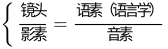
在这方面,不管怎样我先从我们讲过的角度表述这一点,这让我们完全没兴趣。相反,让我们大有兴趣的,是图像的这第 1 个方面:
由取景确定的各个物体 = 影素。
For cinemes, it’s relatively simple; once again, it is the determination of the objects that fit into a shot and they are determined by the framing. This is what he suggests calling cineme. So, where it changes, where it changes in a way that cannot suit us for the moment, we will have to see this whole cinema-language problem – but finally, this is, this is a problem, that we’ve already talked about too much… We must, we must stop on this point; we must let things rest — because his idea is that, once it’s said that certain linguists have discovered that there might be a so-called double articulation phenomenon in language, he wants to find the equivalent of double articulation in the cinema image. So, he said, the first articulation would be the shot and the second articulation would be the cinemes. As a result, he could write: shot over cineme equals the equivalent of moneme in linguistics over phoneme. This aspect, I am stating it for the moment, in any case, from the point of view we’ve reached, it does not interest us at all. What interests me a lot, however, is this first aspect of the image: objects determined by framing equal cinemes.
第 3 个方面。他说,而所有电影人都是这么说的——我想到的是爱森斯坦写的文章,在这方面也很令人惊叹——总之,他说:“最终,一部电影要是没有一个全有,就一文不值。”这个全有就是电影中整体的概念。在这一点上,如果电影人有分歧,如果伟大的导演们有分歧,那是因为他们真的不是用一样的手段来具化(法语 actualiser)、来构想、或者来实现全有。但全有的理念就是:总有一个整体是与电影合为一体了,同时与各个图像有一个多变的关系,但这个整体从不只在于单幅图像。从这里就有了一整个流派认为整体就是剪辑这一行为。
A third aspect. He says, and here all filmmakers have always said that — I am thinking of texts by Eisenstein, which are also so impressive in this regard — well, he says: “In the end, a film is worth nothing if there is not a Whole,” the notion of totality in cinema. On this point, if filmmakers differ, if the great directors differ, it is because they really do not have the same way of realizing the Whole, neither of conceiving of it, nor of realizing it. But the idea of the Whole is this: there is always a totality which is united with the film, and which has a variable relation with the images, but which never ties into a single image. Hence an entire school will say that totality is the act of montage.
所以,有了一个全有。假设有一个全有。这个全有,甚至可以构想为全有、绝对的全有、宇宙的全有。这就是帕索里尼称为的理想的段落镜头。理想的段落镜头,而他最后说这个理想的段落镜头,你们知道……它是什么?就是电影的持续(continuity),而那是和什么对立的呢?是与影片的现实而对立的。你们看到了电影的持续,而事实上,存在的东西是各个影片。电影的持续贯穿于各个影片,其本质上就是理想的。为什么段落镜头在帕索里尼看来是理想的呢?我们将看到这会提出种种问题;真的,如帕索里尼所说,他不信奉段落镜头;他自己不这么干,好……他不拍技术的意义上的段落镜头,我们至今也没看到……但你们知道的,我猜想,或者很……他是一个完全没有往段落镜头的方向探索的电影人。但为什么他不追求段落镜头呢?这是因为,对他来说,段落镜头不会混淆于理想的段落镜头,也就是一个无限绵延——他是那么表述的,一个无限绵延,现实无限的持续、绵延。这无法说得更柏格森了。因此,他说,是的,要是有段落镜头,它就不会终结。它会是一个集合;会是贯穿于所有影片的电影整体。它会是对于现实的持续、无限性而进行的再生产,这样它才是纯粹理想的。
So, there is a Whole. Let us assume there is a Whole. We can even conceive of this Whole as the Whole, the absolute Whole, the universal Whole. This is what Pasolini calls the ideal sequence shot. Ideal sequence shot, and he finally says this ideal sequence shot, you know … what is it? It’s cinematographic continuity as opposed to what? As opposed to the reality of the film. You see the cinematographic continuity, in fact, what exists are films. Cinematographic continuity through the films is by nature ideal. Why is the sequence shot ideal in Pasolini’s sense? We’ll see, that will pose all kinds of problems; indeed, as Pasolini says, he does not believe in the sequence shot; he does not do it himself, fine … he does not do a sequence shot in the technical sense that we have not yet seen … But you know, I guess, or many … He’s a filmmaker who does not at all go in the direction of exploring the sequence shot. But why doesn’t he explore the sequence shot? It’s because, for him, the sequence shot only merges with the cinematographic ideal, namely an infinite continuity, and he states it like that, and an infinite duration, infinite continuity and duration of reality. Here we cannot speak in more Bergsonian terms. As a result, he says, well yes, the sequence shot if it existed, well it wouldn’t end. It would be the set; it would be the totality of cinema through all films. It would be the reproduction of continuity and of the infinity of the real, such that it is purely ideal.
于是他指责的,你们看到他指责的,就是拍段落镜头的电影人,他指责拍段落镜头的电影人、那些拍段落镜头的,就是他们相信了段落镜头可以这样具化,使得段落镜头指示了一个理想化的持续,一个对所有电影都一样的理想化的持续。他还说:当我们试着拍一个真实的段落镜头来具化段落镜头,我们会掉进什么里?……这很有趣,他说,因为这明显是错的,但这很有利于他指出:这是在搞自然主义。拍一个段落镜头的时候,段落镜头是理想。他说他同意。但这正是这样一个理想,正是这样理想化的持续、以及这个理想化的持续之无限性,才使你们永远拍不出来那个理想。如果你们试着拍一个段落镜头,你们会掉进最平庸的自然主义。
So what he criticizes, you see, what he criticizes in filmmakers of the sequence shot, what he criticizes in filmmakers of the sequence shot, who created sequence shots, is to have believed that the sequence shot might be realized as such, whereas it indicates an ideal continuity, an ideal continuity equal to all cinema. And he says: when we try to actualize the sequence shot by making a real sequence shot, what do we fall … this is very curious, he says, that gets weakened because it is obviously false, but it is useful for him to say it: we are doing naturalism. When trying to make a sequence shot, the sequence shot is ideal. He says okay. But precisely, it is so much an ideal, it is so much the ideal continuity and the infinity of this ideal continuity that you will never be able to realize it. If you try to achieve a sequence shot, you fall into the flattest naturalism.
所以如果这只是他的批评,那也无关要紧,但他需要这个,他需要说出这一点,因为他的理念是什么呢?是理想的段落镜头,无法通过一些段落镜头而实现;只能通过各个镜头,只能用各个镜头,仅此而已……只能简单地用各个镜头从一个镜头转到另一个,通过一个剪辑的中介从一个镜头转到另一个。换句话说,是镜头之间的剪辑,而非真正的段落镜头,只是镜头之间的剪辑,就能拍出理想的段落镜头。
So, it doesn’t matter if it’s just his criticism, but he needs it, he needs to say that because what’s his idea? It’s that the ideal sequence shot cannot be achieved by sequence shots; it can only be achieved by shots, only by shots simple stated (tout court) … only by shots simply stated referring to one another by, referring to one another through the intermediary of a montage. In other words, it is the montage of shots and not the real sequence shot, it is the montage of shots which alone is capable of achieving the ideal sequence shot. [Pause]
你们看到了,这下我们明白他想说什么了吧。所以他有,他因而有了图像的 3 个层次:影素,也就是取景确定留下的物体;运动镜头;剪辑——每个镜头以及各个镜头的集合通过剪辑而反射出了一个全有,也就是一个理想的段落镜头。你们明白他想说什么了吧;他有一篇文章让我觉得很有趣,他说:是的,理想的段落镜头是一个分析性的持续;它是电影的分析性的持续,贯穿于所有影片。然而我们无法将其实现。为了实现而付出的全部努力都会掉进自然主义,会造成无聊,他说。于是他脑子里有了想法……而这不是,并不是,他脑子里的想法(不是)……和所有那些尝试……所有尝试……不是沃霍尔那样无限的段落镜头。
You see then, so we can see what he means. [Pause] So he has, he therefore has these three image levels: the cinemes, that is, the retained objects determined by framing; the mobile shot; [Pause] the montage through which each shot and all of the shots refer to the Whole, that is, to the ideal sequence shot. You see what he means; he has a text that strikes me as very interesting, he says: yes, the ideal sequence shot is an analytical continuity; it is the analytical continuity of cinema through all films. But we cannot achieve it. All efforts to achieve this directly fall into naturalism and breed boredom, he says. And there he has things in his head … and it is not, it is not, what he has in his head is… all the attempts to… all the attempts to… yes, an infinite Warhol-type sequence shots.
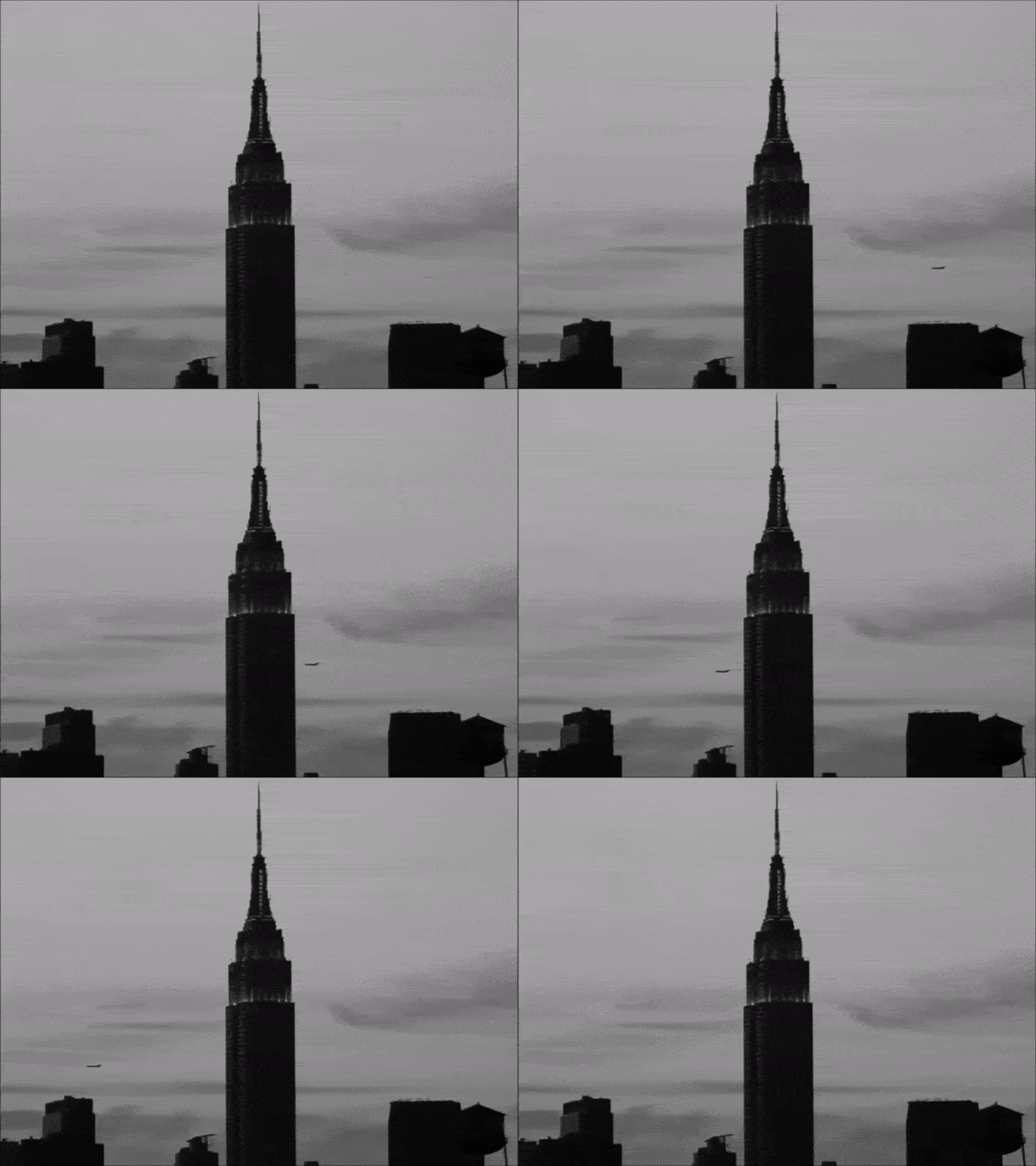
一张图看完 8 小时的沃霍尔《帝国大厦》
(译注:帕索里尼把理想的段落镜头称为“一个无止境的段落镜头”,并称:
电影符号学应该与现实符号学吻合,因为……我们眼前的不是生活现实……[而] 是一个无止境的段落镜头。从我们出生到死亡……电影不过是理想的摄影机,放在这个段落镜头前。 因此,电影事实上是一个假设的、不可能实现的无尽的段落镜头……理想的电影和具体的电影之间有种……质的甚至是意义的跳跃。……剪辑不过是将这条无限长的线 [前称的段落镜头] 缩减成一节线。 见《朱塞佩・卡尔迪洛对帕索里尼的访谈》,收入《异端的影像:帕索里尼访谈录》商务印书馆,2018 年)
那么,好……事实上,电影的分析性的持续是贯穿于所有影片的,而它只能以一种综合的形式来实现,也就是剪辑带来的各个镜头的综合。因此一部片中一个全有的持续,在根本上是综合性的,同时贯穿于所有影片的电影的持续,是一个纯粹的理想,一个分析性的纯粹的理想。
So, good… In fact, the ideal analytical continuity of cinema through all films can only be achieved in a synthetic form, that is, a synthesis of shots brought about through montage. As a result, the continuity of a Whole in a film is fundamentally synthetic, whereas the continuity of cinema through all films, that is a pure ideal, a pure analytical ideal.
于是,你们就明白在什么意义上我可以说:在图像中进行这样三部分的区分……必须如此。你们有了被分割的物体,被取景分割。你们有了构成的运动,是相对于各个物体的,从而构成了镜头,而相对运动把影素——也就是物体,联系到了全有,同时全有分为了和物体一样多的小绵延;至于物体则汇集于仅仅同一个绵延,也就是全有的绵延。所以,你们的三位一体——取景,镜头或分镜,和剪辑——表达了图像的这 3 个方面。
So, you see what sense I can say: in such a tripartite distinction operating in the image … well, you have to say yes. You have the cut-out objects, cut out by the framing. You have the composed movement, relative to the objects, constitutive of the shot, and the relative movement relates the cinemes, that is, the objects, to the Whole, which Whole is divided into as many sub-durations as there are objects, which objects come together into a one and same duration which is that of the Whole. So, your trinity — framing, shot or cutting, montage — would translate these three aspects of the image.
而在这个意义上,可以说,是的,运动-图像,但突然,我们会得知不是所有图像都这样,不是的,这就是我们正在发现的,我们所在的……一个图像,是一种也许很特别的图像,也就是电影本身的一类图像,而它也许不是各个电影图像的全有,甚至可以自成一类,成为电影图像的一个特殊情况。运动-图像,会是什么呢?就是一开头就定义的图像。要称为运动-图像的,是这样一个图像,其中运动会显露绵延——也就是全有的一份变化,换句话说,在这个图像中,镜头是绵延的一个活动截面。而作为绵延的一个活动截面,要明白,作为绵延的一个活动截面,镜头会把取景确定的物体,会把它们——取景确定的这些物体,来联系到绵延着的全有,而且镜头会把绵延着的全有联系到物体上。所以这,就是我们可以称为的运动-图像,其中有许多问题,各种各样的问题,各种问题随之而来——比如说,运动-图像是电影独有的吗?我可以立即告诉你们,在我看来是的,但还有待证明。另一个问题:这是唯一一种电影独有的图像吗?答案我认为显而易见:不是。电影里除了运动-图像还有其他东西。
And in this sense, we could say, yes, the movement-image, there you go, but suddenly, we would learn that not all image is like that, and no, that’s what we are discovering, we have settled into a … an image which is perhaps a very special type of image, that is, which is a properly cinematographic type of image and which is perhaps not the Whole of cinematographic images and may even be a kind, a special case of cinematographic image. What would the movement-image be? It would be the image as we have just defined it from the start. What should be called the movement-image would be an image such that movement would express duration therein, that is, a change in the Whole, in other words, where the plane would be a mobile section of duration. And being a mobile section of duration, understand well, being a mobile section of duration, it would relate the objects determined by the frame, they would relate them, these objects determined by the frame. to the Whole that endures, and it would relate the Whole that endures in objects. And so that’s it, what we could call movement-image, with problems, all kinds of problems, all kinds of problems that would arise, namely, is properly specific cinema? I tell you right away that it seems to me that it is, but it would need to be proved. A different question: is this the only type of image specific to cinema? An answer that I think is obvious: no. There would be other things than movement-images in cinema.
好,好,好,既然说到这儿了,就要引用那些例子了。这是什么意思呢,说在电影的运动-图像中运动显露了绵延,也就是说空间中的运动显露了全有的触动,全有的一份变化或一个触动?我们休息一下。你们休息一下;我 10 分钟、15 分钟后接着讲。
Okay, good, good, but where we’re at, that’s where we’re going to have to bring in examples then. What does it mean that in the cinematographic movement-image, movement expresses duration, that is, the movement in space expresses the affection of the Whole, a change or an affection of the Whole? Here we are, let’s stop here. You take a break; I will resume in ten minutes, fifteen minutes. [Pause; interruption of the recording]
德勒兹:我感觉你们应该累了。好了,我给你们几个实操的题目做做。
学生:啊,太是时候了!
德勒兹:全套实操的题目。所以,我们现在有一个充分论述了的说法在手了,充分论述了运动-图像的说法。运动-图像是一个移位运动的图像,把显然是由取景确定的物体,联系到一个全有上,同时把这个全有联系到物体上,而在其中这些物体就此分开了。你们看,在这个意义上,移位运动表示的一份变化就是一个全有的触动。就这样。
Deleuze: I sense your quite legitimate fatigue. Here, I will give you some practical exercises to do.
Student: Ah, the perfect moment!
Deleuze: A whole series of practical exercises. So, we now have access to a developed expression, the developed expression of the movement-image. The movement-image is the image of a movement of translation which relates determined objects, implied through framing, to a Whole and which relates this Whole to the objects in which they are henceforth divided. You see, in this sense, the movement of translation translates a change as affection of a Whole. There we are.
于是,几乎可以梦想一系列……得梦想一个东西……我想的不是发明一个东西,相反……在这个东西中电影的许多例子会起作用——为了你们好理解——恰恰和谈论音乐时提到的音乐的例子一样。于是我会有一系列例子。我会很快地罗列一连串例子和问题,而下一次我们会再回到这上面。
So, we could almost dream of a series in which … we would have to dream of a thing … I do not think of inventing it, a thing, on the contrary … a thing in which the cinematographic examples would play a role exactly, if you will, the same role as the musical examples when it comes to music. So, I will have a series of examples. I will quickly line up a series of examples and problems, and we’ll return to that next time.
所以关于这个充分论述了的说法:物体、物体之间的相对运动,全有,一个全有或者一个绵延,我对自己说,好,要找……要找些镜头,因为是镜头呈现了运动,而运动把物体联系到了全有上,又把全有联系到了物体上。要找出一系列镜头,在其中这一点在各层次上表现得非常清楚——我告诉自己:一个移位运动显露了一个绵延……我发现,在那里你们可以,是由你们每个人来……我引用得似乎随意,但其实不是……我看了一部怀德……有人告诉我导演叫威廉……威廉・怀德——《失去的周末》,其中有个……(一个学生插嘴)
So, about this developed expression: objects, relative movements between objects, everything, a Whole or a duration, I say to myself, fine, we would have to look for … We would have to look for something like shots since it is the shot which exposes movement, the movement which relates the objects to the Whole, and the Whole to the objects. We should look for a series of shots in which this appears very clearly at different levels. I tell myself: a movement of translation which expresses a duration … I see, there you could, it would be up to each of you to … I am quoting as if at random, these aren’t … I see a film by Wilder … by William, I am told … William Wilder: “Lost Week-end”, in which there is … [A student intervenes on the attribution of the film to another filmmaker]
一个学生:不对,这不是一个人……是怀德,但不是这个。
德勒兹:不是叫比利,对吧……不是比利吗?(103: 00)还是比利?
一个学生:不,不是。
一个女学生:《失去的周末》是比利・怀德的。
德勒兹:啊对,你们看,我的第一个例子……但你们自己就能改过来……我所有例子都是假的。(笑)此外也许……镜头不是……也许……我认为这常有发生……我不会是唯一一个……好……这部片,你们说是《失去的周末》……
之前的学生:比利・怀德,《失去的周末》。
A student: No, it’s not the same … Wilder, it’s not the same.
Deleuze: It’s not Billy, right … it’s not Billy? [103: 00] Is that Billy?
A student: No, no.
Another woman student: “The Lost Weekend” is by Billy Wilder.
Deleuze: Ah good, well you see, my first example … but you will correct this yourself … All my examples are false. [Laughter] Besides, maybe … the shot isn’t … maybe … I think it happens all the time … I won’t be the only one … So good … The film, you say it’s “Lost Weekend” …
The previous student: Billy Wilder, “Lost Weekend”.
德勒兹:你们确定?你肯定?你在哪看的?(笑;听众一片喧哗)好,总之,在这部片子里,你们看到了一次走路。好,就像我们说的追逐,这在电影中很重要,我不太确定因为这场追逐不是一个特别好的例子,追逐正是空间中的一个移位运动,但它显露的绵延并不明显……也许吧,但总之走路更……跟我们有关的是,电影中的行走很有趣。那是酒鬼行走在城市中。酒鬼在城市的行走,是文学和电影中一个常见的主题。菲茨杰拉德有许多令人难忘的篇章关于这个。好,但这里,有个让人惊讶的东西,就是雷・米兰德;我至少对这个演员有把握,他在那里闲逛……而真的,就像人们说的那样:他走向了灭亡。(注:德勒兹是在动作-图像的大形式的背景下提到这部片,见《动作-图像》[The Movement-Image] 第 145 页)
Deleuze: Are you sure? Are you sure? Where did you see that? [Laughter; hubbub in the audience] Okay, well, in this movie you have a walk. Well, just like we say the chase, it’s very important in the cinema, the chase, well, I’m not sure because the chase is not really a good case, the chase is indeed a movement of translation in space, but it is not obvious, the duration that it expresses … Perhaps, but finally the walk is much more … for what concerns us, the walk is very interesting for cinema. This is the alcoholic’s walk in the city. The alcoholic’s walk in the city is a common theme in literature and film. There are unforgettable pages by Fitzgerald on this. Uh, well, but there is something astonishing here, it is Ray Milland; here, I am sure of the actor at least, he takes a walk there … And it is really, as they say: he runs to its doom.[6]
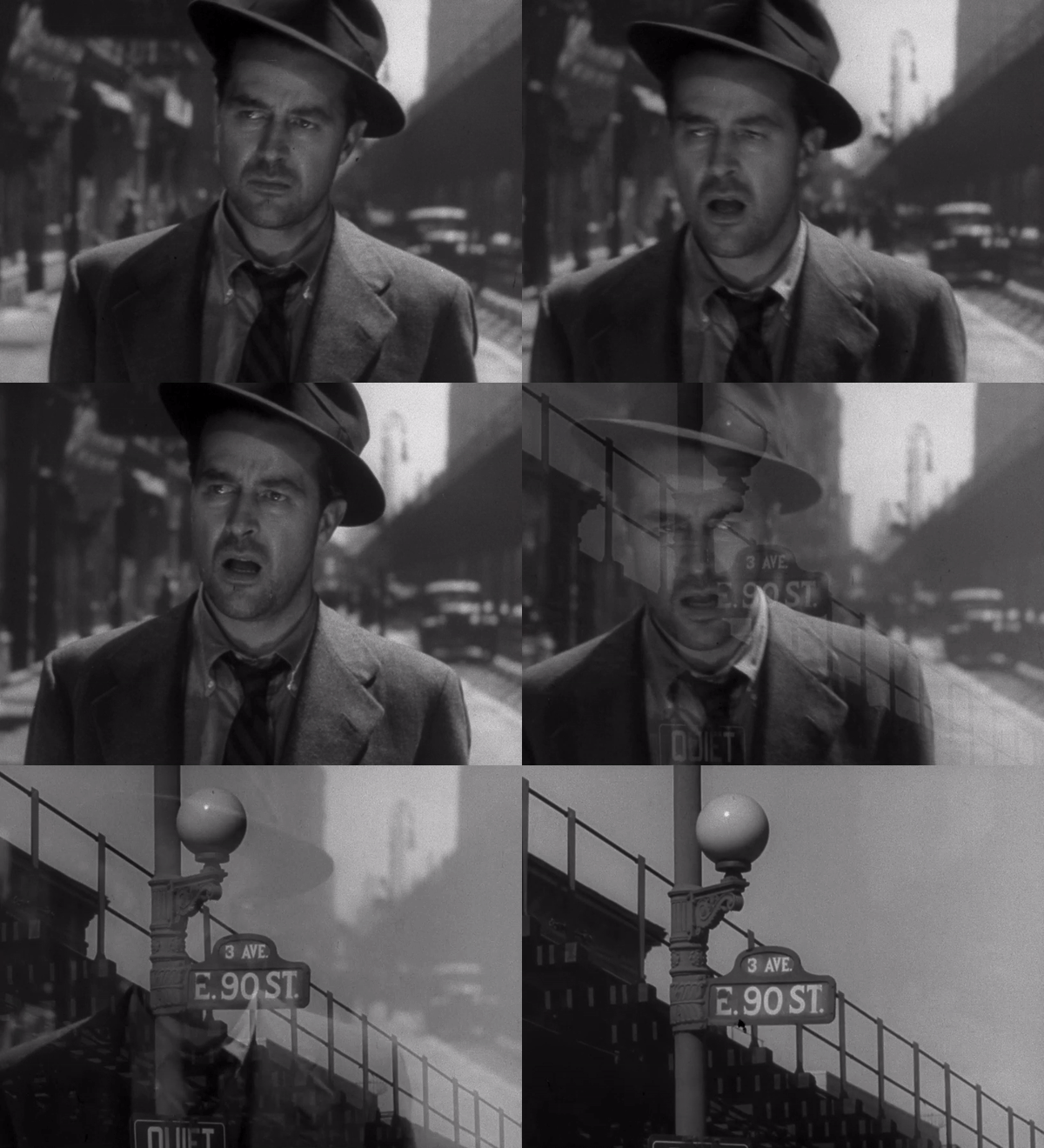
《失去的周末》片段
“他走向了灭亡”这个表达很有趣。比较一下这个表达“他走向了灭亡”……和这如果是图像,会是什么样?好,这就关系到空间中位移真正显露了关于堕落的这个绵延、关于分解的这个绵延,关系到空间中的运动显露的变化就是一个全有的触动。在我看来,这个角色在城市里溜达,酒鬼的溜达,是一个很好很好的案例。但一个更近的电影人……在我看来是文德斯。如果你们拿……(录音中断)
……或者使得全有从两者被分开的一刻,转到两者又被分开的一刻。所以,在这条路上,在我看来会有很多东西……
The expression “he is running to his doom” is odd. Compare the expression “he’s running to his doom” … and then, when it’s in images, what are they? Well, it is a matter of displacement in space truly expressing this duration of degradation, this duration of decomposition, [Pause] movement in space expressing change as affection of a Whole. It seems to me that this character’s walk through the city, the alcoholic’s walk, is a very, very good case. But a more current filmmaker who … it seems to me to be Wenders. If you take … [Interruption of recording]
… Or to causing the Whole to move from a time when the two are apart to another time when the two are again going to be separated. So, on this path, it seems to me that there would be a lot of things to … [Deleuze does not finish] [Pause]
在另一个例子中,运动显露的不再是一个绵延,但空间中的运动把人工分割的各个物体的集合联系到一个绵延上。在这里我马上就可以作一个评论。要记住物体是被人工地分割的这个理念,而取景,对我来说,真的是电影中最人工的操作。但是什么定义了一个取景的好坏呢?必须作出区分。必须差不多确立电影中的一条神圣的法则,一条有用的原则。也就是实用的、一个实用原则。你们可以有很不寻常的、甚至美学上很壮观的取景,但它可能除了是唯美主义以外什么都不是,也就是说一文不值。什么时候会这样?取景总是在一个人工封闭的集合中构成一定数目的物体。如果这个封闭系统保持封闭,就毫无价值,也就是说,只是一种唯美主义;这时候,就是任性的。我告诉自己,我对自己说,你们可以对很多东西有其他品味……比如对很多超现实主义电影,但取景的不寻常的特点,是毫无价值的。你们最多能得到最为混杂的各个物体,如果有必要的话;你们把它们放在一个封闭系统里,不过系统却是封闭的,不向任何绵延开放。
In another case, movement no longer expresses a duration, but movement in space relates a set of artificially cut objects to a duration. Here I immediately make a comment. We must maintain the idea that objects are artificially cut out, and framing is really, it seems to me, the most artificial operation in cinema. But what defines good and bad framing? We should distinguish, we should almost lay down a sacred principle in cinema, a principle of utility. This is pragmatic, a pragmatic principle. You can have very unusual and even aesthetically marvelous framings, and it will be nothing but aesthetic, that is, nothing at all. When what? Framing is always constituting a certain number of objects in an artificially closed set. This is worthless, that is, this is a kind of aesthetics if this closed system remains closed; at that point, this is arbitrary. I tell myself, I tell myself, you can have other tastes in a lot of … in a lot of surrealist films, fine, the unusual nature of the framing is absolutely nothing. You retain the most, if necessary, the most heterogeneous objects, you put them in a closed system, only there you are, the system is closed and does not open onto any duration.
所以取景的条件是要建立一个封闭系统,但又要使这个封闭系统开放,不管在哪方面,在某个会像整体一样运行的东西上开放,因为我们说过从来不是各个物体的集合定义了整体。也就是说:通过这个开放的一面,会有一个时间的操作在影响系统,否则时间会一掠而过,那样你们就有了你们会称为诗意的东西,但其实并不诗意。
So, the condition of framing is to establish a closed system, but to ensure that this closed system opens, on one side or the other, opens onto something that will function as a totality, once we’ve said that it is never the set of objects that defines the totality. That is: through this open side, there will be an operation of time which bites onto the system, otherwise time will slide over it, and you would have something that you could call poetic, but which is not even poetic.
于是我举了些例子,一些著名的取景,在这指引我们。你们每个人都有千百个其他例子。帕布斯特的《潘多拉的魔盒》,片尾有几个伟大的图像:开膛手杰克,他的脸摆着一个姿势,有时候是特写,而开膛手杰克令人心悸的笑,好像他终于解脱了;
《潘多拉的魔盒》剧照
他在露露面前笑,而露露真的好美,
然后露露的脸被紧紧捧住…..总之……你们明白吧。
接着,那把刀,就给一个特写或者几个特写提供了一个对象,那把面包刀。
你们这就有了两张脸、刀、照亮刀的灯。一个取景就有了。你们确定了镜头中的各个物体。显然,这样一个取景组成了一个封闭系统,但只有在系统如此开放以至于真实时间影响着系统时才得以运行,也就是说从全有的第一个状态——露露的信任、开膛手杰克的笑——通过刀的中介,而过渡到了全有中的一份变化:开膛手的脸接近了镜头,他再也无法不盯着刀看,他要杀死露露,在一个分解——露露本身的分解——的过程终结时。
So, I choose some examples, some famous framings, just to guide us here. Each of you has a thousand other examples. “Lulu” by Pabst, the large images at the end; Jack the Ripper, whose face is in certain positions, sometimes in close-ups, and Jack the Ripper’s astonishing grin as if he were delivered; he smiles in front of Lulu who is so beautiful, and then Lulu’s face which is really gripped … anyway … you see. And then, the knife, including which will provide an object for a close-up or for close-ups, the bread knife. There you have the two faces, the knife, the lamp that lights the knife. There we have a framing. You have determined the objects of the shot. [Pause] Obviously, such a framing constitutes a closed system but that works only to the extent that it opens such that real time bites onto the system, that is, that we pass from a first state of the Whole — Lulu’s confidence, the smile of Jack the Ripper — through the intermediary of the knife, we pass on, there is a change in the Whole : the ripper’s face closes in, he can no longer prevent himself from staring at the knife, he is going to assassinate Lulu, at the end of a process of decomposition, decomposition of Lulu herself.
另一个人工的封闭系统的例子会确定电影图像……那么回到那杯水,那杯糖水或者别的什么。在取景中水杯的作用——我提这个,不是因为杯子比其它东西重要,而是因为它是一个很好的封闭系统——对水杯的著名使用,尤其是希区柯克有两个伟大的例子:那个著名的片段,对吧,在那个著名的图像中,有个东西是透过盛牛奶的杯子来看的,然后牛奶的高度升高了,直到占满整个屏幕。这是一个美丽的图像;这就是我们说的一个美丽的电影图像。

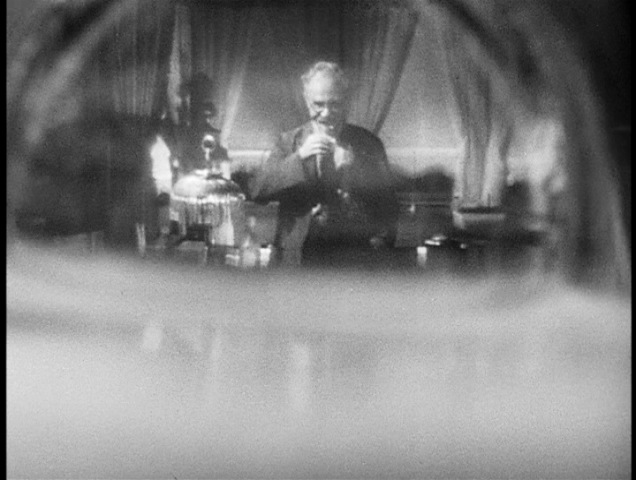
《爱德华大夫》片段
或者那个著名的杯子……是在哪个片子里来着?在《深闺疑云》,我希望……是希区柯克的吧,《深闺疑云》?(有学生称是)你们看,终于有一次,是……好,我们猜想这个著名的杯子被下了毒……所以这里你们就有了一个封闭系统……然后他走上楼梯……
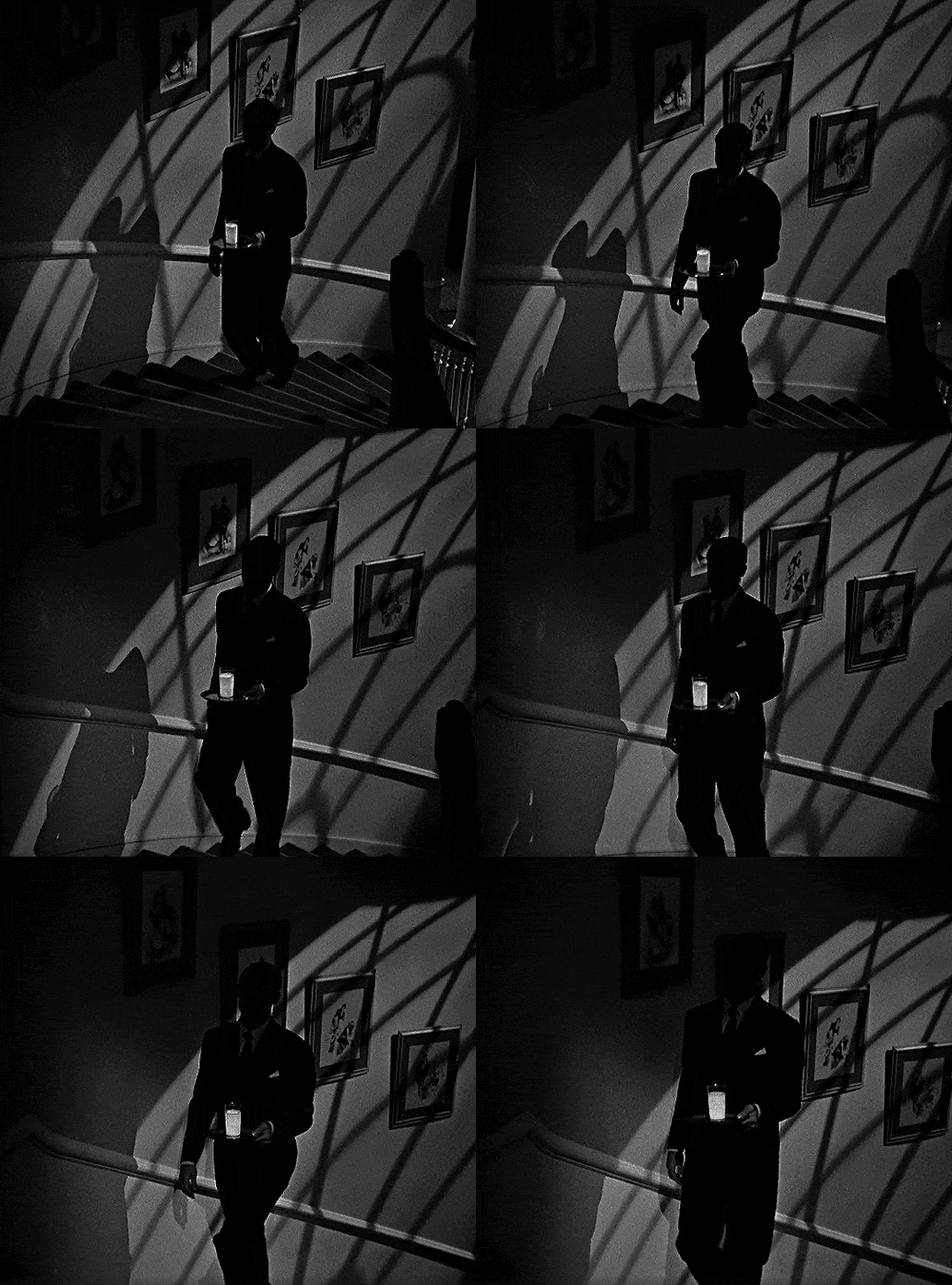
《深闺疑云》片段
他把杯子拿给妻子……
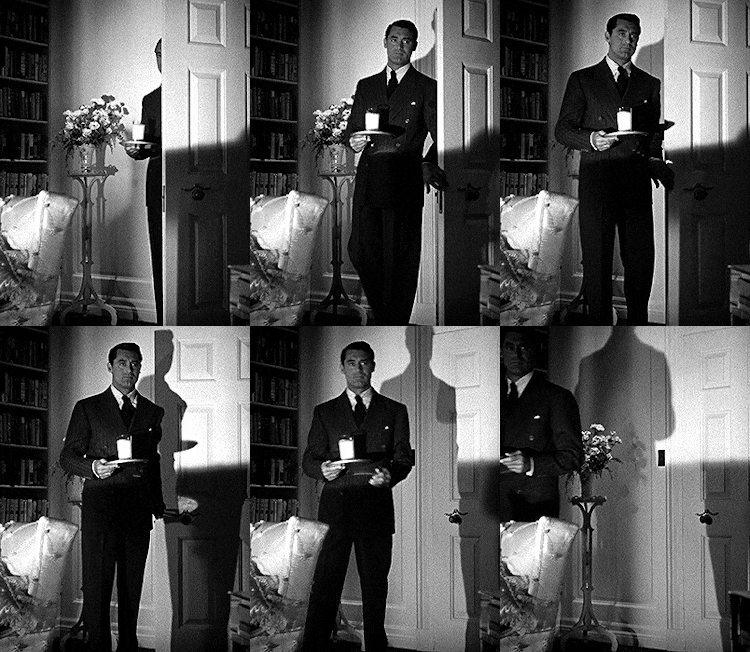
女人的脸,接着就是……杯子,杯子的特写。
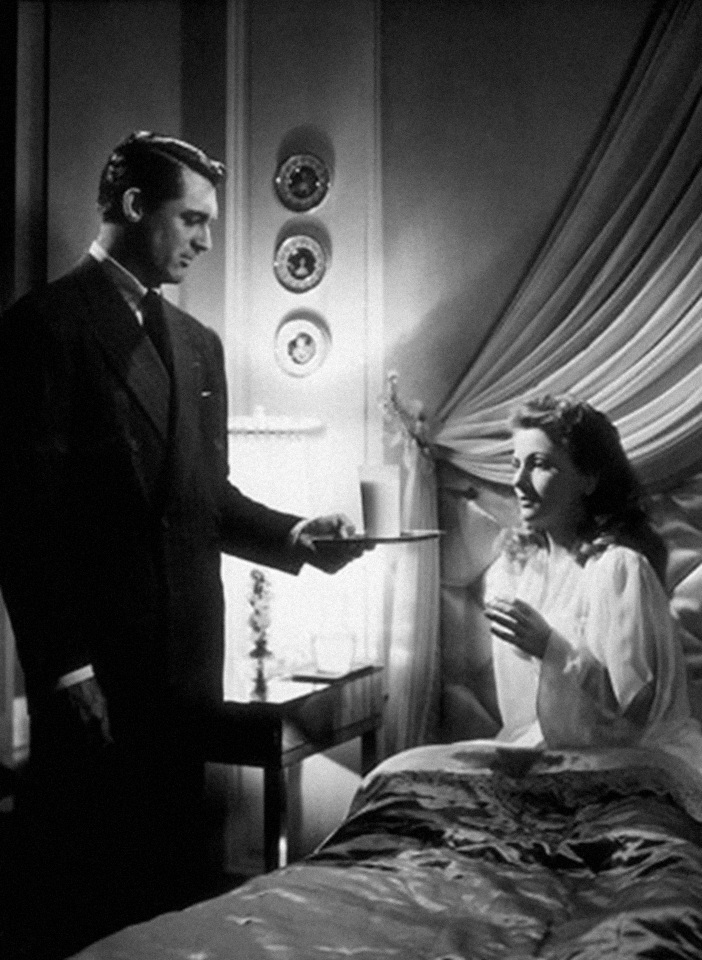
Another example of an artificially closed system which will determine the cinema image, the role of … so let’s go back to the glass of water, the glass of sweetened water, or whatever. The role of water glasses in the framing — I am saying that it is not that the glass is more important than anything else but, since it is a good closed system - the famous use of water glasses, in particular by Hitchcock, in two big cases: the famous sequence, right, the famous image in which something is viewed through the glass of milk, and then the level of milk rises until it invades the whole screen . There we have a beautiful image; this is what we call a beautiful cinema image. Or the famous glass in … what is it in? in “Suspicion”, I hope … is it by Hitchcock, “Suspicions”? [Affirmative response from a student] You see, for once, it’s … well, the famous glass that’s supposed to be poisoned … so there you have a closed system … and then he goes up the stairs … he brings the glass to his wife … the woman’s face, and then … the glass, the close-up of the glass.
对我而言,我会在什么意义上试着来评论取景的各种操作呢?就是作为对一个封闭系统的确定,但有一个条件:就是人工的封闭系统要在同一个图像上既是人工地封闭的,同时又不再封闭——停止封闭就是由于它被图像的运动、被运动联系到了一个绵延上,也就是联系到了一份变化的全有上。
Here it seems to me, in which sense I would try to comment on the operations of framing as determination of a closed system, but on one condition: it’s that the artificially closed system must in the same image be artificially closed and cease being closed, and to cease being closed insofar as it is brought back by the movement of the image, insofar as it is brought back by the movement to a duration, that is, to a Whole that changes.
第 2 点,第 2 类评论。很明显在第 2 个层次上,我把镜头定义为各物体之间一个复杂的相对运动的确定,而我的这个定义召唤的是各种各样的、几乎是一个电影史了。因为这个概念肯定是——我很快地回顾一下作为参考,免得你们不会对我……免得你们在这点上有疑问——当电影开始于一个固定镜头时,镜头是不能在空间上来认识的。我是说,镜头要么是大全景,要么是近景、甚至特写,要么是中景(译注:原文“plan du milieu”与法语的中景“plan moyen”有出入),而摄影机一动,镜头就要变。这就是最初时的一些条件。电影作为艺术,要存在下去,一项条件就是要从摄影机变得可移动这一刻——也就是当同样一个镜头在新的意义上可以汇集好几个旧的意义上的镜头的时候——开始转变。
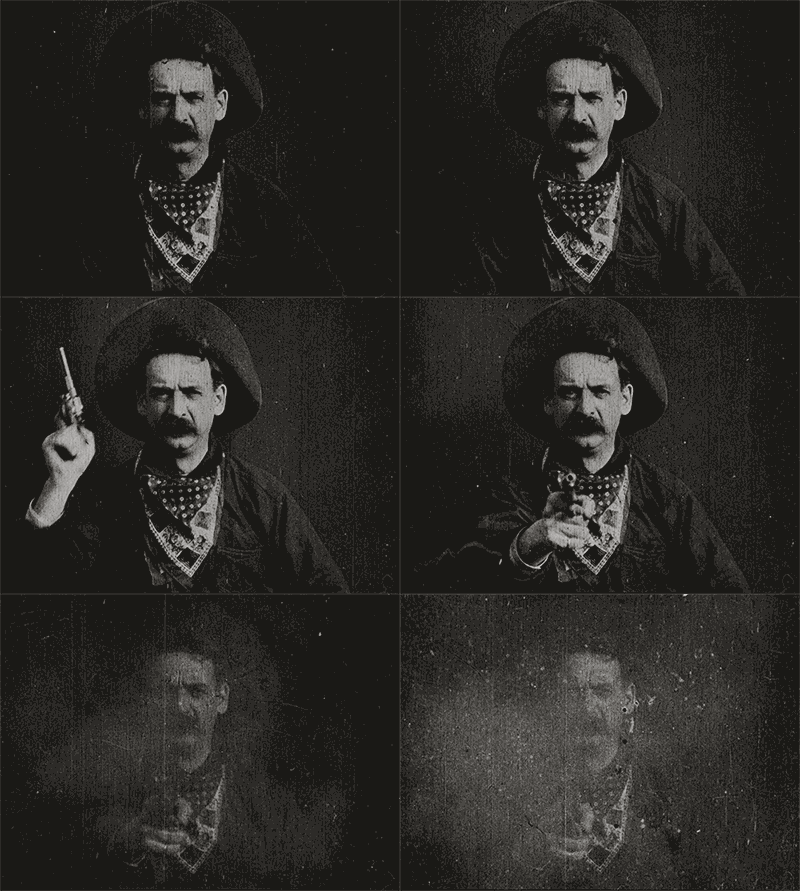
《火车大劫案》的固定镜头
A second remark, second order of comments. Obviously when, on the second level, I defined the shot as the determination of a complex relative movement between objects, this hearkened to all kinds, almost to a history of cinema that I am passing over. Because it is very certain that the notion — I recall it quickly for the record, so that I do not get … or that I’m not asked questions on this point — that when the cinema has started with a stationary camera, the shot could not be understood spatially. I mean, it was either a far wide shot, or a close shot and even a closeup, or a middle shot and, for the camera to move, the shot had to be changed. These are the conditions at the very beginning. Cinema as art, in order to exist, passes, among other things, from the moment when the camera becomes mobile, that is, when the same shot in the new sense can unite several shots in the old sense.
我会说得更简单些:镜头从变成一个时间的现实、而非空间的现实这一刻起,就不再成为……对,不如说:镜头不再是一个空间的分割,而成为一个时间过程;在那一刻,镜头可以定义为——包括在镜头是静态的时候,镜头可以定义为复杂运动,也就是说要么运动是被各种东西和存在物、而非被摄影机来操作着,要么就是把各种存在物和取入镜头的物体连接起来而受限的运动。因此正是在这一刻,镜头决定了一个操作,而通过这个操作,运动把物体联系到了一个全有上。好。那么,我说的就是在一个时间性的电影化的现实(cinematographic reality)之中的镜头,而非在一个空间截面里。
I would say more simply, from the moment that the shot becomes a temporal and no longer spatial reality, ceases being … yes, rather: that the shot ceases being a spatial cut in order to become a temporal process, at that moment, the shot can be defined, including when it is immobile, the shot can be defined by the complex movement, that is, either the movement operated by things and beings and not by the camera, or by the impeded movement which connects beings and framed objects between them. As a result, at this precise moment, the shot designates the operation by which movement relates objects to a Whole. Good. So, I’m indeed talking about the shot within a temporal cinematographic reality and not a spatial section.
但是当一个镜头是一个运动-图像时,是什么使得镜头可以在这一刻结束或者在那一刻开始呢?是什么创造了运动的统一?在这个层次上,如果你们已经明白了我的意思,就没问题了。运动的统一,是被这个运动非常充分地确定的……不如说各种复杂的运动是在这个时候、也只有在这个时候才合为一体——就是当这些运动把物体联系到了全有的一份变化、而运动就建立于这些物体之间的时候。所以运动可以是一也可以是多,取决于运动是否可以把取景中的物体联系到全有的变化。
But then what allows me to say henceforth, a shot is a movement-image, what makes it possible to end at such a moment or to begin at such a moment? What creates the unity of movement? At this level, we have no problem if you have understood me. The unity of movement is very sufficiently determined by this, a movement does not … or rather complex movements are one to the extent and exclusively to the extent that they relate objects between which they are established to a change in the Whole. So, the movement will be one or multiple, depending on whether or not it relates framed objects to the change in the Whole.
因此到最后,在这个意义上定义镜头可能会很有趣——在不断运动的现实的意义上,在动态的现实的意义上,对,而不是空间的现实——以运动结束的方式来定义。我之所以思考这个因为它在这里很复杂;我讲得很快,因为我记不住那么多文章。那些文章这有一些那有一些。你们知道目前的电影的文献怎么个不成体统,也就是说,很……最“棒”的就是文章往往没有编纂(成册)等等……唉,这很烦人……但在《电影手册》的一套书中,我经常会看到在我看来非常……一方面,有一些阿莱克山大・阿斯特吕克(Alexandre Astruc)的文章,对我来说,他是史上关于电影的最好的作家之一……阿斯特吕克的文章和里维特的文章,在其中的一个电影评论里头……这些完全不是对电影的反思性的东西;而是他(看完电影后)这样顺便地,通过评论一部影片,来琢磨这个那个作者完成一个镜头的方式。为了你们好理解,事实上从我的角度看这是很好的:以镜头结束而非开始的方式来定义镜头,这最终是一回事。但(以镜头结束来定义)更好。为什么?如果镜头的统一真的是时间性的,如果使得一个运动同一的——也就是拍一个镜头的——真的是镜头的统一把取入镜头的物体联系到全有中的一份变化上这个力量,那么显然镜头结束的方式才是决定性。
As a result, in the end, it might be very interesting to try to define the shot in this sense, in the sense of moving reality, in the sense of, yes, dynamic reality, and rather than spatial, of defining it by the way in which it ends. I am thinking about this because it’s complicated there; I am going very quickly because I can’t remember the texts enough, alas. These are texts here and there. You know the extent to which the film literature at the moment is still in bad shape, that is, it is greatly … The best things are sometimes articles that are not collected [in volumes], etc. … Well, it’s disturbing … But in the collection of the Cahiers du cinema, here and there I saw things that seemed very … some texts by Alexandre Astruc, on the one hand, who, it seems to me, is one of the best writers on cinema there is … Texts by Alexandre and texts by [Jacques] Rivette, in which in the course of a film review … These are not at all reflective things about cinema; it’s just in passing like that, reporting on a film, he considers the way one author or another finishes a shot. If you like, in fact, from my point of view, this is very good: defining the shot by how it ends and not by how it begins, this ultimately comes down to the same thing. But it’s better. Why? If it is true that the unity of the shot is temporal, if it is true that what makes a movement one, that is, makes a shot, it is its power to relate framed objects to a change in the Whole; it is obviously the manner in which the shot ends that is determining.
不过,我记得有个地方,阿斯特吕克说得很让人困惑,但接着很快就——如果你们知道的话,这差不多是下一讲的内容,你们会给我找到东西(讲的)……他谈到茂瑙的镜头时说:这很有趣,茂瑙……他的镜头总是像一种凶杀一样结束。他说的不是发生在图像上的一个凶杀。镜头走向死亡,而且是走向一个暴毙。好……我其实不知道他在说什么,但……我都不知道他是不是说过这句,他可能说的是其它东西,这很复杂,我没有……我手头没这篇文章。你们看,但总之假设我们可以这么说。
And I remember there, very confusedly, Astruc saying, but then very quickly – this would be almost for the next time if you think about it, you’ll find things for me at… — He talks about Murnau’s shots, and he says: it’s curious, Murnau, it’s … the shots always end like a kind of murder. He’s not talking about a murder taking place on the image. The shot goes toward death, but to a violent death. So fine, hey … I don’t even know what he means, but … and I don’t even know if he’s saying that, he might be saying something else, it’s complicated, I don’t have the…, I no longer have the text. You see, but anyway let’s suppose we can say that.
然后许多其他作家,比如巴赞,巴赞说到罗塞里尼的镜头是怎么结束的。他说,罗塞里尼带给了电影很妙的东西,而且他试着说明,罗塞里尼是怎么标签式地结束一个镜头的。这一次不是在一种暴毙中,镜头中没有一个暴毙了,而是一种非同寻常的节制(sobriety),也就是罗塞里尼式的节制,其中镜头真正被削简为……最终削简为最纯粹的运动,这就是罗塞里尼的方式,总在寻找、总在找最简单、最纯粹的运动,在两个运动中,选最简单、最纯粹的,同时引导镜头到一种自然而然的熄灭(extinction)中。镜头就像耗尽了自己,好像再没什么可说的了,于是就转到了另一个镜头。这就像罗塞里尼的镜头有了一种自然死亡。反正,都不是一些好词。
And then a lot of writers, Bazin for example, Bazin told him about how Rossellini’s shots end. He was saying, that’s great what Rossellini brought to cinema, and he was trying to say it, the Rossellini signature of how a shot ends. This time, it’s not in a violent kind of death; there is not a violent death of the shot, there is a kind of extraordinary sobriety which is the Rossellini sobriety in which the shot is really reduced to … In the end, with the purest movement, always searching, that’s Rossellini’s expression, always searching for the simplest and purest movement, between two movements, choosing the simplest and the purest, and bringing the shot to some kind of natural extinction. The shot itself is like it exhausted itself, that it has nothing more to say, so we move on to another shot. There this would be like a kind of natural death of the Rossellinian shot. In the end, I’m saying this very badly.
接着,我认为里维特也走向了……据我所知,在他们三人之间、在这三个影评人之间完全没商量过。里维特自己,也谈到了结束,谈到了沟口健二的镜头怎么结束。所以……这是很像……因为他是,他是镜头运动用得最复杂的电影人之一。他拍过极为复杂的运动。于是,这种运动结束时,会像……有一种……我都不敢说出来,因为这听起来太简单了。在茂瑙那里,是镜头的暴毙;在罗塞里尼那里,是自然死亡和熄灭;而沟口健二的镜头则通过一种自杀、一种切腹自尽,原因是贵族义务(法語 noblesse oblige,原指欧洲贵族有义务有责任),你们懂的。所以,我想说的其实不是这个,这完全不在我要说的点子上——这些都是杂七杂八的一些回忆,而是想说这个问题:一个电影人如何结束他的镜头,可能决定了如何理解镜头的功能——这个功能作为动态的现实,也就是说镜头像时间一样,而不再是空间的截面。

沟口健二的《山椒大夫》片段
And then, I believe that Rivette is also led, and it seems to me that there is no concertation at all between the three of them, between these three film critics, Rivette himself, he was talking about the end, how the Mizoguchi shots end. So… this is very like … because he’s, he’s one of the filmmakers who makes the handling of camera mobility the most, the most complex. He has extremely complex movements. So, and it ends, there like … with a kind of … I hardly dare say it because it’s getting too easy. The violent death of the shot in Murnau, the natural death and extinction in Rossellini, by a kind of suicide of the Mizoguchian shot, a kind of hara-kiri there, because, noblesse oblige, you see. So, I’m not saying that at all; there, it’s not at all to the point, what I’m saying is very confused memories. This is to say that the question: how a man of cinema finishes his shots, would perhaps be decisive in understanding this function of the shot insofar as being a dynamic reality, that is, the shot as time and no longer spatial section.
总之,最后一个评论,我想说说全有的这个叙述。镜头,好,被认为是显露了全有中的一份变化,好。这就意味着,镜头与其他镜头,不仅仅通过自身在示意,而且在这个意义上是在向其它镜头示意。因为如果全有是变化,它就不会停止变化,所以一个镜头不会耗尽全有中的变化。因此这就是镜头与其它镜头,从而就有了剪辑的主题(thème)来显露全有。
Well, what … Finally, final point, I mean on this story of the Whole. The shot, fine, it’s supposed to express a change in the Whole, fine, [Pause] implied that the shot with other shots, not already by itself, but in that sense, it beckons to other shots. Since if the Whole is change, it will not stop changing, so a shot will not exhaust the change in the Whole. It is therefore the shot with other shots, hence the theme of the montage, that will express the Whole.
我们来到了最后一个问题……我有的是所谓……因为……必须说……这个问题都还没办法提。问题就是这个全有,究竟是什么?因为说到底,全有在哪儿?它由什么组成?这个全有令人着迷……我是说,关于电影中的现实(reality in cinema)之少,已经说了很多。电影中的现实,像大家在电影中注意到的那样,很奇怪大家相信这一点,而这个现实却从不出现。任何出现都缺失了,取入镜头的物体也并不在那里。
We come across one last problem there that … I have what is called … because … it will be necessary… we do not even have the means to consider it yet. It’s that this Whole, but what is it? Because after all, where is it? What does it consist of? This Whole is intriguing … I mean, there’s been a lot of talk about the lack of reality in cinema. The reality of cinema, as everyone says, in cinema, it’s weird that people believe in it so much whereas there is no presence. The absence of any presence, the framed objects are not there.
何况,电影中有什么东西令人不安呢?那些物体不是没在那里了,而是从没在那里。不只是不会在那里了,而是从未在那里。电影中没有全有,或者至少没有大全有,对吧?它只存在于观众的眼里,或者观众的心里;为什么?你们连像戏剧中一个布景中共存的各个元素都没有,因为你们总可以之后再布景……之后再搭建。你们总可以再加上。而且,你们可以在上面画,有一些……影史上有个时期,你们可以在摄影镜头上画布景。你们可以想干什么就干什么。却从没有一个时期,一个全有是给定的或者可给出的。你们会告诉我它这么办是因为电影是按照时间顺序的,好,没错,而这也许是电影独有的。这个全有绝对不是给定的,然而全有还是电影的问题所在。全有不在那里。
Moreover, what is annoying about the cinema? It’s not that it’s not there, but it’s that they’ve never been there. If it was just that they are no longer there, but they have never been there. There is no Whole in cinema, or at least the Whole, right? It exists only in one’s eye, the viewer’s, or in the viewer’s mind; why? You don’t even have the coexisting elements of a stage set as in theater, because you can always screw the set after … set it up after. You can always add it. And besides, you can paint some, there are … there’s a point in the history of cinema, you can paint it on the camera lens of the set. You can do whatever you want. At no point is a Whole given or giveable. You will tell me that is fine since it is on the order of time. Fine, so okay, but maybe this is unique to cinema. It is absolutely not given, this Whole, that is a matter for cinema. It is not there.
在一定程度上,发生的是什么?他们都说,普多夫金说得很好,说电影中存在的,是成堆、成卷的胶片。成卷的胶片,得了,这就够了。而用这些我可以干我想干的,我总是可以剪下一段,放进那里,好了。但那一段从未存在过;这一切完全没存在过,那这些都是什么呢?是那一点现实。它吸引我们的地方要与其他艺术有差异。这就是为什么有一个根本的操作,又是为什么直到现在、在我们讲的这一点上,全有既不可以通过一个所谓的剪辑的操作来把握,也不是可以这样来独立地定义。因为为了解决这些问题而在这一系列例子中和我们有关系的,是来看看镜头应该以什么方式激发、诱发、确定了没有给定的全有。各种镜头怎么通过剪辑的操作,成了“兴奋剂”;而镜头正是在我说过的意义上通过运动的确定来定义的,好,那它是以什么方式激发这个不存在的全有的?又一次,可能没有一个单义的(译注:法语 univoque,即只有一个意义的)回答。而我不是想说、这也完全不是要设立一个剪辑理论。你们看我的问题变得很具体了。至于剪辑,我们之后会回到上面再讨论,但……那……那完全不是一回事;我提出的是问题的一个很特别的方面。
In a sense, what is there? They all said it: Pudovkin said it very well, that what exists in cinema, there are piles of rolls of film, full stop, that’s it, rolls of film, and with which I can do whatever I want, I can always cut one out, put it there, okay. But that has never existed; all that doesn’t exist at all, so what is it? This little bit of reality. It will be necessary for this to concern us in contrast with the other arts. And that is why there is a fundamental operation and why, until now, at the point we’ve reached, the Whole is neither graspable nor definable independently of a so-called montage operation. [Pause] As a result, what would matter to us in a series of examples, to finish with all this, is to see how shots are supposed to arouse, evoke, determine the Whole that is not given. How through the operation of montage, shots are stimulants (susciteurs), shots defined precisely by the determination of movement in the sense in which I have said, well, in what way does it arouse this Whole that does not exist? There again, there may not be a clear answer. And I don’t mean to say, that wouldn’t at all be a theory of montage. You see, my problem is much more specific. We’ll come back to a discussion of montage later, but … it’s … it’s entirely different; it’s a very particular aspect of the problem I’m raising.
通过什么操作、镜头又是如何从剪辑的一刻起,激发了一个不存在的全有,它完全没存在过,甚至在胶片上都不存在?我会说有好几个答案,所以在这里……如果你们想听的话,在我看来……可以回答:我会说,有一个构思可以叫——我还是觉得这有关的是总体上的剪辑问题——可以叫作辩证的一个构思。对辩证、剪辑的辩证的构思,我在这里说的是再简单不过的东西了,也就是:镜头,每个镜头和互相联系的各个镜头,要尽可能多地和可以对立的或者对立的运动来互相作用。在爱森斯坦那里,你们会发现这一点,而在许多俄罗斯人那里,你们也会发现剪辑的一个辩证构思。而正是通过运动的对立这个作用,全有被激发了,而变化作为全有的触动得以呈现。这就有了一个剪辑的辩证这个观念。
By what operations and how do shots, from the moment they are edited, stimulate a Whole that does not exist, that does not exist anywhere, that does not even exist on the roll of film? Well then, … I would say there are several answers, so there we … if you will, it seems to me … the answer: I would say, there is a conception that could be called – once again, I still feel this concerns the problem of montage in general — a conception that one might call dialectical. Dialectics, a dialectical conception of montage, I am saying here the simplest possible things which is that: shots, each shot and the shots in relation to each other, must play as much as possible with opposable or opposing movements. For Eisenstein, you find that, but also in many Russians, you find here a dialectical conception of montage. And it is through the play of oppositions of movements that the Whole is aroused, and that change as affection of the Whole is presented. Hence the idea of a dialectic of montage.
还有另一种构思;我跟自己说,这不曾是法国电影的一个原创吗?这一次,是一个与剪辑大相径庭的构思,在跟我们有关的视角上,我差点要这么说。你们看到我拿来剪辑的问题完全不是为了这个问题本身,而只是在运动-全有的关系这个层面上。目前我只有对这个方面有兴趣。我给出的第一个答案,假设是一个俄罗斯式的答案,就是……就是通过对立了各个运动在每个镜头中、在各个镜头之间,而且在从一个镜头到另一个之间,全有才得到激发,全有才被诱发了。在一个法式的构思中,我说的就是冈斯、莱尔比耶(L’Herbier),甚至之后的格黑米永,有一个很有趣的构思,而这也成就了电影的一个伟大时刻。我会说这是一个量性的构思。这不是运动的一个辩证构思,会诱发全有;而是运动的一个量性构思。
There would be another conception; I say to myself, wasn’t that something original in French cinema? This time, it’s a very different conception of montage, I would say almost, from the point of view that concerns us. You see that I take the problem of montage not at all for itself, but solely at the level of the movement-Whole relationship. It’s only from this aspect for the moment that interests me. I present a first answer, let’s assume it’s a Russian answer, it was … it is by opposing movements in each shot and in shots and from one shot to another that the Whole is stimulated, that the Whole is evoked. In a French conception, I’m also saying in Gance, [Marcel] L’Herbier, but even Grémillon later, there is a very interesting conception which was nevertheless a great moment in cinema. I would say it’s a quantitative conception. It is no longer a dialectical conception of movement that will evoke the Whole; it is a quantitative conception of movement. [Pause]
什么意思呢?在我看来那个时代的所有这些法国人,至少当他们变得伟大时,都有一种项目吧?一种项目,被我一表达,听上去非常非常随意;这就是如何把最大数量的运动放进一个镜头,还要冒着差一点就过于抽象的危险?冒着几乎太抽象的风险,那是要干什么?来引发一阵镜头的急雨(法语 précipitation),因为你们在一个镜头里的运动的数量越多,镜头看起来越短。而这就造就了,这些东西仍然是一个不同凡响……冈斯的、莱尔比耶的、格黑米永的作品等等,造就的是这些对风格的伟大试验(法语 épreuves),也就是——法兰多拉舞、舞蹈;艾普施坦也如此,他们都是,在我看来这真的是一类问题……就像哲学上有民族特色一样,电影也有民族特色。这类考验他们都经受过了——在小咖啡馆跳舞,一个封闭环境里的法兰多拉舞。我最近看了部格黑米永的默片《马尔东纳》,里面有一场舞蹈,在一个封闭空间的法兰多拉舞,在……一个封闭空间里的法兰多拉舞,这不是……这是……甚至对西奥德梅克(Robert Siodmak)这样的人,他们刚到法国就足以找到这些主题并起头。
What does it mean? It seems to me that all the French of that time, at least when they are great ones, have some kind of project? A kind of project, and when I express it, that seems very, very arbitrary; it’s how to put the maximum amount of movement into a shot, almost bordering on abstraction? Even if it means bordering on abstraction and prepared to do what? To cause a rush of shots, because the greater the quantity of movement you have in a shot, the shorter the shot will appear. And that results, these things which are nevertheless a marvel by … by Gance, by L’Herbier, by Grémillon etc., it results in these kinds of great feats of style, namely: the farandole, dance, Epstein too, all of them really, it seems to me that is truly a kind of problem … here, there are, just as there are national characteristics in philosophy, there are national characteristics in cinema. This sort of trial they all went through, dancing in the tavern, the farandole, the farandole in a closed environment. I recently saw a silent Grémillon film, “Maldone,” which has a dance, a farandole in an enclosed space, in … the farandole in an enclosed space, that’s not … it is… So even guys like [Robert] Siodmak, it was enough for them to arrive in France, for them to find these themes and to get started with them as well.
帕尔奈:……(他)说最有条理(order)地作最多的表达……
德勒兹:是这个,可能就是这个。我会说……我更想说,是的:费力地表达一下,就是在一个封闭空间,也就是在一个取入镜头的空间中最大数量的运动。而冈斯,你们明白的,冈斯的大师之作总是这类运动的一道急雨,也就是开始于会在一个运动中被捕捉的一个空间,而即使是从量化的角度上,这个运动也不会停止壮大。艾普施坦,艾普施坦著名的嘉年华,绝对是……我会说这一次剪辑发挥作用,不是通过从运动的动态对立的角度上,而是从运动的数量的角度上把运动,也就是说激发了全有的理念,既然这个全有是纯粹理想的。
Claire Parnet: … [he] said the maximum expression in the maximum order …
Deleuze: Well that’s it, maybe that’s it. Here, I would say … I would prefer, well yes: the hard expression, maximum quantity of movement in an enclosed space, that is, in a framed space. And Gance, you understand, Gance’s masterpiece has always been this kind of rush of movement, that is, starting from a space that will be caught in a movement that does not stop increasing even from a quantitative point of view. Epstein, Epstein’s famous travelling fair, it’s absolutely … I would say this time around that it’s by taking the movement not from the point of view of its dynamic oppositions, but by taking it from the point of view of view of the quantity of movement, that montage operates, that is, gives rise to the idea of the Whole since this Whole is purely ideal.
然后会有,会有最后一个答案,显然我这么干有点简单了,但只能如此了……要结束了……那就是德国电影,德国电影有很多……受到了那么多那么多影响,因为……有个东西很有意思,这是一个甚至必须面对面地回应柏格森的问题,要是柏格森在这儿……有一个令人不安的问题,就是:为什么那么多人,一旦跟他们说起绵延,马上会想到一个分解过程?这很有趣;为什么对绵延有一种悲观?绵延,它会分解。绵延是一种背离(defection)。绵延是化尘为土。
And then there would be, there would be, the last answer, obviously it’s a little easy what I’m doing here, but that’s how it is … it’s in order to finish here … It’s German cinema, German cinema with all its … so, so many influences because there you have it … There is something odd, and here, it is a problem that must be answered even with regard to Bergson, assuming Bergson is there … there is a disturbing problem, which is: why do so many people, as soon as we talk to them about duration, immediately think of a process of decomposition? This is odd; why is there a kind of pessimism about duration? The duration, that’s it, it breaks down. [Pause] Duration is a defection. Duration is turning into dust.
这很有趣;对于柏格森,完全不是这样;相反,绵延是新事物的涌现。它是新事物的突然出现。但事实是,谈到绵延时,我们会有印象是一个分解的过程。一切生命,当然了,是一个菲茨杰拉德式的分解过程。这是一个说法;这是绵延的通常说法。啊,如果这是一个分解过程,那么它绵延着……对……谁在有电影之前就把绵延引入了小说?把绵延以最纯粹的形式引入小说中的,是福楼拜。是福楼拜,尤其是在《包法利夫人》中,而且理所当然,所谓的现实主义、自然主义与关于绵延的事业严格来说是分不开的。然而这个绵延怎么就成了一个分解过程?如果有个东西绵延着,就会分崩离析——这完全不是柏格森主义的。
This is odd; for Bergson, it wasn’t that at all; on the contrary, duration was the emergence of the new. It was the emergence of the new. But the point is, when we talk about duration, we get the impression of a process of decomposition. All life, of course, is a process of decomposition signed by Fitzgerald. This is the expression; this is the ordinary expression of duration. Ah, if it’s a decomposition process, it endures … yeah … yeah … Who was it that introduced duration into the novel before there was cinema? The person who introduced duration into the novel in its purest form was Flaubert. It’s Flaubert, especially in Madame Bovary, and surely what we call realism or naturalism is strictly inseparable from the enterprise of duration. And how is it that this duration is a process of decomposition? If it endures, it breaks down. That’s not Bergsonian at all. [Pause]
而在所有电影史上被普遍认为是电影的福楼拜的人物,也就是伟大的自然主义者,把绵延带进电影里的天才,他是谁呢?这是广为人知了;他就是施特洛海姆。是施特洛海姆的《贪婪》,其中事实上就像人们说的那样,这是第一次没有一个运动或一个活动性(mobility)不是联系到各个角色的绵延上的。这是神来之笔。不是其他人还没意识到绵延,而是在这里绵延是作为心理意识在电影中登场了。《贪婪》怎么就恰恰成为对一个分解过程,甚至是对一个双重分解的过程的大师级研究呢?
And, who is considered everywhere, in all the histories of cinema, as the Flaubert of cinema, that is, the great naturalist, the genius who brought duration to cinema? This is well known; it’s von Stroheim. It’s von Stroheim with “Greed” where, in fact, as they say, it’s the first time that there isn’t a single movement or a single mobility that is not related to the duration of the characters. It was a stroke of genius. It’s not that the others weren’t already aware of duration, but here really, duration as psychological consciousness makes its entry into the cinema. How is it that “Greed” is precisely the masterful study of a process of decomposition and even a double process of decomposition?
这一次我想说是分解运动——要是你们更喜欢的话可以说下落——负责成为一个操作,而通过这个操作,运动可以引发一个全有的理念。运动要引发一个全有的理念,只有作为关于一个分解的种种运动,而其中伴随的是一个分解,其中这些都是关于一个下落的运动。然而这完全不是必然的。我会说这就是一个剪辑,但它既不再是俄罗斯式的辩证,也不是法式的量化——在我试着说过的意义上——而是一个强化的剪辑。所以在这里,有一个多义性,不过多义性的地方到处都是。这是一个强化剪辑,哦哦……是的,这太复杂了,所以你们看,我们就讲到这。
I mean, this time, it is the movement of decomposition or, if you prefer, it is the collapse (chute) which is responsible for being the operation through which movements can evoke the idea of a Whole. Movements can only evoke the idea of a Whole, it is said, insofar as they are movements of a decomposition, in which they accompany a decomposition, in which they are the movements of a collapse. And this is not at all required. I would say here that this is a montage, so no longer, neither dialectic as in the Russian view, nor quantitative as in the French view — in the sense I have tried to describe this — but intensive montage. So there, an equivocation exists, but everywhere there are equivocations. This is an intensive montage, oh la la … Yes, it’s too complicated, so you see, this is the point we’ve reached…
下次,我想要的是这个……当然我会解释我刚在这里是什么意思,会很快说一下。我希望你们思考一下这一切:你们也要聊聊,你们也要看看,你们自己和这些东西是什么关系……要是……然后,我会以总结柏格森的论点来结束,而我们就会结束第一个(部分)……接着通过探索我所在的位置,我们会完成第一个研究的小类。我们会转到下一个小类……(2: 13: 46)
Next time I would like this … Of course, I will explain what I meant here, but very quickly. I would like for you to think about all this: that you speak, that you speak and that you too see where you are in relation to this … if … and so then, I will finish by summarizing Bergson’s theses, and we will have finished a first [segment] … and then by finishing where I have situated, and we will have finished a first research group. We’ll move on to another group… [End of tape] [2: 13: 46]
注
为了存档的需要,文本在巴黎八大的听写的基础上增改了,而且和英译一样都完成于 2020 年 7 月。
Notes
[1] Creative Evolution, http://www.gutenberg.org/cache/epub/26163/pg26163.txt .
[2] In fact, Bergson says: “Such a science would be a mechanics of transformation, of which our mechanics of translation _would become a particular case, a simplification, a projection on the plane of pure quantity.”
[3] _Matter and Memory, https://antilogicalism.com/wp-content/uploads/2017/07/matter-and-memory.pdf?fbclid=IwAR0HJ6_hrj8joXLywu3LVtYuCJRH6EjmmRo-LsRO7v8XcPcxZXBzjgnpERw.
[4] Creative Evolution, ibid.
[5] Ibid.
[6] Deleuze refers to this film in the context of the grand form of action-image, _The Movement-Image, _p. 145.
NOTES
For archival purposes, the transcription based on the Paris transcripts has been augmented and updated in July 2020, as well as the completed translation.
法语
Partie 1
[La transcription commence en medias res avec Deleuze en train de répondre à une intervention faite avant le commencement de l’enregistrement]
… comme caractéristique, finalement, de l’art, de l’art en général, enfin, de beaucoup de formes d’art, et ça, tu l’as opposé à une autre reconstitution du mouvement dont tu prétendais que c’était deux reconstitutions de différentes natures, une autre reconstitution du mouvement qui consistait à reconstituer le mouvement, non plus en fonction d’instants privilégiés, mais en fonction d’instants quelconques, en fonction de l’instant quelconque.
Et ça, je disais en effet, ça, c’est le cinéma, et avant le cinéma, c’était ça, le roman, la relation du mouvement à l’instant quelconque et non plus à des instants privilégiés. Alors l’objection qu’ il me fait, c’est – ce n’est pas une objection en fait, c’est quand même… — ça revient à dire : il ne faut pas aller si vite parce qu’après tout, un homme de cinéma aussi important et aussi fondamental [1 :00] qu’Eisenstein, qu’est-ce qu’il fait sinon une reconstitution du mouvement à partir d’instants privilégiés ? Voyez, ça a l’apparence d’une objection, mais comme il ne m’a jamais fait d’objection, Dieu merci, ça ne doit pas en être une. [On entend la voix du participant qui avait posé la question] C’est au contraire, c’est au contraire, l’offre d’une direction à analyser.
Une seconde question qui m’intéresse là mais qui serait plus technique, c’est — c’est très bizarre — s’il est vrai que Bergson tend à définir — mais ça, on ne l’a pas bien vu — tend à définir, le Tout, la totalité par l’Ouvert, alors que pour la plupart des gens, le Tout, c’est au contraire quelque chose de fermé. C’est bizarre, ça veut dire quelque chose, vous lâchez des formules du type : « eh ben, le Tout, ce n’est pas difficile, c’est l’Ouvert ». La question est que, s’il est vrai que [2 :00] Bergson dit ça, bizarrement il y a quelqu’un d’autre qui a dit ça aussi, et c’est Heidegger, et c’est Rilke ; il y a des poèmes très beaux de Rilke sur l’Ouvert. Et est-ce qu’il y aurait un rapport ça, entre l’idée bergsonienne et Heidegger ou Rilke ou Hölderlin ?
Bon, je veux juste répondre à la sec… à la première question, ou essayer de répondre à la première question parce qu’elle renvoie à quelque chose que je peux considérer comme du déjà-fait, et que, en effet, ça fait problème. Bon, si on voit un film de Eisenstein, qu’est-ce qui se passe ? Mais enfin, en effet, c’est du mouvement, c’est même parmi les plus beaux mouvements de cinéma, mais comment ne pas reconnaître que c’est une reproduction, une reconstitution du mouvement en fonction d’instants privilégiés, et à la lettre, en fonction [3 :00] de points de crise ? Bon, je dis, ce n’est une objection qu’en apparence, je crois, parce qu’en fait, qu’est-ce qui se passe ? Quand je disais le cinéma, il ne se définit pas simplement par la reproduction du mouvement, il se définit par ceci : il y a cinéma lorsque la reproduction du mouvement découle d’une analyse du mouvement, bien, ce qui revient au même que dire, il y a cinéma lorsqu’il y a reproduction du mouvement en fonction de l’instant quelconque.
Pourquoi ? Parce que vous n’avez d’analyse du mouvement que lorsque le mouvement n’est pas découpé d’après des instants privilégiés, mais découpé d’après les instantanés. L’instantané, c’est l’instant quelconque. Un instant quelconque étant donné, alors, qu’est-ce que ça veut dire concrètement ? [4 :00] Vous sentez bien que l’instant quelconque, c’est en fait une relation, c’est une relation entre deux instants, sinon, c’est une abstraction, l’instant quelconque. On dira, c’est quoi l’instant quelconque ? Ce n’est rien, quoi ; c’est quoi ?
En fait, instant quelconque, c’est une notion parfaitement concrète et déterminable. Si je dis « instant quelconque » comme ça, ça veut dire, un instant indéterminé, un instant égalique. Donc comment déterminer l’instant quelconque ? L’instant quelconque est parfaitement déterminé comme équidistance entre deux instants. Donc, vous avez des instants équidistants. Dès lors, votre analyse du mouvement mérite le nom « analyse du mouvement » puisqu’elle considère des coupes équidistantes. A ce moment-là, il y a analyse du mouvement.
Vous voyez que ce ne sont pas des instants privilégiés, là ; vous pouvez définir concrètement et distinguer [5 :00] concrètement l’instant quelconque et l’instant privilégié. Ce n’est évidemment pas un instant privilégié puisque l’instant quelconque désigne seulement la relation entre deux instants dont le caractère n’est nullement d’impliquer un sommet, un minimum ou un maximum du mouvement ou même une singularité du mouvement, mais uniquement d’être équidistants de l’instant, de l’autre instant. Bien.
Alors, je dis, et je crois pouvoir maintenir que, si le mouvement n’est pas reproduit en fonction d’instants quelconques, c’est-à-dire, en fonction d’instants équidistants, il n’y a pas cinéma ni possibilité de cinéma. Bien. Et ça, ça reste vrai [6 :00] pour… [Début de commentaire de Claire Parnet] …à la lettre, le cinéma en tant que technique assignable.
Claire Parnet : Et la vidéo ?
Mais là-dessus, [brève réponse à Parnet] – Oh la vidéo, ce n’est pas le cinéma — Mais là-dessus, [brève réponse Parnet, qui dit, _Oui] Là-dessus…, [_Pause] que des instants quelconques, c’est-à-dire des instants équidistants soient choisis de manière à coïncider avec [Pause] des instants privilégiés vieille manière, ça c’est parfaitement possible. Pour ceux qui se rappellent les thèses d’Eisenstein, [7 :00] pensez à la manière dont il a — même c’en est à un point où on se dit, mais pourquoi est-ce qu’il insiste là-dessus ? — sur les considérations numériques du nombre d’or, non seulement dans chaque image mais dans la succession des images, tout son caractère quantitatif du mouvement.
Oui, je dirais de Eisenstein qu’il est complètement, évidemment, homme de cinéma. Ça va de soi. Mais une de ses astuces diaboliques, c’est de restituer un monde épique et un monde tragique. Restituer un monde épique et un monde tragique, je veux dire un monde épique et un monde tragique, c’était bien des mondes qui reconstituaient le mouvement mais à partir d’instants privilégiés. Eisenstein fait du cinéma. En tant qu’il fait du cinéma, il est comme tout le monde, [8 :00] c’est-à-dire, il ne peut reconstituer le mouvement et il ne doit reconstituer le mouvement que de cette manière radicalement nouvelle, en fonction d’instants équidistants donc d’instants quelconques.
Mais ce qu’il y a d’étonnant chez Eisenstein, c’est qu’il se sert de la méthode cinématographique pour restaurer un nouveau monde épique et tragique, c’est-à-dire, il calcule ses équidistances de telle manière qu’elles ressuscitent des moments privilégiés. Et ça, vous pouvez toujours mais le procédé sera quand même le maintien de l’équidistance suivant des rapports du nombre d’or, de la section d’or. J’ai répondu ? [Réponse de «Ah tout à fait » dans la salle]
Voilà. Alors, bon, continuons, continuons. La dernière fois, et j’insiste beaucoup sur… [9 :00] mon besoin vraiment de beaucoup numéroter ce que nous faisons pour que, quand on avance…, et puis je ne le dis pas pour que vous veniez toujours aussi nombreux, mais je le dis pour que vous veniez moins nombreux. Quand vous venez, il faudra venir tout le temps, hein, il le faut, parce que ce n’est pas découpable ce que je fais cette année. Alors vous avez tort de venir comme ça.
Mais vous voyez, la dernière fois, on a vu deux thèses de Bergson sur le mouvement. Et c’était comme un premier chapitre, quoi, pour appeler ça d’un nom commode. C’était : les thèses de Bergson sur le mouvement, si, savoir s’il peut en sortir pour le cinéma. On en a vu deux. Je ferai une récapitulation quand j’aurai fini ce que je veux faire aujourd‘hui. Et on abordait la troisième thèse de Bergson sur le mouvement.
Ses thèses, encore une fois, ça se complique, parce qu’elles ne sont pas — c’est comme tout, c’est comme toujours en philosophie, [10 :00] il n’y a pas de telle page à telle page ou à tel moment, Bergson qui change de thèse ; c’est dans les mêmes pages que tout ça co-existe, que par glissement, il passe d’un niveau à un autre. — Ses trois thèses sur le mouvement, c’est comme trois niveaux d’analyse du mouvement. Et au niveau de cette troisième thèse, la plus complexe évidemment, ça devient… très difficile, peut-être beaucoup plus intéressant que les autres thèses. Mais justement les autres thèses étaient nécessaires pour arriver à l’énoncé de celle-ci.
Et l’énoncé de celle-ci, elle consisterait à dire — c’est ce que j’avais essayé de faire, de dire la dernière fois – [Pause] non seulement, si j’essaie de lui donner un résumé vraiment, non seulement, l’instant est une coupe immobile du mouvement, [11 :00] mais le mouvement est une coupe mobile de la durée. Je vais dire en quoi c’est une thèse complexe alors parce que on est sorti du bergsonisme le plus traditionnel, le plus connu. Le bergsonisme le plus connu, c’est celui qui met d’un côté mouvement et durée, et de l’autre côté espace et instant, et qui nous dit, vous ne reconstituerez pas le mouvement avec de l’espace parcouru pas plus que vous ne reconstituerez de la durée avec des instants. Mais là, vous voyez, il ne s’agit plus de dire ça. Il ne s’agit pas de contredire ça, mais grâce à la première thèse, il passe à un niveau beaucoup plus complexe d’analyse.
Qu’est-ce que ça veut dire ce « de la même manière que » ? De la même manière que l’instant [12 :00] est une coupe immobile du mouvement, eh bien, le mouvement est une coupe mobile de la durée. Si bien que, là, cette thèse, je vous disais, on pourrait presque la présenter sous forme d’un rapport dit d’analogie, rapport d’analogie que l’on énoncerait ainsi : coupe immobile instantanée, coupe immobile instantanée sur mouvement dans l’espace égale mouvement dans l’espace sur durée. [Pause] Ce n’est pas mal qu’il [13 :00] le dise ; évidemment, il le dit.
Voilà une phrase que je lis lentement, tirée de L’Evolution créatrice : [Pause] « les déplacements » — je lis lentement pour que vous suiviez bien — « les déplacements tout superficiels de masse et de molécules, que la physique et la chimie étudient, deviendraient » — il met un conditionnel, il est très prudent — « deviendraient par rapport au mouvement vital qui se produit en profondeur, qui est transformation et non plus translation, ce que la station d’un mobile est [14 :00] au mouvement de ce mobile dans l’espace » (p.30),[1] « deviendraient par rapport à ce mouvement vital qui se produit en profondeur », c’est-à-dire à la durée, « ce que la station d’un mobile est au mouvement de ce mobile dans l’espace ». Donc il nous propose explicitement l’analogie : « station immobile ». [Interruption de l’enregistrement]
Bon, et j’ajoute, et ce n’est pas bien. J’ajoute, et ce n’est pas bien ; ça veut dire quoi, et ce n’est pas bien? Ça veut dire, je m’en tiens à Bergson, c’est Bergson qui me soucie, ce n’est pas bien pour Bergson. Car Bergson n’a pas cessé de dire et ne cessera jamais de dire : vous n’avez pas le droit de reconstituer le mouvement avec des coupes immobiles. Donc, du côté de, premier membre de mon équation : ce n’est pas bien. [15 :00] Le second membre : « mouvement dans l’espace sur durée », quand je dis « ce que la station immobile est au mouvement, le mouvement l’est à la durée ». Donc, le second terme de mon équation, à savoir que : « le mouvement dans l’espace exprime de la durée », pas pour Bergson, c’est bien ça. Là, le coefficient affectif dit que c’est bien ça, c’est bien ça. On pressent de la formule « c’est bien ça » à savoir « c’est bien ça et ça marche ».
Donc, quand j’établis mon rapport d’analogie, il y a, en même temps, un glissement affectif du « ça ne marche pas » à « ça marche ». Le mouvement est bien une coupe mobile de la durée. [16 :00] Si bien que notre premier problème, c’est : qu’est-ce que ça veut dire cette thèse bergsonienne très curieuse, parce qu’enfin, autant on pouvait être à l’aise, relativement, on savait tout ça d’avance, que finalement, bon, l’espace parcouru et le mouvement, c’étaient irréductibles, tout ça, on savait tout ça. Mais maintenant, il est en train de nous dire tout à fait autre chose. Et j’en doute que ce qu’il a dit nous paraissait si simple, mais on était tellement content d’avoir compris… – Il faut se méfier toujours avec les philosophes : quand on est très content d’avoir compris, c’est que ce qu’on a compris, c’est une condition pour comprendre encore autre chose qu’on n’a pas compris. — Alors… je veux dire, c’est toujours des textes à plusieurs niveaux. Donc, ma question actuellement quant à cette troisième thèse, c’est : qu’est-ce ça peut bien vouloir dire concrètement, « le mouvement dans l’espace est une coupe mobile de la durée » ?
Eh bien, procédons tout doucement. [17 :00] Ça veut dire, d’une certaine manière, que [Pause] le mouvement, c’est quoi, le mouvement dans l’espace ? [Pause] Le mouvement dans l’espace, je dirais que, comme on dit, le mouvement, c’est essentiellement relatif. Qu’est-ce que ça veut dire : « le mouvement est relatif » ? Ça veut dire que si fort que vous sachiez quel est le mobile, vous pouvez toujours penser le mouvement comme purement relatif ; c’est-à-dire, ce par quoi, ce par rapport à quoi un mouvement se fait, vous pouvez aussi bien dire ou penser que c’est cela qui se meut par rapport au mobile posé à son tour comme immobile, [18 :00] la relativité du mouvement. Vous pouvez aussi bien dire que vous vous déplacez par rapport au paysage ou que le paysage se déplace par rapport à vous. Je ne dis pas que vous pouvez le sentir comme ça et, dans certains cas, vous le sentez comme ça. Mais vous pouvez le penser. Ce qui revient à dire quoi ? [Toussotements dans la salle] [Pause]
Je dirais du mouvement qu’il est fondamentalement une relation entre parties. [Pause] Je dis le mouvement exprime de la durée. Ça veut dire quoi ? C’est ça qu’on essaie de commenter, [19 :00] encore une fois, chez Bergson. Qu’est-ce que veut dire « le mouvement exprime de la durée » ? La durée, c’est quoi ? C’est ce qui change. Et Bergson finalement n’a jamais donné une autre définition à la durée. La durée, c’est ce qui change ; c’est ce qui change et qui ne cesse pas de changer. On avance un peu.
Le changement, c’est quoi ? Pour des raisons qu’on ne va comprendre que tout à l’heure, — il faut bien que je me précède dans cette analyse —, Bergson nous montrera que le changement, lui, c’est une affection du Tout. Le mouvement : relation entre parties ; le changement : affection du Tout. Sans comprendre encore, je veux dire, sans bien comprendre [20 :00] où on va — on va quelque part — le mouvement exprime de la durée, cela veut dire, une relation entre parties exprime une affection du Tout. Le changement, c’est l’affection du Tout ; le mouvement, c’est la relation entre parties, bon. Un mouvement exprime un changement. Le mouvement exprime de la durée, cela veut dire, le mouvement comme relation entre parties exprime un changement comme affection du Tout.
On a au moins donné un corps plus détaillé à la thèse bergsonienne. Est-ce que c’est vrai, ça ? Qu’est-ce que ça peut vouloir dire ? Un mouvement, donc, exprime un changement plus profond. Ce que Bergson traduit [21 :00] parfois très durement, très… quand il veut supprimer tout ordre suivi, il dit, une translation exprime finalement une transformation ; transformation, plus profond que la translation, c’est-à-dire le mouvement comme relation entre parties, il y a la transformation comme changement d’un Tout. [Pause]
Bien plus, dans un texte de L’Évolution créatrice, il dira : « au-delà de la mécanique de la translation, il fallait imaginer une mécanique de la transformation. »[2] Bon. [Pause] Il faudrait… Plus ça se complique, plus la philosophie doit être rythmée tout d’un coup par des retombées très simples, très concrètes. Ça a l’air déjà très compliqué, [22 :00] très métaphysique. En fait, est-ce qu’il ne veut pas dire quelque chose de très simple aussi, ça ne s’exclut pas, là où le plus complexe coïncide vraiment avec le plus simple, dans une espèce de chute ? Ben oui, je crois, il veut dire quelque chose de très simple.
Mouvement, prenons des exemples de mouvement : je sors. Je sors, je vais faire ma petite promenade. Deuxième exemple : l’oiseau s’envole. Troisième exemple : je cours parce que j’ai vu à 10 mètres quelque chose à manger. Qui niera que tout cela, [23 :00] c’est des mouvements ? Vous n’allez pas nier ça quand même ? Mais bien plus. En fait, c’est du vrai mouvement ça. Parce que les physiciens, ils nous parlent de quoi ? Si je me situe par exemple au niveau des physiciens du XVIIème siècle, ils nous parlent de quoi ? De boules de billards. Voilà ma question.
Vous comprenez, quand on veut progresser, ça dépend de quel progrès on se propose, mais il faut généralement bien choisir ses exemples. Je dis : le mouvement exprime de la durée, c’est-à-dire, le mouvement comme relation entre parties exprime un changement comme affection du Tout. C’est exactement pareil, pour le moment, ce n’est pas pareil mathématiquement, sentez, c’est… je peux passer d’une formule à l’autre. De la formule, simple mais difficile à comprendre, [24 :00] le mouvement exprime de la durée, je suis passé à — en essayant d’un peu mieux définir — à « le mouvement comme relation entre parties exprime un changement comme affection du Tout ». Ouais, alors, ce n’est pas évident si… tout dépend comment je taille mes exemples.
Si j’invoque mes boules de billard, c’est du mouvement. Toute la physique de la communication du mouvement au XVIIème siècle s’est faite à partir d’exemples de ce type. Deux corps en mouvement se rencontrent, qu’est-ce qui se passe ? Dans quel cas est-ce que chacun de deux rejaillit ? Dans quel cas est-ce que l’un entraîne l’autre ? D’après quelles lois l’un entraîne-t-il l’autre, etc. ? Bon, c’est des exemples du mouvement, pour et dans quel but ? C’est beau l’exemple du mouvement mais dans un but déterminé, [Pause] à savoir [25 :00] pour faire une science quantitative du mouvement et de la communication du mouvement. Donc ce n’est pas étonnant qu’on s’adresse à ce type de mouvement. Lorsque je pose une toute autre question, le mouvement dans l’espace exprime-t-il quelque chose d’une autre nature ? Il est bien probable qu’il faudra d’autres exemples.
Or, je reprends : je sors faire ma promenade quotidienne. Supposons que je sois un être d’habitude. Même si… A 5 h, à 5 h, Emmanuel Kant sortait tous les jours faire sa petite promenade. Quand la nuit tombe, le vampire s’envole. Le vampire se lève quand la nuit tombe. [26 :00] Qu’est-ce que ça veut dire, tout ça ? Vous pouvez multiplier les exemples. Cela va de soi que, lorsqu’il s’agit de mouvements réels et non pas de mouvements abstraits déjà saisis dans des conditions artificielles comme les boules de billard, quand il s’agit de mouvements réels, ça exprime de la durée en quel sens ? Je ne sors pas n’importe quand, n’importe comment, je ne fais pas une translation dans l’espace comme ça. Ma translation dans l’espace est à la lettre produite par quoi ? Quand la nuit tombe, je sors. En d’autres termes, c’est un changement dans le Tout.
Vous me direz, qu’est-ce que c’est ce Tout ? On va très, très lentement. [27 :00] C’est un changement assignable comme affection d’un Tout, le Tout de la ville, le Tout de la journée, le Tout de la campagne. Il m’appelle à la translation au point que ma translation ne fait qu’exprimer ce changement dans le Tout. [Pause] Ça va de soi. Et même si je sors, si je fais ma petite promenade après avoir bien travaillé, bon, même chose. Il faudrait dire : un changement assignable dans le Tout est comme la raison suffisante du mouvement de translation. C’est lui le déclencheur du mouvement. [28 :00]
L’oiseau s’envole — supposons qu’il s’agisse d’une migration — c’est ça, un mouvement concret, un mouvement réel. Ce n’est pas les boules de billard dans leur système isolé, boules de billard qui sont supposées se mouvoir d’elles-mêmes, dans l’exemple de la pure physique de la communication du mouvement. L’oiseau s’envole et migre, supposons. Il est bien évident que la migration comme mouvement de translation exprime un changement dans le Tout, à savoir un changement climatique. [Pause]
Je cours ayant vu une nourriture, ayant faim ; translation dans l’espace, qui implique quoi ? [29 :00] Mais c’est exactement comme si, entre ma faim et la nourriture, — je pourrais presque les assimiler en terme alors de physique, à nouveau pour revenir à la physique, à une différence de potentiel — une différence de potentiel s’est creusée dans un Tout, c’est-à-dire dans l’ensemble de mon champ perceptif. Une différence de potentiel s’est creusée entre ma sensation de faim, la perception de l’objet-aliment. Le mouvement dans l’espace trouve sa raison dans cette différence de potentiel puisqu’il se propose précisément [Pause] une sorte d’égalisation de potentiel au sens où 30 :00 j’absorbe la nourriture. A ce moment-là, une autre différence de potentiel se creusera dans le Tout. Je serai allé d’un état du Tout à un autre état du Tout.
Si vous comprenez des exemples aussi simples, eh bien, qu’est-ce qui se passe ? A la limite, il n’y a jamais de mouvement de translation à l’état pur dans le monde. Les mouvements de translation expriment toujours par nature les changements du Tout. [Pause] En d’autres termes, les mouvements dans l’espace, les mouvements de translation renvoient toujours à des changements qualitatifs ou évolutifs. Ça paraît très simple tout ça mais si j’insiste tellement, c’est pour vous faire suivre l’espèce de cheminement de la pensée bergsonienne à cet égard, [31 :00] où précisément il met en valeur les choses extrêmement simples mais sans lesquelles on ne comprend pas du tout ça.
Or ça, je peux le dire presque, là, je peux réintroduire le concret dans la science. [Pause] Et cette fois, c’est la première fois que je cite un texte de Matière et Mémoire : [Pause] « il ne s’agit plus de savoir… », chapitre… dernier chapitre, chapitre 4, « il ne s’agit plus de savoir comment se produisent dans telle partie déterminée de la matière des changements de position »[[3] [32 :00] — remarquez « dans quelle partie déterminée de la matière des changements de position », mais il s’agit de savoir comment s’accomplit dans le Tout un changement d’aspect, changement dont il nous resterait d’ailleurs à déterminer la nature. [Pause] Et, dans le même chapitre, phrase encore plus nette, il nous dit finalement, même les physiciens doivent bien se cont…, doivent bien invoquer des mouvements de type tourbillonnaire. Ils ont beau décomposer le mouvement au maximum, ils en viennent toujours à des mouvements tourbillonnaires. « Or, la direction que [ces mouvements] indiquent n’est pas douteuse. Ils nous montrent, cheminant à travers l’étendue concrète, [33 :00] des modifications, des perturbations, des changements de tension ou d’énergie » — c’est ce que j’appelais tout à l’heure des différences de potentiel – « et rien d’autre chose »,[4] c’est-à-dire, vous n’avez pas un mouvement de translation qui ne renvoie à une perturbation, à une modification, à un changement de tension ou d’énergie.
Voyez : dire « le mouvement, exprime la durée », ou dire, ce qui revient au même, « le mouvement comme relation entre parties exprime un changement comme affection du Tout », voyez, ça revient exactement à dire toute translation trouve sa raison dans une perturbation, dans une modification, dans un changement de tension ou d’énergie qui affecte le Tout [34 :00] ou qui affecte un Tout. Voilà, alors, il faut que je sois très, très… Pourquoi est-ce qu’on ne le sent pas ? Pourquoi est-ce qu’on le sent et qu’on croit à une espèce d’autonomie du mouvement dans l’espace ? Pour une raison très simple je crois, et que Bergson a très bien analysée. C’est que, [Pause] c’est pour la même raison que finalement, on prend toujours sur les choses des vues immobiles, des coupes immobiles.
En effet, je divise finalement le monde en deux. Je distingue des qualités et des quantités. Qualité, c’est par exemple, le rouge et je pense que le rouge, c’est quelque chose de simple, que c’est une sensation simple et, qu’en tant que sensation simple, c’est dans ma conscience. [35 :00] Or, c’est de la même manière et c’est en même temps que j’attribue à ma conscience des sensations qualitatives simples, et que j’attribue à la chose des déterminations quantitatives infiniment divisibles. J’ai mis les qualités dans ma conscience comme quelque chose de simple, et je renvoie aux choses des mouvements infiniment divisibles. Et, c’est sur la base de ce dualisme que je viens un peu [à dire], eh bien, oui, tout ce qui est qualitatif, c’est ma conscience, c’est ma sensation qualitative, et ce qui revient aux choses, c’est un peu l’univers, c’est un peu l’univers de, euh, du cartésianisme, et ce qui revient aux choses, c’est [36 :00] le mouvement infiniment divisible. Mais en fait, ce n’est pas simple non plus. Si je m’interroge sur ce que c’est qu’une qualité, qu’est-ce que c’est une qualité ?
Une qualité, c’est une perturbation. Une qualité, c’est un changement de tension, c’est un changement d’énergie ; une qualité, c’est une vibration ou c’est des millions et des trillions de vibrations. Une qualité, elle existe peut-être bien dans ma conscience comme sensation simple, mais elle existe dans la matière comme vibration et manière de vibrer. Le rouge, c’est un mode de vibration, le bleu, c’en est un autre. Que dire alors de ce mouvement-là ? La lumière devient [37 :00] rouge. Qu’est-ce que c’est ce mouvement que j’exprime dans le terme « rougir » ? La lumière devient rouge ou bien de rouge, elle passe au bleu. C’est des variations de vibrations. Ce mouvement vibrationnel, lui, il dépasse complètement la dualité entre une sensation supposée simple et un mouvement de translation supposé suffisant. En fait, c’est deux abstraits, la sensation simple et le mouvement supposé suffisant. Ce qui est concret, c’est quoi ? C’est le mouvement comme trouvant sa raison, comme trouvant son principe de production, dans quoi ? Dans un changement. [38 :00] Ça bleuit, ça rougit, ça passe du rouge au bleu. La lumière passe d’une couleur à une autre, etc., etc.
Bon, qu’est-ce que j’ai fait jusqu’à maintenant ? J’ai juste essayé de commenter, qu’est-ce que ça peut vouloir dire : le mouvement dans l’espace exprime de la durée. Mais quand même, j’ai été trop vite parfois. « Le mouvement dans l’espace exprime de la durée », j’ai tout de suite transformé ça en « le mouvement comme relation entre parties exprime un changement comme affection du Tout ». Alors, ça pouvait se faire parce que ça coulait tout seul mais maintenant on revient un peu en arrière. Comment, qu’est-ce que ça veut dire ça ? Est-ce que j’avais le droit d’introduire, alors, des notions aussi complexes et pourquoi ?
Je suppose que vous m’accordiez que, d’accord — de ce point de vue, ça ne veut pas dire que vous êtes d’accord vous-même, [39 :00] mais vous verrez plus tard, il faut d’abord comprendre — supposez que vous m’accordiez que, en effet, le changement exprime de la durée. [Pause] Vous dites, oui, en effet, quand je sors à 5 h du soir, ma translation renvoie à un changement. Or, la durée, c’est ce qui change. Donc, d’accord, jusque-là, ça va. Mais comment introduire ces notions alors, « le mouvement comme relation entre parties exprime le changement comme affection d’un Tout » ?
Là, il faut aussi faire confiance à Bergson et c’est très dur finalement. Vous sentez bien que tout ce autour de quoi il tourne, c’est une certaine manière de dire : vous savez, le Tout et les parties, c’est deux notions qui ne sont pas sur le même plan. Bon. En d’autres termes, ce n’est pas en faisant une addition de parties qu’on arrive [40 :00] à un Tout. D’accord. Tel que Bergson le dit, il ne serait pas ni le premier ni le dernier à le dire. Beaucoup d’auteurs nous ont expliqué que le Tout et les parties, ce n’était pas sur le même plan. Ce qui va nous intéresser, ou ce qui devrait nous intéresser, c’est la manière dont, pour lui, ce n’est pas sur le même plan où, là, je crois, il est très unique, Bergson. Parce que son idée elle est très simple, elle consiste à dire, « ben, oui, ce n’est pas sur le même plan, parce que les parties, c’est toujours dans l’espace alors que le Tout, c’est le temps réel ». Et ça, c’est très nouveau. Autant l’idée que « le Tout, c’est autre chose que la somme de ses parties », c’est une idée très courante, tout à fait courante, mais la répartition des deux plans, des parties et du Tout sous la forme, les parties, c’est de l’espace et le Tout, c’est du temps réel, ça c’est très curieux. [41 :00] Parce que, qu’est-ce qu’il veut dire ?
Vous vous rappelez, là — je ne voudrais pas trop revenir là-dessus — que j’ai essayé la dernière fois de montrer pourquoi, selon Bergson, le Tout n’était pas donné. Le Tout n’est pas donné, en effet. Qu’est-ce qui est donné ? Ce qui est donné, mettons, c’est des objets. Ces objets, sans doute, peuvent être parties, peuvent être des parties ; parties de quoi ? Je dirais, des objets… Vous pouvez toujours faire des sommes, vous pouvez toujours, par exemple, faire entrer un objet dans un système. On verra à quel point tout à l’heure, mais il faut attendre, à quel point pour le cinéma, c’est très important ça. Vous pouvez toujours faire un système. Bien plus, vous pouvez toujours clore un système. Vous établissez un système clos, par exemple, ce qu’il y a sur la table, et vous décidez de ne pas [42 :00] considérer le reste. [Pause] Remarquez, même si je disais, c’est un Tout, ça, ce qui n’est pas sûr, mettons, un ensemble, c’est un ensemble qualifié : c’est l’ensemble des objets qui sont sur cette table. De même, si je dis l’ensemble des objets rouges, c’est un ensemble qualifié. Qualifié en quel sens ? En le sens que cet ensemble se définit par ce qu’il exclut, les objets non-rouges. Mais, lorsque je dis, « le Tout » — tous les objets rouges, acceptons l’idée que ça ait un sens, que cette formule ait un sens. Tous les objets qui sont sur cette table, là aussi, [43 :00] acceptons qu’une telle formule ait un sens.
Mais si je dis, « le Tout », le Tout, tout court, est-ce que ça a un sens ? Il est bien évident que le Tout, tout court n’est ni donné, ni même donnable. L’ensemble des objets qui sont sur cette table, c’est donné, l’ensemble des objets rouges, c’est donnable. Mais le Tout ? C’est si peu donné ou même donnable, que beaucoup d’auteurs ont pensé que, la formule « le Tout » était un concept vide ou un non-sens, [Pause] bon, que c’était un non-sens, que la formule « le Tout » n’avait strictement aucun sens. [Pause]
Chez Bergson, c’est très curieux. [44 :00] Lui, il va son chemin très… Et on risque de se retrouver bergsonien avant d’avoir compris comment ni pourquoi. Car il nous dit à peu près ceci : le Tout n’est pas donné, ni donnable, d’accord. Est-ce que je dois en tirer la conclusion que le Tout n’a pas de sens ? Non. Cela veut dire qu’il n’est pas de l’ordre du donné. Oui. Alors de quel ordre est-ce qu’il pourrait être ? Il est de l’ordre de ce qui se fait et ne cesse pas de se faire. Vous vous rappelez, ça, ça renvoie à des choses qu’on a vu la dernière fois, ce qui se fait, et ne cesse pas de se faire. Ça, c’est la durée. C’est la création d’un quelque chose de nouveau à chaque instant. C’est l’instant suivant qui continue l’instant [45 :00] précédent au lieu de le reproduire. C’est la production d’un quelque chose de nouveau. Le Tout, il dira, c’est forcé que ce ne soit pas donné ni donnable. Encore une fois, c’est ce qui se fait, c’est-à-dire, c’est la durée. C’est ce qui se fait , c’est très curieux, tout ça. Comprenez, il ne veut pas dire une chose plus compliquée ; lorsqu’il dit, le Tout, c’est l’Ouvert. Le Tout, c’est l’Ouvert.
Et il y a des pages de Bergson, là aussi, il faut se méfier, on a parfois l’impression que une page vous rappelle une page d’un autre auteur. Et puis, vous vous apercevez que en fait, c’est juste le contraire. Je veux dire, il y a une série, il y a une métaphore qui court, à travers toute l’histoire de la pensée, à savoir, c’est une métaphore qui consiste à rapporter l’un à l’autre, le vivant et le Tout de l’univers. Et dire, [46 :00] oui, si le vivant ressemble à quelque chose, ce n’est pas à quelque chose d’inanimé, ce n’est pas à un objet. Si le vivant ressemble à quelque chose, il faut le comparer, non pas à un objet mort, il faut le comparer au Tout de l’univers. C’est la fameuse théorie du microcosme. Le vivant est un microcosme, c’est-à-dire un petit monde ; il n’est pas un objet dans le monde, il est lui-même un petit monde. En d’autres termes, il doit être comparé au monde, au Tout.
Or, ça, c’est une thèse qui court les rues, que les philosophes ont beaucoup développé. Ce sont… [Bruits dans le micro, mot incompréhensible] Jusqu’à Bergson, comment ça s’interprétait ? Cette thèse bien connue, elle consistait à dire, de même que le Tout est la totalité la plus extensible, [47 :00] c’est-à-dire l’ensemble de tous les ensembles, c’est-à-dire, de même que le Tout est fermé sur soi, de même que le Tout est la fermeture absolue, le vivant, est naturellement fermé sur soi. Bien sûr, il n’est pas complètement fermé ; il est une image du Tout.
Voilà que Bergson reprend une vieille thèse : le vivant comme microcosme, c’est-à-dire, le vivant n’est pas comparable à un objet, il est comparable au Tout. Mais cette thèse, il en inverse complètement les signes. C’est curieux, hein, c’est assez beau, la manière dont il renouvelle complètement un très vieux thème, parce que vous voyez, ce que lui va dire, [48 :00] si le vivant est comparable au Tout, c’est parce que le Tout, ce qui se fait, c’est-à-dire, c’est l’Ouvert et que le vivant est naturellement ouvert. Il est ouvert sur quoi ? Eh bien, le propre du vivant, c’est d’être ouvert sur l’Ouvert. Il est ouvert sur le Tout mais le tout lui-même, c’est l’Ouvert. [Pause]
Et c’est là que Bergson, lance dans L’Évolution créatrice un exemple qui va beaucoup nous servir plus tard pour le cinéma, donc je suis forcé de lire la page. [Pause] Il explique que, bien sûr, on peut toujours fermer un système. [49 :00] Voyez, je peux toujours fermer un système. Ça revient à dire quoi ? Eh bien, j’isole un certain nombre de choses. Par exemple, je mets sur la table tel et tel objet, et puis je dis, il n’y a que ça qui m’intéresse. Vous me direz, c’est une isolation par pensée, mais je peux aussi isoler mieux, je les mets dans une boîte. J’isole. Ou bien, je peux faire le vide dans la boîte, j’aurai encore mieux isolé. Mais telle que la science s’intéresse beaucoup et à comme condition cette constitution, je n’emploierai pas le mot « Tout », là, où je ne l’emploierai plus au sens bergsonien : constitution d’ensemble fermé ou de système clos.
Et en effet, vous pouvez sans doute étudier un phénomène, scientifiquement, que en le rapportant à un système clos. Pourquoi ? Parce que vous ne pouvez le quantifier que comme ça, vous voyez bien alors ce qu’il veut dire Bergson. C’est pour ça que la science est bien incapable [50 :00] de saisir le mouvement de translation comme expression d’un changement plus profond. La science, elle ne peut étudier ces phénomènes, selon Bergson, qu’en isolant, c’est-à-dire, non pas en faisant des Tout mais en arrachant au Tout. Arracher au Tout quelque chose, c’est constituer un système clos, c’est-à-dire un ensemble. Là, on est en train d’essayer finalement de distinguer les deux concepts « ensemble » et « Tout ».
Or pourquoi est-ce que la science procède comme ça ? Parce qu’elle ne peut quantifier, que lorsqu’elle saisit un phénomène, en rapport avec quelque chose qui peut ensuite rendre possible une équation. Qu’est-ce qui peut rendre possible une équation ? La seule chose qui puisse rendre possible une équation, [51 :00] c’est un système de coordonnées, abscisse et ordonnée. Quelque chose doit servir par rapport à un phénomène, il faut que vous ayez quelque chose qui puisse servir d’abscisse et quelque chose qui puisse servir d’ordonnée. Mais il ne faut pas exagérer, c’est évident, c’est évident, évident, évident. Qu’est-ce que c’est, abscisse et ordonnée ? C’est des noms mathématiques, mais pourquoi ? Il n’y a pas à se demander pourquoi les mathématiques marchent dans la physique quand même.
Ces abscisses et ordonnées sont des notions mathématiques qui renvoient immédiatement en physique, à quoi ? A un système clos. Dès lors, dans les conditions où vous avez instauré un système clos, par abscisse et ordonnée, c’est bien forcé que vous ayez coupé le mouvement de translation de ce à quoi il renvoie. Alors… Dans un système clos, en même temps, qu’est-ce qui se passe ? Eh bien, le temps ne mord pas. Le temps, il ne mord pas, ce n’est pas un temps réel comme dit Bergson. [52 :00] Et pourtant, chacun sait que le temps mord même sur un système clos. Oui, parce qu’il n’est que pratiquement clos. Si tenu que soit son fil qui le relie à un Tout, il y a un fil qui le relie à un Tout et c’est par ce fil et c’est uniquement par ce fil que le temps réel mord sur le système. Il faut bien que le système soit quelque part ouvert, si mince soit l’ouverture et c’est par cette ouverture que le temps réel mord effectivement, a prise sur le système.
D’où cette page célèbre de Bergson. « Nos raisonnements sur les systèmes isolés ont beau impliquer que l’histoire passée, présente et future de chacun d’eux serait dépliable tout d’un coup en éventail. » — Tout est donné. On fait comme si tout était donné – [53 :00] « Cette histoire ne s’en déroule pas moins au fur et à mesure comme si elle occupait une durée analogue à la nôtre. »[5] « Comme si elle occupait une durée analogue à la nôtre », c’est-à-dire le temps réel mord quand même.
Et voilà l’exemple célèbre : « si je veux me préparer un verre d’eau sucré… Si je veux me préparer un verre d’eau sucré, j’ai beau faire, je dois attendre que le sucre fonde. »[6] Cet extrait célèbre de Bergson, il est très curieux parce que, il faut que vous admiriez quelque chose. « Je me prépare… » et il dit, « il faut attendre que le sucre fonde. » Voyez ce qu’il veut dire, l’exemple est très bien adapté à ce qu’il veut dire : j’ai mon verre, je mets de l’eau et un sucre dedans. J’ai constitué un système artificiellement clos. Le verre comme contenant, qui isole, l’eau [54 :00] et je mets un sucre dans l’eau. Bien. Si le système était entièrement clos, eh bien, voilà, le temps serait comme une espèce de succession où l’instant suivant reproduit l’instant précédent. Ce n’est pas ça. Il faut attendre que le sucre fonde.
C’est très curieux ce qu’il dit, parce qu’enfin, la première réaction, oui, mais de quoi il parle ? Il est bien connu qu’avec une petite cuillère on peut précipiter… Oui, c’est vrai. Qu’est-ce que ça veut dire « que le sucre fonde » ? C’est un mouvement de translation. Les particules du morceau de sucre, là, se détachent, tombent dans le fond, vous avez beau agiter avec votre petite cuillère, vous précipiterez le temps mais il faut attendre que le sucre fonde. C’est-à-dire dans un système clos, il y a toujours [55 :00] une ouverture, parfois le temps a prise sur le système.
Si bien que, de ce point de vue, vous direz, là, on va retomber en plein sur le commentaire littéral de Bergson, vous pourrez dire : le mouvement de translation, les particules de sucre qui se séparent du morceau — c’est un mouvement de translation encore une fois — marque le passage d’un premier état du Tout à un second état du Tout, [Pause] c’est-à-dire, le passage d’un état où, vous avez « sucre dans l’eau » à un autre état du Tout où vous avez « eau sucrée ». Il a fallu du temps réel pour passer de l’un à l’autre.
Bergson n’en demande pas plus. Il faut bien qu’il y ait une ouverture qui relie le système artificiellement clos, [56 :00] c’est-à-dire que le système ne soit clos qu’artificiellement. Mais qu’il garde un rapport avec l’Ouvert, parfois le temps réel… il faut attendre que le sucre fonde. Tout ceci pour dire quoi ? En quel sens finalement Bergson peut traiter comme équivalent les notions de durée, de Tout, le Tout et un _Tout. A quelle condition finalement ? A condition de bien séparer les deux concepts d’« ensemble » et de « Tout ». L’ensemble, c’est quoi ? D’après la lettre qui me semble du bergsonisme, il faudrait dire « l’ensemble, c’est une réunion de parties dans un système artificiellement clos ». [_Pause] [57 :00] Et c’est très vrai que le mouvement de translation est une relation entre parties. [Pause]
Le « Tout », c’est quoi ? Le « Tout », c’est l’Ouvert, c’est le rapport du système avec l’Ouvert. C’est-à-dire, c’est le temps réel ou la durée. [Pause] « Durée » égale « Tout ». Par là même, devrait devenir comme limpide, la formule complexe de tout à l’heure : « le mouvement comme relation entre parties exprime [58 :00] un changement comme affection du Tout ». [Pause] Si bien qu’à la limite…
Une étudiante : [On commence à parler, mais Deleuze dit]
Deleuze : Quoi ?… Une seconde, tu diras après si il y a… A la limite, qu’est-ce que serait notre conclusion, pour essayer de voir l’ensemble de cette troisième thèse bergsonienne sur le mouvement ? Ça reviendrait à dire : écoutez, il faut distinguer trois niveaux. Il faut distinguer trois niveaux. Voilà. J’essaie maintenant, j’essaie de vous avoir donné juste assez de données pour comprendre cette thèse compliquée.
Trois niveaux qui seraient trois niveaux de quoi ? Je prépare [59 :00] ce que j’ai encore à dire aujourd’hui, à part, peut-être, je n’en sais trop rien, mais c’est ça qui nous intéressera tout à l’heure, peut-être trois niveaux qui appartiennent à ce qu’il faut appeler l’image. Mais peu importe. Ces trois niveaux, ce serait quoi ? Premier niveau : les objets dans l’espace, objets qui sont des parties. [Fin de la cassette] [59 :35]
… Mais contrairement aux logiciens, il dirait le « Tout » n’en a pas moins un sens. Simplement, ce n’est pas l’ensemble de tous les ensembles, le Tout qui est de la durée, c’est-à-dire de l’Ouvert ou du changement. [Pause] [60 :00]
Deuxième niveau : le mouvement, qui est essentiellement relatif aux objets dans l’espace, le mouvement de translation qui est relatif aux objets dans l’espace, mais qui rapportent ces objets dans l’espace à la durée, d’où : le mouvement dans l’espace exprime la durée. [Pause] Si bien que maintenant, je ne me contenterai pas de dire, voyez comme ces trois niveaux, je ne me contenterai pas… ces trois niveaux… Je retrouve exactement… Au niveau des objets [61 :00] et des ensembles artificiellement clos, c’est quoi ? C’est l’équivalent de ce qu’il appelait tout à l’heure les coupes immobiles. C’est l’équivalent des coupes immobiles instantanées. [Pause]
Le « Tout », le troisième niveau, c’est l’équivalent de la durée, et je dirais, en quel sens, le mouvement de translation, c’est-à-dire, le mouvement dans l’espace, en quel sens le mouvement dans l’espace exprime la durée ou exprime-t-il de la durée ? Maintenant, je peux dire mieux : il exprime de la durée exactement dans la mesure où le mouvement dans l’espace rapporte les objets entre lesquels il s’établit à la durée, c’est-à-dire au Tout. [62 :00] La translation exprime une perturbation plus profonde.
Voyez, cette fois-ci, j’ai une distinction triadique. Le mouvement, c’est ce qui rapporte les objets dans l’espace à la durée et ce qui rapporte la durée aux objets dans l’espace. Le mouvement, c’est ce qui fait que les objets dans l’espace durent malgré tout, si clos que soit le système artificiel où je les considère. Et c’est ce qui fait en même temps que la durée concerne non seulement ce qui se passe en moi, mais ce qui se passe dans les choses. Donc, le mouvement dans l’espace, là, a la double, a la situation charnière — c’est pour ça que c’était le niveau deux — de rapporter les objets dans l’espace au Tout, c’est-à-dire à la durée et le Tout aux objets dans l’espace. [63 :00] [Pause] C’est exactement en ce sens, donc, que le mouvement de translation exprime du changement ou de la durée.
Ouais. A une condition — on a presque fini, mais pas tout à fait fini — A une condition. Ce ne marcherait que, voyez, que si mes trois niveaux sont communicants. Il faut que mes trois niveaux soient communicants. Il faut que le mouvement de translation opère de telle façon que, sans cesse, les objets découpables dans l’espace soient rapportables à la durée et la durée rapportable aux objets. En d’autres termes, rien ne marcherait dans le système si la durée n’avait pas d’elle-même un étrange pouvoir [64 :00] de se diviser et de se réunir et de ne cesser de se diviser et de se réunir. Elle se divise en autant de sous-durées. Elle se divise en autant de rythmes, de sous-durées, qu’il y a d’objets dans l’espace concernés par le mouvement, concernés par tel mouvement, et inversement, ces objets se réunissent dans une seule et même durée. La durée ne cesse d’être… à chaque instant, le mouvement de se diviser et de se réunir.
Or, qu’est-ce que c’est ça ? Qu’est-ce que c’est ? Tous ces exemples, on en aura besoin, c’est pour ça que j’insiste sur la succession des exemples. Le verre d’eau, là. Un autre exemple surgit dans un livre très étrange de Bergson, [65 :00] livre qui a une longue histoire et qui s’appelle Durée et simultanéité. Durée et simultanéité, je dis, là, j’ouvre très vite une parenthèse, c’est un livre très spécial dans l’ensemble des livres de Bergson, car c’est un livre où Bergson prétend se confronter à la théorie de la relativité de Einstein, et il a l’air de critiquer cette théorie de la relativité. Et ce livre est à la fois très déconcertant parce que, on a l’impression, quelque chose, que ça ne va pas, que ça ne va pas. Et puis, on est parfois ébloui, alors, par aussi, des moments qui vont extraordinairement bien. Mais en gros, le ton est : « Eh bien, Einstein n’a pas compris ». Qu’est-ce que Einstein n’a pas compris et que Bergson veut faire savoir ?
Est-ce que Bergson est capable de discuter avec Einstein scientifiquement, [66 :00] c’est-à-dire physiquement ? Oui, sans doute. Sans doute, il était très savant, Bergson. Il savait beaucoup de mathématiques, de physique, c’est pour ça que ça me gêne quand on… Ce qui ne va pas dans Durée et simultanéité, quand on l’interprète sur l’insuffisance des données scientifiques de Bergson. Je n’y crois guère parce que… ces données scientifiques, je crois que… Ça ne doit pas être ça si quelque chose ne va pas. Et pourquoi quelque chose ne va pas ?
C’est que Bergson lui-même a répudié ce livre, a refusé toute réimpression de son vivant. Et c’est même, c’est même assez récemment, que malgré… Même dans son testament, il a interdit la réimpression, et puis, on l’avait réimprimé, heureusement, moi je trouve… C’est… Heureusement et ça, ça pose un problème. Ça pose un problème moral qui nous occupera. Or on l’a réimprimé, donc on le retrouve, ce livre.
Et qu’est-ce qui est gênant en effet, c’est qu’on ne sait pas très bien, est-ce que c’est Bergson, critique de la science, Bergson critique de Einstein, mais il y aurait un côté quand même bizarre. [67 :00] Nous… Remarquez que, depuis la dernière fois, nous sommes mieux armés pour comprendre ce qu’il voulait, de tout évidence, dans Durée et simultanéité. Il ne s’agissait pas pour lui de critiquer la relativité, ça, pas du tout ; ce serait une idée de dément. Ce qu’il voulait de très, très différent, c’était : proposer et faire la métaphysique de la relativité.
Vous vous rappelez son idée. Il y a une science moderne qui se distingue de la science ancienne. Et la distinction « science moderne »-« science ancienne », elle est très, très facile à énoncer. C’est l’histoire des moments privilégiés. La science moderne, c’est le rapport du mouvement à l’instant quelconque. La science ancienne, c’est le rapport du mouvement à l’instant privilégié. Et il ajoutait, Bergson ajoutait, mais c’est bizarre, si la science moderne, c’est bien ça, à savoir : prendre le temps comme variable indépendante, jamais on n’a fait la métaphysique de cette science-là. [68 :00] Car la métaphysique dite moderne s’est finalement greffée sur la métaphysique antique. Elle a raté sa grande occasion. Sa grande occasion, ça aurait été de faire la métaphysique qui corresponde à cette science-là. A science nouvelle, métaphysique nouvelle. Puisque, le monde moderne apportait une science nouvelle, la science qui consistait à traiter le temps comme variable indépendante, c’est-à-dire, à reconstituer le mouvement à partir de l’instant quelconque, eh bien, il fallait une nouvelle métaphysique, c’est-à-dire, une métaphysique du temps et pas de l’éternel. C’est ce que Bergson préfère, euh, prétend faire avec la durée. Une métaphysique du temps réel au lieu d’une métaphysique de l’éternel.
Alors, c’est normal qu’il se confronte à Einstein. Parce que la théorie de la relativité, c’est…, c’est une espèce de moment privilégié dans [69 :00] l’évolution de la science moderne. Il ne s’agit pas pour Bergson de critiquer la théorie de la relativité, il s’agit de se demander quelle métaphysique peut correspondre à une théorie aussi nouvelle que la théorie de la relativité ?
Or, c’est dans le cadre d’un tel livre, on verra, et on ne pourra voir pourquoi que bien plus tard, c’est dans le cadre d’un tel livre que Bergson nous dit ceci. Il dit, vous savez, Einstein, il ne nous parle que de la simultanéité des instants et… et la théorie de la relativité, c’est d’une certaine manière, une théorie de la simultanéité de l’instant. Quand est-ce et en quel sens peut-on dire que deux instants sont simultanés ? Mais dit Bergson, jamais, on n’aurait, jamais on n’arriverait à l’idée d’une simultanéité des instants si d’abord il y avait autre chose. [70 :00] Et c’est là, qu’il lance son idée : tout simultanéité d’instants présuppose d’abord un autre type de simultanéité qui est la simultanéité des flux. Et Bergson lance la notion de simultanéité de flux. [Pause]
Et la simultanéité de flux, voilà l’exemple qu’il nous donne qui est aussi bon, aussi précieux pour nous, on le verra tout à l’heure, que le verre d’eau sucré. Il dit voilà, je suis, je suis sur la rive, je suis sur la rive et il y a des flux. L’eau qui passe. Premier flux : l’eau qui passe. Deuxième flux : ma vie intérieure. On dirait aujourd’hui, « vie intérieure » (pour ceux qui n’aimerait pas ça), on dirait aujourd’hui (mais ça revient exactement au même) une espèce de monologue intérieur. [71 :00] Mais « monologue », c’est trop langage, il vaut mieux « vie intérieure », ma « vie intérieure », ce n’est pas que ce soit formidable, c’est un flux. Et puis, un oiseau. Un oiseau qui passe. Trois flux. Pourquoi est-ce qu’il faut au moins trois flux ? Eh bien, remarquez que c’est une figure très variable, ces trois flux. Car tantôt je les saisis en un ; espèce de rêverie là, où la continuité de ma vie intérieure, l’écoulement de l’eau, et la traversée ou le vol de l’oiseau tendent à s’unir dans un même rythme. Puis tantôt, j’en fais trois. [72 :00]
Pourquoi est-ce qu’il faut toujours trois ? Eh bien, il faut toujours trois parce qu’il y a toujours… deux flux, étant donnés, il faut bien un troisième pour incarner la possibilité de leur simultanéité ou non, à savoir, la possibilité qu’ils soient réunis dans un même troisième ou qu’ils se divisent. Possibilité de réunion ou de division. [Fin de la cassette] [72 :36]
Partie 2
… Or cette possibilité de réunion-division qui appartient à la notion de flux, elle dépend de quoi sur les trois flux du flux de ma vie intérieure ? C’est mon monologue intérieur qui tantôt réunit les trois flux y compris lui-même, tantôt divise [73 :00] les trois flux en saisissant les deux autres comme extérieurs à ma vie intérieure, à ma durée. C’est une espèce de cogito de la durée qui ne s’exprimerait non plus sous la forme “je pense”, mais “je dure”, c’est-à-dire tantôt je réunis et tantôt je sépare les flux dans une même durée. En d’autres termes, c’est par l’intermédiaire de ma conscience que j’ai le pouvoir de saisir tantôt les flux comme un et tantôt comme plusieurs. Pourquoi j’introduis ça ? Parce que là, alors, on a la formule complète. Si ma durée c’est cette capacité de se diviser, de se subdiviser en flux, ou de réunir les flux en un, vous voyez bien comment ma conscience est comme l’élément actif [74 :00] qui fait communiquer les trois niveaux de, ce que j’appelle provisoirement, de l’image. [Pause]
Rappelez-vous, les trois niveaux de l’image c’est, encore une fois, les objets pris dans des ensembles c’est à dire dans des systèmes artificiellement clos ; [Pause] le Tout d’autre part, [est] à l’autre extrémité, comme durée, comme changement, comme perturbation, puisque le Tout ne peut se définir qu’en fonction de ces perturbations. Le Tout est fondamentalement passage, le Tout est fondamentalement changement de tension, et justement un changement de tension ce n’est pas localisable. Un changement de tension, une différence de potentiel, ce n’est pas localisable. Ce qui est localisable c’est les deux termes entre lesquels la différence s’établit. Mais la différence même concerne [75 :00] un Tout. Le Tout marche par différence. Il fonctionne par différence. Donc le Tout, c’est-à-dire l’Ouvert, le changeant, la durée.
Le mouvement, troisièmement ou plutôt deuxièmement entre les deux, le mouvement dans l’espace, le mouvement de translation, je dis que le mouvement de translation rapporte les objets à la durée et rapporte la durée aux objets. Quand les objets se rapportent à la durée, c’est comme si les flux se réunissaient en un, quand la durée, le Tout, se rapporte aux objets c’est comme si, au contraire, la durée se divisait en sous durées, se divisait en flux distincts, et vous avez le mouvement perpétuel par lesquels les flux se divisent et par lesquels les flux se réunissent. [76 :00] En d’autres termes, c’est comme ma conscience, au sens le plus psychologique qui soit, c’est ma conscience psychologique qui assure la ventilation des trois niveaux. Si bien que je peux dire maintenant, et ce n’est pas par hasard, c’est que de même que je disais, le vivant a une affinité avec le Tout, à plus forte raison, les systèmes psychiques ont une affinité avec le Tout.
Si bien qu’à la limite même d’une espèce de manière progressive très bizarre, je pourrais composer les vivants et à plus forte raison les êtres psychiques, je pourrais les composer entre eux jusqu’à ce que j’arrive à une seule et même durée qui sera le Tout avec un grand T. En tous cas, pour le moment, on a juste commenté cette troisième thèse de Bergson, à savoir [77 :00] non seulement l’instant est une coupe immobile du mouvement, mais le mouvement est une coupe mobile de la durée, thèse qui reprend l’ensemble puisque le mouvement est une coupe mobile de la durée. Oui, parce qu’il rapporte les objets isolés ou isolables à la durée fonctionnant comme Tout et rapporte la durée fonctionnant comme Tout aux objets dans lesquels la durée va se diviser en sous-durées. [Pause]
Alors ce que je voudrais dire avant que vous vous reposiez, c’est : bon, eh bien, qu’est-ce qui nous reste ? Enfin évidemment, ça suppose que vous ayez suivi là, mais je crois que [78 :00] ce n’était pas trop, trop difficile.
Ce quoi nous reste, c’est maintenant poser une question alors un peu … on prend un peu d’écart vis-à-vis de Bergson, à savoir, bon : est-ce que tout ça, ça a des conséquences, bon je schématise mon changement de plan, est-ce que ça a des conséquences pour le cinéma, pour l’image de cinéma ? Après tout, c’est presque l’épreuve de ce sujet tel que je voudrais le traiter cette année. Qu’est-ce que ça veut dire ? Je vais le dire ce qu’il s’agirait de se demander. Mais on ne peut pas se demander s’il n’y a pas déjà une évidence que ça marche. Alors ça dépend de vous tout ça.
La question que je me pose c’est : Supposons que l’image de cinéma soit l’image mouvement. Ce qu’il convient d’appeler image mouvement est ce que ce n’est pas cette image constituée par les trois niveaux que l’on vient de voir, [79 :00] des objets, des mouvements, un tout ou une durée ? Et l’image mouvement consisterait exactement en ceci : elle rapporte les objets, le mouvement rapporte les objets à la durée et sous divise la durée en autant de sous durées qu’il y a d’objets, donc communication entre les niveaux. [Pause]
Est-ce qu’il y a ça ? Essayons de situer là un des concepts, des très gros concepts cinématographiques. [80 :00] [Pause] Qu’est-ce qu’on appelle un cadrage ? Ça serait déjà profitable si on arrivait à des définitions très simples ; les définitions sont toujours beaucoup trop compliquées. Qu’est-ce que c’est l’opération de cadrer au cinéma ? Moi je dirais, eh ben, c’est très simple : cadrer, c’est constituer un système artificiellement clos. En d’autres termes, cadrer c’est [Pause] choisir et déterminer les objets et êtres qui vont entrer dans le plan — on ne sait pas encore ce que c’est qu’un plan — les objets qui vont entrer dans le plan sont déterminés par le cadrage et méritent dès lors, [81 :00] en tant qu’ils appartiennent déjà pleinement au cinéma, un nom spécial. On peut les appeler, par exemple, Pasolini propose le nom de cinème : [Deleuze l’épelle] C.I.N.È.M.E. Il dit, ben oui, les objets qui font partie d’un plan, appelons-les : cinèmes. Cinème… c’est peut-être dangereux, vous sentez que la linguistique n’est pas loin, c’est-à-dire qu’il veut faire un truc, il veut déjà introduire un parallèle…alors nous, il faudrait se méfier de cinème, alors n’importe quoi, vous pouvez les appeler « kinoc-objets »… les « kinoc-objets », vous pouvez les appeler n’importe comment. Les objets-cinéma quoi. C’est le cadrage qui les détermine. Voilà. Et il n’y a aucun inconvénient à dire , bah oui, le cadre c’est un système, c’est l’établissement d’un système artificiellement clos dont le cinéma [82 :00] a besoin. Déjà, à ce moment-là, tout peut rater ou pas, on va voir.
Deuxième chose, deuxième niveau : un mouvement relatif s’établit entre ces objets, vous me direz le… j’entends bien que le deuxième niveau c’est … je fais de l’abstraction… c’est… ce n’est pas, il n’y a pas d’abord ceci et puis… mais sans doute les objets n’ont été choisis qu’en fonction de ce mouvement déjà. Mais la détermination du mouvement relatif entre les objets, qu’est-ce que c’est ça ? La détermination du mouvement, et qu’est-ce qui me fait dire du mouvement relatif, mais en fait il y a plusieurs mouvements. Alors ajoutons : la détermination du mouvement relatif composé entre ces mouvements, qui s‘établit entre ces mouvements, [83 :00] quitte à le justifier plus tard, je dirais, c’est ce que j’appelle un plan. Pour moi, ça a l’avantage dans cette bouillie des définitions du plan, d’introduire une proposition de définition du plan. Elle soulève toutes sortes de difficultés, je le dis tout de suite, mais on ne peut s’en rendre compte que tout à l’heure. Voilà, supposons pour le moment… On changera tout si ça ne marche pas, mais posons comme point de repère, comme guide, je propose comme définition du plan donc : la détermination du mouvement relatif composé entre les objets, qui eux ont été déterminés par le cadrage.
Au plan correspond, si vous voulez comme axe, si je cherche un mot : le découpage. Qu’est-ce que c’est “découper” au cinéma ? Eh bien, découper c’est déterminer le mouvement complexe relatif [84 :00] qui réunira les objets cadrés et se divisera entre les objets cadrés de telle manière que quoi ? Sans doute il faudra ajouter à « de telle manière que » quelque chose ? Bon, aussi il y a un troisièmement, mais alors découper un roman par exemple, découper un roman dans un scénario c’est quoi ? Je crois que c’est très exactement, découper ça veut dire là une chose très simple, une opération très simple, très difficile à faire, à savoir : choisir les mouvements complexes qui vont correspondre à un plan et puis à autre plan.
Je dis de telle manière que, de telle manière que quoi ? Eh bien, il faut choisir le mouvement relatif complexe qui constitue le plan de telle manière qu’il rapporte l’ensemble des objets cadrés, à quoi ? A un Tout. [85 :00] C’est-à-dire à une durée, un Tout, c’est-à-dire à une durée. Ah bon, parce que le cinéma s’occuperait fondamentalement de la durée au sens bergsonien ? Peut-être, on ne sait pas encore, mais enfin… [Pause] Mais, la manière dont le mouvement relatif composé entre les objets, c’est-à-dire un plan, se rapporte par son mouvement au Tout implique et passe par le rapport de ce plan avec d’autres plans. Si bien que… si bien que [Pause] ce troisième niveau comme concept cinématographique, à savoir le rapport du plan avec un Tout que le mouvement dans l’espace présent dans [86 :00] le plan est censé exprimer, renvoie exactement au concept de montage.
On aurait donc déjà trois concepts cinématographiques qui répondraient… En somme je ne fais rien là, je ne fais que… J’essaie… ce qui m’ennuierait, c’est que ça ait l’air d’une application… — Vous ne voulez pas là, il y a quelqu’un… je crois que c’est… votre mouvement… non, vous n’êtes pas sur une prise là ? non… Qui est ce qui fait ça alors ?… Ah, c’est peut-être de l’autre côté ?… Il n’y a pas quelqu’un qui s’appuie sur quelque chose, non ?… — Vous comprenez je ne voudrais pas que ça ait l’air d’une application, il faudrait… c’est autre chose dans mon esprit certes… Voilà, alors quitte à faire des applications, c’est pour…
Je vois quelqu’un qui a dit ça très bizarrement, qui a… qui est le plus proche de ce que j’essaie de… c’est, je viens de le citer, c’est Pasolini. [87 :00] Pasolini, ce qui compromet tout c’est la manière, mais ce n’est pas la seule fois, c’est la manière dont la linguistique frappe partout, donc elle a frappé là, et c’est terrible. Quand la linguistique frappe, plus rien ne repousse. [Rires] Alors c’est très simple, lui il est tellement obsédé par son histoire de linguistique et d’application de la linguistique au cinéma que la pureté de ses schémas en est compromise.
Mais si j’essaie…la pensée de Pasolini, elle est très complexe, si j’essaie d’en extraire un aspect, je ne prétends pas vous donner le tout de la pensée de Pasolini, il est très sensible à une espèce de division tripartite de l’image, où Pasolini nous dit : eh bien voilà je vous propose de distinguer dans l’image de cinéma, les cinèmes, le plan, et le plan [88 :00] séquence idéal. [Pause] Voilà. Et il dit : on ne peut comprendre le cinéma qu’à partir de ces trois concepts. Eh bien, il se croit linguiste ; en fait il est bergsonien quoi…il n’y a pas de honte, c’est même mieux. Parce que, prenons mot à mot, comment il conçoit.
Pour les cinèmes c’est relativement simple ; encore une fois, c’est la détermination des objets qui entrent dans un plan et ils sont déterminés par le cadrage. C’est ça qu’il propose d’appeler cinème. Alors, là où ça tourne, là où ça tourne d’une manière qui ne peut pas nous convenir pour le moment, on aura à voir tout ce problème cinéma-langage — mais enfin c’est, c’est un problème… où déjà on a déjà [89 :00] trop parlé… Il faut, il faut arrêter sur ce point. Il faut laisser les choses se reposer — parce que lui, son idée c’est que, une fois dit que certains linguistes ont découvert qu’il y aurait peut-être un phénomène dit de double articulation dans le langage, il veut trouver l’équivalent d’une double articulation dans l’image de cinéma. Alors il dit, la première articulation ce serait le plan et la seconde articulation ce serait les cinèmes. Si bien qu’il pourrait écrire : plan sur cinème égale équivalent de monème en linguistique sur phonème. Cet aspect, je le dis pour le moment en tous cas du point de vue où nous en sommes ça ne nous intéresse pas du tout. En revanche, ce qui m’intéresse beaucoup, c’est ce premier aspect de l’image : les objets déterminés par le cadrage égalent cinèmes.
Troisième aspect. Il dit, et là tous les cinéastes ont toujours [90 :00] dit ça — je pense à des textes de Eisenstein, qui sont aussi tellement frappant à cet égard — enfin, il dit : “Finalement, un film ça ne vaut rien s’il n’y a pas un Tout,” la notion de totalité au cinéma. Là-dessus, si les cinéastes se distinguent, si les grands metteurs en scène se distinguent c’est que, ils n’ont vraiment pas la même manière d’actualiser le Tout, ni de le concevoir, ni de l’actualiser. Mais l’idée de Tout c’est que : il y a toujours une totalité qui ne fait qu’un avec le film, et qui a un rapport variable avec les images, mais qui ne tient jamais en une image. D’où toute une école dira que la totalité c’est l’acte du montage.
Donc, il y a un Tout. Supposons qu’il y ait un Tout. Ce Tout, on peut même le concevoir comme le Tout, le Tout absolu, le Tout universel. [91 :00] C’est ce que Pasolini appelle : plan séquence idéal. Plan séquence idéal, et il dit finalement ce plan séquence idéal, vous savez… c’est quoi ? C’est la continuité cinématographique par opposition à quoi ? Par opposition à la réalité du film. Vous voyez la continuité cinématographique, en effet, ce qui existe ce sont des films. La continuité cinématographique à travers les films, elle est par nature idéale. Pourquoi est-ce que c’est idéal le plan séquence au sens de Pasolini ? On verra ça posera toutes sortes de problèmes ; en effet, comme dit Pasolini, il ne croit pas au plan séquence ; il n’en fait pas lui, bon… il ne fait pas de plan séquence au sens technique qu’on n’a pas encore vu… mais vous le savez, [92 :00] je suppose, ou beaucoup… C’est un cinéaste qui n’est pas du tout dans le sens de la recherche du plan séquence. Mais pourquoi il n’est pas à la recherche du plan séquence ? C’est parce que, pour lui, le plan séquence ne se confond qu’avec l’idéal cinématographique, à savoir une continuité infinie, et il s’exprime comme ça, et une durée infinie, continuité et durée infinie de la réalité. Là on ne peut pas parler en termes plus bergsoniens. Si bien que, il dit : ben oui, le plan séquence s’il existait, eh bien il n’aurait pas de fin. Ce serait l’ensemble, ce serait la totalité du cinéma à travers tous les films. Ce serait la reproduction de la continuité et de l’infinité du réel, [93 :00] si bien qu’il est purement idéal.
Alors ce qu’il reproche, vous voyez ce qu’il reproche aux, aux cinéastes du plan séquence, ce qu’il reproche aux cinéastes du plan séquence, qui ont fait des plans séquences, c’est d’avoir cru que le plan séquence était actualisable comme tel, alors qu’il indique une continuité idéelle, une continuité idéelle égale à tout le cinéma. Et il dit : lorsqu’on essaie d’actualiser le plan séquence en faisant un plan séquence réel, qu’est-ce qu’on tombe… là c’est très curieux, il dit, là ça faiblit parce que c’est manifestement faux, mais ça lui est utile de le dire : on fait du naturalisme. Quand on essaie de réaliser un plan séquence, le plan séquence est l’idéal. Il dit d’accord. Mais justement, c’est tellement un idéal, [94 :00] c’est tellement la continuité idéelle et l’infinité de cette continuité idéelle que vous ne pourrez jamais le réaliser. Si vous essayez de réaliser un plan séquence, vous tombez dans le plus plat naturalisme.
Alors peu importe si c’est juste sa critique, mais il en a besoin, il a besoin de dire ça parce que quelle est son idée ? C’est que le plan séquence idéel, il ne pourra pas être réalisé par des plans séquence ; il ne pourra être réalisé que par des plans, que par des plans tout court… que par des plans tout court renvoyant les uns aux autres par, renvoyant les uns aux autres par l’intermédiaire d’un montage. En d’autres termes, c’est le montage de plans et non pas le plan séquence réel, c’est le montage de plans qui est seul capable de réaliser le plan séquence idéel. [Pause]
Vous voyez, alors on voit bien ce qu’il veut dire. [95 :00] [Pause] Il a donc, il a donc ces trois niveaux d’image : Les cinèmes, c’est-à-dire les objets retenus déterminés par le cadrage ; le plan mobile ; [Pause] le montage par lequel chaque plan et l’ensemble des plans renvoient au Tout, c’est-à-dire au plan séquence idéal. Vous voyez ce qu’il veut dire, il a un texte qui me paraît très intéressant, il dit : oui, le plan séquence idéal, c’est une continuité analytique, c’est la continuité analytique du cinéma à travers tous les films. Or on ne peut pas [96 :00] le réaliser. Tous les efforts pour réaliser ça directement tombent dans le naturalisme et engendre l’ennui, dit-il. Et là il a des choses dans la tête… et ce n’est pas, ce n’est pas, ce qu’il a dans la tête c’est… tous les essais de… tous les essais de… oui, de plans séquences infinis du type Warhol.
Alors, bon… En fait, la continuité analytique idéale du cinéma à travers tous les films ne peut être réalisée que sous une forme synthétique, c’est-à-dire synthèse de plans opérée par le montage. Si bien que la continuité d’un Tout dans un film est fondamentalement synthétique alors que la [97 :00] continuité du cinéma à travers tous les films, ça, est un pur idéal, est un pur idéal analytique.
Alors, vous voyez en quel sens je peux dire : dans une telle distinction tripartite opérant dans l’image… Eh bien, il faut dire oui. Vous avez les objets découpés, découpés par le cadrage. Vous avez le mouvement composé, relatif aux objets, constitutifs du plan et le mouvement relatif rapporte les cinèmes, c’est-à-dire les objets, au Tout, lequel Tout se divise en autant de sous durées qu’il y a d’objets, lesquels objets se réunissent en une seule et même durée qui est celle du Tout. Donc votre trinité — cadrage, plan ou découpage, montage — traduirait ces trois aspects de l’image. [98 :00]
Et en ce sens, on pourrait dire, oui l’image-mouvement, voilà, mais du coup, on apprendrait que toute image n’est pas comme cela, et non, c’est ça qu’on est en train de découvrir, on s’est installé dans un… une image qui est peut-être un type d’image très spéciale, c’est-à-dire qui est un type d’image proprement cinématographique et qui n’est peut-être pas le Tout des images cinématographiques et peut-être même une espèce, un cas spécial d’image cinématographique. L’image-mouvement, ce serait quoi ? Ce serait l’image telle qu’on vient de la définir depuis le début. Ce qu’il faudrait appeler l’image-mouvement, ce serait une image telle que le mouvement y exprimerait de la durée, c’est-à-dire un changement dans le Tout, en d’autres termes, où le plan serait une coupe mobile de la durée. Et étant [99 :00] une coupe mobile de la durée, comprenez bien, étant une coupe mobile de la durée, il rapporterait les objets déterminés par le cadre, ils les rapporteraient, ces objets déterminés par le cadre au Tout qui dure, et il rapporterait le Tout qui dure aux objets. Et c’est ça, donc, que nous pourrions appeler image-mouvement, avec des problèmes, toutes sortes de problèmes, toutes sortes de problèmes qui surgiraient, à savoir est-ce que c’est propre au cinéma ? Je vous dis tout de suite que, il me semble que oui mais il faudrait le montrer. Toute autre question : est-ce que c’est le seul type d’image propre au cinéma ? Réponse que je crois évidente : non. Il y aurait d’autres choses que des images - mouvements au cinéma.
Bon, bon, bon, mais là au point où on en est, c’est là qu’il va alors falloir invoquer alors des exemples. Qu’est-ce que ça veut dire que dans l’image-mouvement cinématographique le mouvement exprime de la durée, [100 :00] c’est-à-dire le mouvement dans l’espace exprime l’affection du Tout, un changement ou une affection du Tout ? Voilà, on se repose là. Vous vous reposez. Je reprends dans dix minutes, un quart d’heure. [Pause ; interruption de l’enregistrement]
Deleuze : Je sens votre fatigue légitime. Voilà, je vais vous donner des exercices pratiques à faire.
Un étudiant : Ah, le meilleur moment !
Deleuze : Toute une série d’exercices pratiques. Donc, nous disposons maintenant d’une formule développée, la formule développée de l’image-mouvement. L’image-mouvement est l’image d’un mouvement de translation qui rapporte des objets déterminés, sous-entendu [101 :00] par le cadrage, à un Tout et qui rapporte ce Tout aux objets dans lesquels ils se divisent dès lors. Vous voyez, en ce sens, le mouvement de translation traduit un changement comme affection d’un Tout. Voilà.
Alors, on pourrait presque rêver d’une série où… il faudrait rêver d’une chose… Je ne pense pas l’inventer, une chose, au contraire… une chose où les exemples cinématographiques joueraient exactement, si vous voulez, un rôle, le même rôle que les exemples musicaux quand on parle de musique. Alors j’aurais une suite d’exemples. J’aligne très vite une suite d’exemples et de problèmes et l’on reprendra là la prochaine fois.
Sur cette formule développée donc : objets, mouvements relatifs [102 :00] entre les objets, tout, un Tout ou une durée, je me dis et bien, il faudrait chercher… il faudrait chercher comme des plans puisque c’est le plan qui expose le mouvement, le mouvement qui rapporte les objets au Tout et le Tout aux objets. Il faudrait chercher une série de plans où cela apparaît très clairement à des niveaux différents. Je me dis : un mouvement de translation qui exprime une durée… Je vois, là vous pourriez, ce serait à chacun de vous de… Je cite comme au hasard, ce n’est pas des… je vois un film de Wilder… de William, on me dit… William Wilder : « Lost Week-end », où il y a… [Intervention des étudiants sur l’attribution du film à un autre cinéaste]
Une étudiante : Mais non, ce n’est pas le même… Wilder, ce n’est pas le même.
Deleuze : Ce n’est pas Billy, non… ce n’est pas Billy ? [103 :00] C’est Billy ?
Un étudiant : Non, non.
Une étudiante : “The Lost Week-end”, c’est de Billy Wilder.
Deleuze : Ah bon, et bien vous voyez, mon premier exemple… mais vous corrigerez vous même… Tous mes exemples sont faux. [Rires] D’ailleurs peut-être que… le plan n’est pas… peut-être… Je crois que ça arrive tout le temps… Je ne serai pas le seul… Alors bon… Le film, vous dites que c’est « Lost Week-end »…
L’étudiante : Billy Wilder, “Lost Week-end”.
Deleuze : Vous êtes sûr ? Tu es sûr ? Où tu as vu ça ? [Rires ; brouhaha dans l’assistance] Bon, enfin, dans ce film, vous avez une promenade. Bon, tout comme on dit la poursuite, c’est très important au cinéma, la poursuite, eh bien, je n’en suis pas sûr parce que la poursuite, ce n’est pas tellement un bon cas justement, la poursuite, c’est bien un mouvement de translation dans l’espace mais ce n’est pas évident la durée qu’il exprime… Peut-être mais enfin la promenade c’est beaucoup plus… pour ce qui nous occupe, c’est très intéressant la promenade au cinéma. C’est la promenade de l’alcoolique dans la ville. [104 :00] La promenade de l’alcoolique dans la ville, c’est un thème commun à la littérature et au cinéma. Il y a des pages inoubliables de Fitzgerald là-dessus. Euh bon, mais, là il y a quelque chose d’étonnant, c’est Ray Milland, là je suis sûr de l’acteur au moins, il se balade là… Et c’est vraiment, comme on dit : il court à sa perte.[7]
C’est curieux l’expression « il court à sa perte ». Comparez l’expression « il court à sa perte »… et puis quand ce sont des images, c’est quoi ? Eh bien, il s’agit que le déplacement dans l’espace exprime véritablement cette durée de la dégradation, cette durée de la décomposition, [Pause] que le mouvement dans l’espace exprime un changement [105 :00] comme affection d’un Tout. Il me semble que la promenade-là du personnage dans la ville, la promenade de l’alcoolique est un très, très bon cas. Mais un cinéaste plus actuel et qui lui… il me semble que c’est Wenders. Si vous prenez… [Interruption de l’enregistrement]
… Ou de faire passer le Tout d’un moment où les deux sont séparés, à un autre moment où les deux vont être à nouveau séparés. Donc, dans cette voie, il me semble qu’il y aurait beaucoup de choses à… [Deleuze ne termine pas] [Pause]
Autre cas, non plus le mouvement exprime une durée, mais le mouvement dans l’espace rapporte un ensemble d’objets artificiellement découpés à une durée. Là je fais immédiatement une remarque. Il faut maintenir l’idée que les objets soient artificiellement découpés, [106 :00] et le cadrage est vraiment, il me semble, l’opération la plus artificielle du cinéma. Mais qu’est-ce qui définit un bon et un mauvais cadrage ? Il faudrait distinguer, il faudrait presque poser un principe sacré en cinéma, un principe d’utilité. C’est pragmatique, un principe pragmatique. Vous pouvez avoir des cadrages très insolites et même esthétiquement merveilleux, et ce ne sera rien que de l’esthétisme, c’est-à-dire rien du tout. Quand quoi ? Cadrer c’est toujours constituer un certain nombre d’objets en un ensemble artificiellement clos. Ça ne vaut rien, c’est-à-dire c’est de l’esthétisme si ce système fermé reste fermé ; à ce moment-là, c’est arbitraire. Je me dis, moi je me dis vous pouvez avoir d’autres goûts dans beaucoup de… dans beaucoup de films surréalistes, [107 :00] bon, le caractère insolite du cadrage, c’est strictement néant. Vous retenez les objets les plus, au besoin les plus hétéroclites, vous les mettez dans un système clos, seulement voilà, le système est fermé et ne s’ouvre sur aucune durée.
Donc la condition du cadrage c’est d’instaurer un système clos, mais de faire en sorte que ce système clos s’ouvre, d’un côté ou de l’autre, s’ouvre sur quelque chose qui va fonctionner comme totalité, une fois dit que ce n’est jamais l’ensemble des objets qui définit la totalité. C’est-à-dire : par ce côté ouvert, il y aura une opération du temps qui mord sur le système, sinon le temps glissera là-dessus et vous auriez quelque chose que vous diriez poétique mais qui n’est même pas poétique.
Alors je prends des exemples, de cadrages célèbres, là juste pour orienter. Chacun de vous a mille autres exemples. [108 :00] « Lulu » de Pabst, les grandes images de la fin ; Jack l’éventreur, dont le visage est dans certaines positions, parfois en gros plans, et le sourire étonnant de Jack l’éventreur, comme s’il était délivré ; il sourit devant Lulu qui est tellement belle, et puis le visage de Lulu qui est vraiment pris… enfin bref… vous voyez. Et puis, le couteau, y compris qui donnera objet à un gros plan ou à des gros plans, le couteau à pain. Voilà, vous avez les deux visages, le couteau, la lampe qui éclaire le couteau. Voilà un cadrage. Vous avez déterminé les objets du plan. [Pause] Il est évident que, un tel cadrage [109 :00] constitue un système clos, mais ne fonctionne que dans la mesure où il s’ouvre de manière à ce que le temps réel morde sur le système, c’est-à-dire que l’on passe d’un premier état du tout — la confiance de Lulu, le sourire de Jack l’éventreur — par l’intermédiaire du couteau, on passe, il y a un changement dans le Tout : le visage de l’éventreur se referme, il ne peut plus s’empêcher de fixer le couteau, il va assassiner Lulu, à la fin d’un processus de décomposition, décomposition de Lulu elle-même.
Autre exemple de système artificiellement clos et qui va déterminer l’image cinéma. Le rôle des… alors reprenons le verre d’eau, le verre d’eau sucrée ou d’autre chose. [110 :00] Le rôle des verres dans le cadrage — je dis ça, ce n’est pas que le verre soit plus important qu’autre chose mais, comme c’est un bon système clos — la fameuse utilisation des verres, notamment par Hitchcock, dans deux grands cas : la fameuse séquence n’est-ce pas, la fameuse image où quelque chose est vu à travers le verre de lait, et puis le niveau du lait monte jusqu’à envahir tout l’écran. Ça c’est, c’est une belle image, c’est ce qu’on appelle une belle image de cinéma. Ou bien le fameux verre dans… c’est dans quoi ? dans « Soupçons », j’espère… c’est de Hitchcock, « Soupçons » ? [Réponse affirmative d’un étudiant] Vous voyez, pour une fois, c’est… Eh bien, le fameux verre supposé être empoisonné… là vous avez bien un système clos alors… et puis il monte l’escalier… il apporte le verre à sa femme… le visage de la femme, [111 :00] et puis… le verre, le gros plan du verre.
Voilà il me semble, dans quel sens j’essaierais de commenter les opérations de cadrage comme détermination d’un système clos, mais à une condition : c’est que le système artificiellement clos doit dans la même image être artificiellement clos et cesser de l’être, et cesser de l’être en tant qu’il est rapporté par le mouvement de l’image, en tant qu‘il est rapporté par le mouvement à une durée, c’est-à-dire à un Tout qui change.
Deuxième remarque, deuxième ordre de remarque. Evidemment lorsque au second niveau, j’ai défini le plan comme détermination d’un mouvement relatif complexe entre les objets, [112 :00] ça faisait appel à toute sorte, presque à une histoire du cinéma sur laquelle je passe. Parce que, il est très certain que la notion — je rappelle vite pour mémoire, pour qu’on ne me fasse pas des… ou qu’on ne me pose pas des questions sur ce point — que lorsque le cinéma a commencé par une caméra fixe, le plan ne pouvait être compris d’une manière spatiale. Je veux dire, c’était ou bien plan d’ensemble lointain, ou bien plan rapproché et même gros plan, ou bien plan du milieu et, pour que la caméra bouge, il fallait changer de plan. C’est les conditions du tout début. Le cinéma comme art passe, pour exister, entre autres, à partir du moment où la caméra devient mobile, c’est-à-dire où un même plan au sens nouveau peut réunir plusieurs plans au sens ancien. [113 :00]
Je dirais plus simplement, à partir du moment où le plan devient une réalité temporelle et non plus spatiale, cesse d’être… oui, plutôt : au moment où le plan cesse d’être une découpe spatiale pour devenir un processus temporel, à ce moment-là, le plan peut se définir, y compris quand il est immobile, le plan peut se définir par le mouvement complexe, c’est-à-dire soit le mouvement opéré par les choses et les êtres et pas par la caméra, soit par le mouvement empêché qui relie les êtres et les objets cadrés entre eux. Si bien que le plan désigne à ce moment-là précisément, l’opération par laquelle le mouvement rapporte les objets à un Tout. Bon. Donc je parle bien du plan au sein d’une réalité cinématographique [114 :00] temporelle et non pas d’une coupe spatiale.
Mais alors qu’est-ce qui permet si je dis dès lors, un plan c’est une image-mouvement, qu’est-ce qui permet de finir à tel moment ou de commencer à tel moment ? Qu’est-ce qui fait l’unité du mouvement ? A ce niveau, on n’a aucun problème si vous m’avez compris. L’unité du mouvement, elle est très suffisamment déterminée par ceci, un mouvement ne… ou plutôt des mouvements complexes ne font qu’un dans la mesure et exclusivement dans la mesure où ils rapportent les objets entre lesquels ils s’établissent à un changement dans le Tout. Donc le mouvement sera un ou multiple, suivant qu’il rapporte ou non des objets cadrés au changement dans le Tout.
Si bien que finalement, ce serait peut-être très intéressant d’essayer de définir le plan en ce sens, [115 :00] au sens de réalité mouvante, au sens de réalité, oui, dynamique, et plutôt que spatiale, de le définir par la manière dont il finit. Je pense à ceci parce que c’est compliqué là, je vais très vite parce que je ne me souviens pas assez des textes, hélas. Ce sont des textes par-ci par-là. Vous savez à quel point la littérature cinématographique est pour le moment encore en mauvais état, c’est-à-dire, c’est beaucoup… Les meilleures choses, ce sont parfois des articles qui ne sont pas réunis etc. … Bon, c’est gênant… Mais dans l’ensemble des Cahiers du cinéma, j’ai vu par-ci par-là des choses qui me paraissaient très… des textes d’Alexandre Astruc, d’une part, qui, il me semble, est un des meilleurs écrivains sur le cinéma qui soit… Des textes d’Alexandre et des textes de Rivette, où au passage d’un compte rendu de film… Ce ne sont donc pas du tout des choses de réflexion [116 :00] sur le cinéma ; c’est en passant comme ça, en rendant compte d’un film, il s’interroge sur la manière dont chez tel ou tel auteur finit un plan. Si vous voulez, en effet de mon point de vue c’est très bien : définir le plan par la manière dont ça finit et pas dont ça commence, ça revient au même finalement. Mais c’est meilleur. Pourquoi ? Si c’est vrai que l’unité du plan elle est temporelle, que si c’est vrai ce qui fait qu’un mouvement est un, c’est-à-dire fait un plan, c’est sa puissance de rapporter les objets cadrés à un changement dans le Tout, c’est évidemment la manière dont le plan finit qui est déterminante.
Or, je me souviens là, très confusément, d’Astruc disant mais alors très vite — ce serait presque pour la prochaine fois si vous y pensez, vous me trouvez des choses chez — Il parle des plans de Murnau, et [117 :00] il dit : c’est curieux, Murnau, c’est… les plans, ça finit toujours comme par une espèce de meurtre. Il ne parle pas d’un meurtre qui s’effectuerait sur l’image. Le plan va à la mort, mais à une mort violente. Ah bon, tiens… Je ne vois même pas ce qu’il veut dire, mais… et je ne sais même pas bien s’il dit ça, il dit peut-être quelque chose d’autre, c’est compliqué, je n’ai pas le, je n’ai plus le texte. Vous voyez, mais enfin supposons qu’on puisse dire ça.
Et puis beaucoup d’auteurs, Bazin par exemple, Bazin lui parlait de la manière dont les plans de Rossellini se terminent. Il disait, c’est génial ce que Rossellini a amené au cinéma, et il essayait de le dire, la signature Rossellini comment un plan se termine. C’est cette fois non pas dans une espèce de mort violente, il n’y a pas une mort violente du plan, il y a une espèce d’extraordinaire sobriété qui est la sobriété Rossellini où le plan est réduit vraiment à… [118 :00] finalement, au mouvement le plus pur, toujours chercher, ça c’est la formule de Rossellini, toujours chercher le mouvement le plus simple et le plus pur, entre deux mouvements, choisir le plus simple et le plus pur. Et amener le plan jusqu’à une espèce d’extinction naturelle. Le plan lui-même est comme, s’est lui-même épuisé, il n’a plus rien à dire alors on passe à un autre plan. Là ça serait comme une espèce de mort naturelle du plan rossellinien. Enfin ces mots sont très mauvais.
Et puis, je crois que c’est Rivette qui lui est amené aussi, et il me semble qu’il n’y a pas du tout concertation entre eux trois, entre ces trois critiques de cinéma, Rivette lui, il parlait de la fin, de la manière dont se finissent les plans Mizoguchi. Alors… là c’est très comme… parce que c’est, c’est un des cinéastes qui fait le maniement de la mobilité de caméra [119 :00] la plus, la plus complexe. Il a des mouvements extrêmement complexes. Alors, et ça se termine, là comme… par une espèce de… j’ose à peine dire parce que ça devient trop facile. La mort violente du plan chez Murnau, la mort naturelle et l’extinction chez Rossellini, par une espèce de suicide du plan mizoguchien, une espèce de hara-kiri là, parce que, noblesse oblige, vous voyez. Alors, je ne dis pas ça du tout, là ce n’est pas du tout au point ce que je dis ce sont des souvenirs très confus. C’est pour dire que la question : comment un homme de cinéma termine ses plans serait peut-être déterminant pour comprendre cette fonction du plan en tant que réalité dynamique, c’est-à-dire le plan comme temps et non plus la coupe spatiale.
Enfin, qu’est-ce que… Enfin, dernière remarque, je veux dire cette histoire de Tout. Le plan, bon, [120 :00] il est censé exprimer un changement dans le Tout. Bien. [Pause] Sous-entendu, le plan avec d’autres plans, non déjà par lui-même, mais en ce sens il fait signe à d’autres plans. Puisque si le Tout est changement, il ne cessera pas de changer, donc un plan n’épuisera pas le changement dans le Tout. C’est donc le plan avec d’autres plans, d’où le thème du montage qui va exprimer le Tout.
On tombe sur un dernier problème là que… J’ai ce qui s’appelle… parce que… il faudra, on n’a pas encore même les moyens de le poser. C’est que ce Tout, mais qu’est-ce que c’est ? Parce qu’enfin, où est-ce qu’il est ? En quoi il consiste ? C’est intrigant ce Tout… je veux dire, ça a été beaucoup fait le discours sur le peu de réalité du cinéma. La réalité du cinéma, [121 :00] comme remarque tout le monde, dans le cinéma, c’est bizarre que les gens ils y croient tellement alors qu’il n’y a pas de présence. L’absence de toute présence, les objets cadrés ils ne sont pas là.
Bien plus, qu’est-ce qui est gênant dans le cinéma ? Ce n’est pas qu’il ne soit pas là, mais c’est qu’ils n’ont jamais été là. Si c’était simplement qu’ils ne sont plus là, mais ils n’ont jamais été là. Il n’y a pas de Tout au cinéma. Ou du moins le Tout, quoi ? Il existe que dans l’œil de celui, du spectateur, ou dans la tête du spectateur, pourquoi ? Vous n’avez même pas comme au théâtre les éléments coexistants d’une scène, parce que le décor, vous pouvez toujours le foutre ap … le mettre après. Vous pouvez toujours le rajouter. Et en plus vous pouvez en peindre, il y a des… il y a un moment dans l’histoire du cinéma, vous pouvez en peindre sur le verre de la caméra du décor. Vous pouvez faire tout ce que vous voulez. A aucun moment un Tout n’est donné ni donnable. Vous me direz ça convient puisqu’il [122 :00] est de l’ordre du temps. Bon, mais d’accord, mais c’est peut-être propre au cinéma. Il n’est absolument pas donné ce Tout dont il est pourtant question au cinéma. Il n’est pas là.
En un sens qu’est-ce qu’il y a ? Ils l’ont tous dit : Poudovkine le disait très bien que ce qu’il y a dans le cinéma, il y a des bouts de pellicules, un point c’est tout, des bouts de pellicules. Et avec quoi je peux faire ce que je veux, je peux toujours en couper une, la mettre là, bon. Mais ça n’a jamais existé ça, ça n’a pas d’existence tout ça qu’est-ce que c’est ? Ce peu de réalité. Ça, il faudra bien que ça nous occupe par différence avec les autres arts. Et c’est pour ça qu’il y a une opération fondamentale et que, jusqu’à maintenant, au point où nous en sommes, le Tout n’est pas saisissable ni définissable indépendamment d’une opération dite de montage. [Pause] Si bien que ce qui nous importerait dans une série d’exemples pour en finir avec tout ça, c’est [123 :00] voir de quelle manière des plans sont supposés susciter, évoquer, déterminer le Tout qui n’est pas donné. Comment par l’opération du montage, des plans sont susciteurs, des plans définis précisément par la détermination du mouvement au sens où je l’ai dit, eh bien, de quelle manière est-ce que, elle suscite ce Tout qui n’existe pas ? Là aussi il n’y a peut-être pas de réponse univoque. Et je ne veux pas dire, là ce ne serait pas du tout une théorie du montage qu’il faudrait faire. Vous voyez mon problème est beaucoup plus précis. Le montage, on sera amené à en reparler plus tard mais… c’est… c’est tout à fait autre chose, c’est un aspect très particulier du problème que je prends. [124 :00]
Par quelles opérations et comment, des plans dès le moment où ils sont montés suscitent-ils un Tout qui n’existe pas, qui n’existe nulle part, qui n’existe même pas sur la pellicule ? Eh bien… je dirais il y a plusieurs réponses, alors là on… si vous voulez, il me semble …réponse : je dirais, il y a une conception qu’on pourrait appeler — je sens encore une fois que ça concerne le problème du montage en général — une conception qu’on pourrait appeler dialectique. La dialectique, conception dialectique du montage, je dis là les choses les plus simples qui soient, c’est que : les plans, chaque plan et, les plans les uns par rapport aux autres doivent jouer au maximum de mouvements opposables ou opposés. Chez Eisenstein vous trouvez [125 :00] ça, mais chez beaucoup de Russes vous trouvez ça, une conception dialectique du montage. Et c’est par le jeu des oppositions de mouvements que le Tout est suscité, et que le changement comme affection du Tout est présenté. D’où l’idée d’une dialectique du montage.
Il y aurait une autre conception ; je me dis est-ce que ça n’a pas été une espèce d’originalité du cinéma français ? Une conception cette fois-ci très différente du montage, je dirais presque, du point de vue qui nous occupe. Vous voyez que je prends le problème du montage non pas du tout pour lui-même mais uniquement au niveau rapport mouvement-Tout. C’est uniquement sous cet aspect pour le moment qui m’intéresse. Je dis une première réponse, supposons une réponse russe, ça a été… c’est en opposant les mouvements dans chaque plan et dans les plans et d’un plan [126 :00] à l’autre que le Tout est suscité, que le Tout est évoqué. Dans une conception française, je dis aussi bien Gance, [Marcel] L’Herbier, mais même Grémillon plus tardivement, il y a une conception très intéressante qui a été quand même un grand moment du cinéma. Je dirais que c’est une conception quantitative. Ce n’est plus une conception dialectique du mouvement qui va évoquer le Tout, c’est une conception quantitative du mouvement. [Pause]
Qu’est-ce que ça veut dire ? Il me semble que tous les français de cette époque, enfin quand ils sont grands, ont une espèce de, de projet ? De projet, et quand je l’exprime ça fait très, très arbitraire, c’est : comment mettre un maximum de quantité de mouvement dans un plan ? [127 :00] Quitte à presque frôler l’abstraction. Quitte à frôler l’abstraction et quitte à faire quoi ? A entraîner une précipitation des plans, car plus vous aurez de quantité de mouvement dans un plan, plus le plan semblera court. Et ça donne, ces choses qui sont quand même une merveille de… de Gance, à « L’Herbier », à Grémillon etc., ça donne ces espèces de grandes épreuves de style, à savoir : la farandole, la danse, Epstein aussi, tous quoi, ça c’est vraiment il me semble une espèce de problème… là, il y a, tout comme il y a des caractères nationaux dans la philosophie, il y a des caractères nationaux dans le cinéma. Cette espèce d’épreuve par laquelle ils passaient tous, la danse dans la guinguette, la farandole, la farandole en milieu fermé. J’ai vu récemment un film muet de Grémillon, “Maldone,” qui a une danse, une farandole dans un espace clos, dans… la farandole en espace clos, ça ce n’est pas…c’est… alors même des types comme [Robert] Siodmak, il suffisait qu’ils arrivent [128 :00] en France pour qu’eux ils trouvent ces thèmes et qu’ils s’y mettent aussi.
Claire Parnet : … disait le maximum d’expression dans un maximum d’ordre…
Deleuze : Eh bien c’est ça, ça peut-être ça. Là, moi je dirais … moi je préférerais, eh bien oui : la formule dure, maximum de quantité de mouvement dans un espace clos c’est-à-dire dans un espace cadré. Et Gance, vous comprenez, le chef d’œuvre de Gance a toujours été cette espèce de précipitation du mouvement, c’est-à-dire partir d’un espace qui va être pris dans un mouvement qui ne cesse pas de s’accroître du point de vue même quantitatif. Epstein, la célèbre fête foraine de Epstein, c’est absolument… Je dirais cette fois-ci que c’est en prenant le mouvement non pas du point de vue de ses oppositions dynamiques, mais en en prenant le mouvement du point de vue de la quantité de mouvement que le montage opère, c’est-à-dire, suscite l’idée du Tout [129 :00] puisque ce Tout est purement idéel.
Et puis il y aurait, il y aurait, la dernière réponse, évidemment c’est un peu facile ce que je fais là mais c’est comme ça… c’est pour finir… C’est le cinéma allemand. Le cinéma allemand avec toutes ses… tellement, tellement d’influences parce que voilà… Il y a quelque chose de curieux, et là, c’est un problème dont il faut répondre même vis-à-vis de Bergson, à supposer que Bergson soit là… il y a un problème gênant, c’est : pourquoi tant de gens, dès qu’on leur parle de durée, pensent immédiatement à un processus de décomposition ? C’est curieux, pourquoi est-ce qu’il y a une espèce de pessimisme de la durée ? La durée c’est, ça se décompose. [Pause] La durée, c’est une défection. La durée c’est tomber en poussière.
C’est curieux, pour Bergson ce n’était pas ça du tout ; [130 :00] au contraire la durée, c’était l’émergence du nouveau. C’était le surgissement du nouveau. Mais le fait est, quand on parle de durée on a l’impression d’un processus de décomposition. Toute vie, bien entendu, est un processus de décomposition signé Fitzgerald. C’est la formule, c’est la formule ordinaire de la durée. Ah, si c’est un processus de décomposition ça dure… ouais… ouais… Qui est-ce qui a introduit la durée dans le roman avant qu’il y ait le cinéma ? Celui qui a introduit la durée dans le roman à l’état pur, c’est Flaubert. C’est Flaubert, notamment dans Madame Bovary, et sûrement ce qu’on appelle le réalisme ou le naturalisme est strictement indissociable de l’entreprise de la durée. Or comment se fait-il que cette durée soit un processus de décomposition ? [131 :00] Si ça dure, ça se décompose. Ça ce n’est pas du tout bergsonien. [Pause]
Or, qui est-ce qui est considéré partout, dans toutes les histoires du cinéma comme le Flaubert du cinéma, c’est-à-dire le grand naturaliste, le génie qui a apporté la durée dans le cinéma ? Bien connu c’est Stroheim. C’est Stroheim avec “Les Rapaces” où en effet comme on le dit, c’est la première fois qu’il n’y a pas un seul mouvement ou une seule mobilité qui ne soit rapporté à la durée des personnages. Ça a été un coup de génie. Ce n’est pas que les autres, ils n’avaient pas déjà conscience de la durée, mais là vraiment la durée comme conscience psychologique fait son entrée au cinéma. Comment se fait-il que [132 :00] “Les Rapaces” soit précisément l’étude magistrale d’un processus de décomposition et même d’un double processus de décomposition ?
Je veux dire cette fois-ci c’est le mouvement de décomposition ou, si vous préférez, c’est la chute qui est chargée d’être l’opération par laquelle les mouvements peuvent évoquer l’idée d’un Tout. Les mouvements ne peuvent évoquer l’idée d’un Tout, dirait-on, que dans la mesure où ils sont mouvements d’une décomposition, où ils accompagnent une décomposition, où ils sont les mouvements d’une chute. Or ce n’est pas du tout forcé ça. Je dirais là que c’est un montage, alors non plus, ni dialectique à la russe, ni quantitatif à [133 :00] la française — au sens où j’ai essayé de le dire — mais un montage intensif. Donc là, il y a une équivoque, mais partout il y a des équivoques. C’est un montage intensif, oh la la… Oui, c’est trop compliqué, alors vous voyez, on en est par là…
La prochaine fois, je voudrais ceci… Bien sûr j’expliquerai ce que je voulais dire là, mais très vite. Je voudrais que vous, vous réfléchissiez à tout ça : que vous parliez, que vous parliez et que vous voyez, vous aussi, où vous en êtes par rapport à ça… si… et puis alors, je terminerai en résumant les thèses de Bergson et on aura fini un premier… et puis en terminant là où j’en suis, et on aura fini un premier groupe de recherche. On passera à un autre groupe… [Fin de la bande] [2 :13 :46]
Notes
[1] https://philosophie.cegeptr.qc.ca/wp-content/documents/L%C3%A9volution-cr%C3%A9atrice.pdf .
[2] Au fait, Bergson dit, “Une pareille science serait une mécanique de la transformation, dont notre mécanique de la translation deviendrait un cas particulier, une simplification, une projection sur le plan de la quantité pure. » Ibid., p. 30.
[3] Le texte que cite Deleuze se lit ainsi : « il ne s’agirait plus de savoir comment se produisent, dans telles parties déterminées de la matière, des changements de position », p. 117, http://classiques.uqac.ca/classiques/bergson_henri/matiere_et_memoire/matiere_et_memoire.pdf
[4] Ibid., p. 120.
[5] L’Evolution créatrice, Ibid., p. 16.
[6] Ibid., _p. 16.
[7] Deleuze se réfère à ce film dans le contexte de l’image-action, grande forme, dans _L’Image-Mouvement, p. 201.

若有收获,就点个赞吧
0 人点赞


