Given a rectangle of size n x m, find the minimum number of integer-sided squares that tile the rectangle.
Example 1:
Input: n = 2, m = 3
Output: 3
Explanation: 3 squares are necessary to cover the rectangle.2 (squares of 1x1)1 (square of 2x2)
Example 2: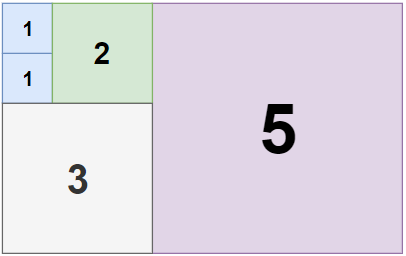
Input: n = 5, m = 8
Output: 5
Example 3:
Input: n = 11, m = 13
Output: 6
解题思路:
class Solution {public:map<long, int> set;int res = 100000001;int tilingRectangle(int n, int m) {if (n == m) return 1;if (n > m) {int temp = n;n = m;m = temp;}int *h = new int[n + 1];memset(h, 0, (n + 1) * sizeof(int));dfs(n, m, h, 0);return res;}private: void dfs(int n, int m, int h[], int cnt) {if (cnt >= res) return;bool isFull = true;int pos = -1, minH = 100000001;// 看看数组h是不是满了,没满的话顺便记录一下最低的位置minH和对应的索引posfor (int i = 1; i <= n; i++) {if (h[i] < m) isFull = false;if (h[i] < minH) {pos = i;minH = h[i];}}// 如果铺满了if (isFull) {res = min(cnt, res);return;}// 没铺满的话,继续铺/* 这里有一个小trick,把整个数组h的状态映射到一个long的整数类型上。这个映射是一对一的映射!!!具体方法是把数组看成(m+1)进制的数,就可以转化成一个long类型的整数了。因为base的选取是(m+1),而数组中的每个数都不超过m,故肯定是一个一对一的映射!即不可能存在两个不一样的数组映射到同一个long类型的整数上。*/long key = 0, base = m + 1;for (int i = 1; i <= n; i++) {key += h[i] * base;base *= m + 1;}if (set.count(key) && set[key] <= cnt) return;set[key] = cnt;// 找到和pos一样低的末尾位置int end = pos;while (end + 1 <= n && h[end + 1] == h[pos] && (end + 1 - pos + 1 + minH) <= m) end++;// 找到了pos~end这个最低位置的区间后,从end开始,遍历到pos位置,每次铺一块砖。// 再继续 dfsfor (int j = end; j >= pos; j--) {int curH = j - pos + 1;int next[n + 1];memcpy(next, h, (n + 1)*sizeof(int));for (int k = pos; k <= j; k++) {next[k] += curH;}dfs(n, m, next, cnt + 1);}}};

若有收获,就点个赞吧
0 人点赞


