- 树的数据结构
- 树的递归
- Maximum Depth of Binary Tree">LeetCode NO.104 Maximum Depth of Binary Tree
- Balanced Binary Tree">LeetCode NO.110 Balanced Binary Tree
- Diameter of Binary Tree">LeetCode NO.543 Diameter of Binary Tree
- Path Sum III">LeetCode NO.437 Path Sum III
- Symmetric Tree">LeetCode NO.101 Symmetric Tree
- Delete Nodes And Return Forest">LeetCode NO.1110 Delete Nodes And Return Forest
title: 程序猿养成之路:Hello树先生
date: 2021-03-18 12:13:14
tags:
- 程序猿养成之路
- 算法
树的数据结构
作为(单)链表的升级版,我们通常接触的树都是二叉树(binary tree),即每个节点最多有两个子节点;且除非题目说明,默认树中不存在循环结构。LeetCode 默认的树表示方法如下。
struct TreeNode {int val;TreeNode *left;TreeNode *right;TreeNode(int x) : val(x), left(NULL), right(NULL) {}};
可以看出,其与链表的主要差别就是多了一个子节点的指针。
树的递归
LeetCode NO.104 Maximum Depth of Binary Tree
题目描述
返回二叉树的最大深度。
题解
int maxDepth(TreeNode* root) {return root? 1 + max(maxDepth(root->left), maxDepth(root->right)): 0;}
LeetCode NO.110 Balanced Binary Tree
题目描述
判断二叉树是否平衡。
题解
bool isBalanced(TreeNode* root) {return height(root)!=-1;}int height(TreeNode* root){if(root == NULL) return 0;int leftheight = height(root->left);int rightheight = height(root->right);if(leftheight == -1 || rightheight == -1 || abs(leftheight-rightheight) > 1) return -1;return 1+max(leftheight,rightheight);}
LeetCode NO.543 Diameter of Binary Tree
题目描述
寻找二叉树的最长直径。直径的定义是二叉树上任意两节点之间的无向距离。
题解
int diameterOfBinaryTree(TreeNode* root) {int diameter = 0;helper(root,diameter);return diameter;}int helper(TreeNode* root , int& diameter){if(root == NULL ) return 0;int l = helper(root->left,diameter),r = helper(root->right,diameter);diameter = max(l+r,diameter);return 1+max(l,r);}
LeetCode NO.437 Path Sum III
题目描述
You are given a binary tree in which each node contains an integer value.
Find the number of paths that sum to a given value.
The path does not need to start or end at the root or a leaf, but it must go downwards (traveling only from parent nodes to child nodes).
The tree has no more than 1,000 nodes and the values are in the range -1,000,000 to 1,000,000.
Example:
root = [10,5,-3,3,2,null,11,3,-2,null,1], sum = 8
``` 10 / \ 5 -3
/ \ \
> 3 2 11<br />/ \ <br />3 -2 1> Return 3. The paths that sum to 8 are:> 1. 5 -> 3> 2. 5 -> 2 -> 1> 3. -3 -> 11**题解**```cppclass Solution {public:/*前缀和解法*前缀和的概念:一个节点的前缀和就是该节点到根之间的路径和。*前缀和的意义:因为对于同一路径上的两个节点,上面的节点是下面节点的祖先节点,所以其前缀和之差即是这两个节点间的路径和(不包含祖先节点的值)。*哈希map的使用:key是前缀和, value是该前缀和的节点数量,记录数量是因为有出现复数路径的可能。*回溯的意义:因为只有同一条路径上的节点间(节点和其某一祖先节点间)的前缀和做差才有意义。所以当前节点处理完之后,需要从map中移除这一个前缀和,然后再进入下一个分支路径。*/int pathSum(TreeNode* root, int sum) {//key:前缀和 value:前缀和出现的次数unordered_map<int,int> preFixSum;//初始化mappreFixSum[0] = 1;int curSum = 0;int res = 0;//递归子树recur(root,sum,0,res,preFixSum);return res;}void recur(TreeNode* root,int sum,int curSum,int& res,unordered_map<int,int>& preFixSum){if(root==NULL) return;//计算当前节点前缀和curSum += root->val;//查找map,计算当前有多少前缀和为curSum-sum的节点res+=preFixSum[curSum-sum];preFixSum[curSum]++;//递归左右子树recur(root->left,sum,curSum,res,preFixSum);recur(root->right,sum,curSum,res,preFixSum);//回溯,恢复原状preFixSum[curSum]--;}};
LeetCode NO.101 Symmetric Tree
题目描述
判断一棵二叉树是否对称。
Given the root of a binary tree, check whether it is a mirror of itself (i.e., symmetric around its center).
Example 1:

Input: root = [1,2,2,3,4,4,3]
Output: true
Example 2:
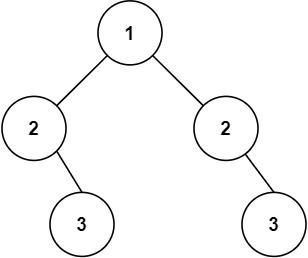
Input: root = [1,2,2,null,3,null,3]
Output: false
Constraints:
The number of nodes in the tree is in the range [1, 1000].
-100 <= Node.val <= 100
题解
判断一个树是否对称等价于判断左右子树是否对称。笔者一般习惯将判断两个子树是否相等或对称类型的题的解法叫做“四步法”:(1)如果两个子树都为空指针,则它们相等或对称;(2)如果两个子树只有一个为空指针,则它们不相等或不对称;(3)如果两个子树根节点的值不相等,则它们不相等或不对称;(4)根据相等或对称要求,进行递归处理。
bool isSymmetric(TreeNode* root) {
    if(root==NULL) return true;
    return helper(root->left,root->right);
}
bool helper(TreeNode* left,TreeNode* right){
    if(!left && !right) return true;
    if(!left || !right ) return false;
    if(left->val != right->val) return false;
    return helper(left->left,right->right) && helper(left->right,right->left);
}
LeetCode NO.1110 Delete Nodes And Return Forest
题目描述
Given the root of a binary tree, each node in the tree has a distinct value.
After deleting all nodes with a value in to_delete, we are left with a forest (a disjoint union of trees).
Return the roots of the trees in the remaining forest. You may return the result in any order.
Example 1:
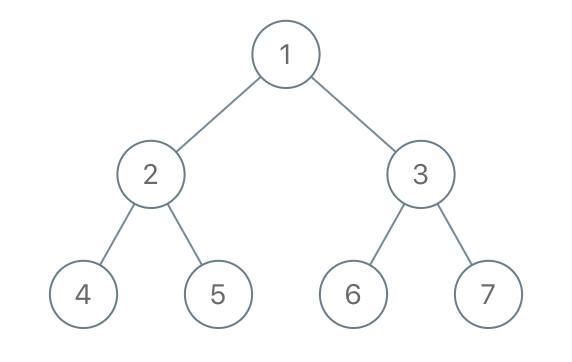
Input: root = [1,2,3,4,5,6,7], to_delete = [3,5]
Output: [[1,2,null,4],[6],[7]]
Example 2:
Input: root = [1,2,4,null,3], to_delete = [3]
Output: [[1,2,4]]
Constraints:
The number of nodes in the given tree is at most 1000.
Each node has a distinct value between 1 and 1000.
to_delete.length <= 1000
to_delete contains distinct values between 1 and 1000.
题解
/**
 * Definition for a binary tree node.
 * struct TreeNode {
 *     int val;
 *     TreeNode *left;
 *     TreeNode *right;
 *     TreeNode() : val(0), left(nullptr), right(nullptr) {}
 *     TreeNode(int x) : val(x), left(nullptr), right(nullptr) {}
 *     TreeNode(int x, TreeNode *left, TreeNode *right) : val(x), left(left), right(right) {}
 * };
 */

//后序遍历写法
TreeNode* deleteNode(TreeNode* root,set<int>& dict,vector<TreeNode*>& forest){
    if(root==NULL) return roo
    root->left = deleteNode(root->left,dict,forest);
    root->right = deleteNode(root->right,dict,forest);
     //查找节点并删除
    if(dict.find(root->val)!=dict.end()){
        if(root->left){
            forest.push_back(root->left);
        }
        if(root->right){
            forest.push_back(root->right);
        }
        root = NULL;
    }
    return root;

vector<TreeNode*> delNodes(TreeNode* root, vector<int>& to_delete) {
    vector<TreeNode*> forest;
    set<int> dict(to_delete.begin(),to_delete.end()
    root = deleteNode(root,dict,forest);
    if(root){
        forest.push_back(root);
    }
    return forest;
}
/**
 * Definition for a binary tree node.
 * struct TreeNode {
 *     int val;
 *     TreeNode *left;
 *     TreeNode *right;
 *     TreeNode() : val(0), left(nullptr), right(nullptr) {}
 *     TreeNode(int x) : val(x), left(nullptr), right(nullptr) {}
 *     TreeNode(int x, TreeNode *left, TreeNode *right) : val(x), left(left), right(right) {}
 * };
 */

//前序遍历写法,较为繁琐
vector<TreeNode*> delNodes(TreeNode* root, vector<int>& to_delete){
    vector<TreeNode*> forest;
    set<int> dict(to_delete.begin(),to_delete.end());
    TreeNode* prev = NULL;
    root = deleteNode(root,dict,forest,prev);
    if(root){
        forest.push_back(root);
    }
    return fore
}

TreeNode* deleteNode(TreeNode* root,set<int>& dict,vector<TreeNode*>& forest,TreeNode* prev){
    if(root==NULL) return NULL;
    TreeNode* l = root->left;
    TreeNode* r = root->right;
    prev = root;
    if(dict.find(root->val)!=dict.end()){
        if(l && dict.find(l->val)==dict.end()){
            forest.push_back(l);
        }
        if(r && dict.find(r->val)==dict.end()){
            forest.push_back(r);
        }
        root = NULL;

    if(prev){
        prev->left = deleteNode(l,dict,forest,prev);
        prev->right = deleteNode(r,dict,forest,prev);
    }
    return root;
}

若有收获,就点个赞吧
0 人点赞


