0x00 前言:Concept
在学习内存管理这个体系结构之前,我们先要理解这几个概念以及缩写
概念:
文件页
内存回收,也就是系统释放掉可以回收的内存,比如缓存和缓冲区,就属于可回收内存。它们在内存管理中,通常被叫做文件页(File-backed Page)。大部分文件页,都可以直接回收,以后有需要时,再从磁盘重新读取就可以了。
脏页
些被应用程序修改过,并且暂时还没写入磁盘的数据(也就是脏页),就得先写入磁盘,然后才能进行内存释放。 这些脏页,一般可以通过两种方式写入磁盘。可以在应用程序中,通过系统调用 fsync ,把脏页同步到磁盘中;也可以交给系统,由内核线程 pdflush 负责这些脏页的刷新。
文件映射页
除了缓存和缓冲区,通过内存映射获取的文件映射页,也是一种常见的文件页。它也可以被释放掉,下次再访问的时候,从文件重新读取。(mmap)
匿名页
应用程序动态分配的堆内存,也就是在内存管理中说到的匿名页(Anonymous Page),它们很可能还要再次被访问啊,不能直接回收,这些内存自然不能直接释放。但是,如果这些内存在分配后很少被访问,似乎也是一种资源浪费。
Linux Swap
Linux的 Swap 机制把这些不常访问的内存先写到磁盘中,然后释放这些内存,给其他更需要的进程使用。再次访问这些内存时,重新从磁盘读入内存就可以了。
缩写
PGD:Page Global Dictory 页面全局目录(顶层页表)
PUD: Page Upper Dictory 上层页表(二级页表)
PMD: Page Middle Dictory 中级页表(三级页表)
0x01 Struct
address_space
定义:
是页高速缓存(page cache)的核心数据结构。在很多时候,内核在读写磁盘时都引用页高速缓存,新页被追加到页高速缓存以满足用户态进程的读请求。如果页不在高速缓存中,新页就被追加到高速缓存。这样作的目的就是为了更快的效率,比如有一些页,经常
被访问,那么此时,如果内存空间允许的话,可以考虑让它们长期驻留在页高速缓存中,这样要比从磁盘访问它们效率更高。而address_space结构体就是嵌入在页所有者的索引节点对象中的数据结构。而_页描述符与它的联系是通过其中的字段_mapping和index来完成的。前者指向拥有页的索引节点的address_space对象,index字段表示在所有者的地址空间中以页大小为单位的偏移量,即在所有者的磁盘映像中页中数据的位置。在页高速缓存中查找页时使用这两个字段。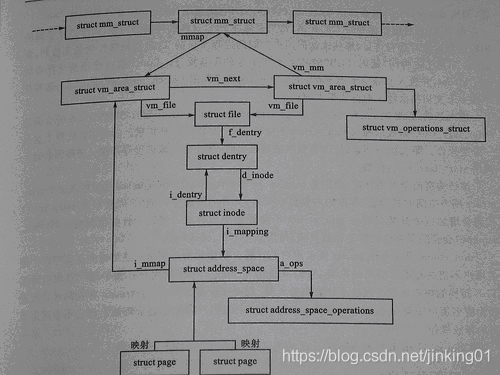
struct address_space {struct inode *host; /* owner: inode, block_device拥有它的节点 */struct radix_tree_root page_tree;/* radix tree of all pages包含全部页面的radix树 */rwlock_t tree_lock; /* and rwlock protecting it保护page_tree的自旋锁 */unsigned int i_mmap_writable;/* count VM_SHARED mappings共享映射数 VM_SHARED记数*/struct prio_tree_root i_mmap; /* tree of private and shared mappings 优先搜索树的树根*/struct list_head i_mmap_nonlinear;/*list VM_NONLINEAR mappings 非线性映射的链表头*/spinlock_t i_mmap_lock; /* protect tree, count, list 保护i_mmap的自旋锁*/unsigned int truncate_count; /* Cover race condition with truncate 将文件截断的记数*/unsigned long nrpages; /* number of total pages 页总数*/pgoff_t writeback_index;/* writeback starts here 回写的起始偏移*/struct address_space_operations *a_ops; /* methods 操作函数表*/unsigned long flags; /* error bits/gfp mask ,gfp_mask掩码与错误标识 */struct backing_dev_info *backing_dev_info; /* device readahead, etc预读信息 */spinlock_t private_lock; /* for use by the address_space 私有address_space锁*/struct list_head private_list; /* ditto 私有address_space链表*/struct address_space *assoc_mapping; /* ditto 相关的缓冲*/} __attribute__((aligned(sizeof(long))));
mm_struct
定义
一个进程的虚拟地址空间主要由两个数据结来描述。一个是最高层次的:mm_struct,一个是较高层次的:vm_area_structs。最高层次的mm_struct结构描述了一个进程的整个虚拟地址空间。较高层次的结构vm_area_truct描述了虚拟地址空间的一个区间(简称虚拟区)。每个进程只有一个mm_struct结构,在每个进程的task_struct结构中,有一个指向该进程的结构。可以说,mm_struct结构是对整个用户空间的描述。
struct mm_struct {//指向线性区对象的链表头struct vm_area_struct * mmap; /* list of VMAs *///指向线性区对象的红黑树struct rb_root mm_rb;//指向最近找到的虚拟区间struct vm_area_struct * mmap_cache; /* last find_vma result *///用来在进程地址空间中搜索有效的进程地址空间的函数unsigned long (*get_unmapped_area) (struct file *filp,unsigned long addr, unsigned long len,unsigned long pgoff, unsigned long flags);unsigned long (*get_unmapped_exec_area) (struct file *filp,unsigned long addr, unsigned long len,unsigned long pgoff, unsigned long flags);//释放线性区时调用的方法,void (*unmap_area) (struct mm_struct *mm, unsigned long addr);//标识第一个分配文件内存映射的线性地址unsigned long mmap_base; /* base of mmap area */unsigned long task_size; /* size of task vm space *//** RHEL6 special for bug 790921: this same variable can mean* two different things. If sysctl_unmap_area_factor is zero,* this means the largest hole below free_area_cache. If the* sysctl is set to a positive value, this variable is used* to count how much memory has been munmapped from this process* since the last time free_area_cache was reset back to mmap_base.* This is ugly, but necessary to preserve kABI.*/unsigned long cached_hole_size;//内核进程搜索进程地址空间中线性地址的空间空间unsigned long free_area_cache; /* first hole of size cached_hole_size or larger *///指向页表的目录pgd_t * pgd;//共享进程时的个数atomic_t mm_users; /* How many users with user space? *///内存描述符的主使用计数器,采用引用计数的原理,当为0时代表无用户再次使用atomic_t mm_count; /* How many references to "struct mm_struct" (users count as 1) *///线性区的个数int map_count; /* number of VMAs */struct rw_semaphore mmap_sem;//保护任务页表和引用计数的锁spinlock_t page_table_lock; /* Protects page tables and some counters *///mm_struct结构,第一个成员就是初始化的mm_struct结构,struct list_head mmlist; /* List of maybe swapped mm's. These are globally strung* together off init_mm.mmlist, and are protected* by mmlist_lock*//* Special counters, in some configurations protected by the* page_table_lock, in other configurations by being atomic.*/mm_counter_t _file_rss;mm_counter_t _anon_rss;mm_counter_t _swap_usage;//进程拥有的最大页表数目unsigned long hiwater_rss; /* High-watermark of RSS usage */、//进程线性区的最大页表数目unsigned long hiwater_vm; /* High-water virtual memory usage *///进程地址空间的大小,锁住无法换页的个数,共享文件内存映射的页数,可执行内存映射中的页数unsigned long total_vm, locked_vm, shared_vm, exec_vm;//用户态堆栈的页数,unsigned long stack_vm, reserved_vm, def_flags, nr_ptes;//维护代码段和数据段unsigned long start_code, end_code, start_data, end_data;//维护堆和栈unsigned long start_brk, brk, start_stack;//维护命令行参数,命令行参数的起始地址和最后地址,以及环境变量的起始地址和最后地址unsigned long arg_start, arg_end, env_start, env_end;unsigned long saved_auxv[AT_VECTOR_SIZE]; /* for /proc/PID/auxv */struct linux_binfmt *binfmt;cpumask_t cpu_vm_mask;/* Architecture-specific MM context */mm_context_t context;/* Swap token stuff *//** Last value of global fault stamp as seen by this process.* In other words, this value gives an indication of how long* it has been since this task got the token.* Look at mm/thrash.c*/unsigned int faultstamp;unsigned int token_priority;unsigned int last_interval;//线性区的默认访问标志unsigned long flags; /* Must use atomic bitops to access the bits */struct core_state *core_state; /* coredumping support */#ifdef CONFIG_AIOspinlock_t ioctx_lock;struct hlist_head ioctx_list;#endif#ifdef CONFIG_MM_OWNER/** "owner" points to a task that is regarded as the canonical* user/owner of this mm. All of the following must be true in* order for it to be changed:** current == mm->owner* current->mm != mm* new_owner->mm == mm* new_owner->alloc_lock is held*/struct task_struct *owner;#endif#ifdef CONFIG_PROC_FS/* store ref to file /proc/<pid>/exe symlink points to */struct file *exe_file;unsigned long num_exe_file_vmas;#endif#ifdef CONFIG_MMU_NOTIFIERstruct mmu_notifier_mm *mmu_notifier_mm;#endif#ifdef CONFIG_TRANSPARENT_HUGEPAGEpgtable_t pmd_huge_pte; /* protected by page_table_lock */#endif/* reserved for Red Hat */#ifdef __GENKSYMS__unsigned long rh_reserved[2];#else/* How many tasks sharing this mm are OOM_DISABLE */union {unsigned long rh_reserved_aux;atomic_t oom_disable_count;};/* base of lib map area (ASCII armour) */unsigned long shlib_base;#endif};

若有收获,就点个赞吧
0 人点赞


