1. Add Two Numbers
https://leetcode.com/explore/interview/card/top-interview-questions-medium/107/linked-list/783/
merge lists with carry value:
/*** Definition for singly-linked list.* struct ListNode {* int val;* ListNode *next;* ListNode() : val(0), next(nullptr) {}* ListNode(int x) : val(x), next(nullptr) {}* ListNode(int x, ListNode *next) : val(x), next(next) {}* };*/class Solution {public:ListNode* addTwoNumbers(ListNode* l1, ListNode* l2) {ListNode* dummy = new ListNode(-1);ListNode* curr = dummy;int carry = 0;while(l1 || l2){int a = l1 ? l1->val : 0;int b = l2 ? l2->val : 0;curr->next = new ListNode((a + b + carry) % 10);carry = (a + b + carry) / 10; //over 10, carry value is 1l1 = l1 ? l1->next : NULL;l2 = l2 ? l2->next : NULL;curr = curr->next;}if(carry!=0) //if there is a carry value at last, add a new node of 1curr->next = new ListNode(1);return dummy->next;}};
2. Odd Even Linked List
https://www.yuque.com/akiencore/yeyky8/pwh4fl/edit?toc_node_uuid=Ii4DR7VgEcE67yxq
2 lists, one jump from the last node of another one:
//CAUTION: it is talking about the node number and not the value in the nodes
class Solution {
public:
    ListNode* oddEvenList(ListNode* head) {
        if(!head || !head->next) return head;

        ListNode* odd = head;
        ListNode* even = head->next;
        ListNode* head2 = even;

        while(odd->next && even->next){ //if both have next
            odd->next = even->next;
            odd = odd->next;

            even->next = odd->next;
            even = even->next;
        }
        odd->next = head2;

        return head;
    }
};
3. Intersection of Two Linked Lists
https://leetcode.com/explore/interview/card/top-interview-questions-medium/107/linked-list/785/
“switch”:
/**
 * Definition for singly-linked list.
 * struct ListNode {
 *     int val;
 *     ListNode *next;
 *     ListNode(int x) : val(x), next(NULL) {}
 * };
 */
class Solution {
public:
    ListNode *getIntersectionNode(ListNode *headA, ListNode *headB) {
        ListNode* curr1 = headA;
        ListNode* curr2 = headB;
        int switched1 = 0;
        int switched2 = 0;

        while(curr1 && curr2){
            if(curr1 == curr2) return curr1;

            curr1 = curr1->next;
            curr2 = curr2->next;

            if(!curr1 && !curr2)
                break;

            if(!curr1 && switched1 == 0){
                curr1 = headB;
                switched1 = 1;
            } else if(!curr1 && switched1 == 1){
                curr1 = headA;
                switched1 = 0;
            }

            if(!curr2 && switched2 == 0){
                curr2 = headA;
                switched2 = 0;
            } else if(!curr2 && switched2 == 1){
                curr2 = headB;
                switched2 = 1;
            }
        }

        return NULL;
    }
};
- To simply explain, this idea is to let 2 curr nodes switch between each other if it meets an end
- and they will meet if they have an intersection, before that, both curr nodes passed the same number of steps

for example,
curr1 from A: 1-9-1-2-4-(null, turn to the head of B)3-2
curr2 from B: 3-2-4-(null, turn to the head of A)1-9-1-2
- if no intersections at all, both nodes reach the end at the same time
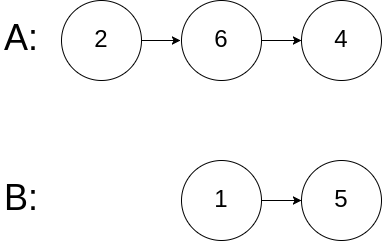
for example,
curr 1 from A: 2-6-4-(null, turn to the head of B)1-5-NULL
curr 2 from B: 1-5-(null, turn to the head of A)2-6-4-NULL

若有收获,就点个赞吧
0 人点赞


