layout: post title: Async Iterable/Enumerable vs. Reactive-Streams tags:
- 对比点评
原文 Async Iterable/Enumerable vs. Reactive-Streams{:target=”_blank”}。
介绍
在响应式数据处理流水线中,当两个部分处理数据速度不同时,如果我们不希望缓冲区爆炸或者内存耗尽,那 backpressure 就至关重要了。RxJava 和 Reactive-Streams 设计了一套非阻塞、基于请求协调的处理机制,但可能我们也听说过其他的解决方案。一个经常被提及的概念就是 Async Iterables(Java 中的概念)或者 Async Enumerables(C# 中的概念)了。
实际上 Rx.NET 有一个子项目 Ix.NET(Interactive Extensions 的缩写),其中就使用了 Async Enumerables。它通过 MoveNext()(相当于 hasNext())返回一个 Task(相当于 CompletableFuture、Promise)来解决 backpressure 的问题:当 Task 完成时,我们可以消费 Current 的值(相当于 next() 函数),由于我们只能在消费了当前的数据之后才能调用 MoveNext(),所以自然就解决了 backpressure 的问题。
遗憾的是,我没有找到 IAsyncEnumerable 的 Java 实现(不过我也只是用 Google 搜索了几次),所以我决定用 Java 8 自己实现一下,看看让数据在其中流动需要做些什么,以及对比一下它和我当前对响应式数据流的最新理解—— Reactive-Streams-Commons ——的性能差异。
基本 API
由于 Async Enumerables 的设计从源头上考虑了延迟执行,所以基本 API 包括下面两个接口:
interface IAsyncEnumerable<T> {IAsyncEnumerator<T> enumerator();}interface IAsyncEnumerator<T> {CompletionStage<Boolean> moveNext(CompositeSubscription cancel);T current();}
IAsyncEnumerable 相当于是 Iterable,它能发出 IAsyncEnumerator。IAsyncEnumerator 的 moveNext 函数能返回一个 CompletionStage,它能用于表明当前能否通过 current() 获取数据(true 表示能,false 表示数据流终止)。C# 的 CancellationToken 和 CompositeSubscription 类似,所以我就用它来实现取消了。
(注:我现在还没想好怎么实现组合取消,Ix.NET 的 IAsyncEnumerator 是一个 IDisposable,而且 Task 也可以取消,不像 CompletionStage 无法取消。不过幸运的是,在这篇博文中,我并不太需要这个特性。)
消费 IAsyncEnumerable
消费一个 IAsyncEnumerable 还是很直观的,尽管不像 C# 的 async/await 那样简单。如果我们只关心单一数据,那我们可以这样实现:
IAsyncEnumerable<T> source = ...IAsyncEnumerator<T> enumerator = source.enumerator();enumerator.moveNext(new CompositeSubscription()).whenComplete((b, e) -> {if (e != null) {e.printStackTrace();} else if (b) {System.out.println(enumerator.current());} else {System.out.println("Empty!");}});
当然,基于 CompletionStage 的 API,我们可以这样轻易地处理单一的数据。
但如果要消费 IAsyncEnumerator 中的多个数据,那就要做更多事情了,我们需要递归调用 moveNext,直到数据流终止,或者出现错误:
public void consumeAll(IAsyncEnumerator<T> enumerator, CompositeSubscription csub) {if (csub == null) {csub = new CompositeSubscription();}CompositeSubscription fcsub = csub;enumerator.moveNext(new CompositeSubscription()).whenComplete((b, e) -> {if (e != null) {e.printStackTrace();} else if (b) {System.out.println(enumerator.current());// go recursiveconsumeAll(enumerator, fcsub);} else {System.out.println("Empty!");}});}
不幸的是,如果 CompletionStage 是同步的,那我们可能遇到 StackOverflowError,因为我们在无限调用 consumeAll。因此我们需要一个线程跳转,以确保调用栈不会太深:
public final class AsyncConsumer<T> implements Subscription {final Consumer<? super T> onNext;final Consumer<Throwable> onError;final Runnable onComplete;final IAsyncEnumerator<T> enumerator;final AtomicInteger wip;final Queue<CompletionStage<Boolean>> queue;final CompositeSubscription csub;final CountDownLatch cdl;public AsyncConsumer(IAsyncEnumerator<T> enumerator,Consumer<? super T> onNext,Consumer<Throwable> onError,Runnable onComplete) {this.enumerator = enumerator;this.onNext = onNext;this.onError = onError;this.onComplete = onComplete;this.wip = new AtomicInteger();this.queue = new SpscLinkedArrayQueue<>(16);this.csub = new CompositeSubscription();this.cdl = new CountDownLatch();}public void consumeAll() {if (csub.isUnsubscribed()) {cdl.countDown();return;}CompletionStage<T> stage = enumerator.moveNext(csub);queue.offer(stage);if (wip.getAndIncrement() == 0) {do {stage = queue.poll();stage.whenComplete((b, e) -> {if (csub.isUnsubscribed()) {cdl.countDown();return;} else if (e != null) {onError.accept(e);cdl.countDown();} else if (b) {onNext.accept(enumerator.current());consumeAll();} else {onComplete.run();cdl.countDown();}});} while (wip.decrementAndGet() != 0);}}public void await() throws InterruptedException {cdl.await();}public boolean await(long timeout, TimeUnit unit) throws InterruptedException {return cdl.await(timeout, unit);}@Overridepublic void unsubscribe() {csub.unsubscribe();}@Overridepublic boolean isUnsubscribed() {return csub.isUnsubscribed();}}
看起来很吸引人,除了发出事件的回调以及 IAsyncEnumerator,我们还需要一个 wip 计数器和 queue,就像以前的队列漏一样。我们用 CompositeSubscription 实现取消,用 CountDownLatch 实现阻塞等待。consumeAll() 每次消费一个数据,线程跳转的循环确保了每次只会有一个 whenComplete() 处于运行中。在回调中,我们用 Consumer 发出相应的事件,如果来了数据,那就递归调用 consumeAll。线程的跳转确保了无论是同步调用还是异步调用,我们都不会重入 consumeAll。
编写 IAsyncEnumerable 数据源
当然我们需要数据源才能工作,作为所有响应式编程库中最基础、最标准的数据源——range()——可以说是响应式编程领域的 for 循环了。
public final class AsyncRange implements IAsyncEnumerable<Integer> {final int start;final int count;@Overridepublic IAsyncEnumerator<Integer> enumerator() {return new AsyncRangeEnumerator(start, count);}static final class AsyncRangeEnumerator implements IAsyncEnumerator<Integer> {final long end;long index;static final CompletionStage<Boolean> TRUE =CompletableFuture.completedFuture(true);static final CompletionStage<Boolean> FALSE =CompletableFuture.completedFuture(false);public AsyncRangeEnumerator(int start, int count) {this.index = start - 1;this.end = (long)start + count;}@Overridepublic CompletionStage<Boolean> moveNext(CompositeSubscription csub) {long i = index + 1;if (i == end) {return FALSE;}index = i;return TRUE;}@Overridepublic Integer current() {return index;}}}
range 操作本身是同步的,在我看来,CompletableFuture 和 AsyncSubject 一样,而由于我们需要返回的是 true 或者 false 常量,因此我们可以使用共享的、已结束的 Future 对象。由于 moveNext() 会在 current() 之前调用,所以 index 初始值是 start - 1,并在 moveNext() 中把 index 加一。如果 index == end,那我们就返回 false,否则我们把 index 加一然后返回 true。
异步化
当然我们需要的是异步,所以让我们实现一下 observeOn 和 subscribeOn 操作符。前者确保 CompletionStage<Boolean> 的代码在指定的线程执行,后者确保 moveNext() 的代码执行在指定的线程(所以我们就可以在 moveNext() 或者 enumerator() 中进行阻塞 IO 操作了)。此外,编写这两个操作符我们已经很熟练了,对吧?
observeOn
如果大家有些不熟悉的操作符要实现,那我建议看看 Erik Meijer 在 Channel 9 的视频:follow the types。我们知道,我们有一个上游数据源,以及一些异步数据源。为了简洁起见,我们直接使用 Executor,因为 CompletionStage 的 XXXAsync 函数和 Executor 几乎一模一样。
public final class AsyncObserveOn<T> implements IAsyncEnumerable<T> {final IAsyncEnumerable<T> source;final Executor executor;public AsyncObserveOn(IAsyncEnumerable<T> source, Executor executor) {this.source = source;this.executor = executor;}@Overridepublic IAsyncEnumerator<T> enumerator() {return new AsyncObserveOnEnumerator<>(source.enumerator(), executor);}// ...}
这个套路大家应该都很熟悉了,脏活累活都被 AsyncObserveOnEnumerator 包揽了:
static final class AsyncObserveOnEnumerator<T> implements IAsyncEnumerator<T> {final IAsyncEnumerator<T> enumerator;final Executor executor;public AsyncObserveOnEnumerator(IAsyncEnumerator<T> enumerator, Executor executor) {this.enumerator = enumerator;this.executor = executor;}@Overridepublic CompletionStage<Boolean> moveNext(CompositeSubscription csub) {return enumerator.moveNext(csub).thenApplyAsync(v -> v, executor);}@Overridepublic T current() {return enumerator.current();}}
我承认我对 CompletionStage 不是很熟悉,所以我觉得 thenApplyAsync 是把数据送到指定 Executor 最简单的办法了。其他的代码看起来都很直观了,而且比咱们 Rx 风格的 observeOn() 简短得多。
subscribeOn
由于我们不知道 IAsyncEnumerable 是否会在 moveNext() 中实现异步,我们必须想个办法(subscribeOn),确保 moveNext() 发生在另外的线程:
public final class AsyncSubscribeOn<T> implements IAsyncEnumerable<T> {final IAsyncEnumerable<T> source;final Executor executor;public AsyncSubscribeOn(IAsyncEnumerable<T> source, Executor executor) {this.source = source;this.executor = executor;}@Overridepublic IAsyncEnumerator<T> enumerator() {AxSubscribeOnEnumerator<t> enumerator = new AxSubscribeOnEnumerator<>(executor);executor.execute(() -> {IAsyncEnumerator<T> ae = source.enumerator();enumerator.setEnumerator(ae);});return enumerator;}// ...}
我们把 source.enumerator() 的调用转移到了 Executor 中,而不是直接调用,在调用 enumerator() 时我们将会有一个合法的 IAsyncEnumerator(这一操作在消费者看来被推迟了),不过我们仍需要返回一个 IAsyncEnumerator。这里的困难之处就在于如何允许在没有合法的上游 Enumerator 时调用 moveNext()。幸好,CompletionStage 能帮我们解决这一难题:
static final class AxSubscribeOnEnumerator<T> implements IAsyncEnumerator<T> {final Executor executor;final CompletableFuture<IAsyncEnumerator<T>> onEnumerator;public AxSubscribeOnEnumerator(Executor executor) {this.executor = executor;this.onEnumerator = new CompletableFuture<>();}void setEnumerator(IAsyncEnumerator<T> enumerator) {onEnumerator.complete(enumerator);}@Overridepublic CompletionStage<Boolean> moveNext(CompositeSubscription token) {return onEnumerator.thenComposeAsync(ae -> ae.moveNext(token), executor);}@Overridepublic T current() {IAsyncEnumerator<T> ae = onEnumerator.getNow(null);return ae != null ? ae.current() : null;}}
我们准备了一个 onEnumerator CompletableFuture,当 setEnumerator 调用时,我们将获得实际的上游 IAsyncEnumerator,这时 Future 将会完成。这里最大的技巧在于,当 onEnumerator 的值到达时,我们立即在 Executor 上调用上游的 moveNext() 方法。thenComposeAsync 操作符和 flatMap 差不多。current() 函数则需要一些额外的逻辑,我们先尝试获取上游 Enumerator,如果此时还没有,那就直接返回 null,如果相应的 CompletionStage 还没有发出之前,我们不能调用 current()。
基准测试
既然我们有了这三个最基础的操作符,那就为 IAsyncEnumerable 和最新的 Reactive-Streams-Commons 做一个基准测试的对比吧。相关的源码可以从 GitHub 获取。为了方便,我把上述操作符实现为了流式 API,基本类型是 Ax:Async Extensions。
下面是基准测试的结果(数值越大越好):(i7 4790, Windows 7 x64, Java 8u92)
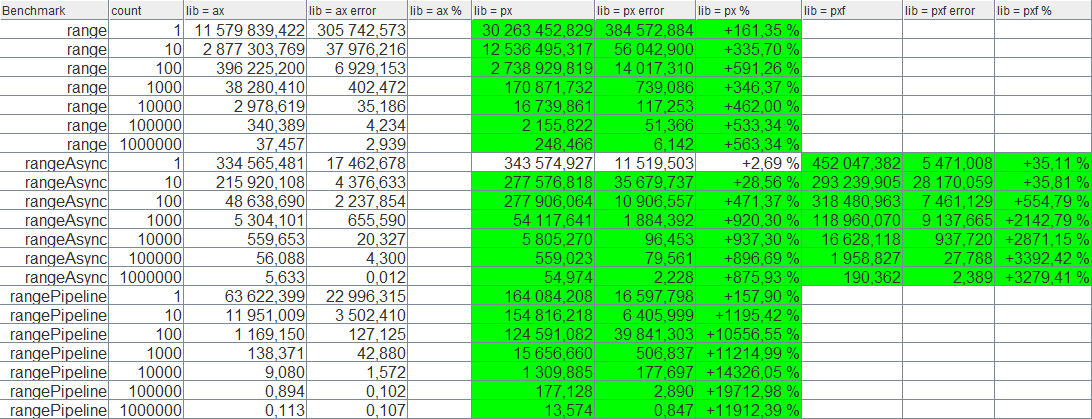
range 测试的是 range(1, count),rangeAsync 测试的是 range(1, count).observeOn(executor),rangePipeline 测试的是 range(1, count).subscribeOn(executor1).observeOn(executor2)。ax 代表我实现的 IAsyncEnumerable,px 代表 Reactive-Streams-Commons (Rsc) 的 Publisher Extensions。由于 Rsc 实现了操作符熔合,因此 rangeAsync() 在启用和禁用操作符熔合的情况下分别作了测试,pxf 代表启用了操作符熔合的 Rsc。
评估
看起来 Rsc 完爆了我实现的 IAsyncEnumerable,无论是同步模式还是异步模式。由于没有第三方的实现可以做对比,我只能猜测 IAsyncEnumerable 开销如此之大的原因了。我有限的 CompletionStage 使用经验告诉我一些原因,但我怀疑这并非根源所在。由于两个库都是使用了单线程 Executor,所以可以排除 Executor 的开销。
剩下的就是架构上、概念上的差异了:
- 每个数据都需要创建一个
CompletionStage,以及一个消费者;Rsc 没有任何内存分配; CompletionStage的行为介于 hot 和 cold 之间,就像AsyncSubject那样,当我们把消费者连接上去的时候,它可能仍在运行,也可能早已停止;这项检查增加了额外开销;Rsc 则是尽可能直接调用onNext;- 调用链越长,就需要越多的
CompletionStage,这就意味着内存分配和单独的任务调度;Rsc 则在异步边界上实现了批处理机制;
总结
我觉得这里的 IAsyncEnumerable 就是响应式数据流的一个特例,它每次都调用 request(1),也存在一些内存分配的开销,使得和高度优化的响应式数据流相比,开销高得多。
当然它看起来更精简,操作符的实现也更简单,但我不得不问,它和 Reactive-Streams 相比,有何优势?
如果大家对优化 IAsyncEnumerable 有任何建议,或者能推荐第三方的实现,我将很乐意重新做一次基准测试,并调整我对这个话题的观点。

若有收获,就点个赞吧
0 人点赞


