准备工作
mysql 语句
######################################### MySQL Crash Course# http://www.forta.com/books/0672327120/# Example table creation scripts################################################################# Create customers table########################CREATE TABLE customers(cust_id int NOT NULL AUTO_INCREMENT,cust_name char(50) NOT NULL ,cust_address char(50) NULL ,cust_city char(50) NULL ,cust_state char(5) NULL ,cust_zip char(10) NULL ,cust_country char(50) NULL ,cust_contact char(50) NULL ,cust_email char(255) NULL ,PRIMARY KEY (cust_id)) ENGINE=InnoDB;########################## Create orderitems table#########################CREATE TABLE orderitems(order_num int NOT NULL ,order_item int NOT NULL ,prod_id char(10) NOT NULL ,quantity int NOT NULL ,item_price decimal(8,2) NOT NULL ,PRIMARY KEY (order_num, order_item)) ENGINE=InnoDB;###################### Create orders table#####################CREATE TABLE orders(order_num int NOT NULL AUTO_INCREMENT,order_date datetime NOT NULL ,cust_id int NOT NULL ,PRIMARY KEY (order_num)) ENGINE=InnoDB;######################## Create products table#######################CREATE TABLE products(prod_id char(10) NOT NULL,vend_id int NOT NULL ,prod_name char(255) NOT NULL ,prod_price decimal(8,2) NOT NULL ,prod_desc text NULL ,PRIMARY KEY(prod_id)) ENGINE=InnoDB;####################### Create vendors table######################CREATE TABLE vendors(vend_id int NOT NULL AUTO_INCREMENT,vend_name char(50) NOT NULL ,vend_address char(50) NULL ,vend_city char(50) NULL ,vend_state char(5) NULL ,vend_zip char(10) NULL ,vend_country char(50) NULL ,PRIMARY KEY (vend_id)) ENGINE=InnoDB;############################ Create productnotes table###########################CREATE TABLE productnotes(note_id int NOT NULL AUTO_INCREMENT,prod_id char(10) NOT NULL,note_date datetime NOT NULL,note_text text NULL ,PRIMARY KEY(note_id),FULLTEXT(note_text)) ENGINE=MyISAM;###################### Define foreign keys#####################ALTER TABLE orderitems ADD CONSTRAINT fk_orderitems_orders FOREIGN KEY (order_num) REFERENCES orders (order_num);ALTER TABLE orderitems ADD CONSTRAINT fk_orderitems_products FOREIGN KEY (prod_id) REFERENCES products (prod_id);ALTER TABLE orders ADD CONSTRAINT fk_orders_customers FOREIGN KEY (cust_id) REFERENCES customers (cust_id);ALTER TABLE products ADD CONSTRAINT fk_products_vendors FOREIGN KEY (vend_id) REFERENCES vendors (vend_id);
######################################### MySQL Crash Course# http://www.forta.com/books/0672327120/# Example table population scripts################################################################### Populate customers table##########################INSERT INTO customers(cust_id, cust_name, cust_address, cust_city, cust_state, cust_zip, cust_country, cust_contact, cust_email)VALUES(10001, 'Coyote Inc.', '200 Maple Lane', 'Detroit', 'MI', '44444', 'USA', 'Y Lee', 'ylee@coyote.com');INSERT INTO customers(cust_id, cust_name, cust_address, cust_city, cust_state, cust_zip, cust_country, cust_contact)VALUES(10002, 'Mouse House', '333 Fromage Lane', 'Columbus', 'OH', '43333', 'USA', 'Jerry Mouse');INSERT INTO customers(cust_id, cust_name, cust_address, cust_city, cust_state, cust_zip, cust_country, cust_contact, cust_email)VALUES(10003, 'Wascals', '1 Sunny Place', 'Muncie', 'IN', '42222', 'USA', 'Jim Jones', 'rabbit@wascally.com');INSERT INTO customers(cust_id, cust_name, cust_address, cust_city, cust_state, cust_zip, cust_country, cust_contact, cust_email)VALUES(10004, 'Yosemite Place', '829 Riverside Drive', 'Phoenix', 'AZ', '88888', 'USA', 'Y Sam', 'sam@yosemite.com');INSERT INTO customers(cust_id, cust_name, cust_address, cust_city, cust_state, cust_zip, cust_country, cust_contact)VALUES(10005, 'E Fudd', '4545 53rd Street', 'Chicago', 'IL', '54545', 'USA', 'E Fudd');######################### Populate vendors table########################INSERT INTO vendors(vend_id, vend_name, vend_address, vend_city, vend_state, vend_zip, vend_country)VALUES(1001,'Anvils R Us','123 Main Street','Southfield','MI','48075', 'USA');INSERT INTO vendors(vend_id, vend_name, vend_address, vend_city, vend_state, vend_zip, vend_country)VALUES(1002,'LT Supplies','500 Park Street','Anytown','OH','44333', 'USA');INSERT INTO vendors(vend_id, vend_name, vend_address, vend_city, vend_state, vend_zip, vend_country)VALUES(1003,'ACME','555 High Street','Los Angeles','CA','90046', 'USA');INSERT INTO vendors(vend_id, vend_name, vend_address, vend_city, vend_state, vend_zip, vend_country)VALUES(1004,'Furball Inc.','1000 5th Avenue','New York','NY','11111', 'USA');INSERT INTO vendors(vend_id, vend_name, vend_address, vend_city, vend_state, vend_zip, vend_country)VALUES(1005,'Jet Set','42 Galaxy Road','London', NULL,'N16 6PS', 'England');INSERT INTO vendors(vend_id, vend_name, vend_address, vend_city, vend_state, vend_zip, vend_country)VALUES(1006,'Jouets Et Ours','1 Rue Amusement','Paris', NULL,'45678', 'France');########################## Populate products table#########################INSERT INTO products(prod_id, vend_id, prod_name, prod_price, prod_desc)VALUES('ANV01', 1001, '.5 ton anvil', 5.99, '.5 ton anvil, black, complete with handy hook');INSERT INTO products(prod_id, vend_id, prod_name, prod_price, prod_desc)VALUES('ANV02', 1001, '1 ton anvil', 9.99, '1 ton anvil, black, complete with handy hook and carrying case');INSERT INTO products(prod_id, vend_id, prod_name, prod_price, prod_desc)VALUES('ANV03', 1001, '2 ton anvil', 14.99, '2 ton anvil, black, complete with handy hook and carrying case');INSERT INTO products(prod_id, vend_id, prod_name, prod_price, prod_desc)VALUES('OL1', 1002, 'Oil can', 8.99, 'Oil can, red');INSERT INTO products(prod_id, vend_id, prod_name, prod_price, prod_desc)VALUES('FU1', 1002, 'Fuses', 3.42, '1 dozen, extra long');INSERT INTO products(prod_id, vend_id, prod_name, prod_price, prod_desc)VALUES('SLING', 1003, 'Sling', 4.49, 'Sling, one size fits all');INSERT INTO products(prod_id, vend_id, prod_name, prod_price, prod_desc)VALUES('TNT1', 1003, 'TNT (1 stick)', 2.50, 'TNT, red, single stick');INSERT INTO products(prod_id, vend_id, prod_name, prod_price, prod_desc)VALUES('TNT2', 1003, 'TNT (5 sticks)', 10, 'TNT, red, pack of 10 sticks');INSERT INTO products(prod_id, vend_id, prod_name, prod_price, prod_desc)VALUES('FB', 1003, 'Bird seed', 10, 'Large bag (suitable for road runners)');INSERT INTO products(prod_id, vend_id, prod_name, prod_price, prod_desc)VALUES('FC', 1003, 'Carrots', 2.50, 'Carrots (rabbit hunting season only)');INSERT INTO products(prod_id, vend_id, prod_name, prod_price, prod_desc)VALUES('SAFE', 1003, 'Safe', 50, 'Safe with combination lock');INSERT INTO products(prod_id, vend_id, prod_name, prod_price, prod_desc)VALUES('DTNTR', 1003, 'Detonator', 13, 'Detonator (plunger powered), fuses not included');INSERT INTO products(prod_id, vend_id, prod_name, prod_price, prod_desc)VALUES('JP1000', 1005, 'JetPack 1000', 35, 'JetPack 1000, intended for single use');INSERT INTO products(prod_id, vend_id, prod_name, prod_price, prod_desc)VALUES('JP2000', 1005, 'JetPack 2000', 55, 'JetPack 2000, multi-use');######################## Populate orders table#######################INSERT INTO orders(order_num, order_date, cust_id)VALUES(20005, '2005-09-01', 10001);INSERT INTO orders(order_num, order_date, cust_id)VALUES(20006, '2005-09-12', 10003);INSERT INTO orders(order_num, order_date, cust_id)VALUES(20007, '2005-09-30', 10004);INSERT INTO orders(order_num, order_date, cust_id)VALUES(20008, '2005-10-03', 10005);INSERT INTO orders(order_num, order_date, cust_id)VALUES(20009, '2005-10-08', 10001);############################ Populate orderitems table###########################INSERT INTO orderitems(order_num, order_item, prod_id, quantity, item_price)VALUES(20005, 1, 'ANV01', 10, 5.99);INSERT INTO orderitems(order_num, order_item, prod_id, quantity, item_price)VALUES(20005, 2, 'ANV02', 3, 9.99);INSERT INTO orderitems(order_num, order_item, prod_id, quantity, item_price)VALUES(20005, 3, 'TNT2', 5, 10);INSERT INTO orderitems(order_num, order_item, prod_id, quantity, item_price)VALUES(20005, 4, 'FB', 1, 10);INSERT INTO orderitems(order_num, order_item, prod_id, quantity, item_price)VALUES(20006, 1, 'JP2000', 1, 55);INSERT INTO orderitems(order_num, order_item, prod_id, quantity, item_price)VALUES(20007, 1, 'TNT2', 100, 10);INSERT INTO orderitems(order_num, order_item, prod_id, quantity, item_price)VALUES(20008, 1, 'FC', 50, 2.50);INSERT INTO orderitems(order_num, order_item, prod_id, quantity, item_price)VALUES(20009, 1, 'FB', 1, 10);INSERT INTO orderitems(order_num, order_item, prod_id, quantity, item_price)VALUES(20009, 2, 'OL1', 1, 8.99);INSERT INTO orderitems(order_num, order_item, prod_id, quantity, item_price)VALUES(20009, 3, 'SLING', 1, 4.49);INSERT INTO orderitems(order_num, order_item, prod_id, quantity, item_price)VALUES(20009, 4, 'ANV03', 1, 14.99);############################## Populate productnotes table#############################INSERT INTO productnotes(note_id, prod_id, note_date, note_text)VALUES(101, 'TNT2', '2005-08-17','Customer complaint:Sticks not individually wrapped, too easy to mistakenly detonate all at once.Recommend individual wrapping.');INSERT INTO productnotes(note_id, prod_id, note_date, note_text)VALUES(102, 'OL1', '2005-08-18','Can shipped full, refills not available.Need to order new can if refill needed.');INSERT INTO productnotes(note_id, prod_id, note_date, note_text)VALUES(103, 'SAFE', '2005-08-18','Safe is combination locked, combination not provided with safe.This is rarely a problem as safes are typically blown up or dropped by customers.');INSERT INTO productnotes(note_id, prod_id, note_date, note_text)VALUES(104, 'FC', '2005-08-19','Quantity varies, sold by the sack load.All guaranteed to be bright and orange, and suitable for use as rabbit bait.');INSERT INTO productnotes(note_id, prod_id, note_date, note_text)VALUES(105, 'TNT2', '2005-08-20','Included fuses are short and have been known to detonate too quickly for some customers.Longer fuses are available (item FU1) and should be recommended.');INSERT INTO productnotes(note_id, prod_id, note_date, note_text)VALUES(106, 'TNT2', '2005-08-22','Matches not included, recommend purchase of matches or detonator (item DTNTR).');INSERT INTO productnotes(note_id, prod_id, note_date, note_text)VALUES(107, 'SAFE', '2005-08-23','Please note that no returns will be accepted if safe opened using explosives.');INSERT INTO productnotes(note_id, prod_id, note_date, note_text)VALUES(108, 'ANV01', '2005-08-25','Multiple customer returns, anvils failing to drop fast enough or falling backwards on purchaser. Recommend that customer considers using heavier anvils.');INSERT INTO productnotes(note_id, prod_id, note_date, note_text)VALUES(109, 'ANV03', '2005-09-01','Item is extremely heavy. Designed for dropping, not recommended for use with slings, ropes, pulleys, or tightropes.');INSERT INTO productnotes(note_id, prod_id, note_date, note_text)VALUES(110, 'FC', '2005-09-01','Customer complaint: rabbit has been able to detect trap, food apparently less effective now.');INSERT INTO productnotes(note_id, prod_id, note_date, note_text)VALUES(111, 'SLING', '2005-09-02','Shipped unassembled, requires common tools (including oversized hammer).');INSERT INTO productnotes(note_id, prod_id, note_date, note_text)VALUES(112, 'SAFE', '2005-09-02','Customer complaint:Circular hole in safe floor can apparently be easily cut with handsaw.');INSERT INTO productnotes(note_id, prod_id, note_date, note_text)VALUES(113, 'ANV01', '2005-09-05','Customer complaint:Not heavy enough to generate flying stars around head of victim. If being purchased for dropping, recommend ANV02 or ANV03 instead.');INSERT INTO productnotes(note_id, prod_id, note_date, note_text)VALUES(114, 'SAFE', '2005-09-07','Call from individual trapped in safe plummeting to the ground, suggests an escape hatch be added.Comment forwarded to vendor.');
SQL
SQL(发音为字母S-Q-L或sequel)是结构化查询语言(Structured Query Language)的缩写。SQL是一种专门用来与数据库通信的语言。
MySql
MySQL是一个客户机-服务器DBMS,因此,为了使用MySQL,需要有一个客户机,即你需要用来与MySQL打交道(给MySQL提供要执行的命令)的一个应用。
使用MySql
连接
连接MySql需要以下4个条件
- 主机名(计算机名)——如果连接到本地MySQL服务器,为localhost;
- 端口(如果使用默认端口3306之外的端口);
- 一个合法的用户名;
- 口用户口令(如果需要)。
命令行: mysql [-h主机号 -P端口号] -u用户名 -p密码
选择数据库
例如,为了使用crashcourse数据库,应该输入以下内容:
输入
USE crashcourse;
输出
Database changed
查看数据库和表
show databases;//查看数据库show tables;//查看表show columns from tableName;//显示表结构describe tableName;//显示表结构(为上句的快捷方式)show create database tmp;//显示建数据库tmp的sql语句show create table person;//显示建表person的sql语句show stasus;//显示广泛的服务器状态信息show grants;//用来显示授予用户(所有用户或特定用户)的安全权限;SHOW ERRORS和SHOW WARNINGS,用来显示服务器错误或警告消息。
MySql常用的SHOW语句:https://www.cnblogs.com/zhaoshujie/p/10422396.html
查找数据(select基本用法)
为了使用SELECT检索表数据,必须至少给出两条信息——想选择什么,以及从什么地方选择。
查找单列
SELECT prod_nameFROM products;
查找多列
SELECT prod_id,prod_name,prod_priceFROM products;
查找所有列
SELECT *FROM products;
使用通配符
一般,除非你确实需要表中的每个列,否则最好别使用*通配符。
虽然使用通配符可能会使你自己省事,不用明确列出所需列,但检索不需要的列通常会降低检索和应用程序的性能。
检索不同行(distinct)
select vend_idfrom products;//未去重select distinct vend_idfrom products;//去重
不能部分使用DISTINCT
DISTINCT关键字应用于所有列而不仅是前置它的列。
如果给出SELECT DISTINCT vend_ id,prod_price,除非指定的两个列都不同,否则所有行都将被检索出来。
# 错误sql语句select vend_id, distinct prod_pricefrom products;# 正确sql语句select distinct vend_id, prod_pricefrom products;
限制结果
SELECT语句返回所有匹配的行,它们可能是指定表中的每个行。为了返回第一行或前几行,可使用LIMIT子句。
select prod_namefrom productslimit 5;
返回特定位置的结果,可以使用offset子句,跳过多少条语句。
select prod_namefrom productslimit 5 offset 5;
排序检索数据(order by子句)
关系数据库设计理论认为,如果不明确规定排序顺序,则不应该假定检索出的数据的顺序有意义。
子句(clause)
SQL语句由子句构成,有些子句是必需的,而有的是可选的。
一个子句通常由一个关键字和所提供的数据组成。
子句的例子有SELECT语句的FROM子句。
单列排序
select prod_namefrom productsorder by prod_name;
多列排序
下面的代码检索3个列,并按其中两个列对结果进行排序—首先按价格,然后再按名称排序。
select prod_id,prod_price,prod_namefrom productsorder by prod_price,prod_name;
排序方向(升序,降序)
下面的例子按价格以降序排序产品(最贵的排在最前面)
select prod_id,prod_price,prod_namefrom productsorder by prod_price desc;
DESC关键字只应用到直接位于其前面的列名。只对prod_price列指定DESc,对prod_name列不指定。
因此,prod_price列以降序排序,而prod_name列(在每个价格内)仍然按标准的升序排序。
select prod_id,prod_price,prod_namefrom productsorder by prod_price desc ,prod_name asc;
过滤数据(where子句)
数据库表一般包含大量的数据,很少需要检索表中所有行。
通常只会根据特定操作或报告的需要提取表数据的子集。
只检索所需数据需要指定搜索条件( search criteria ),搜索条件也称为过滤条件( filtercondition )。
Where子句操作符

WHERE子句的位置
在同时使用ORDER BY和WHERE子句时,应该让ORDER BY位于WHERE之后,否则将会产生错误。
# 等于过滤select prod_name,prod_pricefrom productswhere prod_name='fuses';# 不等于过滤select prod_name,prod_pricefrom productswhere prod_name<>'fuses';# 范围过滤select prod_name,prod_pricefrom productswhere prod_price between 5 and 10;# NULL值过滤select cust_idfrom customerswhere cust_email is null ;# 非NULL值过滤select cust_idfrom customerswhere cust_email is not null ;
Where子句组合
- and
此SQL语句检索由供应商1003制造且价格小于等于10美元的所有产品的名称和价格。
这条SELECT语句中的WHERE子句包含两个条件,并且用AND关键字联结它们。
select prod_id,prod_price,prod_namefrom productswhere vend_id=1003 and prod_price<=10;
or
select prod_name,prod_pricefrom productswhere vend_id=1002 or vend_id=1003;
此SQL语句检索由任一个指定供应商制造的所有产品的产品名和价格。
OR操作符告诉DBMS匹配任一条件而不是同时匹配两个条件。and 和 or组合
AND在计算次序中优先级更高
# 默认先and 后 orselect prod_name,prod_pricefrom productswhere vend_id=1002 or vend_id =1003 and prod_price>=10;# 可以使用括号改变计算顺序select prod_name,prod_pricefrom productswhere (vend_id=1002 or vend_id =1003) and prod_price>=10;
in操作符
in操作符用于指定条件的范围。
select prod_name,prod_pricefrom productswhere (vend_id=1002 or vend_id =1003) and prod_price>=10;
通配符
%
匹配任意字符任意次
最常使用的通配符是百分号(%)。在搜索串中,%表示任何字符出现任意次数。
例如,为了找出所有以词jet起头的产品,可使用以下SELECT
select prod_id,prod_namefrom productswhere prod_name like 'jet%';
_
匹配任意字符一次
select prod_id,prod_namefrom productswhere prod_name like '_ ton anvil';
正则表达式
# 匹配产品名称中有1000的数据select prod_namefrom productswhere prod_name regexp '1000'order by prod_name;# .代表匹配任意字符一次select prod_namefrom productswhere prod_name regexp '.000'order by prod_name;# |代表或者,匹配1000或者2000select prod_namefrom productswhere prod_name regexp '1000|2000'order by prod_name;# |代表或者,匹配1000或者2000select prod_namefrom productswhere prod_name regexp '1000|2000'order by prod_name;# []代表选择其中一个进行匹配select prod_namefrom productswhere prod_name regexp '[123] ton'order by prod_name;#[1-5]表示匹配 1-5select prod_namefrom productswhere prod_name regexp '[1-5] ton'order by prod_name;
转义字符:
为了匹配特殊字符,必须用\l为前导。\-表示查找-,\.表示查找.
计算字段
拼接(concat函数)
select concat(vend_name,'(',vend_country,')') as msgfrom vendorsorder by vend_name;
修剪函数
- Trim 去掉两边空格
- LTrim 去掉左边空格
- RTrim 去掉右边空格
别名:as 语句
select concat(vend_name,'(',vend_country,')') as vend_titlefrom vendorsorder by vend_name;
算数运算
select prod_id,quantity,item_price,quantity*item_price as expanded_pricefrom orderitemswhere order_num=20005;
函数
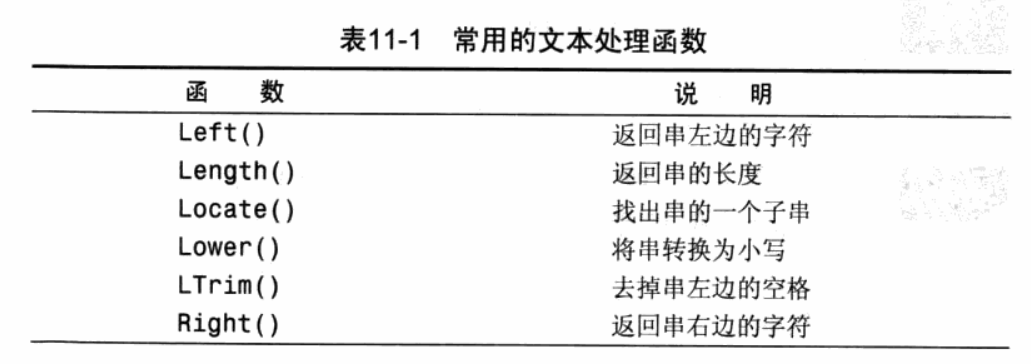
文本处理函数
Upper函数(转大写)
select vend_name ,Upper(vend_name) as vend_name_upcasefrom vendorsorder by vend_name;
lower函数(转小写)
select vend_name ,lower(vend_name) as vend_name_upcasefrom vendorsorder by vend_name;
Left函数(返回左边字符)
# LEFT(str,length);select left('abcd',2);
length函数(返回字符串长度)
select length('abcd');
locate函数(匹配子串)
# locate(subStr,string)select locate('cd','abcd')
日期和时间处理函数
数据结构和类型
日期格式
- Date 存储数据格式为:YYYY-MM-DD,它支持的范围为’1000-01-01’到’9999-12-31’
- DateTime 日期和时间的组合,存储格式为:YYYY-MM-DD HH:MM:SS,它支持的范围为’1000-01-01 00:00:00’到’9999-12-31 23:59:59’
- Timestamp 时间戳,从1970-01-01 00:00:00到当前的时间差值
- 时间类型
- Time

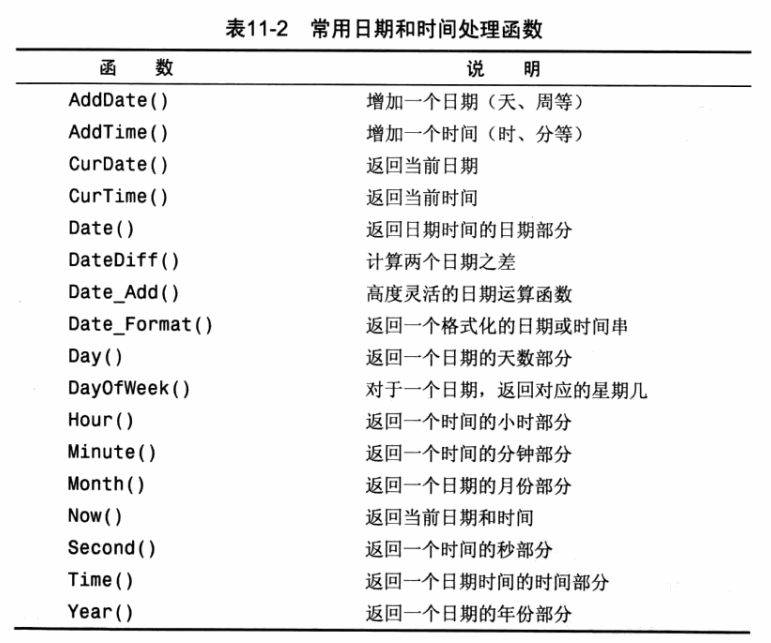
# 日期比较 该语句无法匹配dataTime类型的 2005-09-01 12:00select cust_id,order_numfrom orderswhere order_date='2005-09-01';# 日期比较 该语句可以匹配dataTime类型的 2005-09-01 12:00select cust_id,order_numfrom orderswhere date(order_date)='2005-09-01';
# 匹配特定月份的数据# 方案1 使用between操作符select cust_id,order_numfrom orderswhere date(order_date) between '2005-09-01' and '2005-09-30';# 方案2 使用year和month函数select cust_id,order_numfrom orderswhere year(order_date)=2005 and month(order_date)=9;
数值处理函数

数据汇总
聚集函数
Avg函数(平均值)
use tmp;select avg(prod_price) as avg_pricefrom products;
count函数(计数) ```sql SELECT COUNT(*) AS num_cust FROM customers;
count 函数不会统计NULL值
SELECT COUNT(cust_email) AS num_cust from customers;
- **MAX函数(最大值)**```sqlselect max(prod_price) as max_prod_pricefrom products;
Min函数(最小值)
select min(prod_price) as min_prod_pricefrom products;
sum函数(求和)
select sum(quantity) as sum_quantityfrom orderitemswhere order_num=20005;
不同的值(distinct)
# 统计不同产品价格的平均值SELECT AVG(DISTINCT prod_price) AS avg_priceFROM productsWHERE vend_id = 1003;
数据分组
分组语句
Group语句
# 查询不同供应商的产品总数select vend_id,count(*) as num_prodsfrom productsgroup by vend_id;
having(过滤分组)
select cust_id,count(*) as ordersfrom ordersgroup by cust_idhaving count(*)>=2;
HAVING和WHERE的差别
这里有另一种理解方法,WHERE在数据分组前进行过滤,HAVING在数据分组后进行过滤。这是一个重要的区别,WHERE排除的行不包括在分组中。这可能会改变计算值,从而影响HAVING子句中基于这些值过滤掉的分组。
# 具有2个(含)以上、价格为10(含)以上的产品的供应商select vend_id,count(*) as num_prodsfrom productswhere prod_price >=10group by vend_idhaving count(*)>=2;
select order_num,sum(item_price*quantity) as total_pricefrom orderItemsgroup by order_numhaving sum(item_price*quantity)>50order by total_price;
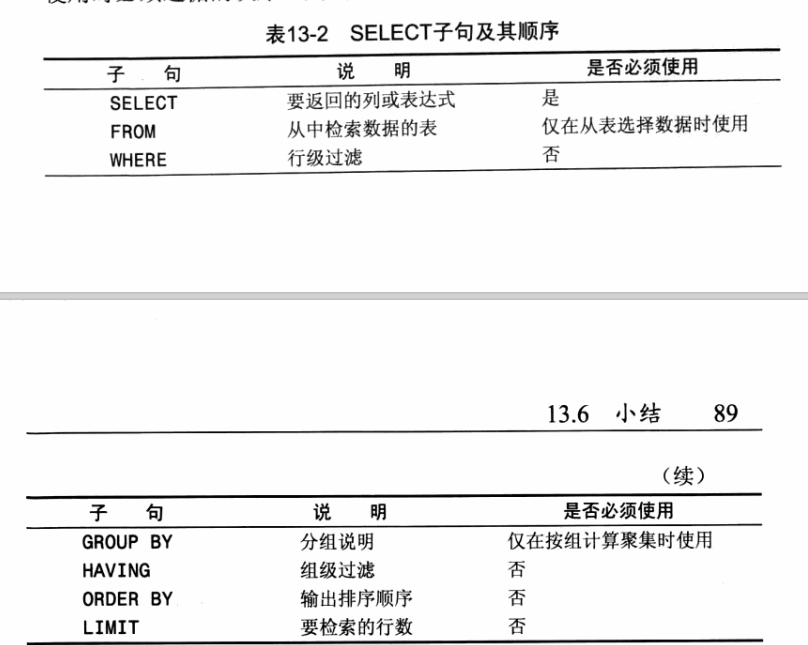
select子句顺序
子查询
如何列出订购物品TNT2的所有客户?(orders,orderItems表)
select *from customerswhere cust_id in(select cust_idfrom orderswhere order_num in(select order_numfrom orderItemswhere prod_id='tnt2'));select cust_idfrom orders left join orderItems on orders.order_num=orderItems.order_numwhere orderItems.prod_id='tnt2';
要显示customers表中每个客户的订单总数(order,customers表)
select cust_name,cust_state,(select count(*)from orderswhere orders.cust_id=customers.cust_id) as ordersfrom customersorder by cust_name;select cust_name,cust_state,count(orders.order_num)from customers left join orders on customers.cust_id=orders.cust_idgroup by cust_nameorder by cust_name;
联结表

若有收获,就点个赞吧
0 人点赞


