递归
一棵树要么是空树,要么有两个指针,每个指针指向一棵树。树是一种递归结构,很多树的问题可以使用递归来处理。
1. 树的高度
- Maximum Depth of Binary Tree (Easy)
public int maxDepth(TreeNode root) {if (root == null) return 0;return Math.max(maxDepth(root.left), maxDepth(root.right)) + 1;}
2. 平衡树
- Balanced Binary Tree (Easy)
3/ \9 20/ \15 7
平衡树左右子树高度差都小于等于 1
private boolean result = true;public boolean isBalanced(TreeNode root) {maxDepth(root);return result;}public int maxDepth(TreeNode root) {if (root == null) return 0;int l = maxDepth(root.left);int r = maxDepth(root.right);if (Math.abs(l - r) > 1) result = false;return 1 + Math.max(l, r);}
3. 两节点的最长路径
- Diameter of Binary Tree (Easy)
Input:1/ \2 3/ \4 5Return 3, which is the length of the path [4,2,1,3] or [5,2,1,3].
private int max = 0;public int diameterOfBinaryTree(TreeNode root) {depth(root);return max;}private int depth(TreeNode root) {if (root == null) return 0;int leftDepth = depth(root.left);int rightDepth = depth(root.right);max = Math.max(max, leftDepth + rightDepth);return Math.max(leftDepth, rightDepth) + 1;}
4. 翻转树
- Invert Binary Tree (Easy)
public TreeNode invertTree(TreeNode root) {if (root == null) return null;TreeNode left = root.left; // 后面的操作会改变 left 指针,因此先保存下来root.left = invertTree(root.right);root.right = invertTree(left);return root;}
5. 归并两棵树
- Merge Two Binary Trees (Easy)
Input:Tree 1 Tree 21 2/ \ / \3 2 1 3/ \ \5 4 7Output:3/ \4 5/ \ \5 4 7
public TreeNode mergeTrees(TreeNode t1, TreeNode t2) {if (t1 == null && t2 == null) return null;if (t1 == null) return t2;if (t2 == null) return t1;TreeNode root = new TreeNode(t1.val + t2.val);root.left = mergeTrees(t1.left, t2.left);root.right = mergeTrees(t1.right, t2.right);return root;}
6. 判断路径和是否等于一个数
Leetcdoe : 112. Path Sum (Easy)
Given the below binary tree and sum = 22,5/ \4 8/ / \11 13 4/ \ \7 2 1return true, as there exist a root-to-leaf path 5->4->11->2 which sum is 22.
路径和定义为从 root 到 leaf 的所有节点的和。
public boolean hasPathSum(TreeNode root, int sum) {if (root == null) return false;if (root.left == null && root.right == null && root.val == sum) return true;return hasPathSum(root.left, sum - root.val) || hasPathSum(root.right, sum - root.val);}
7. 统计路径和等于一个数的路径数量
- Path Sum III (Easy)
root = [10,5,-3,3,2,null,11,3,-2,null,1], sum = 810/ \5 -3/ \ \3 2 11/ \ \3 -2 1Return 3. The paths that sum to 8 are:1. 5 -> 32. 5 -> 2 -> 13. -3 -> 11
路径不一定以 root 开头,也不一定以 leaf 结尾,但是必须连续。
public int pathSum(TreeNode root, int sum) {if (root == null) return 0;int ret = pathSumStartWithRoot(root, sum) + pathSum(root.left, sum) + pathSum(root.right, sum);return ret;}private int pathSumStartWithRoot(TreeNode root, int sum) {if (root == null) return 0;int ret = 0;if (root.val == sum) ret++;ret += pathSumStartWithRoot(root.left, sum - root.val) + pathSumStartWithRoot(root.right, sum - root.val);return ret;}
8. 子树
- Subtree of Another Tree (Easy)
Given tree s:3/ \4 5/ \1 2Given tree t:4/ \1 2Return true, because t has the same structure and node values with a subtree of s.Given tree s:3/ \4 5/ \1 2/0Given tree t:4/ \1 2Return false.
public boolean isSubtree(TreeNode s, TreeNode t) {if (s == null) return false;return isSubtreeWithRoot(s, t) || isSubtree(s.left, t) || isSubtree(s.right, t);}private boolean isSubtreeWithRoot(TreeNode s, TreeNode t) {if (t == null && s == null) return true;if (t == null || s == null) return false;if (t.val != s.val) return false;return isSubtreeWithRoot(s.left, t.left) && isSubtreeWithRoot(s.right, t.right);}
9. 树的对称
- Symmetric Tree (Easy)
1/ \2 2/ \ / \3 4 4 3
public boolean isSymmetric(TreeNode root) {if (root == null) return true;return isSymmetric(root.left, root.right);}private boolean isSymmetric(TreeNode t1, TreeNode t2) {if (t1 == null && t2 == null) return true;if (t1 == null || t2 == null) return false;if (t1.val != t2.val) return false;return isSymmetric(t1.left, t2.right) && isSymmetric(t1.right, t2.left);}
10. 最小路径
- Minimum Depth of Binary Tree (Easy)
树的根节点到叶子节点的最小路径长度
public int minDepth(TreeNode root) {if (root == null) return 0;int left = minDepth(root.left);int right = minDepth(root.right);if (left == 0 || right == 0) return left + right + 1;return Math.min(left, right) + 1;}
11. 统计左叶子节点的和
- Sum of Left Leaves (Easy)
3/ \9 20/ \15 7There are two left leaves in the binary tree, with values 9 and 15 respectively. Return 24.
public int sumOfLeftLeaves(TreeNode root) {if (root == null) return 0;if (isLeaf(root.left)) return root.left.val + sumOfLeftLeaves(root.right);return sumOfLeftLeaves(root.left) + sumOfLeftLeaves(root.right);}private boolean isLeaf(TreeNode node){if (node == null) return false;return node.left == null && node.right == null;}
12. 相同节点值的最大路径长度
- Longest Univalue Path (Easy)
1/ \4 5/ \ \4 4 5Output : 2
private int path = 0;public int longestUnivaluePath(TreeNode root) {dfs(root);return path;}private int dfs(TreeNode root){if (root == null) return 0;int left = dfs(root.left);int right = dfs(root.right);int leftPath = root.left != null && root.left.val == root.val ? left + 1 : 0;int rightPath = root.right != null && root.right.val == root.val ? right + 1 : 0;path = Math.max(path, leftPath + rightPath);return Math.max(leftPath, rightPath);}
13. 间隔遍历
- House Robber III (Medium)
3/ \2 3\ \3 1Maximum amount of money the thief can rob = 3 + 3 + 1 = 7.
Map<TreeNode, Integer> cache = new HashMap<>();public int rob(TreeNode root) {if (root == null) return 0;if (cache.containsKey(root)) return cache.get(root);int val1 = root.val;if (root.left != null) val1 += rob(root.left.left) + rob(root.left.right);if (root.right != null) val1 += rob(root.right.left) + rob(root.right.right);int val2 = rob(root.left) + rob(root.right);int res = Math.max(val1, val2);cache.put(root, res);return res;}
14. 找出二叉树中第二小的节点
- Second Minimum Node In a Binary Tree (Easy)
Input:2/ \2 5/ \5 7Output: 5
一个节点要么具有 0 个或 2 个子节点,如果有子节点,那么根节点是最小的节点。
public int findSecondMinimumValue(TreeNode root) {if (root == null) return -1;if (root.left == null && root.right == null) return -1;int leftVal = root.left.val;int rightVal = root.right.val;if (leftVal == root.val) leftVal = findSecondMinimumValue(root.left);if (rightVal == root.val) rightVal = findSecondMinimumValue(root.right);if (leftVal != -1 && rightVal != -1) return Math.min(leftVal, rightVal);if (leftVal != -1) return leftVal;return rightVal;}
层次遍历
使用 BFS 进行层次遍历。不需要使用两个队列来分别存储当前层的节点和下一层的节点,因为在开始遍历一层的节点时,当前队列中的节点数就是当前层的节点数,只要控制遍历这么多节点数,就能保证这次遍历的都是当前层的节点。
1. 一棵树每层节点的平均数
- Average of Levels in Binary Tree (Easy)
public List<Double> averageOfLevels(TreeNode root) {List<Double> ret = new ArrayList<>();if (root == null) return ret;Queue<TreeNode> queue = new LinkedList<>();queue.add(root);while (!queue.isEmpty()) {int cnt = queue.size();double sum = 0;for (int i = 0; i < cnt; i++) {TreeNode node = queue.poll();sum += node.val;if (node.left != null) queue.add(node.left);if (node.right != null) queue.add(node.right);}ret.add(sum / cnt);}return ret;}
2. 得到左下角的节点
- Find Bottom Left Tree Value (Easy)
Input:1/ \2 3/ / \4 5 6/7Output:7
public int findBottomLeftValue(TreeNode root) {Queue<TreeNode> queue = new LinkedList<>();queue.add(root);while (!queue.isEmpty()) {root = queue.poll();if (root.right != null) queue.add(root.right);if (root.left != null) queue.add(root.left);}return root.val;}
前中后序遍历
1/ \2 3/ \ \4 5 6
- 层次遍历顺序:[1 2 3 4 5 6]
- 前序遍历顺序:[1 2 4 5 3 6]
- 中序遍历顺序:[4 2 5 1 3 6]
- 后序遍历顺序:[4 5 2 6 3 1]
层次遍历使用 BFS 实现,利用的就是 BFS 一层一层遍历的特性;而前序、中序、后序遍历利用了 DFS 实现。
前序、中序、后序遍只是在对节点访问的顺序有一点不同,其它都相同。
① 前序
void dfs(TreeNode root) {visit(root);dfs(root.left);dfs(root.right);}
② 中序
void dfs(TreeNode root) {dfs(root.left);visit(root);dfs(root.right);}
③ 后序
void dfs(TreeNode root) {dfs(root.left);dfs(root.right);visit(root);}
1. 非递归实现二叉树的前序遍历
- Binary Tree Preorder Traversal (Medium)
public List<Integer> preorderTraversal(TreeNode root) {List<Integer> ret = new ArrayList<>();Stack<TreeNode> stack = new Stack<>();stack.push(root);while (!stack.isEmpty()) {TreeNode node = stack.pop();if (node == null) continue;ret.add(node.val);stack.push(node.right); // 先右后左,保证左子树先遍历stack.push(node.left);}return ret;}
2. 非递归实现二叉树的后序遍历
- Binary Tree Postorder Traversal (Medium)
前序遍历为 root -> left -> right,后序遍历为 left -> right -> root。可以修改前序遍历成为 root -> right -> left,那么这个顺序就和后序遍历正好相反。
public List<Integer> postorderTraversal(TreeNode root) {List<Integer> ret = new ArrayList<>();Stack<TreeNode> stack = new Stack<>();stack.push(root);while (!stack.isEmpty()) {TreeNode node = stack.pop();if (node == null) continue;ret.add(node.val);stack.push(node.left);stack.push(node.right);}Collections.reverse(ret);return ret;}
3. 非递归实现二叉树的中序遍历
- Binary Tree Inorder Traversal (Medium)
public List<Integer> inorderTraversal(TreeNode root) {List<Integer> ret = new ArrayList<>();if (root == null) return ret;Stack<TreeNode> stack = new Stack<>();TreeNode cur = root;while (cur != null || !stack.isEmpty()) {while (cur != null) {stack.push(cur);cur = cur.left;}TreeNode node = stack.pop();ret.add(node.val);cur = node.right;}return ret;}
BST
二叉查找树(BST):根节点大于等于左子树所有节点,小于等于右子树所有节点。
二叉查找树中序遍历有序。
1. 修剪二叉查找树
- Trim a Binary Search Tree (Easy)
Input:3/ \0 4\2/1L = 1R = 3Output:3/2/1
题目描述:只保留值在 L ~ R 之间的节点
public TreeNode trimBST(TreeNode root, int L, int R) {if (root == null) return null;if (root.val > R) return trimBST(root.left, L, R);if (root.val < L) return trimBST(root.right, L, R);root.left = trimBST(root.left, L, R);root.right = trimBST(root.right, L, R);return root;}
2. 寻找二叉查找树的第 k 个元素
- Kth Smallest Element in a BST (Medium)
中序遍历解法:
private int cnt = 0;private int val;public int kthSmallest(TreeNode root, int k) {inOrder(root, k);return val;}private void inOrder(TreeNode node, int k) {if (node == null) return;inOrder(node.left, k);cnt++;if (cnt == k) {val = node.val;return;}inOrder(node.right, k);}
递归解法:
public int kthSmallest(TreeNode root, int k) {int leftCnt = count(root.left);if (leftCnt == k - 1) return root.val;if (leftCnt > k - 1) return kthSmallest(root.left, k);return kthSmallest(root.right, k - leftCnt - 1);}private int count(TreeNode node) {if (node == null) return 0;return 1 + count(node.left) + count(node.right);}
3. 把二叉查找树每个节点的值都加上比它大的节点的值
Convert BST to Greater Tree (Easy)
Input: The root of a Binary Search Tree like this:5/ \2 13Output: The root of a Greater Tree like this:18/ \20 13
先遍历右子树。
private int sum = 0;public TreeNode convertBST(TreeNode root) {traver(root);return root;}private void traver(TreeNode node) {if (node == null) return;traver(node.right);sum += node.val;node.val = sum;traver(node.left);}
4. 二叉查找树的最近公共祖先
- Lowest Common Ancestor of a Binary Search Tree (Easy)
_______6______/ \___2__ ___8__/ \ / \0 4 7 9/ \3 5For example, the lowest common ancestor (LCA) of nodes 2 and 8 is 6. Another example is LCA of nodes 2 and 4 is 2, since a node can be a descendant of itself according to the LCA definition.
public TreeNode lowestCommonAncestor(TreeNode root, TreeNode p, TreeNode q) {if (root.val > p.val && root.val > q.val) return lowestCommonAncestor(root.left, p, q);if (root.val < p.val && root.val < q.val) return lowestCommonAncestor(root.right, p, q);return root;}
5. 二叉树的最近公共祖先
- Lowest Common Ancestor of a Binary Tree (Medium)
_______3______/ \___5__ ___1__/ \ / \6 2 0 8/ \7 4For example, the lowest common ancestor (LCA) of nodes 5 and 1 is 3. Another example is LCA of nodes 5 and 4 is 5, since a node can be a descendant of itself according to the LCA definition.
public TreeNode lowestCommonAncestor(TreeNode root, TreeNode p, TreeNode q) {if (root == null || root == p || root == q) return root;TreeNode left = lowestCommonAncestor(root.left, p, q);TreeNode right = lowestCommonAncestor(root.right, p, q);return left == null ? right : right == null ? left : root;}
6. 从有序数组中构造二叉查找树
- Convert Sorted Array to Binary Search Tree (Easy)
public TreeNode sortedArrayToBST(int[] nums) {return toBST(nums, 0, nums.length - 1);}private TreeNode toBST(int[] nums, int sIdx, int eIdx){if (sIdx > eIdx) return null;int mIdx = (sIdx + eIdx) / 2;TreeNode root = new TreeNode(nums[mIdx]);root.left = toBST(nums, sIdx, mIdx - 1);root.right = toBST(nums, mIdx + 1, eIdx);return root;}
7. 根据有序链表构造平衡的二叉查找树
- Convert Sorted List to Binary Search Tree (Medium)
Given the sorted linked list: [-10,-3,0,5,9],One possible answer is: [0,-3,9,-10,null,5], which represents the following height balanced BST:0/ \-3 9/ /-10 5
public TreeNode sortedListToBST(ListNode head) {if (head == null) return null;if (head.next == null) return new TreeNode(head.val);ListNode preMid = preMid(head);ListNode mid = preMid.next;preMid.next = null; // 断开链表TreeNode t = new TreeNode(mid.val);t.left = sortedListToBST(head);t.right = sortedListToBST(mid.next);return t;}private ListNode preMid(ListNode head) {ListNode slow = head, fast = head.next;ListNode pre = head;while (fast != null && fast.next != null) {pre = slow;slow = slow.next;fast = fast.next.next;}return pre;}
8. 在二叉查找树中寻找两个节点,使它们的和为一个给定值
- Two Sum IV - Input is a BST (Easy)
Input:5/ \3 6/ \ \2 4 7Target = 9Output: True
使用中序遍历得到有序数组之后,再利用双指针对数组进行查找。
应该注意到,这一题不能用分别在左右子树两部分来处理这种思想,因为两个待求的节点可能分别在左右子树中。
public boolean findTarget(TreeNode root, int k) {List<Integer> nums = new ArrayList<>();inOrder(root, nums);int i = 0, j = nums.size() - 1;while (i < j) {int sum = nums.get(i) + nums.get(j);if (sum == k) return true;if (sum < k) i++;else j--;}return false;}private void inOrder(TreeNode root, List<Integer> nums) {if (root == null) return;inOrder(root.left, nums);nums.add(root.val);inOrder(root.right, nums);}
9. 在二叉查找树中查找两个节点之差的最小绝对值
- Minimum Absolute Difference in BST (Easy)
Input:1\3/2Output:1
利用二叉查找树的中序遍历为有序的性质,计算中序遍历中临近的两个节点之差的绝对值,取最小值。
private int minDiff = Integer.MAX_VALUE;private TreeNode preNode = null;public int getMinimumDifference(TreeNode root) {inOrder(root);return minDiff;}private void inOrder(TreeNode node) {if (node == null) return;inOrder(node.left);if (preNode != null) minDiff = Math.min(minDiff, node.val - preNode.val);preNode = node;inOrder(node.right);}
10. 寻找二叉查找树中出现次数最多的值
- Find Mode in Binary Search Tree (Easy)
1\2/2return [2].
答案可能不止一个,也就是有多个值出现的次数一样多。
private int curCnt = 1;private int maxCnt = 1;private TreeNode preNode = null;public int[] findMode(TreeNode root) {List<Integer> maxCntNums = new ArrayList<>();inOrder(root, maxCntNums);int[] ret = new int[maxCntNums.size()];int idx = 0;for (int num : maxCntNums) {ret[idx++] = num;}return ret;}private void inOrder(TreeNode node, List<Integer> nums) {if (node == null) return;inOrder(node.left, nums);if (preNode != null) {if (preNode.val == node.val) curCnt++;else curCnt = 1;}if (curCnt > maxCnt) {maxCnt = curCnt;nums.clear();nums.add(node.val);} else if (curCnt == maxCnt) {nums.add(node.val);}preNode = node;inOrder(node.right, nums);}
Trie
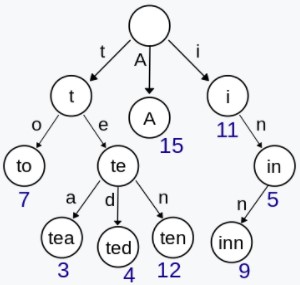
Trie,又称前缀树或字典树,用于判断字符串是否存在或者是否具有某种字符串前缀。
1. 实现一个 Trie
- Implement Trie (Prefix Tree) (Medium)
class Trie {private class Node {Node[] childs = new Node[26];boolean isLeaf;}private Node root = new Node();public Trie() {}public void insert(String word) {insert(word, root);}private void insert(String word, Node node) {if (node == null) return;if (word.length() == 0) {node.isLeaf = true;return;}int index = indexForChar(word.charAt(0));if (node.childs[index] == null) {node.childs[index] = new Node();}insert(word.substring(1), node.childs[index]);}public boolean search(String word) {return search(word, root);}private boolean search(String word, Node node) {if (node == null) return false;if (word.length() == 0) return node.isLeaf;int index = indexForChar(word.charAt(0));return search(word.substring(1), node.childs[index]);}public boolean startsWith(String prefix) {return startWith(prefix, root);}private boolean startWith(String prefix, Node node) {if (node == null) return false;if (prefix.length() == 0) return true;int index = indexForChar(prefix.charAt(0));return startWith(prefix.substring(1), node.childs[index]);}private int indexForChar(char c) {return c - 'a';}}
2. 实现一个 Trie,用来求前缀和
- Map Sum Pairs (Medium)
Input: insert("apple", 3), Output: NullInput: sum("ap"), Output: 3Input: insert("app", 2), Output: NullInput: sum("ap"), Output: 5
class MapSum {private class Node {Node[] child = new Node[26];int value;}private Node root = new Node();public MapSum() {}public void insert(String key, int val) {insert(key, root, val);}private void insert(String key, Node node, int val) {if (node == null) return;if (key.length() == 0) {node.value = val;return;}int index = indexForChar(key.charAt(0));if (node.child[index] == null) {node.child[index] = new Node();}insert(key.substring(1), node.child[index], val);}public int sum(String prefix) {return sum(prefix, root);}private int sum(String prefix, Node node) {if (node == null) return 0;if (prefix.length() != 0) {int index = indexForChar(prefix.charAt(0));return sum(prefix.substring(1), node.child[index]);}int sum = node.value;for (Node child : node.child) {sum += sum(prefix, child);}return sum;}private int indexForChar(char c) {return c - 'a';}}

若有收获,就点个赞吧
0 人点赞


